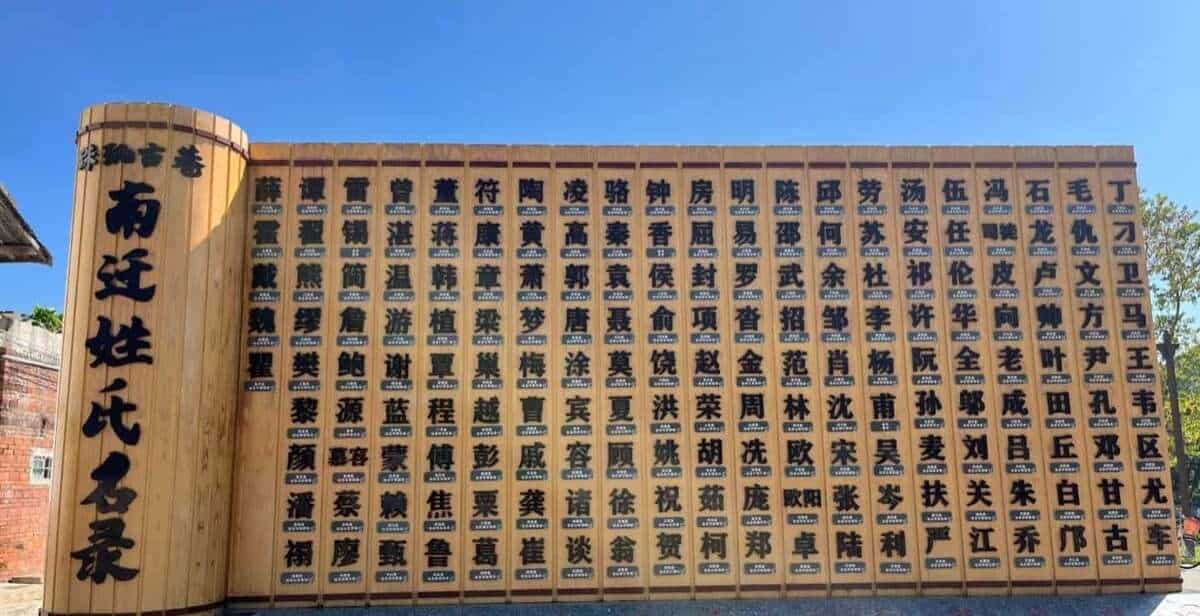
The Fang (方) Surname: From the Fall of the Song Court to the Towers of Kaiping
Fang (方, fāng; Fong in Cantonese-speaking communities) is one of the most portable surnames in the Chinese world — a single character that turns up in the phone books of Vancouver, San Francisco, Havana, and Singapore. In China alone…
Chinese Surnames
This category explores the history, heritage, and cultural significance of various Chinese family names. It covers a wide range of surnames, including those from the Wuyi region and beyond, highlighting their genealogical importance and their role in Chinese migration and traditions.
The Situ (司徒) Surname: From a Zhou Court Office to the Wuyi Diaspora
A Name That Was Once an Office
The Situ (司徒, Sītú) surname is one of the few office-derived compound surnames (官职姓, guānzhíxìng) to survive from Chinese antiquity — it began as the Zhou-dynasty office of Minister of Lands and Education (地官大司徒, dìguān…
The Liao (廖) Surname: From a Xia-Dynasty State to the Wuyi Diaspora
A Name from Before Writing
The Liao (廖, Liào) surname is one of the few Chinese surnames whose story begins before writing. It traces itself to 叔安 (Shū'ān, Shu'an), lord of the ancient 飂 state in the Xia dynasty, whose state name became…
The Han (韩) Surname: From the Warring States to the Wuyi Diaspora
The Han (韩) surname descends from the royal house of a kingdom of the Warring States — the State of Han (韩国, Hánguó), founded when Han Wan (韩万, Hán Wàn), grandson of Duke Wu of Quwo, was enfeoffed at Hanyuan (韩原, Hányuán) in…
The Tang (唐) Surname: From the Sage Emperor Yao to the Wuyi Diaspora
The Sage Emperor and the Multi-Origin Name
The Tang (唐, Táng) surname traces its origins to the sage emperor Yao and the ancient State of Tang — a name carried from the legendary dawn of Chinese history through the archaeology of the…
The Song (宋) Surname: From Weizi's State of Song to the Wuyi Diaspora
A Name That Outlived Every Dynasty
The Song (宋, Sòng) surname descends from 微子启 (Wēizǐ Qǐ, Weizi), a prince of the Shang royal house whose fief — the State of Song (宋国, Sòng guó), founded at Shangqiu (商丘, Shāngqiū) after the Zhou…
The Lei (雷) Surname: From Ancient Fangshan to the Wuyi Diaspora
Roughly 3.7 million people in the world today answer to the surname Lei (雷) — a name that means "thunder" and, in the oldest stories, carries the weight of it. It is not among China's largest surnames; by population it sits somewhere around the…
Gao (高) Surname: From the State of Gao to the Wuyi Diaspora
A Thousand Years on One Page
One surname. One village. One book that claims a thousand years.
The register in question — the genealogy of the Gao (高, Gāo) family of Nafu Village (那伏村, Nàfú Cūn) in Shadui Township, Xinhui District (沙堆镇, 新会区),…
The Yuan (袁) Surname: From the State of Chen to the Wuyi Diaspora
The Name Before the Place
Most Chinese surnames are named for a place. A king granted a fief; the family took the fief's name; the name outlived the fief. The surname Yuan (袁姓, Yuán xìng) did not begin this way. It began…
The Pan (潘) Surname: From the State of Pan to the Wuyi Diaspora
The Pan surname traces to two royal lineages of ancient China. The first descends from the ruling house of the State of Pan (潘国, Pānguó), a small vassal polity of the Zhou period whose princes shared the blood of the Zhou kings;…