

The largest Chinese population in the Caribbean, and the fastest to go
Chinese in Guyana is usually told as a story about arrival. The paperwork supports the opposite. Between July 1852 and March 1853, three ships out of Amoy put Chinese labourers ashore at Demerara: 811 embarked, 164 died at sea, 647 landed.
The colony they reached would take 13,541 Chinese in twenty-six years, more than any other colony in the British Caribbean and five times Trinidad’s intake, against about 239,000 Indians in the same period: a ratio near 1:18. By the 2012 census the community stood at 1,377 people, 0.18% of the country.
So the largest Chinese population in the Caribbean went away faster than any of its neighbours, and no exclusion act explains that.
Three dates carry the beginning: the Glentanner at Georgetown on 12 January 1853; the Lord Elgin on 17 January, after 177 days at sea; the Samuel Boddington, which cleared Amoy on 25 November 1852, only on 4 March 1853.
The outcome was set by composition, not policy: men without women, from Amoy rather than the Siyi counties, on a planter’s contract rather than a broker’s credit, dispersed across dozens of estates instead of settled in a village, with no hall, no school and no newspaper to hold a language in place. The cohort came through Amoy (厦门, Xiàmén), not Macau on a credit ticket, under a colonial bounty and on an indentured contract (契约工, qìyuēgōng) advanced by the planters; the Macau trade is in the site’s coolie-trade overview.
Amoy, not Taishan
All three 1853 vessels cleared Amoy, the correction the piece rests on. The cohort spoke Amoy Hokkien (厦门话, Xiàménhuà) and came from 同安 (Tóng’ān), 海澄 (Hǎichéng), 龙溪 (Lóngxī) and 集美 (Jíměi); their surnames — 陈, 林, 吴, 黄 — reached the manifests as Tan, Lim, Goh, Ng. A reader arriving from the Cuba or Peru pieces expects Taishan and will not find it: unlike the Siyi counties in the Wuyi migration routes, Guyana’s Chinese left no home county to return to.
A bounty built the traffic. $100 per Chinese landed was agreed in August 1851; George Booker arranged the first shipment that September. A Chinese labourer cost £15 a head against £13 for an Indian, and both streams were paid from the same per-pound levy on exported sugar — the fiscal machinery that the end of slavery had put in place. The bounty was withdrawn on 1 August 1853.
The recruiting end was violent: in 1852 Amoy recruits broke out of the barracoons and attacked the foreign hongs, 德记洋行 (Tait & Co.) and 怡和洋行 (Jardine Matheson), and the Qing answer was a ban on 拐卖 (guǎimài), kidnapping and sale. The 1853 charters ran through a single British-licensed channel: Tait & Co., the firm at the centre of the riot, was the sub-contracted recruiter for the Samuel Boddington.
What the 客头 (kètóu, recruiter) earned — $3–5 a recruit, charged at $30–40 — is Amoy testimony, not a Guiana rate. The Guyanese evidence is the outcome: 39 of the Lord Elgin’s 154 passengers were under fifteen, on a bounty that paid the same for a boy as a man. A boy taken that way was a 猪仔 (zhūzǎi), a “piglet,” in the port’s slang.
One hundred and seventy-seven days, and seventy-eight
| Ship | Embarked | Died at sea | Landed | Died after landing | Allotted |
|---|---|---|---|---|---|
| Lord Elgin | 154 | 69 | 85 | 2 | 83 |
| Glentanner | 305 | 43 | 262 | 9 | 253 |
| Samuel Boddington | 352 | 52 | 300 | 21 | 279 |
| Total | 811 | 164 | 647 | 32 | 615 |
One footnote survives the table: Sue-A-Quan’s page gives 51 deaths for the Glentanner voyage, at 16.7%, while his own allotment table implies 52 — 43 at sea plus 9 ashore, since 305 minus 43 leaves the 262 who landed. The rows are printed as they stand in the source; the shilling cannot be made to balance.
Mortality was a chartering decision. The Glentanner was judged “unsuited to serve as an immigrant ship because of bad ventilation and inadequate deck space.” The Lord Elgin sprang a leak on 24 October 1852, her rice fermented, and 45 of her 69 dead were buried before the Cape of Good Hope. Tonnage says the same: the 354-ton Lord Elgin carried 154, the 669-ton Samuel Boddington 352.
The Boddington is the extreme case: only 202 of her 352 苦力 (kǔlì, coolie) passed the surgeon, and she sailed with all of them at 17 over her legal capacity of 335, because the captain was paid per head. Her passengers mutinied; Sue-A-Quan records 41 dead, 11 lost overboard and 29 hospitalised on arrival.
The Whirlwind, 978 tons, left Hong Kong on 24 December 1859 and reached Georgetown on 11 March 1860 — 78 days — with 304 men, 56 women, 7 boys and 4 girls, and no deaths. The 1855 Chinese Passenger Act‘s berth-space and mortality rules separated the two kinds of voyage: the passage was made lethal, and then regulated.
A contract with no country behind it
A printed Guiana contract survives in full: Corona No. 402, Canton, 1873, the emigrant Soo A Cheong, the colony’s agent Theophilus Sampson. It is a Canton form of 1873, not Amoy 1853, so terms may differ.
Service runs five years from the day work starts, or, if the labourer is too ill on arrival, eight days after recovery. He “may not be required to work more than nine and a half hours” in a day — the form’s figure, against the seven and a half hours secondary accounts give; the two figures disagree and no source resolves them. Wages are four dollars a month, “paid every month and shall not be allowed to fall into arrear.” Clause 16 settles the historiographical argument: “No debt that may be incurred by the coolie during the voyage, or in British Guiana, may be construed into a lien on his services.“
The breach nobody enforced was smaller than the ones on paper: the written rice (大米, dàmǐ) ration was routinely replaced with plantains — a practice the compendia report, and this document does not.
The contract had no standing in Chinese law. Under 大清律例 (Dà Qīng Lǜlì), the Qing code, going to sea was 通番 (tōngfān, “traffic with foreign parts”); the 1860 《北京条约》第五款 (Article V of the Convention of Beijing) made Chinese emigration to British colonies lawful seven years after the ships had sailed, and the 1866 中英招工章程 (Sino-British recruiting regulations) added an official at embarkation. Clause 18 says the rest: the labourer enjoys “the protection of the law of the place” in Guiana, and “on his return however to China, this protection will be abrogated.” Hence a fact about archives: no Chinese provincial collection holds a counterpart to the ancestor’s contract, because the Qing state never recognised it.
The debt sat with the planter: this was contract labour, not 赊单工 (shēdāngōng), credit-ticket labour — so no Chinese broker to owe, no 批局 (pījú) remittance house, and no 侨批 (qiáopī) letter corpus at all, which is why the archive the site mines for remittance letters does not exist here. The port record is messier: the Amoy gazetteer and Look Lai both describe credit-ticket at the recruiting end, and clause 16 shows someone thought the distinction needed writing down.
Small lots, by design
Lord Elgin’s 85 survivors went to Blankenburg, 83 of them. The Glentanner’s 253 allotted went to Windsor Forest 105, La Jalousie 103, Pouderoyen 44 and Union 1. The Boddington’s 279 allotted went to Schoon Ord 51, Stewartville 44, Anna Regina 45, Hague 39, Anna Catherina 47, Haarlem 45 and Union 8, with the Vreed-en-Hoop group transferred to Anna Regina in April 1853. Eleven estate names, thirteen rows, 615 men; the largest lot is 105.
The Immigration Agent-General made the distribution from quotas the planters had submitted months earlier, families kept together — so the answer to “assigned or requested” is both: requested in aggregate, allotted in detail.
The managers reported in June 1853. Griffin H. Bascom, Windsor Forest, 24 June: the Chinese “are some of the best labourers… Three or four of the men keep a night school, and are teaching the boys to write and sing.” B. Trotman at Blankenburg: “I am willing to take 50 or 100 more Chinese.” Klein Pouderoyen is the counter-note: many of its Chinese still diseased, the estate having “derived but little benefit from their services.” Keep Bascom’s night school; it keeps everything said later about absence honest.
Why no Chinese village formed follows from the lot size: small lots cut collective bargaining on each estate and left no “line” village to cohere, and when contracts expired in 1857–62 the free settlements appear at Hopetown and Bush Lot on the West Coast Berbice and in West Demerara villages. That the dispersal caused the completeness of the exit is Sue-A-Quan’s and Look Lai’s argument from the allocation records, not a fact in them.
Fifty dollars
Chinese contracts carried a right Indian contracts did not: an explicit right of return, administered as a $50 commutation payment. In the 1873 form it is not an administrative habit but clause 6; re-enlist for a second five years and $25 comes as a bonus, the other $25 at the end of that term.
Return passage cost more than $50, so most men took the cash. A temporary labour scheme became permanent settlement through an accounting practice — a better answer to “why did the family never go back” than any story about hardship.
The 1866 Sino-British recruiting regulations guaranteed return passage, while colonial practice paid $50 in lieu of it. Both are documented, and the discrepancy is the finding.
The traffic’s budget: 13,541 landed between 1853 and 1879 on Sue-A-Quan’s count, against about 239,000 Indians; Look Lai’s 13,533 differs by eight people, a rounding dispute, not a disagreement about scale. The first halt came in May 1854, when transport costs rose by more than 66% and no women could be recruited; James White, sent to fix the supply, was dismissed in June 1854 for recruiting nobody.
The seal was the Dartmouth, which cleared Hong Kong on 24 December 1878 and reached Demerara on 17 March 1879 with 515 people — 436 men, 47 women, 18 boys, 5 girls, 9 infants — including about 70 Christian converts, under free immigration rather than indenture. After 1879 the community grew only by births, from a base in which about 15% were women.
The kitchen
Across the whole intake the allotment books give 11,466 men and 2,075 women — 84.7% male. On the allotted-only cut the figures are 11,295 and 1,998, or 84.9%. The difference is in the denominator, not in the community.
So Chinese men married Afro-Guyanese, Amerindian and Portuguese women, and the households produced the generation called “Chinee-duglas.” Chinese women arrived from 1860, in small numbers, after the 1858 Kwangtung and Kwangsi relaxation permitted contracting “females who were part of entire families” — seven years after the first ships.
The mechanism, stated once: language follows the mother, and the mothers were not Chinese. Nobody forbade Chinese in Guyana. There was no one at home to speak it. The last fluent speakers died in the 1950s and 1960s.
By 1921 only 376 of 2,722 Guyanese Chinese were China-born. And in 1931 R. V. Evan Wong, the first Chinese-Guyanese member of the Legislative and Executive Councils, wrote that the community’s small size was explained by “the extremely low percentage of female to male immigrants.” A Guyanese Chinese made the argument in 1931, in his own colony’s language.
Gao Weinong’s model — sex ratio plus absent clan infrastructure — is the scholarly form of the same claim, and an inference rather than a record.
What was not built
No 会馆 (huìguǎn, native-place hall), no 宗亲会 (zōngqīnhuì, surname association), no 宗祠 (zōngcí, lineage hall), no Chinese-language school and no Chinese-language newspaper appears anywhere in the colonial record. The only colony-wide body was the Chinese Association, founded on Brickdam — Lot 3 — in 1920, at a cost of $5,000 raised by the community; some Chinese reference works give 1918, and the two figures disagree and no source resolves them.
What was built has to be said too: St Saviour’s in Charlestown had its cornerstone laid on 14 August 1874 so that services “could be conducted in the Chinese language by a Chinese catechist,” and became a parish church on 1 January 1939, when the word Chinese was dropped. Central High School, founded in Georgetown in 1927 by J. C. Luck, was Chinese-founded and English-medium.
Two qualifications belong here: three or four men already ran a night school at Windsor Forest in June 1853, and a Chinese-language school is reported from 1985, after the language had died. Hence “no Chinese-language newspaper appears in the colonial record,” never “no Chinese newspaper ever.”
Clementi’s 1915 report is the community’s closing audit, not an opening survey. An official who read Chinese and interviewed immigrants in Amoy dialect found no Chinese school, very few adults literate in Chinese, and predicted the language would die within a generation; it did. Retail and gold-field trading were dominant, and the licensed opium and gambling farms were a revenue line and the community’s main debt at once. His “Chinese” was a statistical category including people of mixed descent, and his tables disagree with the 1911 census; the volume itself was not consulted here, so his findings are book-derived.
Trinidad’s roughly 2,600 Chinese sustained a school and an association into the 1950s; Guiana’s 13,541 did not, and kept fewer institutions than Jamaica’s, which received about 4,000. The likeliest explanation is a funding trilemma — dues from a few hundred shopkeeping families cannot pay for a school, a paper and a cemetery at once — an inference, though Clementi supplies the mechanism.
The Qing record closes the same way: no Guiana file in the Qing protection record; the 1904 保护华工 (bǎohù huágōng, “protection of Chinese labourers”) measures drafted from Cuban and Peruvian cases; the 1893 lifting of 海禁 (hǎijìn), the maritime prohibition, fourteen years after the last shipment; and an Amoy gazetteer chapter on overseas-Chinese affairs with no Guiana caseload.
The credit book
The shop was a bank before it was a shop. The general store (杂货店, záhuòdiàn) drew its power from credit, not goods: book credit advanced to cane cutters between fortnights, and to pork-knockers at the Potaro and Mazaruni workings, where the only way in was a trail and the only way to eat was on tick. A $4 monthly wage, rather than a daily task rate, also let Chinese men bank savings and leave the estate earlier than Indians on the same estate.
The credit relation, not the merchandise, is the root of the exploiting-shopkeeper figure, and it has to be presented as structure. Lynn Pan’s account leans on a pre-existing petty-trade tradition among emigrant Chinese; Look Lai and Sue-A-Quan lean on dispersal, the sex ratio, monthly wages and the absence of a village to return to. The structural account is the better evidenced of the two.
Windsor Forest to 17 March 1970
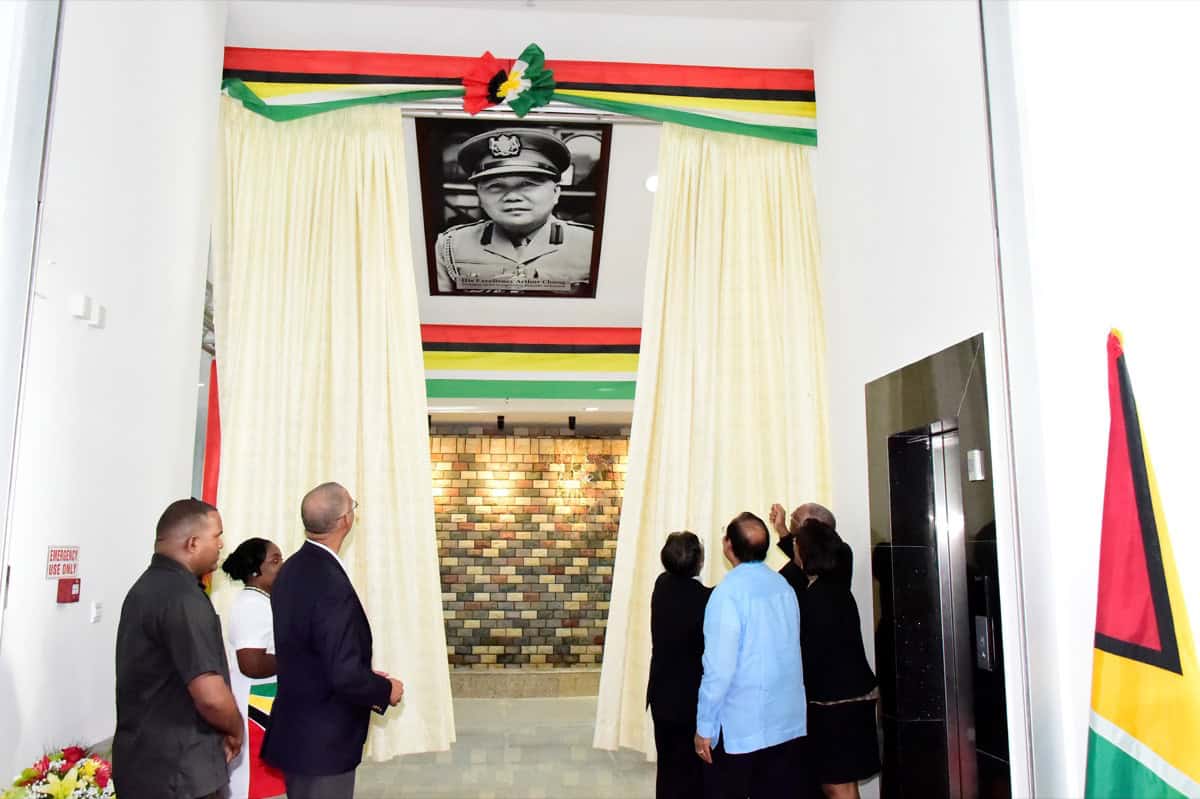
Arthur Chung was born on 10 January 1918 at Windsor Forest, about 8 km from Vreed-en-Hoop on the West Coast Demerara, the youngest of eight children.
His father, Joseph Chung, an immigrant from China, worked as a foreman on Martha Fung-Kee-Fung’s rice property at Windsor Forest, per the Stabroek obituary. A Chinese-language account describes him instead as a kidnapped 猪仔 (indentured recruit) sold to a plantation. The accounts are not exclusive: recruitment in the 1870s leaves forty years in which a labourer could become a foreman — and nothing documents the middle of that life. His mother Lucy was an immigrant from Trinidad, so the household was Caribbean-Chinese in the first generation. He was baptised at St Jude’s Anglican Church, Blankenburg, the estate that took the whole surviving Lord Elgin contingent in 1853 — adjacency, not descent. The family is 客家 (Kèjiā, Hakka), from the later Guangdong stream, and his father came separately.
The career is datable: sworn land surveyor 1940; Middle Temple, called 1947; acting magistrate March 1953; puisne judge of the Supreme Court, confirmed May 1963; then a judge of the Court of Appeal; last case the Rupununi Rebellion murder trial, January 1969. He was never Chief Justice: the Chief Justices of the period were Sir Joseph Luckhoo (1960–66) and Harold Bollers (1966–80).
The PNC nominated him, Burnham announced it at a special sitting on 23 February 1970, and the National Assembly elected him on 17 March 1970; he was re-elected in 1976 and left on 6 October 1980, when Burnham rewrote the constitution to make the presidency executive. He arrived at Parliament still being driven in the governor-general’s Austin Princess limousine. The honest formulation: a head of state acting on ministerial advice, formally empowered, Commander-in-Chief — real on paper, unused in practice. Not “ceremonial and powerless.”
He is widely described — in Guyanese obituaries and Chinese reference works alike, which is repetition rather than independent confirmation — as the first ethnic-Chinese head of state outside Asia. Two facts deflate the trophy: the office was constitutional, and he was elected by an assembly. Sir Solomon Hochoy (何才) was Governor-General of Trinidad, 1962–72; Henk Chin A Sen (陈亚先) was Suriname’s second president, 1980–82, and an executive one. Both held more power than Chung, and neither owed it to the community’s vote.
Hakka ancestry is sourced — the Stabroek obituary, BlackPast, the 《华侨华人百科全书》人物卷 (Encyclopedia of the Overseas Chinese, biographies volume) — while the ancestral county, 广东梅州大埔县 (Dabu County, Meizhou, Guangdong), is probable only, on Chinese secondary accounts, with no clan register consulted. Hakka is the closing layer here, not the founding one: it arrived with the 1879 Dartmouth into a community already sealed, which inverts the Hakka diaspora story.
The name is the thesis in miniature. Chinese reference works give 钟亚瑟 / 鍾亞瑟 (Zhōng Yàsè), and no source shows Chung or his family writing those characters. 亚瑟 renders “Arthur” syllable by syllable, and 亚 is the same address-and-ordinal particle — “junior, second” — behind the “A-” in Fung-A-Fat. So the Chinese name is a rendering of “Arthur Chung,” not a family name recovered from a document: an inference, flagged as one. The family wrote “Arthur Chung”; the Chinese world wrote it back.
On 27 June 1972 Guyana became the first English-speaking Caribbean state to recognise the People’s Republic of China, and in 1977 Chung visited China and met Hua Guofeng. He died on 23 June 2008, aged 90, at Bel Air Springs, Georgetown.
One thousand three hundred and seventy-seven, and the headstone
Two pushes, both datable: the communal violence of the early 1960s sent shopkeeping families out first, and Burnham’s nationalisation programme and import controls squeezed small traders through the 1970s. The destinations were Toronto, New York, Florida and London, and the community roughly halved between the 1960s and the 1980s — Sue-A-Quan’s estimate, an order of magnitude rather than a measurement.
The census shows 2,722 (1921) → 1,864 (1980) → 1,290 (1991) → 1,396 (2002) → 1,377 (2012, 0.18%). A fall of about a third to 1980, then flatness since 1991, because post-1990 arrivals from the People’s Republic have offset the emigration and share neither a language nor a memory with the old families. The figure is 1,377, from the Bureau of Statistics’ Compendium 2; the 1,637 that circulates online is a transposition and would give 0.22%, not 0.18%.
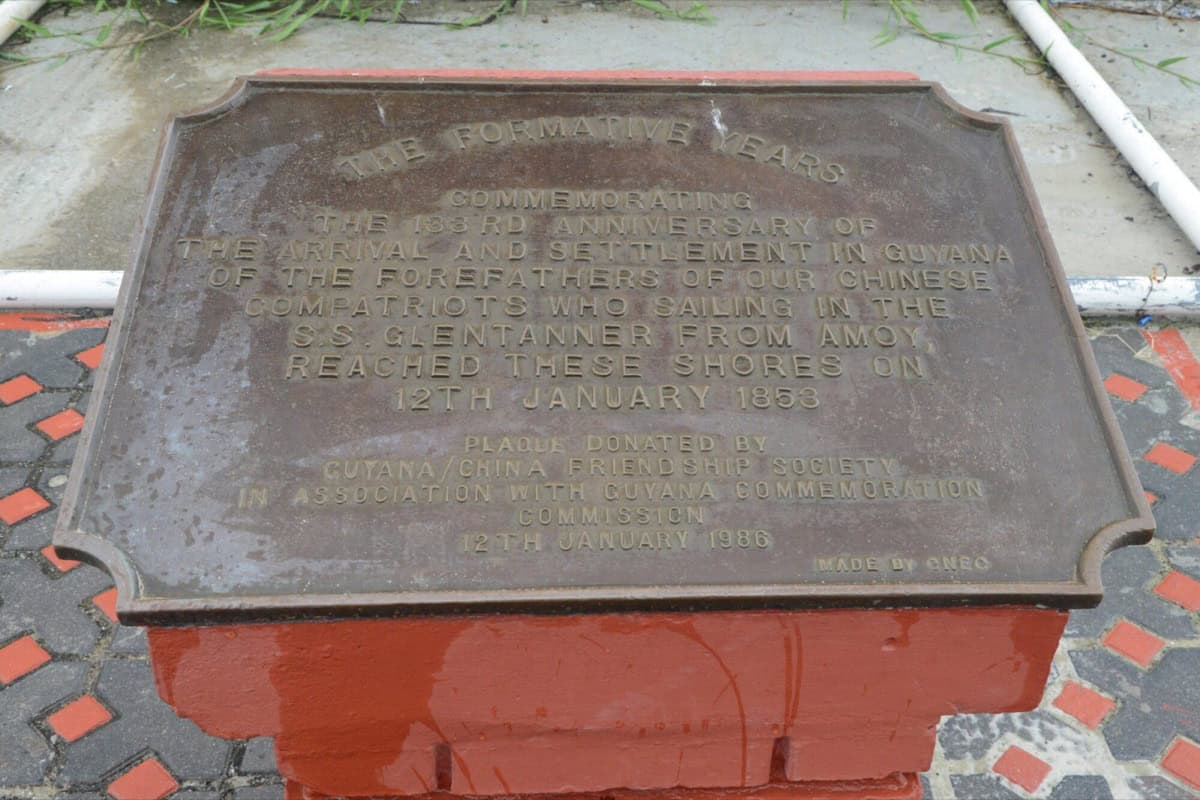
The 2003 sesquicentenary moved recollection from family to heritage; the associations were re-founded in Toronto and New York, not Georgetown. At Windsor Forest a monument was unveiled in 1986 by the Guyana-China Friendship Society, with later work on the same site; on 12 January 2026 the 173rd anniversary was marked there with the PRC ambassador present.
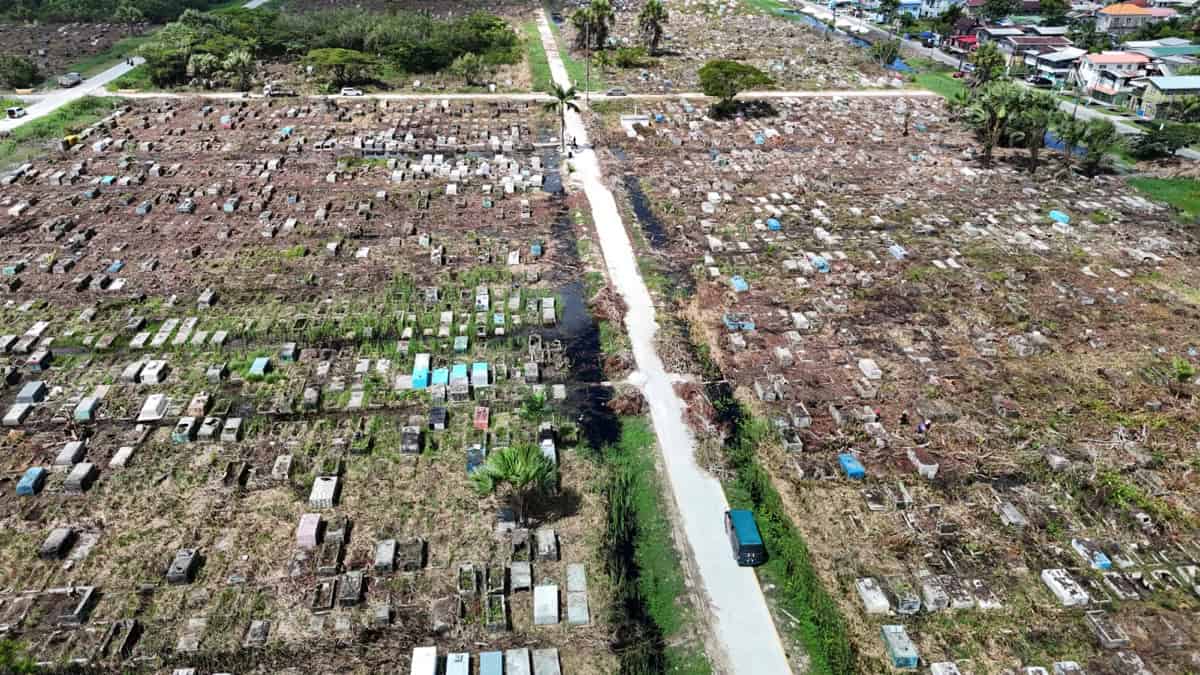
The ground itself is the last absence. Le Repentir, Georgetown’s cemetery, was allotted by religion: Muslims, Hindus, Catholics, Anglicans, Presbyterians — and, on the city’s own lists, the Chinese. The Guyanese-Chinese historian Marlene Kwok Crawford describes it more precisely: a small area unofficially given to Chinese nationals for the occasional Buddhist or Confucianist burial, while “the vast majority of the Chinese Community was Christians and had no connection with this area” — a plot since reabsorbed into the general ground. In 2000 the Chinese Association of Guyana told the council that “the last available spot allotted for burial of Chinese at Le Repentir” had just been taken, and the council voted 10–6 to open 126 new spots, over a mayor who insisted the applicants were not local Chinese. There is no 祠堂 (cítáng, ancestral hall) in Georgetown, and the ground that came closest to standing in for one is no longer distinct.
The wall is built of romanisation. “Ah-” is an address prefix, not a name: Fung Gong-fat became Fung-A-Fat, and the Lord Elgin’s list preserves “Ong-a-im, 25” with an “a-” where a given name should be. Two persons named Chan-A-Shing appear on the Chapman (an 1860 vessel), and Li-A-Tak and Wong-A-Fook recur across several vessels’ records. A hyphenated surname can fuse two generations into one name, and the 族谱 (zúpǔ) of the 同安 lineages stop at the coast — which is why reading one is a skill with its own rules.
The order to read the paper in, with the site’s guides to immigration records covering the method: headstones first, the only document that ever wrote a name down twice — scattered now through the general ground, since the Chinese plot closed in 2000; then the Anglican and Baptist baptism registers, Chinese and English names side by side, catechists on the estates from the 1860s; then the ship manifest appendices; then the county and village surname tables. The Registry of Chinese Immigrants is reported to be at the National Archives, Georgetown. Most readers will not find the village; the record is not missing, it is written in a script that cannot be matched back.
Whether what survived is a culture or a genealogy is left open: Sue-A-Quan’s “Chinese” had become genealogical rather than cultural, and Pan’s is “Chinese by descent, Creole by culture”.
On 12 January the children at Windsor Forest Primary School stand in the yard where the monument went up in 1986, on an estate that took 105 men in 1853, in the village where a president was born in 1918. The ambassador speaks, the Association attends, the date is kept. What a family keeps is thinner and more durable: a surname spelled the way a clerk heard it, a baptism entry with two names on it, a photograph of a shop counter nobody wrote down. The liturgy outlived the lineage. Food outlived speech. The paper outlived the country’s Chinese, and is still there in a romanised name.
Continue Reading
- How the End of Slavery Impacted Chinese Labor Migration
- Cuban Chinese: The Coolie Ships, Havana’s Chinatown, and the Caribbean Diaspora
- How to Read a Chinese Zupu: The 10 Parts, Explained Simply
Stay Connected
Follow RootsOfChina on Facebook and Instagram for new article updates, behind-the-scenes from Kaiping, and stories from the Chinese diaspora.
Sources
- National Trust of Guyana, “Chinese Immigration Monument” — the 1853 arrivals — ntg.gov.gy
- Trev Sue-A-Quan, Chinese in Guyana: Their Roots — voyage table and population series — chineseinguyana.net
- Sue-A-Quan, the Corona No. 402 Guiana contract, Canton 1873 — wage, hours, clauses — Contract.htm
- Sue-A-Quan, allotment tables by estate — Distribution.htm
- Sue-A-Quan, ship pages — passenger lists and tonnage — sites.rootsweb.com
- Odeen Ishmael, Guyana Story ch. 55 — the bounty and “Chinee-duglas” — guyananews.org
- Bureau of Statistics, 2012 Census Compendium 2 — Table 2.1 and the 1,377 figure — statistics.caricom.org
- Stabroek News, “Arthur Chung” obituary, 29 June 2008 — Windsor Forest birth and family — stabroeknews.com
- BlackPast, “Arthur Chung (1918–2008)” — the judicial career — blackpast.org
- Ministry of Foreign Affairs of the PRC, “Ambassador Yang Yang Attends 173rd Anniversary of Chinese Arrival Day,” 13 January 2026 — fmprc.gov.cn
- 中新社, survey of the Chinese in Guyana, 21 September 2012 — the 1985 Chinese-language school — chinanews.com
- U.S. Library of Congress, Guyana: A Country Study, “Portuguese and Chinese” — countrystudies.us
- “The settlement of Chinese in Guyana in the nineteenth century,” Immigrants & Minorities, 1988 — doi.org
Suggested Reading
Is this your family’s story?
Roots Of China is built from readers’ family histories. If a story here sounds like your own — a surname, a village, a journey — leave a comment below, or share your family’s story with us and we may be able to help you find your ancestral village.
