


Between 1840 and 1940, the Siyi (四邑) region of Guangdong sent over two million people overseas — one of the largest sustained migrations in modern history. Taishan alone contributed an estimated 1.3 million emigrants, hollowing out villages and transforming local society into a qiaoxiang (侨乡) — an emigrant homeland dependent on remittances and defined by absence. The story of Chinese emigration is, overwhelmingly, a story of departure: of families walking to the pier, of letters arriving from across the Pacific, of villages built with Gold Mountain money and emptied of working-age men.
Among Taishan’s hundreds of qiaoxiang towns, one — Haiyan (海宴), on the county’s southwestern coast — would become the site of a remarkable experiment. In 1963, the Chinese government built a community there not for those who left, but for those who came back.
The Haiyan Overseas Chinese Farm (海宴华侨农场, Hǎiyàn Huáqiáo Nóngchǎng) was established to resettle over 6,000 returned overseas Chinese (归侨, guīqiáo) from thirteen Southeast Asian countries — Indonesia, Vietnam, Thailand, Malaysia, the Philippines, Singapore, Myanmar, Cambodia, Laos, Brunei, India, and others. These were people fleeing anti-Chinese violence, expropriation, and expulsion. They arrived on what government records call “一片荒凉的海滩” — a desolate beach — barren coastal mudflats with saline soil, typhoon winds, and nothing to build with but their hands and whatever seeds they had carried across the sea.
Half a century later, that desolate beach has become Wufeng Village (五丰村, Wǔfēng Cūn) — a National AAA Tourist Attraction, a social media hotspot, a place locals call “Little Southeast Asia.” The sugarcane fields are still there. So are the pandan rolls, the satay stalls, the ninety-year-old returnees telling their stories to university researchers before time runs out.
This is the story of what happens when the emigrants come home — to a place most had never seen, on land reclaimed from the sea, carrying trauma and seeds and recipes, and building belonging from scratch.

The Coast That Sent Them Away — Haiyan’s Geography and the Emigration Century
Haiyan sits on Taishan’s southwestern coast, facing the South China Sea. Its geography reads like a formula for emigration: limited arable land, a typhoon-prone coast, and proximity to the departure ports that fed emigrants into the Hong Kong and Macau transfer system. Southern coastal Taishan towns sent emigrants at rates exceeding inland towns, and Haiyan was among the highest.
Your surname is your compass — a practical guide to using surname geography, clan genealogies, and qiaopi records. The Wu, Chen, Huang, Li, and Lin clans that shaped Haiyan’s emigration are part of a larger Wuyi pattern: surname groups that turned village ties into global networks.
The mechanism that turned individual emigration into village-wide exodus was the credit-ticket system (赊单制, shēdānzhì): debt-financed passage repaid from future wages. A laborer who could not afford the fare to San Francisco — and almost none could — borrowed from a broker, signed a contract binding his future earnings, and boarded a ship he would spend years paying off. By 1920, some Haiyan villages had over seventy percent of working-age men overseas, their families sustained by remittances and their homes maintained by women who had become, by necessity, the economic managers of households they had never expected to lead.
Haiyan’s coastal geography held a darker role as well. The town’s location made it a recruitment point for the coolie trade to Cuba, Peru, and other Latin American destinations — the semi-enslaved labor system that shipped Chinese workers across the Pacific under conditions so brutal that mortality rates reached twelve to twenty-six percent on the passage alone. Desperate villagers signed indentured contracts unaware of what awaited, lured by brokers’ promises of high wages and quick return. Most never came back.
The geography that pushed Haiyan’s people outward also made departure logistically possible — a cruel practical convenience. Yet the same coastline that had emptied the town would, a century later, become the site of a community built for those who returned.
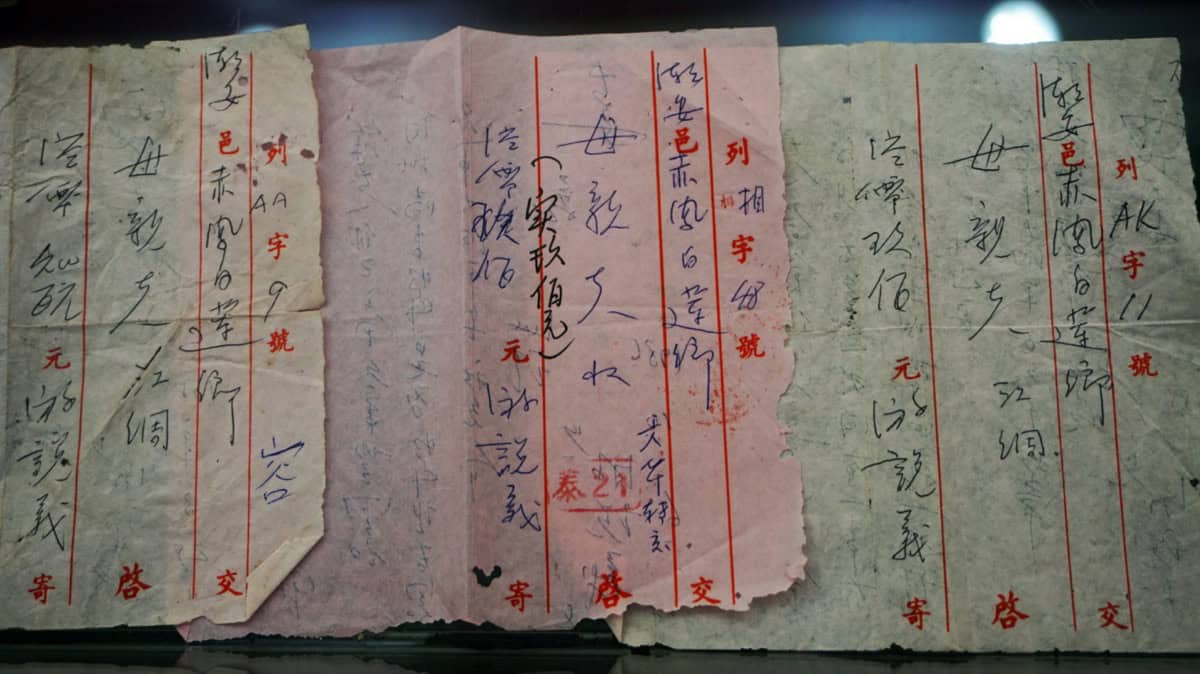
The Remittance Lifeline — Qiaopi Letters and the Families Left Behind
Emigration reshaped Haiyan from the inside out. Some villages received eighty percent of their income from overseas remittances, creating an economy utterly dependent on money that crossed oceans. The instrument of this dependence was the qiaopi (侨批) — the combined remittance letter that placed money and love on the same page, delivered through remittance shops (批局, pījú) that connected San Francisco to a coastal village in Taishan.
The remittance rhythm was seasonal, dictated by the obligations of distant families. Money surged before Chinese New Year, when households needed funds for festivities and debt settlement, and before Qingming, when tomb-sweeping rites demanded ancestral offerings. Remittance shops staffed accordingly; couriers planned their village circuits to match the calendar of diaspora obligation. A courier’s arrival meant either remittance or silence — prosperity or anxiety, connection or abandonment.
The women who managed this economy were the Gold Mountain wives (金山婆, jīnshānpó). With husbands overseas for decades — sometimes for life — these women controlled household finances, directed children’s education, and made the daily decisions that kept families intact. Their independence was real but constrained: they could manage money but not own property, run households but not make major decisions without written instruction from husbands they had sometimes never met. Some were married by proxy (隔山娶, géshān qǔ — “marriage across the mountain”), a rooster standing in for the groom at the ceremony, the bride bound to a photograph and a remittance address.
The qiaopi letters themselves are the primary documentary record of this experience. Decades of separation compressed into folded rice paper: apologies for missed births and deaths, detailed instructions for spending remittances, the accumulating grief of lives lived apart. One letter from a Haiyan emigrant to his wife — asking about the children, enclosing money for the New Year, promising to return “next year” for the fifth year running — is worth more than ten paragraphs of historical summary.
And then the remittances stopped. Between 1949 and 1978, China’s isolation severed the lifeline. The remittance engine went silent. Mansions stood empty, families lost contact, and the Gold Mountain wives who had managed decades of separation found themselves managing something harder: the knowledge that the letters might never come again. This thirty-year rupture created the conditions for a different kind of return — not voluntary, but state-directed.

Coming Home to a Country They’d Never Seen — The 1963 Establishment
In 1963, the State Council’s Overseas Chinese Affairs Office, acting through the Guangdong Provincial People’s Government, established the Haiyan Overseas Chinese Farm on 17.64 square kilometers of southwestern coastal Taishan. It was one of eighty-four state farms created nationwide to resettle returned overseas Chinese — but unique in being located within the ancestral qiaoxiang region itself. Most Overseas Chinese Farms were built in Hainan, Guangxi, or Yunnan, distant from the emigrant homelands. Haiyan’s returnees were settling in the very county their ancestors had left.
The government source describes initial conditions without euphemism: “一片荒凉的海滩” — a desolate beach. Returnees found barren coastal mudflats with saline-alkaline soil that would not grow crops, no infrastructure beyond what their hands could build, and the steady threat of typhoons rolling in from the South China Sea. The nickname that emerged — “Little United Nations” (小小联合国, xiǎoxiǎo liánhéguó) — captured the improbable diversity of the population: over six thousand people from thirteen countries, compressed into a planned settlement called Wufeng Village (五丰村, “Five Prosperities Village”). The name was aspirational. The reality was mud, salt, and wind.
Many of these returnees had never been to China. Their parents or grandparents had emigrated generations ago. They were coming “home” to a country their families had left before they were born, arriving on a beach that barely qualified as land, carrying what they could: clothes, cooking implements, seeds, family photographs, and the trauma of expulsion.
The first and largest group came from Indonesia. They had fled Presidential Decree 10 of 1959, which banned rural Chinese traders, and then the anti-Chinese massacres that followed the 1965 coup. The “Guangcai Boats” (光彩轮, Guāngcǎi Lún) transported them to Guangdong ports — ships named with the irony of history: Guangcai means “glorious colors,” and the passengers were fleeing for their lives.

Three Waves of Return — Violence, Expulsion, and the Journey Back
Haiyan’s returnees did not arrive as a single group. They came in three distinct waves, each carrying different traumas and contributing different cultural elements to the emerging community.
The first wave — Indonesian Chinese (1959–1965) — formed the largest single group. Triggered by Presidential Decree 10 and the subsequent massacres, these returnees brought Bahasa Indonesia, satay, nasi goreng, gado-gado, and memories of violence. Many had been born in Indonesia, raised in its cities and towns, and expelled from the only home they had ever known. Return was not homecoming; it was exile to an ancestral homeland they had only heard about in family stories.
The second wave — Vietnamese Chinese (1978–1979) — arrived under even more desperate circumstances. The Sino-Vietnamese War of 1979 and Vietnam’s systematic expulsion of ethnic Chinese (the Hoa) created the “boat people” crisis: ethnic Chinese fleeing by sea in overcrowded vessels, many drowning before reaching safety. Those who survived arrived traumatized, having lost everything. They brought pho, spring rolls, and a distinct coffee culture — Vietnamese drip coffee served with condensed milk, a taste that still marks certain kitchens in Wufeng Village. The Vietnamese wave was the most abruptly displaced: expelled rather than fleeing, arriving in chaos rather than organized resettlement.
The third wave comprised smaller groups from across Southeast Asia — Malaysian, Thai, Burmese, Cambodian, Laotian, Indian, Filipino, and Singaporean returnees. Their numbers were smaller, but they were crucial to the “thirteen countries” identity that defines Haiyan. Each group brought distinct languages, religious practices, and cuisines, layering additional complexity onto an already improbable community.
Despite their different origins and traumas, returnees shared the experience of arriving in a country most had never seen, to land that was barely land. The state created a bureaucratic classification — the “three categories of overseas Chinese” (三类侨, sān lèi qiáo) — that conferred both benefits (housing, jobs) and stigma (suspicion, second-class status). The question all returnees faced, regardless of which wave they arrived in, was the same: were they coming home, or being resettled?
Building a Village from Mud — The Physical Transformation of the Coast
The land returnees were given was not ready for them. It had to be made.
The work began with sea reclamation (围海造田, wéihǎizàotián): enclosing sections of coastal mudflat behind seawalls, then desalinating the saline-alkaline soil through repeated cycles of flooding and drainage. This took years — years of backbreaking manual labor with no heavy machinery, just human bodies moving earth and stone against the sea. First-generation returnees describe it in terms that make the labor visible: sun, salt, typhoons, and the knowledge that they were building for children who would inherit a land they had never known.
Once the soil could grow things, the farm found its economic identity: sugarcane. Haiyan became the “Sugar Capital” (蔗糖之乡, zhètáng zhī xiāng), building a sugar refinery that achieved production-supply-marketing integration — the full-cycle agricultural industry that made the farm self-sufficient. Returnees also introduced tropical crops they had known in Southeast Asia: pepper, coffee, rubber, coconut. The seeds they had carried in their luggage transformed the local landscape. A Taishan coastal mudflat began to look, in places, like a corner of Indonesia or Vietnam — not through design, but through the agricultural knowledge embedded in returnee hands.
The community’s nickname evolved alongside its landscape. It became the “Three-Hundred Village” (三百村, sānbǎi cūn): Hundred Flowers (百花), Hundred Fruits (百果), Hundred Surnames (百姓) — a poetic rendering of the biodiversity and multiculturalism achieved through labor. By the 1980s, the farm was productive, established, and collectively owned. A functioning community existed where none had.

But the farm’s economic arc traced China’s broader transformation. From state-subsidized collective (1963–1980s), it moved through market reform decline (1990s) toward tourism revival (2000s–present). Each phase reshaped the community. The physical achievement of building a village from mud — the seawalls, the desalinated fields, the sugar refinery — is the foundation on which all subsequent chapters rest. And it was built, literally, by hand.
The Taste of Two Homes — Southeast Asian Cuisine in Rural Taishan
Walk through Wufeng Village and the smells shift: lemongrass, fish sauce, coconut milk, pandan — a Southeast Asian olfactory map overlaid on Taishan geography. Food is the most persistent form of cultural transmission among the returnees. Recipes survive language loss, generational distance, and physical displacement. For people who lost property, citizenship, and often family members, cooking was one of the few things they could keep.
The signature food of Haiyan is the pandan roll (斑斓条, bānlán tiáo) — a green pandan-leaf wrapper enclosing sweet coconut filling, unknown elsewhere in Taishan. It sits alongside satay, nasi goreng, and gado-gado from the Indonesian tradition; pho and spring rolls from the Vietnamese; laksa from the Malaysian. On the food street at Wufeng Village’s entrance, a visitor can eat Vietnamese pho for lunch, Indonesian satay for dinner, and Malaysian laksa the next morning — cuisines that coexist in Haiyan as they rarely do in their countries of origin.

The human face of this culinary persistence is Fu Wanhai (傅万海, Fù Wànhǎi), a returnee descendant who was working in Shenzhen — part of the post-reform internal migration that drew young people away from the farm. Five years ago, he returned to Wufeng Village to care for his aging parents. He found a village transforming: tourism developing, visitors arriving for Southeast Asian cuisine, a food street at the entrance. With friends, he opened a Vietnamese restaurant — serving the food his returnee community had preserved for decades, now to paying customers who had driven from Guangzhou and beyond.
Fu Wanhai’s story inverts a pattern. The returnee descendant who left for the city came back — not because he had to, but because the village had become a place worth returning to. The food he serves carries the taste of two homes: the Vietnam his parents were expelled from, and the Taishan coast where they built a new one. For the aging returnees who eat at his tables, the pho is more than pho. It is the taste of Saigon before the war, of kitchens that no longer exist, of a life interrupted. For the tourists who photograph their pandan rolls, it is something simpler: delicious, exotic, Instagram-worthy. Both interpretations are true. The tension between them is Haiyan.
In nearby Duanfen, another Taishan qiaoxiang town, the Mei clan’s diaspora legacy is written in stone and paper — a different expression of the same Wuyi story.
Returnees are described — in a phrase that appears across government and media sources — as 能歌善舞 (nénggē shànwǔ), “talented at singing and dancing.” Southeast Asian performing arts have been preserved alongside cuisine: Indonesian dances, Vietnamese songs, the living culture of thirteen countries maintained in a single village on the Taishan coast.
A “Little United Nations” in Taishan — Thirteen Countries, One Community
The daily reality of Wufeng Village in its prime was extraordinary: returnees from thirteen nations living side by side, not in ethnic enclaves but as neighbors — an Indonesian family next to a Vietnamese family next to a Malaysian family. They used Mandarin for cross-group communication while maintaining their home languages: Indonesian, Vietnamese, Thai, Taishanese. Children grew up multilingual, eating Indonesian breakfast and Vietnamese dinner, navigating a world where thirteen cultures had been compressed into a single settlement.

The village’s thirteen country-themed courtyards give architectural form to this diversity. Each courtyard represents a different nation of origin, with landscaping and decoration reflecting the returnees’ former homes. The visual language is unmistakably Southeast Asian — colorful building facades, wall murals, fluorescent lane markings, rainbow crosswalks — overlaid on the grid of a planned Chinese agricultural settlement. The result is neither fully Southeast Asian nor fully Taishanese, but something new: a built environment that tells the story of return in color and concrete.

The “Three-Hundred Village” nickname captures the lived poetry of this arrangement. Hundred Flowers: the biodiversity of thirteen tropical and subtropical traditions brought to one coastal plain. Hundred Fruits: the agricultural knowledge — pepper, coffee, coconut, rubber — that transformed the landscape. Hundred Surnames: the intermarriage that became the ultimate measure of integration, families where grandmother spoke Indonesian, mother spoke Taishanese, and daughter spoke Mandarin.
The institutional memory of this community lives in the Nanyang Returnee Culture Museum (归侨文化博物馆, Guīqiáo Wénhuà Bówùguǎn), which houses artifacts, photographs, and documents from the farm’s six-decade history. It is a destination for roots-seeking descendants — the children and grandchildren of returnees who have scattered again, returning to Wufeng to understand where their families rebuilt their lives.
The Years of Suspicion — Cultural Revolution and Its Aftermath
The community that had been welcomed by the state was, within a few years, persecuted by it.
During the Cultural Revolution (1966–1976), returnees were targeted as “foreign spies” and “capitalist roaders.” The very thing that defined them — their overseas origins — became grounds for suspicion. The connections that had sustained Haiyan for a century were suddenly liabilities. Returnees who had been brought to China as evidence of socialist humanitarianism found themselves denounced for the foreignness the state had asked them to bring.
The destruction was systematic and, in some ways, permanent. Clan genealogies were burned, severing documented links to overseas branches. Ancestral halls were ransacked or repurposed. Some families burned their own qiaopi letters out of political fear — destroying the documentary record of their own transnational lives. These losses cannot be recovered. The genealogical rupture created by the Cultural Revolution is a direct cause of the roots-seeking difficulty that overseas descendants face today: the paper trail that should connect a family in San Francisco to a village in Haiyan simply does not exist.
During the Mao era, the farm was portrayed in state propaganda as evidence of socialist humanitarianism — a narrative that erased the hardship of returnees’ actual experience. The state’s story and the returnees’ story were not the same. Post-Mao rehabilitation restored returnee status and property rights, but the social damage persisted. The thirty-year gap between 1949 and 1978 — the period when remittances stopped, when genealogies were destroyed, when overseas connections were severed — remains a wound in Haiyan’s transnational history.
The article must acknowledge this period honestly. The facts speak for themselves: a community welcomed and then persecuted, foreignness punished, connections broken.
The Second Leaving — Re-Emigration After Reform and Opening
When Reform and Opening came in 1978, the irony was sharp. The very overseas connections that had made returnees targets during the Cultural Revolution became assets again. Some returnees and their children used those connections to leave — re-emigrating to Hong Kong, Southeast Asia, North America, the same destinations their ancestors had migrated to a century before.
This was the “second leaving”: people brought “home” to China, only to depart again. The sojourner mentality (旅居心态, lǚjū xīntài) that had defined the original emigrants — the belief that overseas life was temporary, that return was always coming — now operated in reverse. Even those who had come back were, in some sense, always in transit. Some had no overseas connections to leverage; their return had been final, not transitional. They stayed because they had no choice, or because the farm had become home in a way that the countries they left behind could no longer be.
Fu Wanhai embodies a different pattern. He left Wufeng for Shenzhen — part of the post-reform internal migration that drew young people from rural communities to China’s coastal cities. But he came back. He returned to care for aging parents, to open a restaurant, to invest in a community that his parents’ generation had built from mud. His story represents the “second-generation overseas Chinese” (侨二代, qiáo èr dài) who are choosing Haiyan over urban China — a reversal of the reversal, a third movement in a migration that keeps rewriting itself.
Reform and Opening also triggered a reconnection boom. Overseas relatives returned to visit, some for the first time in thirty years. Diaspora philanthropy resumed: overseas descendants funding schools, roads, ancestral halls. But thirty years of separation meant some families never reconnected. The genealogical gaps remained permanent. There is a “missing generation” in Haiyan’s transnational history — the generation that was born overseas, that might have maintained the connection, that never knew the village their grandparents left. It is gone.
The Race to Remember — Oral History and the Aging Returnees
The first-generation returnees are now in their seventies, eighties, and nineties. When they pass, their oral histories, languages, and cultural practices die with them. This is not a future crisis; it is happening now. Every year, the pool of living memory shrinks. Every interview conducted by a researcher is potentially the last with that individual.
Two major oral history projects are racing to capture these stories.
Jinan University, led by Professor Liu Yiqiang (刘义强, Liú Yìqiáng) of the International Relations and Overseas Chinese Research Institute, has partnered with the Taishan United Front Work Department, the Nanyang Returnee Culture Museum, and the Hong Kong Taishan Chen Clan Association to produce a landmark oral history book: 《侨兴海宴——海宴华侨农场归侨口述史》 (2024) — Qiaoxing Haiyan: Oral Histories of Returnees to the Haiyan Overseas Chinese Farm. The title is freighted with meaning: 侨兴海宴 — “Overseas Chinese Prosper Haiyan.” Professor Liu describes the returnees’ contribution as “indelible,” the farm as “not only their new home but also witness to their dedication to the motherland, hard struggle, and dream-building in the qiaoxiang.”

Wuyi University’s Guangdong Qiaoxiang Culture Research Institute runs a parallel project: the “Haiyan Overseas Chinese Farm Oral History Project” (海宴华侨农场口述史项目), focused on what it calls “rescuing returnee history, inheriting returnee patriotic sentiment” (抢救归侨历史,传承归侨爱国情怀). Their 2025 book by Ran Yanjie and Qian Yuanchu — 《海宴华侨农场归难侨的农场建设叙事》 — records first-generation and second-generation life histories from the 1960s onward, using the methodology of oral history (口述历史, kǒushù lìshǐ) to document lives that official records never captured.
What is being preserved: stories of arrival — the first sight of the desolate beach, the first typhoon, the first harvest. Stories of food — recipes that grandmothers carried from Jakarta and Saigon. Languages — some returnees are the last speakers of their particular dialect of Indonesian-Chinese or Vietnamese-Chinese.
What is already lost: returnees who died before being interviewed. Photographs burned during the Cultural Revolution. Letters that families destroyed out of political fear. The names of children who died on the boat journey from Vietnam, remembered only in the minds of aging parents who may not live to tell the researchers.
This article itself — in documenting these oral histories — becomes an act of preservation. Whether it is enough depends on time.
From Farm to Tourist Attraction — The “Little Southeast Asia” Transformation
In December 2021, Wufeng Village was designated a National AAA Tourist Attraction. The transformation from collective farm to tourist destination was complete.
The branding is ambitious: “Little Southeast Asia,” “Spice Village,” “Returnee Cultural Heritage.” Visitors come for the food, the architecture, the cultural performances — Indonesian dances, Vietnamese songs, the chance to experience thirteen countries in a single afternoon. The infrastructure has followed: RV camping, fishing, bird-watching at the wetland park, the food street where Fu Wanhai serves his pho. On Chinese social media, the village is a 网红打卡地 (wǎnghóng dǎkǎ dì) — a social media hotspot, a place to be photographed and posted.

The economic reinvention extends beyond tourism. Nanfeng Village (南丰村, Nánfēng Cūn), adjacent to Wufeng, now grows over three hundred mu of spices and aims for two thousand mu as “China’s Largest Spice Village.” Huang Yongjun (黄拥军, Huáng Yōngjūn), a second-generation returnee, returned to develop spice cultivation — another “侨二代” choosing the farm over the city, another layer added to the community’s ongoing reinvention. From sugar to spices to tourism: the farm keeps pivoting.

But the tourism transformation raises uncomfortable questions. Is Wufeng Village a living community or a theme park? The “Little Southeast Asia” branding sells an experience — colorful architecture, exotic food, Instagram backdrops. The oral history projects preserve a community — trauma, persecution, loss, resilience. These are in tension.
What visitors see: the themed courtyards, the food street, the dance performances, the rainbow crosswalks. What visitors miss, a few streets away: the aging returnees whose stories are being recorded before they die, the families who burned their own qiaopi letters during the Cultural Revolution, the thirty years when overseas connections were severed, the pandan rolls made from recipes carried across the sea by a grandmother who never saw Indonesia again.
The question is not whether tourism is good or bad for Haiyan. The question is whose story the tourism tells — and whose it leaves out. The article should sit with this ambiguity. Both things are true: the food is delicious, and the food carries trauma. The buildings are colorful, and the buildings stand on reclaimed land built by hand. The village is a tourist attraction, and the village is home to people whose lives the tourists will never understand.
What Endures
Haiyan’s story traces a full circle: from sending emigrants (1840s–1940s) to receiving returnees (1960s–1970s) to becoming a heritage destination (2000s–present). This arc mirrors modern China’s transformation from labor exporter to global power — but at a human scale, in a single village on the Taishan coast, where the evidence of every phase is still visible. The empty mansions of emigrants who never returned. The sugar refinery that made a “desolate beach” productive. The pandan rolls that carry the taste of two homes.
The paradox at the heart of this story is the paradox of return itself. The original emigrants — the 1.3 million who left Taishan — dreamed of coming home. Most never did. The returnees — the six thousand who came to Haiyan — were coming “home” to a place most had never seen. Both groups were caught in the same tension: the idea of home pulling them in opposite directions across the South China Sea. Haiyan shows us both sides — the absence and the arrival, the departure and the return — in a single landscape.
What the returnees built is not just a village. It is a triple-layer identity: Taishanese qiaoxiang, Southeast Asian cultural fusion, and twenty-first-century heritage site. The taste of pandan rolls in a Taishan village is the taste of something genuinely new — not the food of Indonesia or Vietnam or China, but the food of a community that made itself from all three. When emigrants come home, they do not simply return. They transform the place they return to.
The first-generation returnees are dying. Their oral histories are being recorded, but not all of them. Their languages are being documented, but some will disappear. Their recipes are being cooked — in Fu Wanhai’s Vietnamese restaurant, in the food stalls along the tourist street, in the kitchens of aging grandmothers who still make pandan rolls the way their mothers taught them in Jakarta — but the hands that first carried those recipes across the sea will not be here much longer.
What endures is not the state farm, not the sugar refinery, not even the AAA tourism rating. What endures is the food, the stories, the children who grew up speaking Indonesian-Taishanese and making pandan rolls, the community that proved — on a desolate beach, against every expectation — that belonging can be built from scratch. The outward journey of emigration is well-known. The inward journey of return, less so. Haiyan shows us both. That is what endures.
Continue Reading
Continue your exploration of Taishan’s qiaoxiang diaspora with these related deep-dives from the Roots of China archive:
-
Duanfen: Heart of Taishan’s Qiaoxiang Diaspora — The township where Haikou Port, the Mei clan, and UNESCO silver letters converge in a uniquely intense concentration of diaspora heritage.
-
Baisha Village, Kaiping: One Village, Five Continents — How a single Kaiping village’s emigration networks stretched across five continents, tracing the full global geography of Wuyi diaspora.
-
Reading Qiaopi: What Remittance Letters Reveal About Wuyi Families — The emotional and economic world of the silver letters that sustained qiaoxiang families for a century — the documentary heartbeat of diaspora life.
-
Your Surname is Your Compass: How to Trace Your Wuyi Roots — A practical guide to using surname geography, clan genealogies, and qiaopi records to trace your family back to its Wuyi ancestral village.
Sources
Book Sources (7 academic works):
1. Zhang Yinglong et al. 《五邑华侨华人史》 (2001). Guangdong People’s Publishing.
2. Mei Weiqiang, Zhang Guoxiong. 《广东台山华侨史》 (2010). China Overseas Chinese Publishing.
3. Liu Jin. 《银信与五邑侨乡社会》 (2011). Guangdong People’s Publishing.
4. Yuan Ding, Chao Longqi. 《跨国移民与近代广东侨乡》 (2019). Social Sciences Academic Press.
5. Madeline Y. Hsu. Dreaming of Gold, Dreaming of Home: Transnationalism and Migration Between the United States and South China, 1882–1943 (2000). Stanford University Press.
6. 《岭南姓氏族谱辑录》 (2002). Guangdong People’s Publishing.
7. 《归侨侨眷与广东侨乡社会变迁》 (2012).
Government and Academic Sources:
– jiangmen.gov.cn — Haiyan Overseas Chinese Farm establishment, oral history projects, tourism development (2023–2025).
– cnts.gov.cn — Taishan municipal government: Wufeng Village tourism, Haiyan town administration, National AAA Scenic Area designation.
– wyu.edu.cn — Wuyi University Guangdong Qiaoxiang Culture Research Institute: farm establishment analysis, oral history project documentation.
– jnu.edu.cn — Jinan University: “侨兴海宴” oral history symposium, Professor Liu Yiqiang’s research.
– chinadaily.com.cn — Coverage of 《侨兴海宴》 oral history book publication (2024).
– qb.gd.gov.cn — Guangdong Qiaoban: Fu Wanhai personal story, rural revitalization coverage (2026).
– southcn.com — Southern Metropolis Daily: aerial photography, cultural fusion reporting.
– sohu.com — Cultural heritage and tourism coverage.
Oral History Publications:
– 《侨兴海宴——海宴华侨农场归侨口述史》 (2024). Jinan University International Relations/Overseas Chinese Research Institute.
– Ran Yanjie, Qian Yuanchu. 《海宴华侨农场归难侨的农场建设叙事》 (2025). Wuyi University Guangdong Qiaoxiang Culture Research Institute.
Suggested Reading
Is this your family’s story?
Roots Of China is built from readers’ family histories. If a story here sounds like your own — a surname, a village, a journey — leave a comment below, or share your family’s story with us and we may be able to help you find your ancestral village.
