

Between 1840 and 1940, the Siyi (四邑, Four Counties) region of Guangdong sent over two million laborers overseas — the largest sustained labor migration in modern Chinese history. These were not explorers or merchants. They were farmers, woodcutters, and village men who walked from counties like Taishan (台山) and Kaiping (开平) to the departure piers at Haikou Port (海口埠) and sailed into a world hungry for their labor.
They built the transcontinental railroads of North America. They dug guano from the Chincha Islands of Peru until the ammonia dust turned their lungs white. They planted the market gardens that fed California and Australia. They cooked in the chop suey houses of a nation and washed its clothes in basement laundries. What they built — tracks, tunnels, farms, cuisines, and communities — reshaped not just their host countries but the villages they left behind.
This atlas maps that labor: every continent, every industry, every piece of the world that Wuyi hands built. The thread running through it is the qiaopi (侨批, remittance letter) — the combined money-order-and-letter that laborers sent home across oceans, decades, and silence. In one such letter, a railroad worker in the Sierra Nevada wrote to his wife in Taishan: “I am alive. I am sending thirty dollars. Tell our son to study hard.” That sentence is the pulse of this atlas.
1. The Men Who Laid the Tracks Across a Continent
The Central Pacific Railroad needed men who could survive the Sierra Nevada in winter. It found them in Wuyi.
At its peak, approximately 12,000 Chinese laborers — roughly 85 percent of the Central Pacific workforce — blasted and graded the roadbed for the western half of the transcontinental railroad. An estimated 70 percent came from the Siyi counties, with Taishan men forming the single largest group. They earned $30 to $35 a month while white workers drew $35 to $45, and the Chinese laborers paid for their own food, tea, and medicine out of those wages.
The winter of 1866–67 buried the Sierra in snowdrifts 40 feet deep. Chinese workers tunneled through them, living in caverns carved beneath the snowpack, lowering one another by rope to plant nitroglycerin charges on cliff faces. The Summit Tunnel — 1,659 feet through solid granite — took two winters of around-the-clock labor. Avalanches swept workers into ravines. An estimated 1,200 or more Chinese laborers died building the Central Pacific alone.
In June 1867, something remarkable happened: 5,000 Chinese railroad workers walked off the job, demanding $40 a month and a ten-hour day. It was the largest labor action in the United States to that date. The strike ultimately failed — the company cut supplies and starved them back to work — but it announced that Wuyi laborers were not passive tools. They were men who knew the value of their own hands.
Across the border, the Canadian Pacific Railway (1881–1885) employed approximately 17,000 Chinese workers, again overwhelmingly from Taishan. In the Fraser Canyon, a single landslide near Hells Gate killed an estimated 600 men. After the last spike was driven, Canada imposed a head tax of $50 — later raised to $500 — and in 1923 banned virtually all Chinese immigration with the Chinese Immigration Act.
And then there is the photograph. At Promontory Summit, Utah, on May 10, 1869, the Golden Spike was driven to join the Union Pacific and Central Pacific railroads. The famous photograph shows a crowd of dignitaries, engineers, and workers. It shows no Chinese faces — none of the men who had been the majority of the workforce, none of the survivors who had tunneled through granite and winter. The erasure began at the moment of completion.
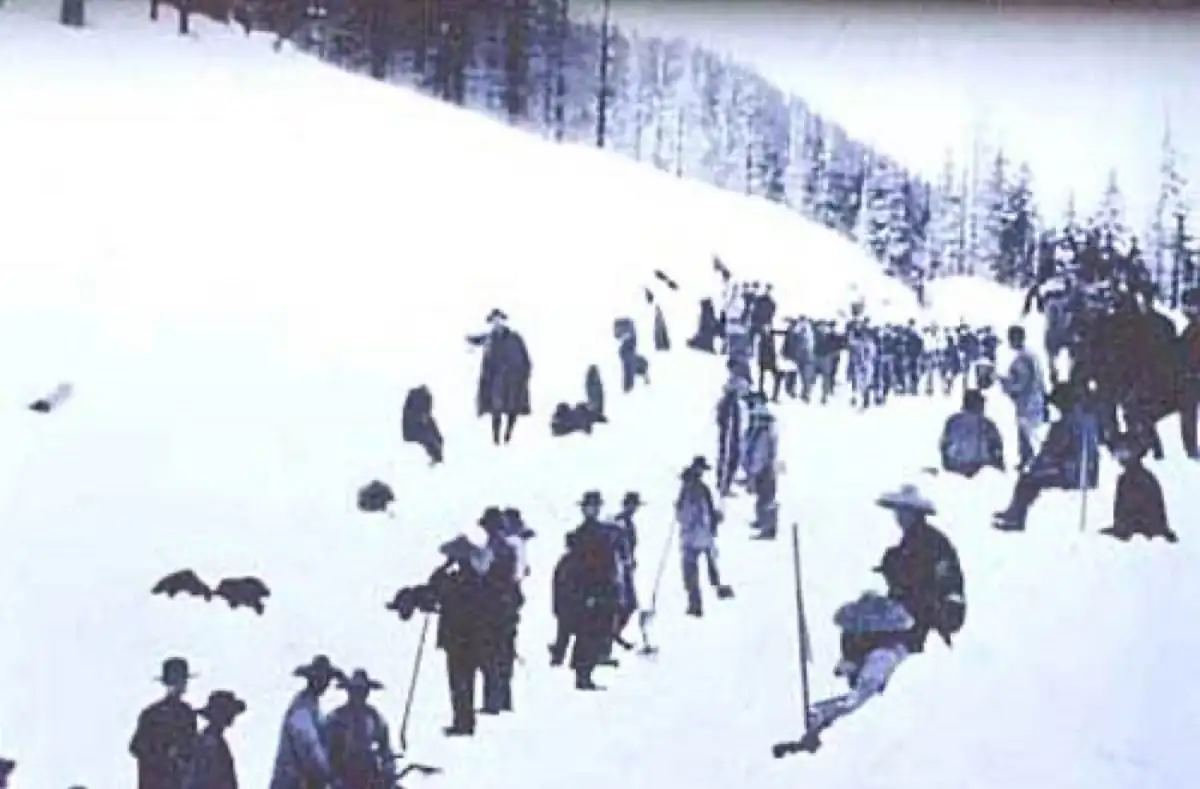
For the full story: Chinese Railroad Workers: Building America, Facing Exclusion
2. The Ships That Carried Men Like Livestock
Before the railroad workers, there were the men in the holds.
Between 1847 and 1874, during what historians call the “coolie trade era” (苦力贸易, kǔlì màoyì), an estimated 125,000 to 250,000 Chinese laborers were shipped under coercive contracts to Cuba, Peru, and other Latin American destinations. For the ship-by-ship account of these crossings — Cuba, Peru, and Jamaica — see our guide to the coolie trade ships of the Americas. Most came from the Siyi counties. They were recruited, deceived, and often kidnapped by labor brokers (客头, kètóu) who sold them to Portuguese-licensed barracoons in Macau — holding pens where conditions were, by multiple contemporary accounts, worse than those of the African slave trade.
The system was called the “piglet trade” (猪仔贸易, zhūzǎi màoyì), and the name was exact. Men were held in overcrowded pens, branded, and loaded onto ships where mortality rates on the four-month Pacific crossing routinely reached 10 to 40 percent. Those ships were called “floating hells.”
In Cuba, approximately 125,000 Chinese laborers were put to work on sugar plantations under eight-year contracts that functioned as life sentences. The average labor life expectancy after arrival was five years. The overall mortality rate was approximately 75 percent. They cut cane on the same plantations that enslaved Africans had worked a generation earlier — the abolition of the trans-Atlantic slave trade had created a labor vacuum, and Chinese bodies filled it.
In Peru, the work was even more lethal. Approximately 100,000 Chinese laborers were sent to the guano deposits of the Chincha Islands. Guano — accumulated seabird excrement, rich in nitrogen — was the world’s most coveted fertilizer in the nineteenth century. The ammonia dust caused respiratory disease, blindness, and despair. Of the estimated 4,000 coolies sent directly to the Chincha Islands, nearly all died. Suicide rates among guano workers were among the highest recorded in any labor system. Others built the Central Railway of Peru, the highest standard-gauge railway in the world, clawing track into the Andes at altitudes above 15,000 feet.
The Qing government formally banned the coolie trade in 1874, but contract labor continued under different names for decades. The Chinese-Peruvian and Chinese-Cuban communities that survive today — Havana’s Barrio Chino, Lima’s chifa restaurants — began in these barracoons and guano pits.
For the full story: The Coolie Trade: Chinese Laborers in the Shadow of Abolition
3. From the Goldfields of California to the Rivers of Otago
The word that reached Wuyi villages in 1849 was one syllable: Gold Mountain (金山, Jīnshān). It was a myth that traveled faster than any ship.
The California Gold Rush drew the first mass wave of Wuyi laborers to North America. Ships out of Hong Kong packed men into steerage, and by 1852 the Chinese population of California had reached 25,000 — overwhelmingly men from the Siyi counties. They worked placer claims already abandoned by white miners, reworking the tailings with the patience of farmers. They paid the Foreign Miners’ Tax — a levy explicitly designed to drive them out — and they kept digging.
The gold didn’t stay in California. When the Australian rushes ignited in the 1850s, Wuyi men sailed south. By 1857, approximately 40,000 Chinese miners — again, mostly from the Siyi region — were working the Victorian goldfields. The pattern repeated: they worked claims others had abandoned, they were taxed and harassed, and when gold dwindled, they pivoted. The anti-Chinese riots at Lambing Flat, New South Wales, in 1861 — where white miners drove Chinese laborers from the fields with whips and clubs — became a template for the violence that would follow Chinese laborers across the Pacific world.
The rushes rippled further. New Zealand’s Otago gold rush of 1861 drew several thousand Wuyi miners to the South Island. In every goldfield, the same cycle: arrival, taxation, violence, and — when the easy gold was gone — a turn toward the land. The miners who had come for gold became the market gardeners who would feed the nations that had tried to expel them.

4. How Wuyi Farmers Fed Two Continents
The gold ran out. The Wuyi laborers stayed, and they did what they had always done: they farmed.
In California, Chinese market gardeners — many of them former miners — transformed the agricultural landscape. By the 1880s, they supplied an estimated 75 percent of the state’s fresh produce. They brought intensive farming techniques from the Pearl River Delta: raised beds, hand irrigation, intercropping, and a relentless attention to soil. White consumers who supported Chinese exclusion laws nevertheless bought Chinese-grown vegetables at every city market.
The same pattern unfolded in Australia. In the Riverina region of New South Wales, Wuyi laborers transformed arid land into productive farms using Chinese irrigation techniques they had learned in their home villages. By 1900, Chinese market gardeners supplied an estimated 75 to 80 percent of Sydney’s fresh vegetables. Every Australian town of any size had its Chinese gardens on the outskirts — corrugated iron huts, raised beds, a horse and cart for deliveries. The men who worked those gardens lived under the White Australia Policy (1901), which banned new Chinese immigration and reinforced the bachelor society that already defined Chinese Australian life.
In New Zealand, Chinese market gardeners similarly dominated vegetable production through the early twentieth century. The post-gold pattern was universal: the men who had come to dig for gold stayed to dig in soil, and they fed the nations that had tried to drive them out.

For the full story: Siyi Market Gardeners: The Chinese Farmers Who Fed Australia
5. From Slavery to Coolie Labor on Caribbean Plantations
Sugar built the modern world, and Wuyi laborers built the sugar.
Cuba was the largest coolie destination in the Americas. Approximately 125,000 Chinese laborers — nearly all men, nearly all from the Siyi region — worked Cuban sugar plantations under conditions that were, by the testimony of the laborers themselves in surviving qiaopi letters, indistinguishable from slavery. They cut cane alongside the last generation of enslaved Africans, and when slavery was finally abolished in Cuba in 1886, Chinese laborers remained on the same plantations under the same overseers. The transition from enslaved African labor to coerced Chinese labor was direct — not an improvement, but a replacement.
The pattern extended across the Caribbean. Chinese laborers were sent to sugar plantations in Jamaica, Trinidad, and British Guiana (now Guyana) from the 1850s onward. In Hawaii, Chinese laborers were recruited for sugar plantations from the 1850s through the 1890s, predating the mainland railroad migration. These Hawaiian workers formed the nucleus of what would become one of the most established Chinese American communities in the Pacific.
What endures from this chapter is not just the sugar — it is the hybrid communities that grew from it. Chinese-Cuban, Chinese-Jamaican, Chinese-Trinidadian cultures exist today because men from Taishan and Kaiping survived the sugar fields and built families. Havana’s Barrio Chino, once the largest Chinatown in Latin America, is a testament to survival that began in cane.
For the full story: Chinese in Cuba: A History of Resilience and Legacy
6. The Laundries and Chop Suey Houses That Built Chinese America
Not all labor built railroads. Some built dinner.
By 1900, approximately 25 percent of all Chinese workers in the United States worked in laundries — an industry that Wuyi laborers did not choose but were forced into. White employers would not hire Chinese men for most jobs. White customers, however, would pay them to wash clothes. So Wuyi men — railroad veterans, miners, farmers — became laundrymen. They worked sixteen-hour days in basement shops, hauling water by hand, pressing shirts with irons heated on coal stoves. It was brutal, intimate work, and it built the economic foundation of Chinese America.
Then came the restaurants. By the 1920s, chop suey houses — serving a dish unknown in China but invented by Wuyi cooks for American palates — had spread across the United States. Chop suey, egg foo young, fortune cookies: these were not Cantonese traditions brought from the villages. They were Wuyi inventions, crafted in restaurant kitchens from ingredients available in a new land and adapted to the tastes of a nation that wanted the exotic without the unfamiliar.
The arc of this labor is remarkable to trace. The men who washed clothes in basement laundries saved enough for their sons to run restaurants. The restaurant owners saved enough for their grandchildren to become doctors, lawyers, and engineers. This is the three-generation arc of Wuyi labor migration: railroad hands, laundry hands, professional hands — each generation building on the exhaustion of the last.

7. The Gold Mountain Wives Who Held the Villages Together
For every man who sailed from Haikou Port, a woman remained.
They were called Gold Mountain wives (金山婆, jīnshānpó) — women whose husbands labored overseas while they managed family farms, raised children, maintained ancestral rites, and waited. The waits were not measured in months. They were measured in decades. A man might leave for Jīnshān in 1880 and return in 1910, if he returned at all. The male-to-female ratio in overseas Chinese communities was approximately 20 to 1 by 1900 — men lived in what scholars call “bachelor societies,” while their wives lived as de facto widows in villages that slowly emptied.
The qiaopi letters that moved between these separated spouses are among the most intimate documents in migration history. Wives wrote to husbands about harvest yields, tax payments, children’s illnesses, and the endless work of maintaining a clan’s standing in a village where the men had vanished. Some women managed substantial sums of remittance money (侨汇, qiáohuì), becoming the economic heads of households and, in some cases, community leaders. Their signatures appear on land deeds, school donation rosters, and diaspora association records.
Some of these wives never met their husbands. Marriages were arranged by letter — a man in California or Australia selected a bride from his home village through intermediaries, sent money for the ceremony, and remained abroad while she moved into his family home to serve his parents. The children born from brief visits or, later, from photographs alone grew up knowing their father as a signature on a qiaopi envelope.
The Gold Mountain wife was not a passive figure. She was the anchor of a system that could not have functioned without her. The remittance economy that transformed Wuyi — the diaolou towers, the schools, the paved roads — passed through her hands.

For the full story: Gold Mountain Wives: The Jinshanpo Who Held Wuyi Together
8. Diaolou, Schools, and the Landscape Remittances Made
The money came home, and home was never the same.
By the 1920s, annual remittances flowing into the Wuyi region exceeded an estimated $100 million. This was not scattered charity — it was an economic force that physically rebuilt five counties. The most visible result stands across the rice paddies of Kaiping: the diaolou (碉楼), multi-story fortified towers that mix Chinese defensive architecture with Victorian, Mediterranean, and Art Deco flourishes. More than 1,800 of these towers were built in Kaiping alone, each one a declaration — a man from this village went overseas, and his money built this. UNESCO inscribed the Kaiping Diaolou as a World Heritage site in 2007.
The towers are the landmarks, but they are not the whole landscape. By the 1930s, an estimated 80 percent of schools in Taishan county were built or funded by overseas remittances. The first electric power plant in Taishan, built in 1919, ran on overseas capital. Roads, bridges, wells, and ancestral halls (祠堂, cítáng) — all of it was paid for by men washing clothes in San Francisco basements, cutting cane in Cuba, and growing vegetables on the outskirts of Sydney.
This is the qiaoxiang (侨乡, emigrant homeland) landscape — a physical record of overseas labor written in brick, stone, and reinforced concrete. Walking through a Taishan village today, you can read the architecture like a map of the diaspora: a Victorian veranda here, a Mediterranean balcony there, a Roman arch over the doorway of a house built by a man who spent thirty years in the goldfields. The buildings are beautiful. But they are also empty — the remittance economy maintained structures but could not replace the people who built them. Many of these villages are now hollow (空心村, kōngxīn cūn), their residents scattered across the world their ancestors helped build.
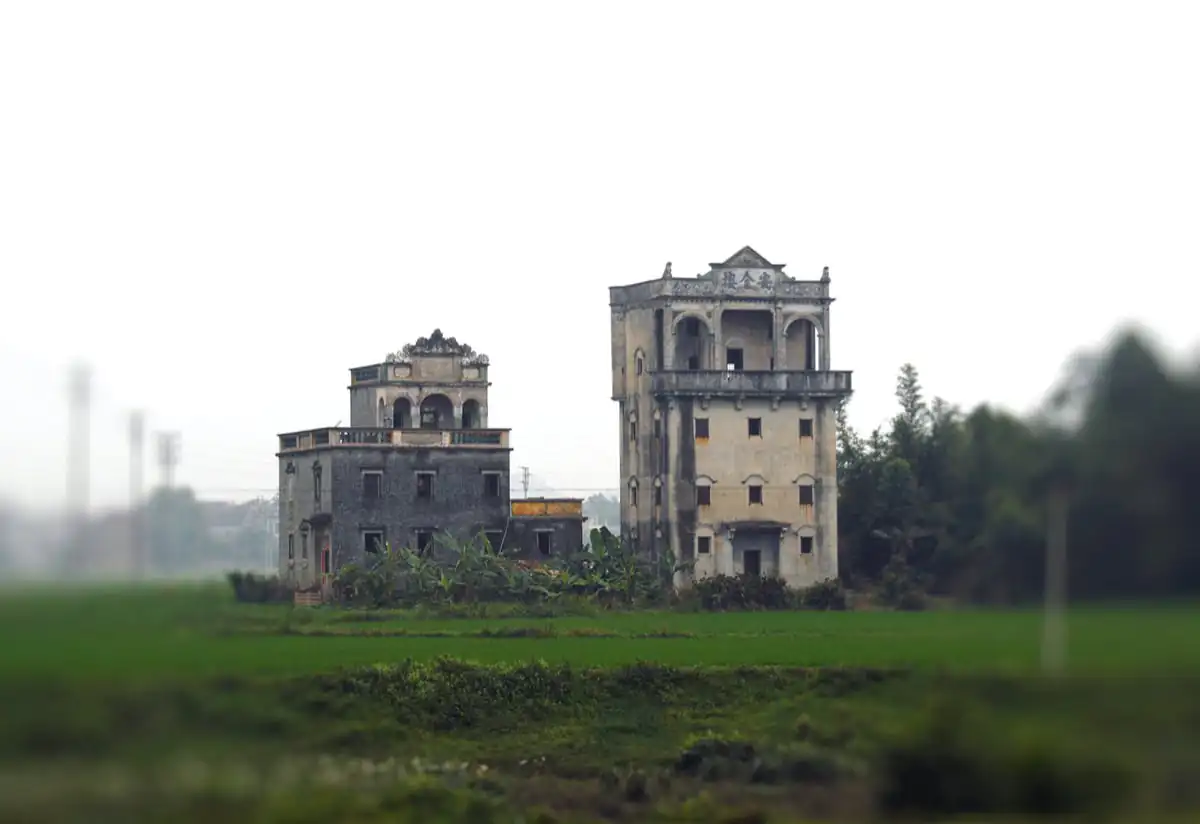
For the full story: Kaiping Diaolou and Tangkou: A Community Project
9. What the Gold Mountain Guests Brought Home
Not every man stayed abroad. An estimated 15 to 30 percent of Wuyi laborers eventually returned — figures that vary significantly by destination and era. They were called Gold Mountain guests (金山客, jīnshānkè), and what they brought back was more than money.
The most ambitious thing they built was the Sunning Railway (新宁铁路). Constructed between 1906 and 1909, it was China’s first wholly Chinese-owned and Chinese-built railway, funded entirely by capital from returned overseas Wuyi laborers. The men who built it had worked on American railroads — they came home with engineering knowledge, organizational experience, and the conviction that Taishan deserved what California had. The railway connected Taishan’s villages and market towns for nearly three decades before being destroyed during the Second Sino-Japanese War in 1938.
The railway was exceptional, but the pattern was not. Returned laborers brought industrial skills, Western medical knowledge, and political ideas — overseas Wuyi communities were major funders of Sun Yat-sen’s revolutionary movement, which toppled the Qing dynasty in 1911. They brought new architectural styles, new crops, new ways of organizing communities. They came home carrying the world they had seen, and they laid it down in the villages they had left.
The ideal that drove many of them was luòyèguīgēn (落叶归根) — “falling leaves return to their roots.” But the ideal was also a myth, one that sustained families through decades of separation. Most laborers never returned. They died abroad, their bones shipped back to Wuyi for burial when families could afford it, their names inscribed on village memorials alongside men who had died in the same foreign fields. The Sunning Railway is a monument to those who made it back. The qiaopi letters are the testament of those who did not.

For the full story: The Sunning Railway: China’s First Overseas-Chinese-Funded Railroad
10. From Laborers to a Global Diaspora
Today, an estimated 1.3 million people of Taishanese descent live outside China — more than the roughly one million who live in Taishan itself. The Wuyi labor migration did not end. It became a diaspora.
The arc is visible across three generations. The first generation drove spikes and washed shirts. The second generation ran restaurants and grocery stores, sent their children to universities, and moved to suburbs their parents could not have entered. The third generation — the grandchildren of railroad workers and laundrymen — are doctors, lawyers, engineers, and increasingly, heritage-seekers. They return to Wuyi villages with DNA test results and smartphone photos of gravestones, looking for the ancestral homes their grandparents described in qiaopi letters written seventy years ago.
The physical legacy is being recognized at the highest levels. UNESCO’s inscription of the Kaiping Diaolou as a World Heritage site in 2007 and the Qiaopi Archives as a UNESCO Memory of the World register in 2013 have brought international attention to what Wuyi laborers built — not just abroad, but at home. Descendant communities have organized memorial projects and recognition campaigns. In 2019, at the 150th anniversary of the transcontinental railroad’s completion, descendants of Chinese railroad workers stood at Promontory Summit and were photographed in the frame their ancestors were excluded from.
The Wuyi labor story is, in the end, every immigrant labor story. People leave home to build someone else’s, and in the process, they change both worlds. The railroads still run. The market gardens still grow. The diaolou towers still stand above the rice paddies. And somewhere in an archive in Kaiping, a qiaopi letter written by a man in a Peruvian guano pit or a California laundry still says what they all said: I am alive. I am sending money. Do not forget me.
Sources
- 梅伟强, 张国雄. 《五邑华侨华人史》 [History of Wuyi Overseas Chinese]. 广东高等教育出版社, 2001.
- 梅伟强, 关泽锋. 《广东台山华侨史》 [History of Overseas Chinese from Taishan, Guangdong]. 中国华侨出版社, 2010.
- 刘进, 刘平. 《银信与五邑侨乡社会》 [Qiaopi and Wuyi Qiaoxiang Society]. 广东人民出版社, 2011.
- 袁丁. 《跨国移民与近代广东侨乡》 [Transnational Migration and Modern Guangdong Qiaoxiang]. 中华书局, 2019.
- Hsu, Madeline Y. Dreaming of Gold, Dreaming of Home: Transnationalism and Migration Between the United States and South China, 1882–1943. Stanford University Press, 2000.
- 赵汝诚. 《旅居者与移民——美国太平洋铁路华工与爱尔兰劳工报纸形象分析》 [Sojourners and Immigrants: Newspaper Image Analysis of Chinese and Irish Workers on the US Pacific Railroad]. 中国华侨出版社, 2012.
- 黎禹君, 王乐怡. “华工修筑美国太平洋铁路时使用的道钉” [The Spikes Used by Chinese Laborers Building the US Pacific Railroad]. 江门市人民政府 [Jiangmen Municipal People’s Government], March 16, 2024. https://www.jiangmen.gov.cn/
- 谭金花, 梅伟强. “五邑华工与美国铁路建设” [Wuyi Chinese Laborers and US Railroad Construction]. 国务院侨务办公室 [Overseas Chinese Affairs Office of the State Council], November 15, 2023. https://www.gqb.gov.cn/
- UNESCO. “Kaiping Diaolou and Villages.” World Heritage List, 2007. https://whc.unesco.org/en/list/1112/
- UNESCO. “Qiaopi and Yinxin Correspondence and Remittance Documents from Overseas Chinese.” Memory of the World Register, 2013.
Continue Reading
This atlas connects to deep-dive articles that tell the full story of each industry and community. Start here:
-
The Coolie Trade: Chinese Laborers in the Shadow of Abolition — The full account of the Macau barracoons, the “floating hell” ships, and the 125,000+ Wuyi laborers shipped to Cuba and Peru between 1847 and 1874.
-
Chinese Railroad Workers: Building America, Facing Exclusion — The iconic Wuyi labor experience: 12,000 workers on the Transcontinental Railroad, the 1867 strike, and the exclusion laws that reshaped Chinese America for a century.
-
Chinese Railroad Workers: The Wuyi Villages That Built the Transcontinental — The specific Wuyi villages that sent thousands of railroad workers, the names behind the payrolls, and the families who waited for letters that never came.
-
Taishanese Migration: The Zhuzai and Shedan Systems — An exploration of the credit-ticket (赊单, shēdān) and “piglet” systems — the recruitment mechanisms that moved two million laborers from village to ship to worksite.
-
The Sunning Railway: China’s First Overseas-Chinese-Funded Railroad — The story of what returned laborers built at home: a railway, a revolution, and a transformed landscape.
Suggested Reading
Is this your family’s story?
Roots Of China is built from readers’ family histories. If a story here sounds like your own — a surname, a village, a journey — leave a comment below, or share your family’s story with us and we may be able to help you find your ancestral village.
