

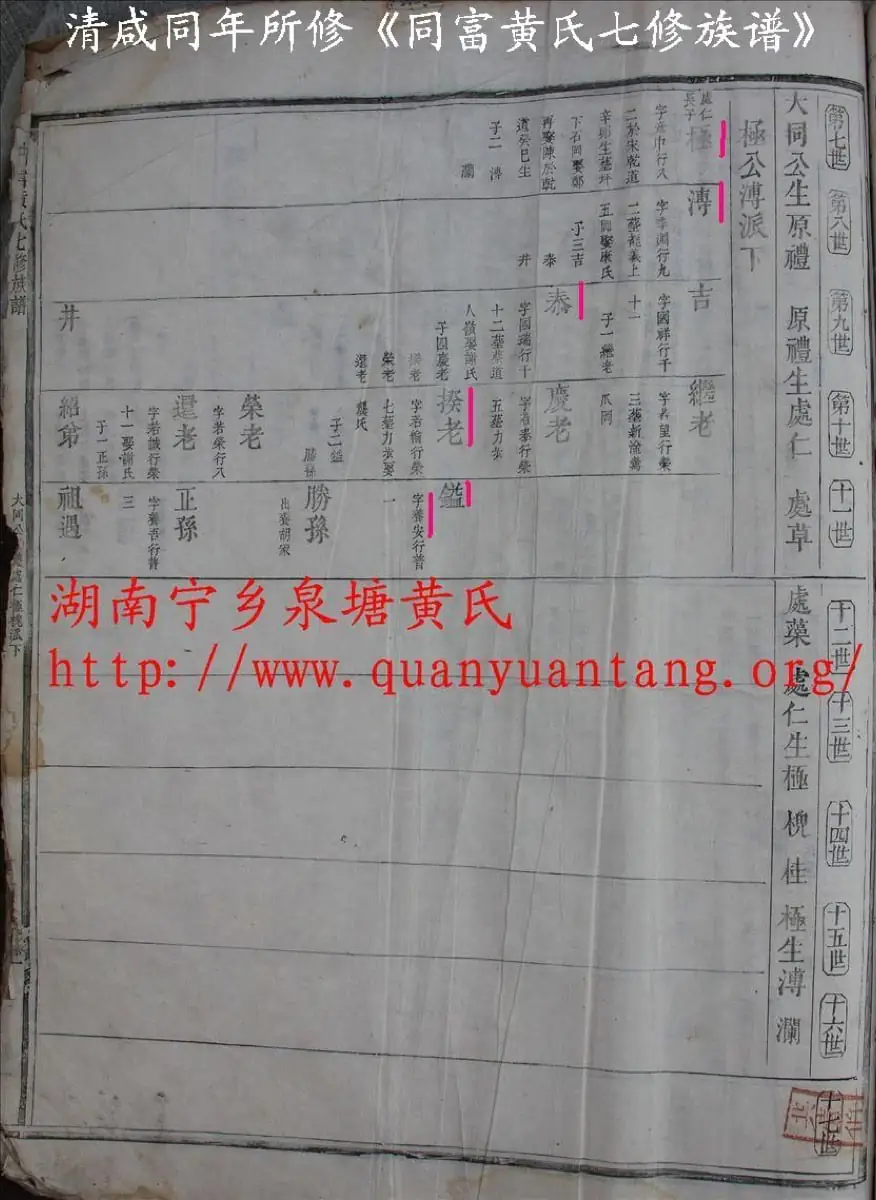
For four thousand years, the character 黄 (Huáng) has traveled across the Chinese-speaking world — carved into ancestral tablets in Henan, inked onto qiaopi letters bound for Gold Mountain (金山, Jīnshān), engraved on association plaques in San Francisco, and typed into DNA test profiles by descendants who have never spoken a word of Taishanese. The Huang surname is the eighth most common in China, carried by more than thirty-two million people globally. In Taishan alone, nearly two hundred thousand bear the name — and an equal number carry it overseas. But the story of the Huang surname begins with a kingdom that no longer exists: a small fiefdom in the Central Plains, conquered in 648 BCE, whose survivors adopted the name of their fallen state and carried it south, across oceans, and into the twenty-first century.
Origins: The Kingdom of Huang and the Birth of a Surname
The ancient Kingdom of Huang (黄国, Huáng Guó) occupied present-day Huangchuan County in Henan Province. Founded during the Xia Dynasty around 2100 BCE, the kingdom flourished for nearly fifteen hundred years as a minor but persistent state on the southern periphery of the Central Plains civilization. In 648 BCE, the ascendant State of Chu conquered and absorbed it. The kingdom vanished from the map, but its survivors performed an act of collective memory that would echo across four millennia: they adopted the name of their fallen state — Huang — as their surname. The Taishan municipal government traces the surname’s origin to this foundational moment.
The ancient character 黄 may have originally depicted a jade pendant (璜, huáng), according to the philologist Guo Moruo’s research cited by Taishan authorities. An older tradition links the Huang to the Dongyi “Yellow Bird” tribe (黄夷, Huáng Yí), one of the Nine Yi clans of ancient eastern China, who worshipped the oriole as their totem. Competing genealogies trace the lineage either through the Yellow Emperor (黄帝, Huáng Dì) or through the lesser sovereign Shaohao (少昊). The multiplicity of origin stories is itself the point: Huang identity has always been capacious enough to hold them all.
The surname’s institutional identity crystallized at Jiangxia (present-day Wuhan, Hubei). During the Eastern Han Dynasty, Huang Xiang (黄香, Huáng Xiāng, 68–122 CE) earned legendary status for his filial piety — in summer he fanned his father’s bed to cool it; in winter he warmed the quilts with his own body. The adage “Under Heaven there is none to match him — the Huang boy of Jiangxia” (天下无双,江夏黄童, tiānxià wúshuāng, Jiāngxià Huáng tóng) entered the Chinese canon. His son Huang Qiong (黄琼, Huáng Qióng) and grandson Huang Wan (黄琬, Huáng Wǎn) both attained high office, establishing four generations of scholar-officials. From this lineage emerged the universal Huang ancestral hall designation: Jiangxia Hall (江夏堂, Jiāngxià Táng). To this day, wherever in the world a Huang ancestral hall stands, the characters 江夏堂 appear above its altar.
The Warring States period contributed another foundational figure: Huang Xie (黄歇, Huáng Xiē, d. 238 BCE), Lord Chunshen (春申君, Chūnshēn Jūn), one of the Four Gentlemen of the Warring States. He served as Prime Minister of Chu, maintained three thousand scholar-retainers, and is recognized across Huang genealogies as the founding ancestor of the Jiangxia lineage. Later, in the Three Kingdoms era, Huang Zhong (黄忠, Huáng Zhōng) joined the Five Tiger Generals of Shu Han — a martial counterpoint to the scholarly tradition.
Qiaoshan’s Decree: One Father, Twenty-One Sons, One Poem

In the year 951 CE, an eighty-year-old man named Huang Qiaoshan (黄峭山, Huáng Qiàoshān, 872–953 CE) summoned his twenty-one sons to his estate in Shaowu, Fujian. He had served the Tang Dynasty as Vice Minister of Works (工部侍郎, Gōngbù Shìláng) and held the title Marquis of a Thousand Households (千户侯, Qiānhù Hóu). He had married three wives — Lady Shangguan (上官氏, Shàngguān Shì), Lady Wu (吴氏, Wú Shì), and Lady Zheng (郑氏, Zhèng Shì) — each of whom had borne him seven sons. Now, in the twilight of his life, he made the single most consequential decision in Huang clan history.
Qiaoshan divided the family fortune into twenty-one shares — eight hundred thousand strings of copper cash and over eight hundred items of gold and silver. Each son received a horse, a share of the wealth, and a freshly compiled copy of the Huang Clan Genealogy (黄氏家谱, Huángshì Jiāpǔ). Three eldest sons — one from each wife — would remain to care for their aging parents. The other eighteen must leave, each riding out to found a new settlement. Qiaoshan’s rationale, preserved in clan records: “Fish in a pond are far inferior to cranes among the clouds. Good men need not cling to this patch of native soil — their ambitions should span all directions, their vision encompass the world!” (池内之鱼,远逊云间之鹤。好男儿不必恋此一方故土,而应志在四方,放眼天下).
The night before their departure, Qiaoshan composed a poem — the Departure Poem (遣子诗, Qiǎn Zǐ Shī), also known as the Clan Recognition Poem (认宗诗, Rènzōng Shī). He instructed each son to memorize it:
策马登程出异疆,任从随处立纲常。
年深外境犹吾境,日久他乡即故乡。
朝夕莫忘亲命语,晨昏须荐祖宗香。
惟愿苍天垂庇佑,三七男儿永炽昌。
The poem urged the sons to ride forth, to establish order wherever they settled, to treat foreign lands as home after many years, to never forget their father’s words, to offer incense to the ancestors at dawn and dusk, and to pray that Heaven would protect all twenty-one brothers — may they forever flourish.
The names of the twenty-one sons are themselves encoded in a mnemonic poem (廿一公名赞): He (和), Mei (梅), Xun (荀), Gai (盖), Chu (楚), Gui (龟), Yang (洋), Zheng (政), Hua (化), Qu (瞿), Lu (卢), Fu (福), Lin (林), Tang (唐), Zu (祖), Tan (潭), Cheng (城), Guang (光), Chang (昌), Ceng (层), Gui (贵). They dispersed across Fujian, Jiangxi, Guangdong, and Hunan. Within two generations, Qiaoshan had one hundred grandsons and three hundred thirty-four great-grandsons.
A cross-book tension demands honesty: Qiaoshan does not appear in official dynastic histories. The saying goes that he was “名不见经传,事不载史志” — his name absent from the classics, his deeds unrecorded in the official chronicles. The Qiaoshan narrative may be a Song-dynasty clan construction — a genealogical invention designed to give the vast Huang diaspora a single, emotionally coherent origin story. Yet for the Huang clan worldwide, Qiaoshan is culturally true. Over sixty regional variants of the Departure Poem have been documented. The clan rule states explicitly: “Anyone who can recite this poem is of the same clan — invite them in, treat them as kin” (凡能背诵此诗者,即是同宗亲派,请升堂入室,不得异视). The Qiaoshan spirit (峭公精神, Qiàogōng Jīngshén) — willingness to venture into unknown territory and establish new roots — became a self-fulfilling prophecy for the Huang diaspora.
Southward: From Fujian to Zhuji Lane to Baisha-Chaojing

The route from Qiaoshan’s sons in Fujian to the Huang heartland of Taishan followed one of the great migration corridors of Chinese history. During the Tang-Song transition, waves of northern families pushed south — first to the Fujian highlands around Ninghua Shibi (宁化石壁), then through the mountain passes into northern Guangdong. The funnel point was a single lane in Nanxiong: Zhuji Lane (珠玑巷, Zhūjī Xiàng), a narrow alleyway through which approximately seventy percent of all Pearl River Delta lineages are believed to have passed — a migration geography that reshaped the villages of Taishan.
The Huang lineage reached Zhuji Lane through Huang Juzheng (黄居正, Huáng Jūzhèng, also recorded as 黄居政), a scholar from Putian, Fujian. He achieved the jinshi degree (进士, presented scholar) — traditionally called zhuangyuan (状元) in clan records — in 1175. He rose to Vice Minister of Personnel (吏部侍郎, Lìbù Shìláng) and Academician of the Tianzhang Pavilion (直天章阁学士, Zhí Tiānzhāng Gé Xuéshì). After falling out with powerful ministers, he was posted to the Guangnan Circuit and relocated his family to Nanxiong Zhuji Lane in 1223 CE. The so-called “Hu Fei Incident” (胡妃之乱) — in which an imperial concubine’s escape triggered a mass southward flight from Zhuji Lane — may have accelerated the Huang clan’s final push into the Pearl River Delta.
Juzheng’s son Huang Yuanshen (黄源深, Huáng Yuánshēn) earned his own jinshi degree in 1181 and served as Prefect of Xuzhou (徐州知府) and Zhejiang Chief Transport Commissioner (浙江都漕运史). He made the decisive move from Zhuji Lane to Dujuan (杜阮) in Xinhui County, establishing what would become the Six Great Houses (六大房, Liù Dà Fáng) — his six sons, each the founder of a regional Huang sub-lineage.
Among them, two sons shaped the Taishan Huang world. Guozong (国宗) entered Taishan through Baisha and Chaojing — the undisputed Huang heartland. Guotai (国泰) established the largest Taishan branch; by the fifth generation, his great-grandson Yinlong (隐龙) had moved to Dongkou (洞口), becoming the founding ancestor of a lineage that would produce over twenty thousand descendants by the 1921 census in the Dezhi (德智) branch alone.
Baisha (白沙) and Chaojing (潮境) became the Huang clan’s demographic and symbolic center in Taishan. A local saying captured the surname’s dominance: “Nine Huang households to one Zhu-Gong” (九黄一朱龚, jiǔ Huáng yī Zhū Gōng) — meaning Huang families outnumbered all others nine to one. Chaojing acquired the nickname “Huang Market” (黄圩, Huáng Xū), so thoroughly did the surname saturate its commercial life. At one point, Chaojing nearly challenged Taicheng for the county seat. By the early twentieth century, Taishan county counted 1,120 natural villages dominated by the Huang surname, with a 1921 census recording over 120,000 Huang residents.
Baisha-Chaojing: The Architectural and Ritual Heart of Huang Taishan
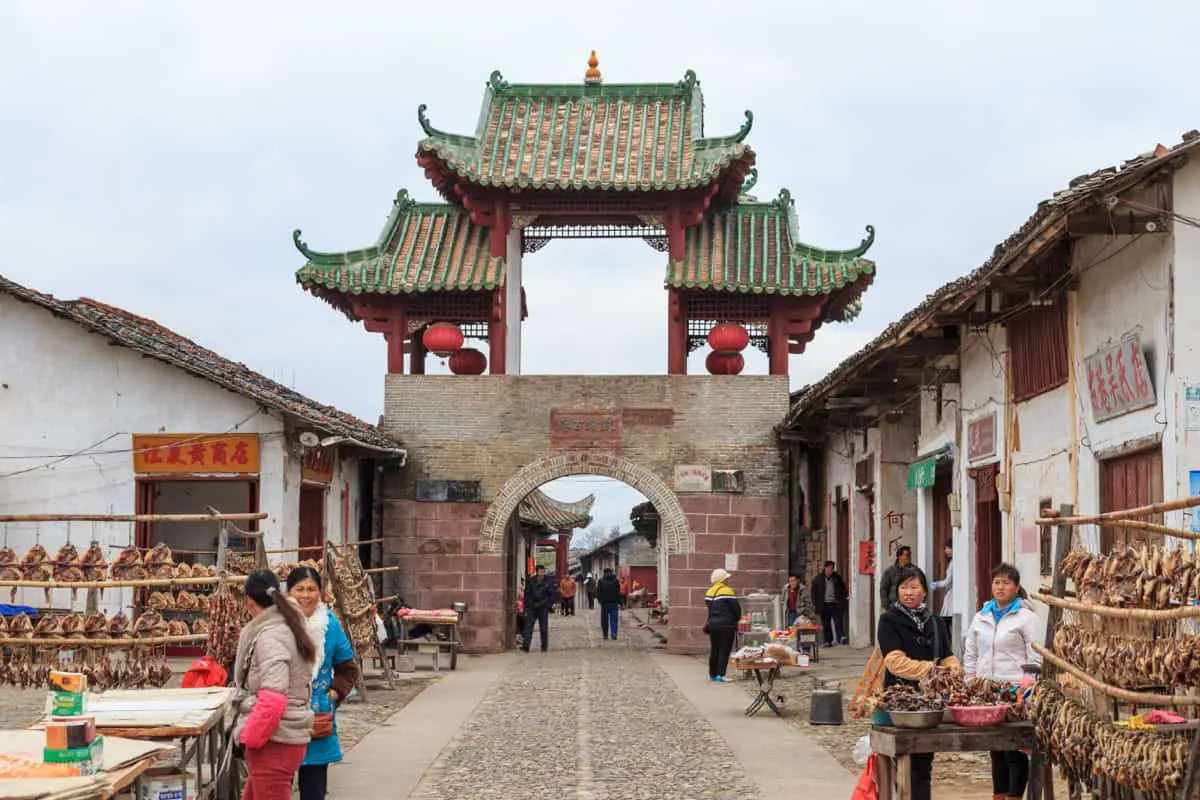
In 1923, the Huang clans of Taishan pooled resources to build a grand ancestral hall at 17 Zhengshi Street in Taicheng. The Huang Great Ancestral Hall (黄氏大宗祠, Huángshì Dà Zōngcí) rose on a three-courtyard Republican-era plan, anchored by six massive granite pillars. Its hall plaque — reading 溥泉堂 (Pǔquán Táng, Puquan Hall) — was calligraphed by Weng Tonghe (翁同龢), the 1894 zhuangyuan and tutor to two Qing emperors. The hall embodied the “ancestral hall plus school” model (祠校合一, Cí Xiào Hé Yī): in 1926 it opened as the Huang Clan School, later evolving into Juzheng Middle School (居正中学, Jūzhèng Zhōngxué) — a living institution where descendants studied beneath the same roof where ancestors were venerated. These ancestral halls are part of Taishan’s broader architectural heritage, where diaspora wealth transformed village landscapes.
The Cultural Revolution gutted the hall. By the 1990s, its rear section had collapsed from structural decay. Restoration came in two waves — the rear hall rebuilt in 1993 through funding from overseas Huang philanthropist Huang Gengping (黄庚平), and the front hall reconstructed in 2002 after a transnational fundraising campaign.
The ancestral landscape extends beyond Taicheng. In Baisha’s Dakeng Village, three Huang ancestral halls stand in close proximity: the Yuanbi Huang Gong Ancestral Hall (原璧黄公祠), the oldest, bearing a Tongzhi-era restoration inscription; the Hongwei Huang Gong Ancestral Hall (宏巍黄公祠), the largest, distinguished by its fine wood carvings; and the Rengkui Huang Gong Ancestral Hall (仞魁黄公祠), the newest, dating to the Guangxu reign. In Chaojing, the Juzheng School moved from Taicheng in 1950 and continues operating to this day. The Tong’an Building (同安楼) at Wangdi Village and the Xunwu Building (洵武楼) at Hushan Village stand as architectural witnesses to Huang prosperity.
These halls were not merely buildings. They functioned as ritual centers for emigration departure ceremonies, as reception venues for returning overseas Huang, as sites for clan governance and dispute resolution, as coordination points for remittance distribution, and as archives for genealogical record-keeping. When the overseas Huang returned, they returned to the hall. The physical structure anchored a diasporic identity that spanned continents.
Gold Mountain Calling: The Departure Generation
In the 1850s, Huang men from Baisha, Chaojing, Duanfen, and Haiyan gathered at wharves along the Tan River (潭江, Tán Jiāng). They carried cloth bundles, dried provisions, and the names of relatives already in California. They were not the first Huang to leave Chinese shores — Southeast Asian Huang merchants had been active in Malacca, Batavia, and Singapore for centuries — but they were the vanguard of a migration that would turn Huang into the largest Chinese surname in America.
The 1848 California Gold Rush triggered the first mass wave from the Wuyi region. Huang laborers numbered among the earliest “Gold Mountain guests” (金山客, Jīnshān Kè). By 1850, just two years after gold was discovered at Sutter’s Mill, Huang was already the single largest surname in the newly formed Four Districts Association (四邑会馆, Sìyì Huìguǎn) in San Francisco — the first major regional organization for Siyi immigrants in America.
The credit-ticket system (赊单制, Shēdān Zhì) enabled chain migration at scale. A pioneer — typically a young Huang man — would have his passage advanced by a labor contractor or clan association at a cost of roughly fifty to seventy-five dollars, to be repaid through three to five years of indentured labor. Once established, he sponsored a brother, then a cousin, then a village neighbor. Clan trust reduced default risk: reputation within the surname community served as collateral. This created a self-reinforcing loop — earlier migrants paid for later arrivals, community support attracted new migrants, and Huang’s institutional strength made it an attractive channel.
The epicenter of this departure was Haikou Port (海口埠, Hǎikǒu Bù) in Duanfen Township — known as “the First Port for Cantonese Going Overseas” (广府人出洋第一港). Built in 1853, its five-hundred-meter-long Xilong Street hosted six remittance banks and was nicknamed “Bank Street” (银行街, Yínháng Jiē). From this single wharf, an estimated tens of thousands of Huang men embarked for the Pacific crossing.
By 1870, approximately sixty-three thousand Chinese lived in the United States, roughly eighty percent from the Siyi region. Huang was the single largest surname in the migration stream — a demographic fact that would compound into structural dominance over the following century.
The Association Builders: How Huang Became America’s Largest Chinese Clan

Numerical dominance is one thing. Institutional power is another. The Huang surname achieved both, and it achieved them early — a “first-mover advantage” that compounded across generations — building precisely the kind of clan brotherhoods that sustained the Wuyi diaspora.
The documentary record is unambiguous. In 1850, when Taishan, Kaiping, Enping, and Xinhui immigrants established the Siyi Association (四邑会馆, Sìyì Huìguǎn) in San Francisco, Huang claimed the largest membership. In 1854, when Taishan (then called Xinning, 新宁) immigrants formed the Ning Yeung Association (宁阳会馆, Níngyáng Huìguǎn), Huang held eleven of the board positions — number one among the twenty-six surnames represented. This made Huang the founding powerbroker of what would become the most important Taishan organization in American history. In 1876, when Kaiping and Enping immigrants created the Hop Wo Association (合和会馆, Héhé Huìguǎn), Huang ranked second among seven major surnames.
That institutional power translated into leadership at the highest levels. In 1910, Huang Gongyue (黄公越) served as President of the Chinese Consolidated Benevolent Association (中华总会馆, Zhōnghuá Zǒng Huìguǎn) — informally known as the Six Companies — the supreme governing body of Chinese America. From 1938 to 1940, Huang Jiannong (黄剑农) served as the twelfth Chairman of the New York Chinese Consolidated Benevolent Association (纽约中华公所).
The Huang clan association network evolved across three organizational stages. First came the Jiangxia Hall (黄江夏堂, Huáng Jiāngxià Táng), the earliest formal Huang organization in San Francisco. Then the Yunshan Association (黄云山公所, Huáng Yúnshān Gōngsuǒ), named after Huang Yuanshen’s style name “Yunshan,” serving specifically the Taishan Huang community. In 1942, the two merged into a unified General Association (黄江夏堂云山总公所). Finally, in 1967, the organization was renamed the Huang Clan Association of America (旅美黄氏宗亲总会, Lǚ Měi Huángshì Zōngqīn Zǒnghuì). Today it operates twenty-plus chapters across the United States with over ten thousand members — the largest single-surname Chinese organization in America.
In Los Angeles, Huang dominance became so pronounced that locals joked “those surnamed Huang say they’re surnamed ‘Los Angeles'” — a pun on LA’s Chinese name Luosheng (罗省). In Canada, the Ontario Huang Jiangxia Yunshan Association, founded in 1962, became one of the province’s oldest Chinese organizations. By 2011, the Canadian Governor General had issued an ethnic emblem to the Huang family — the first time a Chinese surname received this honor. Chinese consular officials attended the association’s anniversary celebrations every year from 2015 through 2019, a diplomatic acknowledgment of the clan’s ongoing organizational strength.
In October 2021, the association raised the flag of the People’s Republic of China over its San Francisco headquarters for the first time — an act the Chinese Consul General described as “opening a new chapter in the history of the Huang Clan Association of America.”
The Huang-Wu Alliance: A Trans-Pacific Surname Brotherhood
The story begins, as many clan stories do, with a child and a pond. During the Ming Dynasty, roughly five hundred years ago, a woman of the Huang lineage — daughter of Huang Bangyong (黄邦用), tenth-generation Taishan Huang and founding ancestor of Chuanbu Village (船步) — married into the Wu (伍) clan of Dajiang in Taishan. She bore a son. While visiting her natal home, the child drowned in a pond. Distraught, the mother feared returning to her husband. Her brother and sister-in-law made an extraordinary decision: they gave her their own son, who resembled the drowned child, to raise as her own.
The truth eventually emerged. Rather than conflict, the two clans became sworn brothers. The alliance hardened into institutional form: Huang and Wu jointly belong to the Yunshan Association (云山公所, Yúnshān Gōngsuǒ) across North and South America. They mutually invite each other to all ceremonies and events. The alliance holds in Hong Kong, Macau, and mainland Taishan. The saying — “Huang and Wu are one family” (黄伍一家亲, Huáng Wǔ Yījiāqīn) — is widely recognized across the diaspora.
This trans-Pacific alliance is unique in Chinese surname culture. It demonstrates that clan identity in diaspora is not rigidly bound by blood. Alliances could be forged, identities shared, and survival networks extended. In a world where the surname was the primary social institution, the Huang-Wu alliance represented an early form of multicultural coalition-building — one built on grief, generosity, and four centuries of reciprocity.
The Departure Poem as Living Identity: Paper Sons and the Art of Survival

When Tyrus Wong (黄齐耀, Huáng Qíyào) arrived at Angel Island Immigration Station in 1920, he was nine years old. He carried forged papers identifying him as the son of a merchant who had returned to the United States before the Exclusion laws took effect — a “paper son” (纸儿子, Zhǐ Érzi). He was detained for three weeks, separated from his father, interrogated by immigration officials who asked dozens of detailed questions about a family and a village he had never seen. He would later say: “I always lived in fear, for many years.”
And yet this same boy, carrying a false identity and the weight of a four-thousand-year-old surname, grew up to paint the haunting forest landscapes that defined Walt Disney’s Bambi (1942). His visual language — misty backgrounds, lyrical brushwork, empty space pregnant with mood — drew directly from the Song Dynasty scroll paintings his father had shown him in a village in Taishan. He worked at Warner Bros. on Rebel Without a Cause and The Wild Bunch. In 2001, Disney named him a Legend. He died in 2016 at age 106. His story, like that of so many paper sons, is one where the surname itself became both a burden and a key.
Wong’s story is extraordinary, but the framework that produced it was systematic. The Chinese Exclusion Act of 1882 barred Chinese laborer immigration and prohibited naturalization. The Geary Act of 1892 extended exclusion indefinitely. The Scott Act of 1888 prevented Chinese from returning if they left the United States. The 1924 Immigration Act imposed a complete ban on Asian immigration. The result was a “bachelor society” — sex ratios of ten to twenty men for every woman in Chinese America. Huang men could not bring wives. They could not bring children. They could not become citizens.
The response was the paper son system. An estimated eighty percent of all Chinese entering the United States during the Exclusion era used fraudulent documentation. Paper son slots sold for five hundred to a thousand dollars. Huang associations mobilized genealogists as “relationship manufacturers” — village scholars who fabricated multi-generational family histories. Emigrants memorized fabricated village geographies, ancestor names, and family trees for interrogation. Angel Island, which processed approximately 175,000 Chinese between 1910 and 1940, became a theater of memory where survival depended on the flawless recitation of an invented past.
Among Huang paper sons, the Qiaoshan Departure Poem served a second function — not just genealogical, but forensic. If you could recite the poem, you were clan. The poem that Qiaoshan had composed for his twenty-one sons in 951 CE had become, a millennium later, an identity verification tool in the interrogation rooms of San Francisco Bay.
The 1906 San Francisco earthquake and fire provided a macabre opportunity: destroyed immigration and birth records allowed Huang families already in America to claim pre-Exclusion citizenship, creating “slots” that could be sold to paper sons. The association’s organizational capacity turned a natural disaster into a demographic expansion.
Huang Jinquan (黄金泉, Huáng Jīnquán, 1931–2019), a Baisha native, entered the United States with a cousin and uncle posing as three brothers of another Huang family. Because the sponsor family shared the Huang surname, they could keep their birth surname — a small mercy in a system built on erasure. He rose to become Secretary-General of the Pan-American Chinese Consolidated Benevolent Association, coordinating seventeen regions and seventy-one organizations, and successfully advocated for the legalization of Chinese medicine and acupuncture in California.
Personal Odysseys: Four Huang Figures Across Four Continents

The Huang diaspora produced not only institutional builders but individuals whose lives spanned the full arc of the twentieth century across multiple continents.
James Wong Howe (黄宗霑, Huáng Zōngzhān, 1899–1976) was born in Taishan’s Baisha and emigrated at age five to Washington State. He became the first Chinese-American to win an Academy Award — earning Oscars for Best Cinematography for The Rose Tattoo (1955) and Hud (1963). He pioneered deep-focus, wide-angle, and low-key lighting techniques that reshaped Hollywood’s visual language. His surname origin as Wong — the Cantonese rendering of Huang — connects his Oscar-winning legacy to the same Baisha soil that produced the Qiaoshan poem.
Huang Jie (黄洁, Huáng Jié, 1911–1966), also a Baisha native, built a business empire in Singapore and Indonesia, serving as Vice Chairman of the Palembang Chinese Chamber of Commerce. He organized overseas Chinese donation campaigns in support of the anti-Japanese war. Then, in 1951, he made history: he became the first overseas Chinese investor to return to the newly established People’s Republic of China. He founded the “Hua Jian” (华建) corporation, pioneering the model of overseas Chinese investment that would fuel Guangdong’s development. He rose to Vice Governor of Guangdong Province, met Mao Zedong and Zhou Enlai, and served on the Second and Third National People’s Congress. His return symbolized the “patriotic overseas Chinese” archetype that the new China sought to cultivate.
Huang Guangrui (黄光锐, Huáng Guāngruì, 1898–1985), another Baisha native, was taken to the United States as a child and selected by Sun Yat-sen for flight training in 1920. He founded China’s first Air Force military academy and rose to Major General and Deputy Commander of the Republic of China Air Force. In 1936, in a moment of high political drama, he led an air force defection to Nanjing that prevented a civil war between Guangdong and the central government — preserving China’s air power for the coming war against Japan.
Huang Xiang (黄湘, Huáng Xiāng, 1878–1970), known as Huang Huilong (惠龙), also hailed from Baisha — the same township that produced the other three figures. He served as Sun Yat-sen’s personal bodyguard and, during Chen Jiongming’s 1922 coup attempt, escorted Sun and Madam Sun to safety aboard the warship Yongfeng. He later became Sun Yat-sen Mausoleum Guard Director with the rank of Lieutenant General.
These four lives — spanning Hollywood, the PRC government, the ROC military, and the 1911 Revolution — demonstrate a striking fact: Huang diaspora figures were not merely participants in the history of the twentieth century. They shaped it, on multiple continents and across political divides, often returning to the same cluster of villages in Taishan’s Baisha township.
Letters from Gold Mountain: Qiaopi and the Remittance Economy

A qiaopi letter from a Huang worker in San Francisco to his wife in Baisha, Taishan — dated sometime in the 1890s — carried twenty dollars and a message. Use ten for the children’s school fees, five for rice, and five for the ancestral rites. Tell mother I think of her every day. I will return when the railroad is finished. He never returned. His wife managed the household alone for forty-three years. Their grandchildren now live in Vancouver, Toronto, and Los Angeles.
The qiaopi (侨批, Qiáopī) and yinxin (银信, Yínxìn) system — literally “overseas Chinese letter” and “silver letter” — was the combined letter-and-remittance that sustained the Wuyi diaspora economy for a hundred and fifty years. An estimated one hundred fifty million such letters moved across the Pacific. In 2013, UNESCO inscribed the Qiaopi archives on its Memory of the World Register, recognizing their unparalleled documentary value. Over forty thousand Wuyi items survive in the collection — the single largest concentration of this documentary heritage worldwide.
Haikou Port served as the Huang remittance hub. Its Bank Street hosted six remittance agencies: Juxin Yinhao (钜信银号), Yongmao Yinhao (永茂银号), Wanfeng Bank (万丰银行), and others. Huang-run remittance shops specifically served Huang villages, and the clan’s reputation-based trust system made Huang channels more reliable than impersonal commercial alternatives. Some Huang agencies offered “surname discounts” to fellow clan members.
By the 1920s, remittances accounted for an estimated forty to fifty percent of Taishan’s GDP. Overseas money funded diaolou watchtowers, Western-style mansions, schools, roads, and hospitals. The remittance economy transformed the physical landscape of the Siyi region, creating a hybrid architecture that mixed Cantonese vernacular with European and Southeast Asian influences — visible to this day in the villages of Baisha and Chaojing.
The letters themselves followed conventions. They opened with apologies for the amount sent and promises of more next time. They carried detailed instructions for money allocation: parents’ support, wife’s household expenses, children’s education. Formal Classical Chinese for parents; vernacular Taishanese for wives. Expressions of loneliness, guilt, and longing. In the 1920s and 1930s, “photograph remittances” (相片银信) — studio portraits included with money — allowed separated families to watch each other age through the mail.
The women who received these letters — the “Gold Mountain wives” (金山婆, Jīnshān Pó) — managed households, finances, and ancestral rites alone for decades. Some couples met only months every five to ten years. Children might not meet fathers until adolescence. Some wives outlived their overseas husbands, remaining unmarried due to Confucian virtue norms — “Gold Mountain widows” (金山寡妇). The psychological cost was immense, but so was the extraordinary autonomy of women who ran village economies, made financial decisions, and sustained lineage continuity while their husbands labored on the other side of the Pacific.
The system collapsed twice: first during the Great Depression of the 1930s, when remittances plummeted; then catastrophically during the Japanese occupation of 1938 to 1945, when routes were severed entirely. The post-1949 freeze that followed would be longer and more absolute than anything that came before.
Return and Renewal: The Thirty-Year Freeze and Roots Tourism

In 1949, the revolution severed the Pacific connection. Remittances stopped. Letters stopped. Visits stopped. For three decades — a generation in human terms — the Huang diaspora and the Huang homeland existed in separate worlds.
The Cultural Revolution (1966–1976) targeted overseas connections as “counter-revolutionary.” Huang ancestral halls became commune warehouses. Clan genealogies were hidden or burned. Returned overseas Huang faced persecution. The Huang Great Ancestral Hall in Taicheng, built in 1923 as the proudest architectural expression of Huang clan identity, fell into decay.
When Deng Xiaoping’s reforms reopened China in 1979, the reconnections were awkward and emotional. Overseas-born generations often could not speak Chinese. Village relatives had lived through a social revolution that had transformed every aspect of life. Families reunited across thirty-year gaps, searching for recognition in aged faces.
The roots-seeking (寻根, Xúngēn) movement of the 1980s and 1990s brought overseas Huang back to Baisha, Chaojing, and Taicheng in organized waves. The Huang clan’s extensive genealogy infrastructure gave roots-seekers a smoother experience than many other surnames could offer. The 2006 Taishan Huang Clan Genealogy (台山黄氏族谱, Táishān Huángshì Zúpǔ) was compiled as a diaspora project — an explicit attempt to reconnect branches separated since 1949. Taiwan Huang associations organized regular roots-seeking trips; the Miaoli Huang Clan Association alone has organized sixteen trips since 1986, including three to Jiangxia.
The overseas philanthropy that followed dwarfed government investment. Huang Daoyi (黄道益) donated over forty million Hong Kong dollars to his hometown. Huang Bingli (黄炳礼) donated over sixty million across more than twenty projects. Huang Haochuan (黄浩川) donated over forty million. The Taicheng Huang Ancestral Hall was rebuilt in two phases — the rear hall in 1993 and the front hall in 2002 — funded entirely by diaspora contributions. The Juzheng School was restored. The Juzheng Charitable Trust (居正事业董事会), chaired by Huang Tang (黄棠), continues to manage ancestral properties and fund educational programs from its office at the Great Ancestral Hall.
A small but telling detail: in 2024, a family of Canadian overseas Chinese named Huang Zhuji (黄祝求) returned to Huangchong Village in Xinhui’s Yamen Town seeking their roots. Villagers presented them with a copy of the Huangchong Clan Genealogy. A family member said simply: “This book records the story of our homeland and roots.”
The Huang Diaspora Today: Twenty-First Century Clan Identity
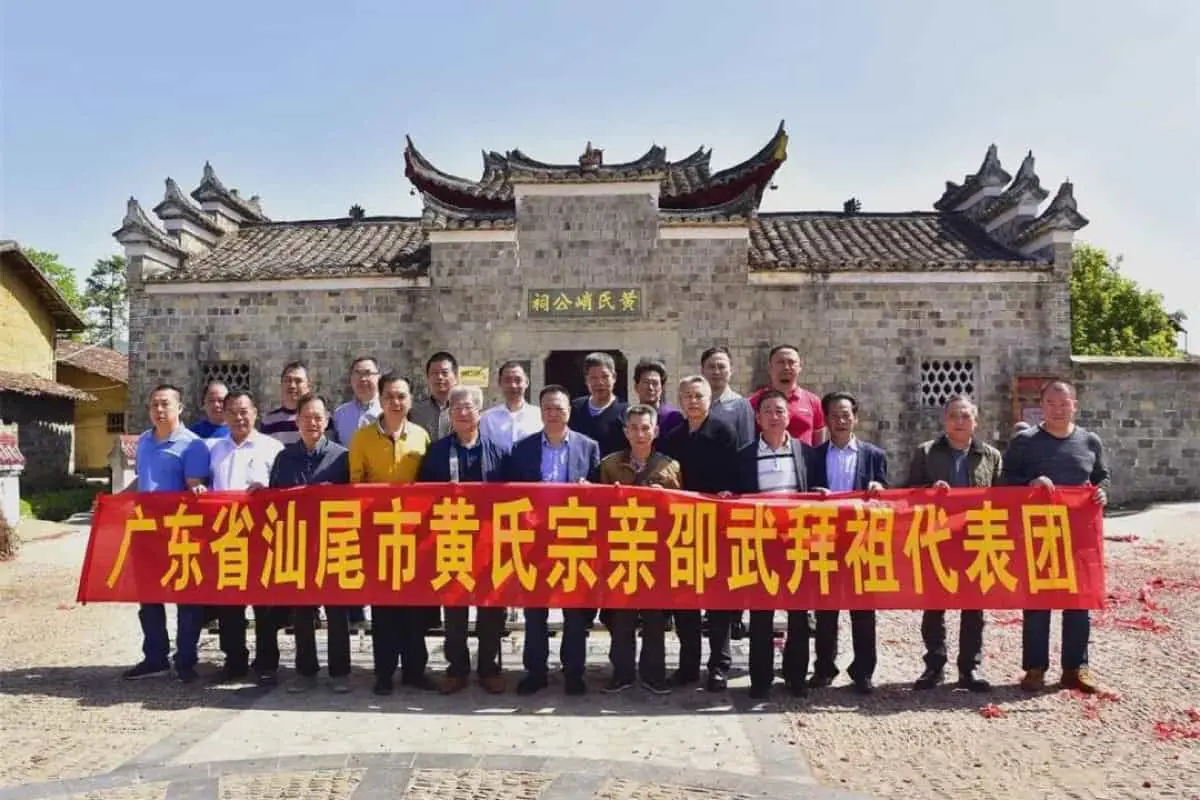
Huang Qiaoshan’s twenty-one sons rode out from a single courtyard in Fujian in 951 CE, each carrying a poem their father had written the night before. Today, their descendants fill Chinatown association halls from San Francisco to New York, from Vancouver to Lima, from Singapore to Sydney. The character 黄 appears on mailboxes in ninety-one countries. Taishan’s own statistics capture the duality: a local population of 930,000, and over 1,300,000 overseas — “half of Taishan is overseas” (台山一半在海外). The Huang surname has done exactly what Qiaoshan intended: it has multiplied.
The global network of Huang organizations is extensive. The World Huang Clan Association (世界黄氏宗亲总会), founded in 1980, serves as an umbrella body. Twenty-plus chapters across the United States and Canada face a generational transition — aging leadership passing to American-born descendants who may not speak Chinese. The associations still function, but their purpose has shifted from mutual aid and immigration assistance to cultural preservation, political advocacy, and professional networking.
The surname itself has fragmented across the diaspora’s many languages: Wong in Cantonese-speaking overseas communities, Hwang in Korean, Huynh or Hoàng in Vietnamese, Oei or Bong in Indonesian, Ng or Eng in Hokkien and Teochew. A Huang in San Francisco and a Wong in Vancouver may not immediately recognize each other as sharing the same 4,000-year-old character — but the clan infrastructure exists to make the connection.
Digital technology is transforming surname identity. Online genealogy platforms connect diaspora descendants who have never set foot in Taishan. DNA testing offers a new form of surname verification — genetic data shows Taishan Huang males with the O-F5498 Y-haplogroup at approximately twenty-five percent frequency. The Departure Poem circulates on WeChat groups alongside wedding announcements and business networking.
The question facing the Huang diaspora today is the question facing every diaspora: what does it mean to belong to a clan when you no longer speak the dialect, no longer know the village name, no longer recognize your generation in the poem? The answer may be that Huang identity was never primarily about language or geography. It was about a technology of collective memory — genealogies, generation poems, ancestral halls, and associational life — that could survive four thousand years and cross oceans. The kingdom fell. The poem survived. The associations rose. The character 黄, carved on an ancestral tablet in Henan in 648 BCE, still appears on mailboxes in ninety-one countries. What survives is not the kingdom or the poem alone, but the idea that a single character can contain it all.
Continue Reading
- Your Surname Is Your Compass: How to Trace Your Wuyi Roots — The foundational guide to surname-based genealogy research in the Wuyi region.
- The Lee Surname Odyssey: A Thousand Years from Longxi to the Wuyi Diaspora — The largest Chinese surname’s journey from ancient Longxi to Taishan and across the Pacific.
- Liu Surname: From Han Dynasty to Wuyi Diaspora — How an imperial surname became a transnational clan.
- Reading Qiaopi: What Wuyi Remittance Letters Reveal — The emotional and economic lifeline binding overseas Chinese to their ancestral villages.
Sources
Books
- 梅伟强、张国雄 主编. 《五邑华侨华人史》. 广东高等教育出版社, 2001.
- 梅伟强、关泽锋. 《广东台山华侨史》. 中国华侨出版社, 2010.
- 刘进. 《银信与五邑侨乡社会》. 广东人民出版社, 2011.
- 袁丁. 《跨国移民与近代广东侨乡》. 社会科学文献出版社, 2019.
- Hsu, Madeline Y. Dreaming of Gold, Dreaming of Home: Transnationalism and Migration Between the United States and South China, 1882–1943. Stanford University Press, 2000.
- 骆伟 主编. 《岭南姓氏族谱辑录》. 广东人民出版社, 2002.
- 黄氏宗亲总会 编. 《黄氏源流与文化》. Various, 2010s.
Government and Institutional Sources
- Taishan Municipal Government. “Huang Surname Origin, Culture, and American Associations.” cnts.gov.cn
- Taishan Municipal Government. “Taicheng Huang Ancestral Halls.” By Huang Jianyun, 2015. cnts.gov.cn
- PRC Foreign Ministry. “2021 Huang Clan Association of America National Day Flag-Raising Ceremony.” fmprc.gov.cn
- PRC Toronto Consulate. “Ontario Huang Jiangxia Yunshan Association 104th Anniversary.” toronto.china-consulate.gov.cn
- Jiangmen Municipal Government. “Huang Zhuocai Qiaopi Research Team.” jiangmen.gov.cn
- UNESCO. “Qiaopi and Yinxin Correspondence and Remittance Documents from Overseas Chinese.” Memory of the World Register, 2013.
Encyclopedia and Reference
- Baidu Baike. “Jiangxia Hall (江夏堂).” baike.baidu.com
- Baidu Baike. “Huang Surname Genealogy (黄姓家谱).” baike.baidu.com
- FamilySearch. “台山黃氏族譜 (2006) Catalog Record.” familysearch.org
Community and Media
- 75one.net Taishan Community Forum. “Huang Surname Comprehensive Article.” 75one.net
- Bilibili. “Famous Overseas Chinese Hometown — Taishan Surnames (Part 6).” bilibili.com
- Guangming Daily. “Huang Qiaogong Poem.” 2009. gmw.cn
- Huang Clan Research Site. “Qiaogong’s 21 Sons Distribution.” hxhshy.com
- Sohu. “Huang Overseas Chinese History and Distribution.” sohu.com
Suggested Reading
Is this your family’s story?
Roots Of China is built from readers’ family histories. If a story here sounds like your own — a surname, a village, a journey — leave a comment below, or share your family’s story with us and we may be able to help you find your ancestral village.

2 Comments
Vyvyen Wong
Hi Steven
Thank you for sharing this whole article. I just had a massive ‘a=ha’ moment reading this article you wrote about the Huang family name. I kept thinking why is this poem sound familiar! It is because it is the same poem left behind by a late aunt (11th generation as was my late father)! I am 12th generation, and we are from the New Guinea islands.
Steven
Hi Vyvyen, glad you find it useful!