


Angel Island Chinese Immigration: The Wooden House and the Carved Poems of the Excluded (1910–1940)
The Wooden House on the Pacific Gate
Between January 21, 1910, and October 1940, a wooded island in San Francisco Bay served as the Pacific gate of the Chinese Exclusion Act (排華法案, Pái Huá Fǎ’àn). Angel Island Chinese immigration was a system of papers, interrogations, and waiting: the station, chosen for its isolation, was designed to detain rather than welcome.
Roughly 500,000 immigrants from more than eighty countries passed through the station’s processing halls over three decades, some 175,000 of them Chinese. Chinese arrivals were the largest group ever held there, though exact totals and shares vary from source to source. Its heart was a two-story wooden barracks ringed in barbed wire: the wooden house (木屋, mùwū) — exclusion’s policy made into architecture.
Here is the turn. The men held inside wrote their case on the walls. Classical verse carved with knife blades, brushed in ink and charcoal into the wood — at least 135 poems collected in the 1980 edition of Island, more than 200 documented on the walls today. They wrote of grief, resentment, longing, and shame. They dated their poems like diary entries and signed almost none of them. In doing so they built the one archive the state never intended to exist: a record of exclusion kept by the excluded, in their own language, on the only paper they owned — the walls.
The story runs in both directions across the Pacific: why they left, what the law did, how they lived in the wooden house, what the walls still say, who waited at home, and how the archive finally came home — to the region that sent the poets.
Why They Left: Land, War, and the Gold Mountain Dream
The men who filled the Angel Island dockets came from a narrow band of the Pearl River Delta: the Four Counties, or Siyi (四邑, Sìyì) — Taishan (台山, Táishān), Kaiping (開平, Kāipíng), Xinhui (新會, Xīnhuì), and Enping (恩平, Ēnpíng) — whose emigrant heartland, together with Heshan (鶴山, Hèshān), is known as Wuyi (五邑, Wǔyì, the Five Counties). Before exclusion, roughly nine of every ten Chinese in the United States came from this region, the subject of the five counties of Guangdong and its diaspora.
They left because staying was becoming impossible. Land was scarce and worked by tenants. The Taiping Rebellion and the Punti–Hakka clan wars (土客械斗, tǔkè xièdòu) had burned through the countryside. Taxes pressed down, and the silk-and-tea handicrafts that had once paid them collapsed under foreign competition. Emigration was a survival strategy, not an adventure — driven, in AIISF’s summary, by famine, rebellion, and economic collapse.
What pulled them was the dream economy of the Gold Mountain (金山, jīnshān). America meant wages against village poverty: a laborer’s dollar could be a landlord’s fortune at home. Returned emigrants built grand houses and endowed schools; each new building advertised the dream. Chain migration followed village and clan lines — whole townships such as Duanfen (端芬) sent a majority of their adult men abroad, passage for the next relative financed by remittance letters (银信, yínxìn). Debt-financed passage under the credit-ticket system bound many a man to years of labor.
These men thought of themselves as 华侨 (huáqiáo) — overseas Chinese whose hearts stayed in the home village while their bodies worked abroad. That self-conception was lived, not performed — a real way of organizing a life, not stereotype evidence. The poems carved at Angel Island would record both the dream and its betrayal in the same breath.
The Law: 1882 and the Paper Regime
On May 6, 1882, Congress did something it had never done before: it restricted immigration by nationality and race. The Chinese Exclusion Act suspended the entry of Chinese laborers for ten years and barred Chinese residents from naturalization — the first federal law of its kind, and the seed of a Pacific-wide pattern.
The pattern hardened with each renewal. The Scott Act of 1888 refused re-entry to laborers who had gone home to visit; the Geary Act of 1892 extended exclusion a further decade and required every resident laborer to carry a certificate of residence on his person — the “dog tags” of the era — while denying Chinese defendants bail and habeas corpus. Exclusion was renewed in 1902, made indefinite in 1904, and extended to all “aliens ineligible for citizenship” by the Johnson-Reed Act of 1924. Only in December 1943 did the Magnuson Act repeal the exclusion acts, replacing them with an annual quota of 105.
Enforcement made identity a matter of paper. Merchants re-entering under Section 6 certificates, laborers under registration documents, every applicant photographed and filed: a Chinese person’s existence before the law became a stack of certificates and files — the bureaucratic artifact that would later make the paper-son system possible. The National Archives still holds these records — Chinese Exclusion Act case files: applications, photographs, hearing transcripts, court records.
The American model spread. Canada imposed its head tax in 1885 and its own exclusion act in 1923 — the parallel gate that Wuyi migrants faced on the northern route. Australia and South Africa followed, and the closed doors of the United States diverted Wuyi migration to Cuba, Mexico, and Peru: Angel Island was one node of a rim-wide regime, not an American anomaly.
Paper Sons: The Fire, the Coaching Books, and the Interrogation of Memory
In April 1906, an earthquake and fire destroyed most of San Francisco’s municipal records — including the birth and immigration documents on which citizenship claims rested. Almost overnight, native-born citizenship claims became virtually uncheckable.
Out of that gap grew the era’s signature mechanism: the paper son (紙兒子, zhǐ érzi; in Cantonese, 纸生仔). Chinese citizens who had lost their papers in the fire returned to China and reported children born abroad — real or invented — selling the identity “slots” to families who wanted to send sons or daughters to America. A young man from Taishan would arrive at Angel Island not as himself but as someone’s paper son, biography memorized.
Be precise about what this was: not the work of any institutional machine, but an individual, family, and village survival strategy — as the historian Estelle Lau frames it, both a weapon of the weak against an unjust law and a rational family calculation. The clan associations and brotherhoods served as legal-defense lifelines for detainees, but the paper system ran on family decisions, brokers, and coaching.
The curriculum was the coaching document (口供紙, kǒugòng zhǐ): a handwritten question-and-answer biography, usually in Taishanese dialect, that simulated an inspector’s interrogation. The earliest known specimen dates to 1902; the longest, at the Wuyi Overseas Chinese Museum (华博馆, Huábóguǎn) in Jiangmen, unrolls seven meters with more than eight hundred questions. These documents are Wuyi’s own material culture of exclusion — the home-region half of a two-sided archive.
The coached details read like a village inventory: ancestors’ names and their exact generations; a grandfather’s birthmark and which side of his face; the number of windows in the house and whether the walls were blue brick or grey; what the luggage contained; lunar-calendar dates for weddings and funerals; sums and ages written in Suzhou numerals (花码字, huāmǎ zì) so no slip of the pen betrayed him. The fear behind the memorization surfaces in the slang: one wrong answer meant the paper was exposed (爆紙, bào zhǐ), and the entry was denied.
The interrogation was an examination of memory. Boards of Special Inquiry asked hundreds of questions about neighbors, house orientation, funerals attended. Applicants and witnesses were questioned separately and their answers cross-checked. An inconsistency could mean deportation; interpreters mediated many hearings and shaped what the state heard. Men who passed did not shed their paper identities — they lived them, sometimes for the rest of their lives, and some children never learned their fathers’ true names.
That double life cast a long shadow. Between 1956 and 1965 the Confession Program, presented as amnesty but entangled with McCarthy-era investigations, pressed paper sons to expose themselves: by its end, Lau’s research records, 13,895 people had confessed, exposing 22,083 others and closing 11,294 paper-son slots. The paper world was dismantled — and the families that had built it were told to forget.

The Journey and the Wooden House
The route ran along one pipeline. From the villages of the Siyi, men walked to the county ports — Haikoubu (海口埠), Guanghai (广海) — or took riverboats to Guangzhou and Hong Kong, the hidden ports of Wuyi emigration. There they boarded Pacific Mail steamers, and after eighteen to twenty days at sea the ship entered San Francisco Bay and angled toward the island’s wharf.
Processing divided passengers by class and race. European and first-class travelers were examined aboard ship and allowed to land; Asian steerage passengers — the great majority of them Chinese — were ferried to the island for medical inspection and interrogation. Only those who passed received a bunk.
The bunk was in the wooden house. The detention barracks held roughly two to three hundred men and thirty to fifty women at a time, behind barbed wire, barred windows, and locked doors. The latrines were open and public. Guards were armed. Food was described as barely edible — about eight cents’ worth a day. Medical exams tested blood and stool for parasites, with body inspections designed to humiliate as much as to examine. The wooden house was a cage, the walls would say in so many words.
Time was the second cage. Chinese detainees typically waited two weeks to six months for their cases; many waited far longer, some for years. A paper son might be held while inspectors wrote to his alleged father, to the village, to anyone who could confirm the coached story.
The women held there bore a separate weight. The few Chinese women detainees — paper wives claiming merchant husbands, merchant wives in their own right — faced suspicion of prostitution as a matter of course, invasive examinations, and separation from their children. Their quarters were in the administration building, which burned in August 1940 as the station was closing; that is why no women’s poems survive on the walls. One documented story, from the historian Robert Barde’s research, tells of Quok Shee (郭雪), a twenty-year-old woman held nearly two years — neither charged nor admitted, alone in a barracks with almost no one who spoke her dialect. One testimony, not a pattern — but the kind of story the male-authored poems cannot tell.

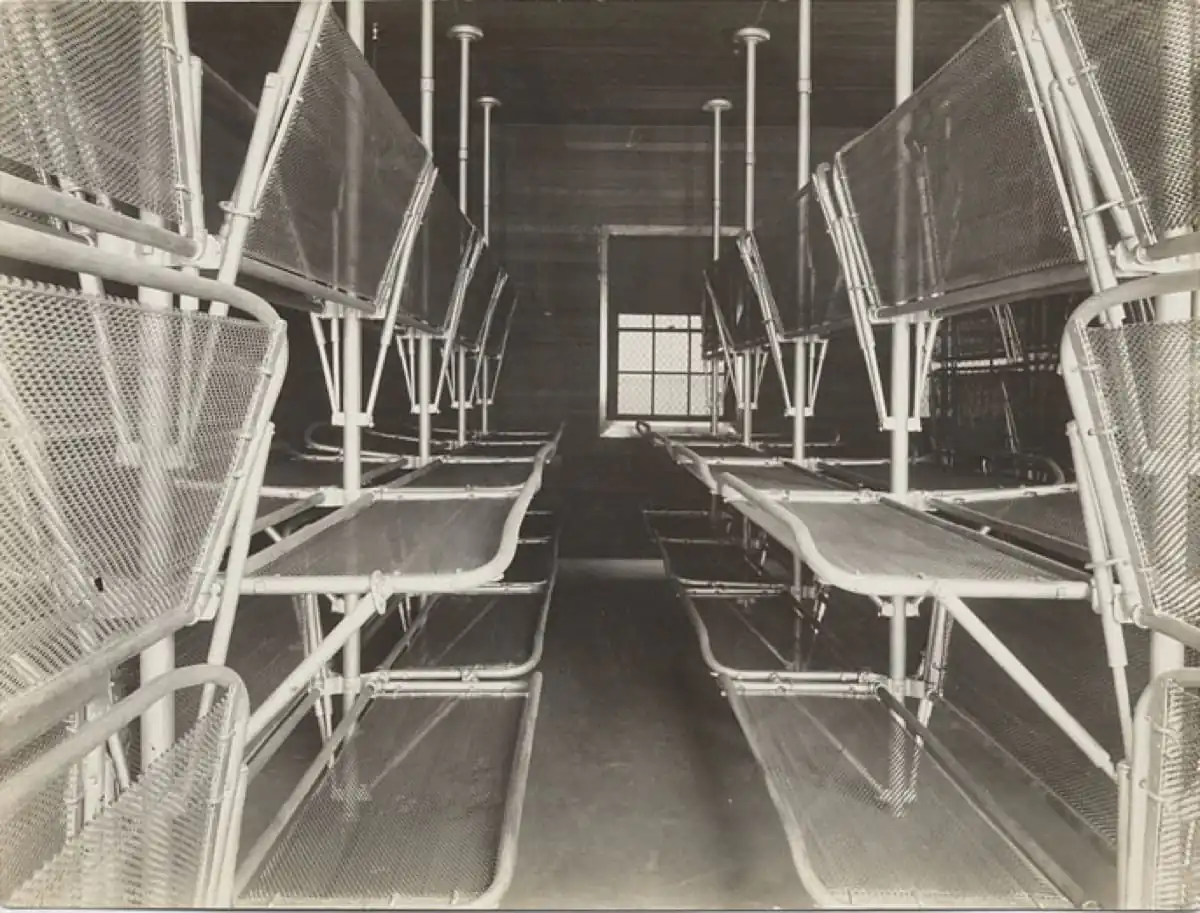
The Poems: An Archive Carved in Wood
The walls of the men’s barracks are a manuscript. Over three decades, detainees carved poems with knife blades and brushed them in ink and charcoal, layering one over another until maintenance crews painted the accumulation grey. Under the paint, the layers survived. Chinese poems are the most numerous of the wall’s languages. At least 135 were collected in the 1980 edition of Island: Poetry and History of Chinese Immigrants on Angel Island; 154 are recorded and translated today in the Angel Island Immigration Station Foundation’s Poetry Finder; more than 200 have been documented on the walls. No single census is authoritative; dozens more lie under the paint.
The poets were village-schooled working men, almost all Cantonese-speaking, with Taishan heavily represented. Few signed their names, likely fearing retribution. The craft is uneven: some poems are polished, some rough — both poles are real, and neither should be romanticized. The forms are classical: about half are seven-character quatrains (七絕, qījué), a fifth regulated verse (七律, qīlǜ), the rest mixed-length lines — plus one long parallel-prose piece, the “Account of Imprisonment in the Wooden House” (木屋拘囚序, Mùwū Jūqiú Xù), which was smuggled out and published in a San Francisco Chinese newspaper on March 16, 1910.
Themes recur: homesickness, broken dreams, national pride, pain and despair, daily life, historical allusion. The poems’ own vocabulary supplies the emotional register: grief (愁, chóu), resentment (恨, hèn), longing (思, sī), shame (恥, chǐ).
Here is the most-quoted carving, Poem #69, as it stands on the wall and in AIISF’s official translation:
木屋拘留几十天,所因墨例致牵连。可惜英雄无用武,只听音来策祖鞭。从今远别此楼中,各位乡君众欢同。莫道其间皆西式,设成玉砌变如笼。
“Detained in this wooden house for several tens of days, / It is all because of the Mexican exclusion law which implicates me. / It’s a pity heroes have no way of exercising their prowess. / I can only await the word so that I can snap Zu’s whip. / From now on, I am departing far from this building / All of my fellow villagers are rejoicing with me. / Don’t say that everything within is Western styled. / Even if it is built of jade, it has turned into a cage.” — translation by AIISF
One word in the second line divides the poem’s readers: AIISF reads 墨例 as the Mexican exclusion law; many Chinese readers read the same characters as “the iniquitous law,” the ink-dark decree. Both readings fit the poem and its century — the ambiguity is part of the record.

The prose account of 1910 is starker. From the 木屋拘囚序, sent out of the barracks to a San Francisco newspaper:
嗚呼!白種強權,黃魂受慘。叱喪家之狗,強入牢籠;追入笠之豚,嚴加鎖鑰。魂消雪窖,真牛馬之不如;淚灑冰天,洵禽鳥之不若也……
清晨盥洗,盡是鹹潮;終日飲滋,無非濁水。
Working gloss, not a literary translation: “Alas — the white race holds power and yellow souls suffer. Driven like stray dogs, forced into cages; pursued like penned hogs, put under lock and key. Spirits dissolve in snow-cold pits, treated worse than oxen and horses; tears fall on frozen ground, less regarded than birds… At dawn, washing is done in salt tide; all day, what one drinks is nothing but turbid water.”
Some carvings are letters home: the closing sections of many poems are “messages to the home village” (寄语梓里, jìyǔ zǐlǐ), following the greeting-and-blessing conventions of the remittance letter (銀信, yínxìn) — the poetic twin of the cash-and-letter packets that flowed the other way across the ocean. A poem and an envelope, written in the same register, carrying the same deferred hope in two directions.
Other carvings carry the national dimension. The theme of 圖強雪恥 (túqiáng xuěchǐ — “strive to strengthen, wipe out shame”) connects personal humiliation to national disgrace: in the late-Qing imagination, the man caged on Angel Island was the symbol of a China too weak to protect its sons. Individual grief became public indictment.
Despair is on the walls too, and it should be named without decoration. Some poems wish for death. The documented case of Fong Fook (方福), a thirty-two-year-old who hanged himself days into his detention in October 1919, is recorded in Erika Lee and Judy Yung’s history of the station; inspectors testified to suicides they had witnessed in 1931 and 1936; detainees’ oral histories carry recurring rumors of men who took their own lives, like the account of 谭马林, held as a boy of twelve. No official tally survives — only recorded cases and the stories men told each other. The despair sat there, in the grey light, under the barbed wire.
The defiance survived too. The last word of the carved archive belongs to the poem that counted its own kind — the wall’s self-portrait, 壁上題詩過百篇:
壁上题诗过百篇,看来皆是叹迍邅。愁人曷向愁人诉,蹇客偏思蹇客怜。得失岂知原有命,富贫谁谓不由天。此间困处何须怨,自由英雄每厄先。
Working gloss, not a literary translation — published English renderings appear in Island (1980/2014) and in Charles Egan’s Voices of Angel Island (2021): “Over a hundred poems stand on the wall, every one a sigh over hardship. The sorrowful tell their sorrow to the sorrowful; the stranded ask pity of the stranded. Gain and loss — who says they are not fated? Wealth and poverty — who says heaven has no hand? Why complain of this place of confinement? Even heroes, it seems, meet hardship first.”
The men who wrote that knew exactly what they were building: an archive, laid down in wood, addressed to whoever came after.
The Home Front: Gold Mountain Wives and the Letters That Answered
The poems were half of a conversation. The other half was written — and waited — at home.
The women left behind were known as Gold Mountain wives (金山婆, jīnshān pó): married before departure, sometimes by proxy, then left to run the household, the land, and the lineage duties alone for decades. Some never saw their husbands again. Their story is told in full in the gold-mountain wives who waited.
Their documentary record is the remittance letter (銀信/僑批, yínxìn/qiáopī) — cash and a few lines of message delivered together by couriers (巡城馬, xúnchéngmǎ, “town-circling horses”) who rode the village routes with money and news. The form was fixed: a short greeting, a blessing, the sum enclosed. The same sentences recurred in thousands of envelopes — all is well at home; the children study; when will you come home — money folded inside for school fees and rice. The qiaopi archive is registered in UNESCO’s Memory of the World — the exact counterpart of the interrogation transcripts filed in Seattle: the Taishan villages kept the one side, the United States government the other, and each side is illegible without the other.
The villages ran on this money. Qiaoxiang — “overseas-Chinese villages” — imported grain and goods paid for by remittances; when war cut the flow in the 1940s, famine followed. The same wealth built the watchtowers and mansions of the region: the 洋樓 (yánglóu) and diaolou that still stand, the schools, and the Sunning Railway built with remittance capital. The visible qiaoxiang of the sending region is the other face of the wooden house.
The human cost was measured in missing generations. Children were raised by mothers and grandparents and met their fathers decades later — or learned of a death by letter, or by a returned trunk. The 金山婆’s lament, sung in Taishan folk songs, and the carved complaint in the barracks speak one emotional language: longing, duty, deferred hope. Two halves of a single economy of separation, one archived in a museum in San Francisco Bay, the other kept in village chests — and only now, a century on, being read together.
Rediscovery: The Walls That Would Not Be Demolished
In 1970, the barracks were scheduled for demolition. A California State Park ranger, Alexander Weiss (亞歷山大·威斯), walked through the condemned building and found, under decades of grey paint, the carved characters — lines and lines of them, layered like sediment. He reached out to San Francisco’s Asian American community, and the community answered.
What followed was a campaign that saved the ruin and turned it into a monument. In 1971 the barracks became a California Historical Landmark and were listed on the National Register. In 1974 an advisory committee formed. In 1976 the state legislature appropriated $250,000 to restore the detention barracks. In 1979 a six-thousand-pound granite monument was installed at the island’s shore, its inscription reading 別井離鄉飄流拘木屋,開天闢地創業在金門 — “leaving home and village to drift in the wooden house; founding a new world in the Golden Gate.”
In 1980, after years of transcribing, translating, and interviewing, the scholars Him Mark Lai, Genny Lim, and Judy Yung published Island: Poetry and History of Chinese Immigrants on Angel Island, 1910–1940. It won the American Book Award in 1982 and became a founding text of Asian American letters — the Pacific counterpart of Ellis Island in poetry and history. The barracks’ first floor opened as a museum in 1983, with the Immigration Station Foundation (later AIISF) as steward; in 1997 the station became a National Historic Landmark, and a $1 million Save America’s Treasures grant in 2001 funded preservation of the poetry itself. After a $15 million restoration, the barracks reopened in February 2009; the centennial year 2010 brought a presidential proclamation of National Angel Island Day; in 2022 the Angel Island Immigration Museum opened in the restored hospital.
The political recognition arrived late and unanimously: the United States Senate apologized for the exclusion acts in October 2011, the House of Representatives in June 2012 — without a single dissenting vote. The apologies did not rewrite the past; they acknowledged the archive of exclusion had been an injustice — and that the excluded had kept their own.
Then the archive came home. In 2018/2019, a Chinese edition of Island appeared — 枕底無花夢不香 (zhěndǐ wúhuā mèng bù xiāng, “without a flower beneath the pillow, dreams carry no fragrance,” a line from the poems) — translated by 榮立宇 and published in Hangzhou. It carries the five sections of the poems — 遠涉重洋 (“journeying across the vast ocean”), 羈禁木屋 (“detained in the wooden house”), 圖強雪恥, 折磨時日 (“tormenting days”), 寄語梓里 — the 木屋拘囚序, poems from Ellis Island and Victoria, and about seventeen to twenty named oral histories drawn from the thirty-nine former detainees interviewed in the 1970s. The book that began as an American literary landmark returned to the region that sent the poets, beside the UNESCO-recognized qiaopi collections and the museums of Wuyi — both ends of the route inside one book.
The oral histories give the anonymous walls names. 朱麗琼 (Chu Lai-king) was detained at about age seven in 1933 with her mother and sisters; under exclusion, her mother had entered as her father’s “sister,” and the daughters were taught to call her “aunt” — the family of four was interrogated separately, every day, and passed. She remembered the experience as darkness and terror. 方文忠 (Paul Fong), later a California assemblymember, whose grandfather was held about two months and kept the pain hidden for decades. Behind the hundred-plus poems stand these specific lives — and, in the community campaigns against exclusion, the long tradition of resistance that the rediscovery continued.

Coda: Walking Into the Archive
The wooden house is still there. A ferry leaves San Francisco for Angel Island, and visitors walk into the restored barracks and stand before the carved walls — poems in wood under glass, some still legible a century on. The Immigrant Heritage Wall outside carries the names of families who passed through. What was built to be forgotten is now a place one visits on purpose.
For descendants, the file exists. The National Archives holds the Chinese Exclusion Act case files — applications, certificates, hearing transcripts, photographs — in Seattle, San Francisco, and San Bruno. AIISF’s Immigrant Voices project collects the oral histories. The two-sided archive is complete: a family’s 口供紙 or 銀信 in a drawer in Taishan, and the man’s case file in a box in Seattle. Put them together, and the man on the page gains his village; the village in the letter gains its man. How to find your ancestral village is where that search begins.
The men who carved the walls had no courtroom, no lawyer, no status before the law that held them. They wrote their case anyway — in classical verse, in their own dialect’s handwriting, on the walls of the prison itself. The state’s records called them numbers and cases and deportable aliens. The walls called them poets.
Under the glass, on the wood that outlived the law, the poem that counted its own kind: over a hundred verses on the wall, each one a sigh at hardship. The sorrowful spoke to the sorrowful; the stranded asked pity of the stranded. A visitor’s hand rests at the glass, and the wall still holds its words.
Continue Reading
- The Chinese Head Tax: How Canada Charged Wuyi Migrants
- Reading Qiaopi: What Remittance Letters Reveal About Wuyi Families
- The Five Counties of Guangdong: A Cultural and Historical Overview
- How to Find Your Chinese Ancestral Village: A Practitioner’s Guide
Stay Connected
Follow RootsOfChina on Facebook and Instagram for new article updates and stories from the Chinese diaspora.
Sources
- Angel Island Immigration Station Foundation — station history, preservation timeline, and the poems.
- AIISF — The Poems of Angel Island — 154 recorded and translated wall poems and their translations.
- AIISF Immigrant Voices — oral histories of former Angel Island detainees.
- National Archives, Seattle — Chinese Exclusion Act case files (Record Group 85) — entry and re-entry applications, photographs, and hearing transcripts.
Books: Lai, Him Mark, Genny Lim, and Judy Yung, Island: Poetry and History of Chinese Immigrants on Angel Island, 1910–1940 (University of Washington Press, 1980; 2nd ed. 2014); Charles Egan, Voices of Angel Island: Inscriptions and Immigrant Poetry, 1910–1945 (Bloomsbury Academic, 2021); Erika Lee and Judy Yung, Angel Island: Immigrant Gateway to America (Oxford University Press, 2010); Estelle T. Lau, Paper Families: Identity, Immigration Administration, and Chinese Exclusion (Duke University Press, 2006). Chinese-language scholarship: 梅伟强、张国雄《五邑华侨华人史》(广东高等教育出版社, 2001); 刘进《银信与五邑侨乡社会》(广东人民出版社, 2011); 麦礼谦、林小琴、杨碧芳 编著,荣立宇 译《枕底无花梦不香:天使岛中国移民的诗歌与历史》(浙江文艺出版社, 2018/2019).
Suggested Reading
Is this your family’s story?
Roots Of China is built from readers’ family histories. If a story here sounds like your own — a surname, a village, a journey — leave a comment below, or share your family’s story with us and we may be able to help you find your ancestral village.
