


The Tang (唐) Surname: From the Sage Emperor Yao to the Wuyi Diaspora
The Sage Emperor and the Multi-Origin Name
The Tang (唐, Táng) surname traces its origins to the sage emperor Yao and the ancient State of Tang — a name carried from the legendary dawn of Chinese history through the archaeology of the Zhou state in Shanxi, down the Zhuji Lane migration corridor into Guangdong’s Wuyi hills, and across the Pacific and Indian Oceans by the emigrants of the Gold Mountain era — so that today the character 唐 is at once a surname, the name of a lost ancient state, and the name of the dynasty that gave China its name to the world.
The oldest origin thread runs to 陶唐氏 (Táotáng shì, the Taotang clan) of the legendary sage emperor 尧 (Yáo). The chronicles say Yao was enfeoffed at Tang — 唐县 (Tángxiàn) in present-day Hebei — and so he is remembered as 唐尧 (Táng Yáo, “Yao of Tang”), with his clan taking the name 陶唐氏. This is the origin tradition the surname claims for itself — legend carried as legend, not settled history. The 《新唐书》 (Xīn Tángshū, New Book of Tang) opens its table of chancellors’ lineages with “唐氏出自祁姓” — “the Tang surname comes from the Qi line” — the closest an origin story of this kind comes to official documentation.
The founding thread of the surname is a state. Around the eleventh century BCE, 周成王 (Zhōu Chéngwáng, King Cheng of Zhou) enfeoffed his younger brother 叔虞 (Shū Yú, Shu Yu) in the state of 唐, in the Fen River valley of southern Shanxi. Under Shu Yu’s son 燮 (Xiè), the state was renamed 晋 (Jìn, Jin) — giving the Tang surname its double association: a Tang descendant of the Shanxi line is, in genealogical terms, kin to the history of the State of Jin, the same double life the Cao surname carries from its own Zhou-era state. And there is a dated adoption event: a second state of Tang, held by the 刘累 (Liú Lěi) branch of Yao’s line in present-day Henan and Hubei, was destroyed by Chu in 505 BCE; the surviving clansmen took the fallen state’s name as their own — the event that ties the Tang surname to the Liu surname in shared descent: kinship claimed, not dominance asserted.
The structure is deliberately multiple. Every branch’s origin claim is a choice among competing traditions; surname dictionaries add later incorporations — non-Han peoples who took the name in later centuries — less well documented. And there is the genre caveat of this series: genealogies commonly claim famous descent, which is why checking claims against official histories keeps the record honest.
The name’s third life is the one most readers already know: 唐朝 (Tángcháo, the Tang dynasty, 618–907) carried the same character — and China’s name — to the world. Tang genealogies invoke that resonance as pride — clan self-understanding, not a claim of imperial descent — a story distinct from the dynasty’s own, told in Cultural Crossroads: The Cosmopolitan Splendor of Tang Dynasty Chang’an. Nationally the surname ranks about 25th, with estimates ranging from roughly eight to more than ten million people depending on the count — sources disagree on the total. The surname tradition attaches 郡望 (jùnwàng, commandery identities) — 晋阳 (Jìnyáng, the old name of Taiyuan), 晋昌 (Jìnchāng), 北海 (Běihǎi), 鲁国 (Lǔguó) — and the 堂号 (tánghào, hall name) 禅让堂 (Shànràng táng), “the Hall of the Throne’s Abdication,” after Yao’s legendary surrender of power. The Jinyang identity claims the Taotang homeland was the Taiyuan plain — a reading from a classical commentary by 杜预 (Dù Yù), a text-based claim, not an excavated one.
A name with this pedigree — a sage emperor, a bronze-age state, a dynasty — arrives in the Wuyi hills, and the record there is very quiet. That contrast is the subject of this article.
The State Under the Ground: Tianma-Qucun, the Quwo Bronzes, and the Shrine at Jin Ci
Most surname origin stories end at the edge of the genealogical register. This one has a material anchor. 天马-曲村 (Tiānmǎ-Qūcūn, Tianma-Qucun), on the Quwo–Yicheng border in southern Shanxi, was identified as the early capital of Jin; discovered in 1962 and excavated from 1979 to 1994 by Shanxi archaeologists and Peking University teams, it put the state that inherited Tang’s name into the ground record.
The excavation’s signature find is the 晋侯墓地 (Jìnhóu mùdì, the Quwo Marquis-of-Jin cemetery): nine groups of tombs, nineteen elite burials, whose bronze inscriptions name five Jin marquises — including 燮父 (Xiè Fù), the ruler who moved the state from Tang to Jin, his tomb excavated in 2020. The bronze names are the state’s self-archaeology: rulers naming themselves on ritual vessels, dug up in our own time.

The readings require care. A rectangular bronze vessel called the 叔夨方鼎 (Shū Zhe fāng dǐng), found with the Xie tomb group, carries an inscription some scholars read as naming 唐叔虞 — the first bronze mention of the founding ancestor. The identification is debated. And 邹衡 (Zōu Héng), the archaeologist who led the northern cemetery excavations, proposed tomb M6081 as Shu Yu’s own tomb; this remains a hypothesis. Shu Yu’s tomb has not been found, and the original location of the state of Tang is itself an open archaeological question. What the ground confirms is the state of Jin and its rulers — no more, and no less. The excavation record is held by the National Cultural Heritage Administration, which lists the Marquis-of-Jin cemetery and the Tianma-Qucun site among China’s key archaeological sites.
The shrine end of the arc is living and visitable. 晋祠 (Jìn Cí, Jin Ci) outside 太原 (Tàiyuán, Taiyuan) was originally called 唐叔虞祠 (Táng Shūyú Cí) — the shrine raised to Shu Yu at the source of the Jinshui, twenty-five kilometers southwest of the city. A first-batch National Key Cultural Relic since 1961 and a national AAAA scenic area since 2011, it holds more than a hundred buildings spanning the Song through Qing dynasties. It is securely a ritual shrine — the surname’s Shanxi pilgrimage site; the disputed tomb-marker traditions of later centuries are kept out of this account. The complex is documented on Wikipedia’s entry for Jinci.

The boundary matters as much as the anchor: the archaeology confirms the historicity of the state and its rulers; it does not confirm the sage-emperor Yao layer, nor any genealogical descent claim. That distinction — between what a bronze inscription proves and what a family tree claims — is exactly the literacy How to Read a Chinese Zupu teaches, and this article wears it lightly.
Zhuji Lane and the Road South
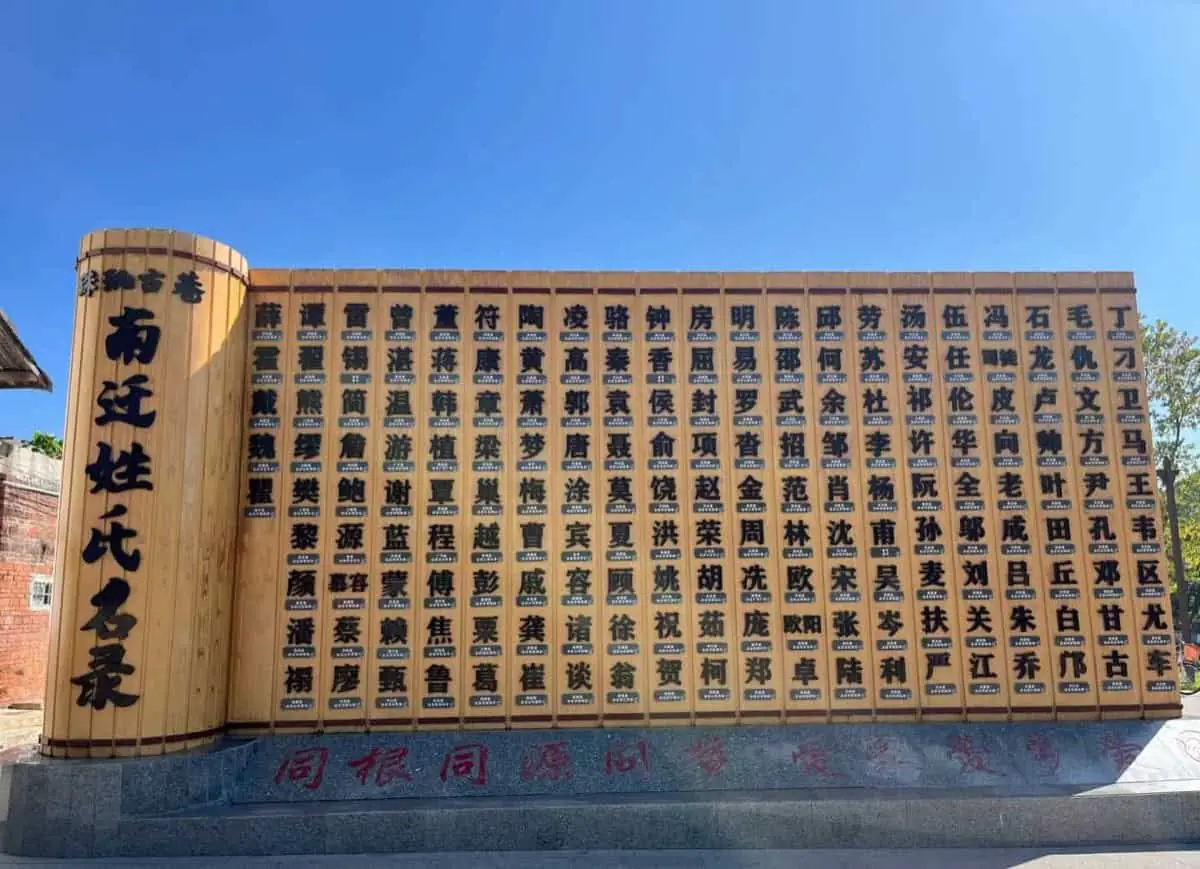
For most Cantonese families, the road south begins at 珠玑巷 (Zhūjī Xiàng, Zhuji Lane) in 南雄 (Nánxióng, Nanxiong), northeast of the county seat at the foot of the 大庾岭 (Dàyǔ Lǐng, Dayu Ridge). For more than 1,300 years the lane was the famous transfer station for Central Plains clans moving into Lingnan; the corridor counts more than 180 surnames transmitted through it, with descendants in the tens of millions across 28 cities and counties — the five counties of Guangdong among them.
The corridor is carried here in two registers, and both are kept. The legend — 珠玑人南迁传说 (Zhūjī rén nánqiān chuánshuō), the tale of imperial persecution, a consort’s flight, and the dispersal of surname clans southward — is recognized as intangible cultural heritage (reported at the national level in 2021; provincial sources also cite 2022), and it is presented as collective memory and contested history, never as settled migration fact. The story’s power is precisely that it is the founding memory of Pearl River Delta families; that is the fact worth stating. The documentary register is thinner but real: 《新会县乡土志·氏族》 (Xīnhuì Xiàn Xiāngtǔzhì · Shìzú), the lineage chapter of Xinhui’s local gazetteer, explicitly lists 唐 among Xinhui’s Zhuji Lane descendant clans — the only Wuyi-county documentary confirmation this research found, as documented in research published by the Qing History Institute at Renmin University of China. It records a claim, not necessarily a verifiable route; and Tang is absent from the Zhuji Lane anthology’s Taishan ten-clan list — selective, not exhaustive.
The corridor’s one documented Tang instance sits just outside the five counties, and the geography is flagged as such. A Zhuhai Tang genealogy reports 唐居俊 (Táng Jūjùn) moving from Shixing’s Zhuji Lane to 香山 (Xiāngshān, today’s 唐家湾/Tángjiāwān, Zhuhai) in 1206, during the Southern Song. It is genealogical memory, sourced from a single zupu, its destination Zhuhai — Guangdong-adjacent, not Wuyi — used here as the corridor’s documented Tang example, never the Wuyi anchor. Even the lane’s name carries the character’s double life: it was originally called 敬宗巷 (Jìngzōng Xiàng) and was renamed for an act of filial piety in the Tang dynasty era — dynasty, not surname, kept distinct. The corridor’s downstream machinery — the credit-and-passage system that later moved so many Wuyi men abroad — is the subject of Why So Many Taishanese Families Ended Up Overseas.
Wuyi Settlement: The Tang Surname, County by County
In the Song–Ming centuries, clans moved from the delta rim into the hills of the 五邑 (Wǔyì, the Five Counties) — 新会 (Xīnhuì), 台山 (Táishān), 开平 (Kāipíng), 恩平 (Ēnpíng), 鹤山 (Hèshān) — settling county by county, hill by hill. For the Tang surname, the settlement is general at best, thin at the surname level: Xinhui has its gazetteer thread; for the other counties, the pattern is regional — Tang families moved as their neighbors did. The environmental push is the economic backdrop to every family decision for generations: mountainous terrain, poor soil, drought, land pressing harder against population.
Here the article makes its honesty move, stated with precision. One Taishan surname compilation ranks Tang around 52nd of 156 surnames — indicative, not official census data. The Taishan county government’s surname series has no Tang entry; the series is not exhaustive. In Kaiping, Tang does not appear among the top ten in one local gazetteer post on the county’s 292 surnames — and absence from a top-ten list is not absence. A Taishan village named 唐美村 (Tángměi cūn) sounds as though it should be a Tang village; nothing in the checked record confirms it, so nothing is asserted. The written record is thin — that is the finding, and the thinness is part of this surname’s story rather than a flaw in it.
The lineage’s internal code exists, though not in Wuyi’s record. 字辈 (zìbèi) generation names — poems whose characters are assigned to each generation in turn, a transnational identifier that lets two strangers on different continents establish kinship in minutes — are documented for Tang branches in Hunan, Sichuan, and Chongqing, but no Wuyi Tang poem verifies, so the system is described here without quoting one.
The pivot line of the article: the name that crowned an empire is, in these hills, a smaller voice in a chorus of Huang, Chen, and Li. The contrast is not an embarrassment — it is the truest thing the record tells us, and it sits beside the scale story of The Wong Surname, whose noble origins carried a very different Wuyi weight. For readers starting their own search, the Surname Compass is the place to begin.

Gold Mountain: Waves, Corridors, and the Demographic Inversion
The classic periodization of Wuyi emigration runs from the post-Opium War decades: the 1850s gold rushes, the railroad labor of the 1870s and 1880s, the pre-First World War peak, the exclusion era, the post-1978 reconnection. For the Wuyi as a whole, the arc ran Southeast Asia first, North America after the gold rushes — Taishan branches leaned North America; Xinhui and Enping branches leaned Southeast Asia. Documented county routes existed — Enping to Cuba, Kaiping to Malaysia — but those are county patterns, and no Tang family’s use of any route is on record. (Cuba appears here as a destination node only.)
The mechanism that moved people along these routes is documented for other surnames, and the distinction is kept explicit. The Taishan library’s history of early emigration records surname corridors: the 梅 (Méi) clan of Duanfen to Chicago and New York, the 马 (Mǎ) clan of Baisha to Canada, the 陈 (Chén) clan of Liucun to Seattle — “one village, one surname,” clans settling together abroad, the chain pulling the next generation to the same address. The model is real; the Tang instance is not verified. This is the honest way to describe how a Wuyi Tang village, had it sent sons, would have traveled — through the same machinery that moved men past the hidden ports of the Wuyi coast and, decades later, poured remittance capital into projects like the Sunning Railway.
The occupational niches in the American West were the surname-generic ones: railroad labor, mining, laundries, restaurants, domestic service. And over it all hung the myth of 金山 (Jīnshān, Gold Mountain) — the golden dream that drew men across an ocean — and its documented underside: the sojourner (金山客, Jīnshān kè) dreaming of gold and dreaming of home in the same breath, a man’s letters measuring the distance between the two. Remittances flowed back to rebuild halls and villages, and the qiaoxiang — the emigrant homeland — inverted demographically, a process that left the villages transformed in ways the next sections follow.

Exclusion, Paper Sons, and the Wider Map
The Chinese Exclusion Act of 1882 shut the door the gold rushes had opened. For sixty-one years, until 1943, a working-class Chinese man could not legally bring his wife or children to America; the 1924 Act tightened the bars further, and the bachelor societies of Chinatown were the human result. But exclusion created the very commodity it meant to destroy: the paper son.
纸儿子 (zhǐ érzǐ, “paper sons”) were the identity-slot economy of the exclusion era, brokered within surname and village networks. A slot — a dead man’s name, or a fabricated one, on a citizenship roster — was bought; a village biography was rehearsed: the well, the lane, the neighbor’s name, the number of steps from the ancestral hall to the house. Immigration officials asked these questions to trip the unprepared; the prepared answered from a script. A man who had never seen Taishan could recite it from a notebook. This is documented practice from the Wuyi record — no Tang-specific paper-son file exists, and none is invented here; the practice is the surname-generic machinery of the era, the same machinery that kept the clans and brotherhoods of the diaspora alive.
The paradox is structural: exclusion intensified the very networks it meant to break. Men rerouted through Canada, Mexico, and Cuba, and toward Southeast Asia; 香港 (Xiānggǎng, Hong Kong) became the staging ground where identity was bought, borrowed, and rehearsed. The paper families created fictive kinship — a man whose “father” he had never met, whose village he had memorized — and fictive kinship became real transnational obligation: remittances sent, funerals attended, children raised for the dead man’s name. It is presented here with its source-critical flag: genealogies corrupted by paper-son fraud must be cross-checked against immigration files. It is never moralized, and never romanticized.
And it raises the question this surname cannot avoid. A paper son carrying 唐 into America is carrying the name without the bloodline. What does a surname mean when it is borrowed? The question echoes in the closing section, where the name’s modern revival answers it in its own way.
Yinxin: Money Plus Message — the Ledger of the Split Family
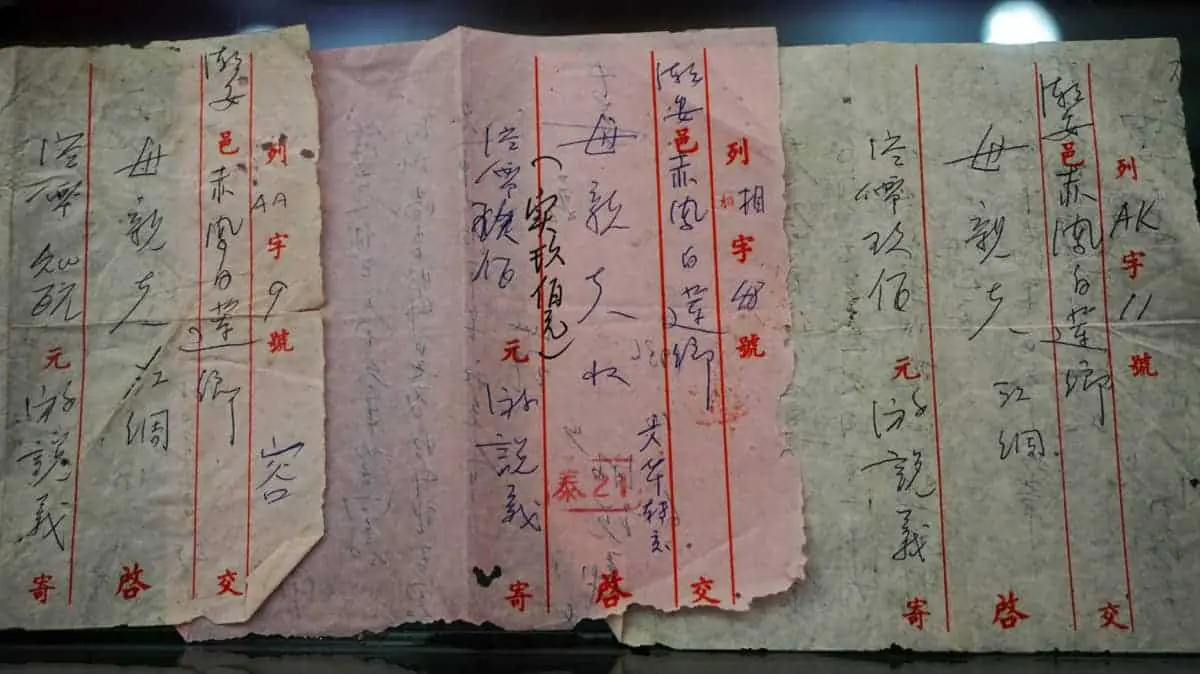
The truest archive of the split family is the envelope. 银信 (yínxìn, “silver letter”) — 侨批 (qiáopī) in the wider Cantonese usage — was a money order and a family letter in one: remittance houses called 批局 (pījú) and 银号 (yínhào) moved them through Hong Kong and Guangzhou, couriers (水客, shuǐkè) carried them to village doors on foot, the letter itself the receipt proving the sender still lived. Money plus message: the message justified the money, and the money made the message legible across an ocean. The system is surveyed in Wikipedia’s overview of qiaopi, the remittance letters of the overseas Chinese.
The emotional economy inside the envelope is remarkably consistent across decades. Longing, guilt over absence, filial obligation — absent fathers known through paper, their instructions arriving with the cash: budgets for the household, schooling decisions for children they had not seen in years, exhortations to honor the ancestors (拜山, bàishān — grave-sweeping at Qingming — is the ritual register of this absence, the subject of Qingming: A Journey Through Time and Memory). The letters were family governance from abroad — 一家两地 (yī jiā liǎng dì, “one family, two places”) — with household economies pooling remittances from sons in different countries. The cycles ran boom, collapse, rupture; the Pacific War severed the lifeline outright.
The infrastructure of this memory is now public and visitable. In 2013 the 侨批 archives were inscribed on the UNESCO Memory of the World register. The 台山银信博物馆 (Táishān yínxìn bówùguǎn, Taishan Yinxin Museum), a thematic museum within the 五邑华侨华人博物馆 (Wǔyì Huáqiáo Huárén Bówùguǎn, the Wuyi Overseas Chinese Museum) in Jiangmen, displays more than a thousand letters; the yinxin plaza’s twenty pillars and 648 porcelain tiles carry letter excerpts into the open air; 海口埠 (Hǎikǒu bù) is remembered as the first port of departure for Cantonese emigrants.
And here the article states its most important honesty: no Tang-family letter has been found in the accessible indexes. The Wuyi yinxin multimedia database exists, but it is not surname-searchable online. What survives in the public record is the genre — and the reader’s own family letters may be among the unindexed. No invented Tang letter is offered in its place. That gap is stated, because a descendant searching for a Tang letter deserves to know where the search actually stands.
Jinshanpo: The Women Who Held the Villages
The demographic inversion of the qiaoxiang had a female face. 金山婆 (Jīnshānpó, “Gold Mountain wives”) — the structure of 男侨女眷 (nán qiáo nǚ juàn, men overseas, women at home) — ran the emigrant households alone: property, children, ancestral rites, de facto headship of the family for decades at a time. The villages hollowed into communities of women, children, and elders, where a man’s absence was measured in seasons between letters.
Migration was a family enterprise, not a drift. The documented strategy was deliberate diversification: one son abroad, one son at home; sons dispatched to different destinations — America for one, Singapore for another — so that no single country’s depression or exclusion law could break the household. The women executed it on the ground: selling the harvest, managing the remittances, marrying the children, keeping the ancestral rites burning so the line stayed unbroken.
The record’s shape tells its own story about who was heard. Women appear in the letters, in the remittance receipts, in the household decisions — and they are almost absent from the genealogies, which were written by and for men. The letter genre is the archive of their agency: a wife’s reply setting terms, a mother’s instruction about a grandson’s schooling, a daughter’s report of the year’s crops. The shape of a single household’s year is the shape of this whole register: planting and harvest, the rites at Qingming, and the day a letter from abroad is read aloud at the table. The grief in this material is structural — it lives in the decades, not in adjectives — and the wider history of these women is told in The Hidden Role of Women in Taishan’s Heritage.
The honesty line again: no named Tang 金山婆 verifies in the accessible record. The register is honored without inventing an ancestor — the absence said aloud because it is true.

Halls, Associations, and the Transformed Village
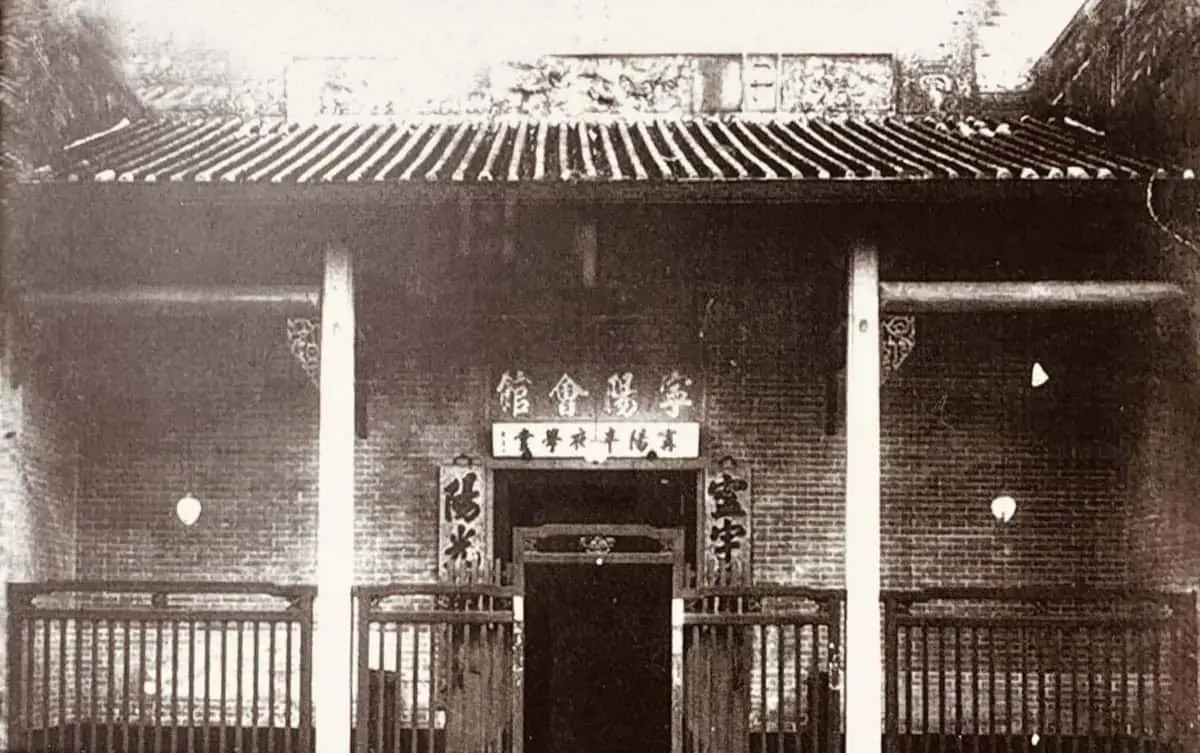
Wherever the diaspora settled, surname associations followed. 唐氏宗亲会 (Táng shì zōngqīn huì, Tang surname associations) operate in overseas cities alongside the better-known Chen, Li, and Huang associations, running the classic menu: rotating credit, burial societies, job placement, remittance channels. The model is documented; each Tang-specific instance must be verified or generalized.
In Southeast Asia, the layer is documented but reported. The 中华唐氏宗亲总会 (Zhōnghuá Táng shì Zōngqīn Zǒnghuì, the national Tang clan federation) and the 中华唐氏海外联谊会 (Zhōnghuá Táng shì Hǎiwài Liányìhuì, the Tang overseas association) report Singapore, Malaysia, and Indonesia branches; Malaysia’s Tang association was reported about forty years old in 2018; a 2017 founding celebration in Palembang, Indonesia, reportedly drew about a thousand Tang clansmen from a dozen countries. The Wuyi anchor is thinner still: a Tang clan website reported that eight representatives of Enping’s Tang association made the annual Jin Ci ancestral pilgrimage in spring 2017, sponsored by Enping businessmen 唐洪辉 (Táng Hónghuī) and 唐永洪 (Táng Yǒnghóng). The source site was unreachable at the time of research, so the account needs reverification before it can be treated as fact. It is the only Wuyi-county Tang organizational anchor found: reported, not confirmed.
North America falls back to the general model. No Tang association appears in the checked 2009 San Francisco roster of Chinatown organizations; this does not prove none existed elsewhere or later. And no Wuyi 唐氏宗祠 (Táng shì zōngcí, Tang ancestral hall) was located in the surveyed Taishan hall surveys or Kaiping gazetteer lists — absence of evidence is not proof of absence. The diaspora-hall model is documented for the surname elsewhere: 唐厝唐氏宗祠 (Tángcuò Táng shì zōngcí) in Jinjiang, Fujian, is an overseas-linked Tang hall — plainly not Wuyi. The ancestral hall as the gravitational center of lineage life is a real mechanism, explored for another clan in The Guan Clan’s 700-Year Odyssey; Tang’s halls, if they stood in the five counties, are not in the found record.
What the record does show, for the whole Wuyi, is a landscape transformed by remittance money: 碉楼 (diāolóu, watchtower houses), Western-style houses, rebuilt halls, roads, bridges — a built world dependent on 侨汇 (qiáohuì, overseas remittances), sustained by overseas-funded schools (侨校, qiáoxiào) and hometown magazines (侨刊, qiáokān), peopled by returning 归侨 (guīqiáo, returned migrants) and the status-marked 金山伯 (Jīnshān bó, “Gold Mountain uncle”). Its political energy ran to revolution, relief, and civic philanthropy. This is the world a Wuyi Tang family would have known, whether or not its own name appears in the hall surveys.

The Name Endures: A Grand Name, a Village-Scale Clan
Genealogies were the diaspora’s two-way record. 族谱 (zúpǔ, clan genealogies) listed emigrants with destination marginalia — 迁美利坚 (qiān Měilìjiān, “moved to America”), 往南洋 (wǎng Nányáng, “to the South Seas”) — and revised charts were shipped home. The Cultural Revolution destroyed great numbers of them; recovery and digitization have become a race against time.
After 1978 came reconnection, with Hong Kong as the hinge and the dialect as glue: 台山话 (Táishān huà) preserved the old phonetics overseas — why the surname sounds like Tang in Mandarin romanization and Tong or Tongh in older Cantonese and Taishanese records. The dialect’s role is the subject of The Siyi Dialect.
The revival is organized. The 《中华唐氏通谱》 (Zhōnghuá Táng shì Tōngpǔ, the Comprehensive Tang Clan Genealogy), published in 2013 in three volumes of roughly three million characters and verified in the Chongqing Library catalog, is a ten-part unity project reaching across provinces. The pilgrimages to the Shanxi origin sites are state-media confirmed: in 2013, more than 300 descendants from the United States, Canada, Australia, Hong Kong, Macau, and Taiwan gathered at the 尧庙 (Yáomiào, Yao Temple) in Linfen; in 2018, more than fifty Tang clansmen from Indonesia, Singapore, and Malaysia worshipped at Jin Ci, where the Malaysian branch’s deputy secretary-general 唐健昕 (Táng Jiànxīn) said, “天下唐氏是一家,唐氏根祖在晋祠” — “all the Tang under heaven are one family; the Tang root-ancestor is at Jin Ci.” That is a participant’s claim, recorded as such. Modern association materials recite a sixteen-character family instruction — 行孝、睦族、尚俭、秉直、守信、存厚、读耕、务实 (xíng xiào, mù zú, shàng jiǎn, bǐng zhí, shǒu xìn, cún hòu, dú gēng, wù shí — honor filial piety, unite the clan, prize frugality, hold to uprightness, keep faith, preserve generosity, blend study with farming, seek substance) — a contemporary codification, not an ancient charter. For the practical seeker, Taishan’s government-backed 侨事通 (Qiáoshìtōng) platform assists overseas descendants with genealogy lookups and ancestral-village confirmation.
The heritage roll-call is one line each, geography flagged: 唐绍仪 (Táng Shàoyí), first premier of the Republic in 1912, and 唐国安 (Táng Guó’ān), first president of Tsinghua — both from Tangjiawan, Zhuhai, outside the five counties; 唐寅 (Táng Yín), the Ming painter of Suzhou; 唐英 (Táng Yīng), the porcelain director of Jingdezhen. Pride for the name — not anchors for this clan.
Now the scale honesty, closed. A top-25 national surname whose Wuyi footprint ranks about 52nd in one Taishan compilation and appears in no Kaiping top-ten list: the grand name is carried by a village-scale clan. The thinness of the written record is stated one final time — as fact about the record, not about the people. This contrast, and this article’s refusal to inflate it, is the closing register — and the trait that separates this surname’s story from the dynasty’s, whose cosmopolitan splendor was a different kind of greatness.
For the descendant who has read this far, the trail is concrete. Search all three spellings of the name — Tang, Tong, Tongh — across immigration files, census rolls, and gravestones: each spelling is a search key, not an obstacle. Find the family village through the Xinhui gazetteer thread or association records. Contact a Tang surname association. Visit Jin Ci, or a Wuyi yinxin museum, and ask the Wuyi yinxin multimedia database. 寻根 (xúngēn, “roots-seeking”) is a verb in Chinese, and it is something you do.
The thesis closes the circle. A sage emperor’s clan-name became a state, the state became a dynasty’s name, and the dynasty’s name was carried across the Pacific by village farmers whose truest record is a letter genre and a thin, honest archive — surname, lost state, and dynasty name, one character 唐, still traveling. No ancestor is invented here; the name itself is the ancestor, and it is findable.

Continue Reading
- The Lee Surname: A Thousand Years from Longxi to Gold Mountain
- The Li (黎) Surname: From the Ancient State of Li to the Wuyi Diaspora
- The Zhang Surname: From Bow Makers to Gold Mountain — A Taishan Clan’s Global Journey
- Your Surname Is Your Compass: How to Trace Your Wuyi Roots
Stay Connected
Follow RootsOfChina on Facebook and Instagram for new article updates, behind-the-scenes from Kaiping, and stories from the Chinese diaspora.
Sources
A note on sources and uncertainty. The origin chain rests on the 《新唐书·宰相世系表》 (New Book of Tang, table of chancellors’ lineages), state-media surname histories, and the Tang-surname monographs 《唐氏源流》 and 《中华唐氏通谱》; population figures are source-specific estimates (rank cited as 25–26; totals ranging roughly 7.8–10+ million). The archaeology rests on National Cultural Heritage Administration records and scholarly accounts; the 叔夨方鼎 reading as naming Shu Yu and the M6081 identification are presented as debated scholarly readings. The Zhuji Lane corridor is carried as collective memory plus documentary claim (Xinhui gazetteer; the 1206 Zhuhai zupu record), never settled fact. The diaspora-era material is the general Wuyi record (B1–B3, B5), with no Tang-specific numbers, corridors, letters, or figures claimed; the Enping association pilgrimage rests on a single clan-website report whose domain was unreachable at research time and must be reverified. The 珠玑巷 intangible-heritage designation is reported at national level (2021) with provincial sources also citing 2022.
- 李孟存、李尚师, 《晋国史》 (山西古籍出版社, 1999) — 叔虞封唐, the 唐→晋 sequence, the Fen valley homeland, the second Tang state’s destruction by Chu in 505 BCE, the Tianma-Qucun/Quwo archaeology.
- 丛珊, 《唐氏源流》 (武汉大学出版社, 2016; 南雄珠玑巷姓氏文化丛书) — the Tang-specific origin/migration study: 陶唐氏 thread, Zhuji Lane entry into Guangdong, branch distribution, associations.
- 《中华唐氏通谱》·总卷 (编纂委员会, 2013, 3 vols.; Chongqing Library catalog K820.9/595) — multi-origin structure, 迁衍分布, 字辈, origin-site relics, overseas-branch records.
- 《新唐书·卷七十四·宰相世系表》 — “唐氏出自祁姓”; the 505 BCE Chu destruction of Tang; the F32 source-critical cross-check apparatus.
- 梅伟强、张国雄, 《五邑华侨华人史》 (广东高等教育出版社, 2001); 张应龙, 《广东台山华侨史》 (广东人民出版社, 2010) — qiaoxiang framework, periodization, land pressure, chain migration, associations, 金山婆, remittance cycles.
- 刘进, 《银信与五邑侨乡社会》 (广东人民出版社, 2011) — the yinxin system, emotional economy, 一家两地, remittance cycles, the 2013 UNESCO Memory of the World inscription.
- Madeline Y. Hsu, Dreaming of Gold, Dreaming of Home: Transnationalism and Migration Between the United States and South China, 1882–1943 (Stanford University Press) — exclusion, paper sons, the sojourner identity.
- National Cultural Heritage Administration (ncha.gov.cn, 2022) — 晋侯墓地及曲村—天马遗址 excavation record; Xinhua (2023) — 晋祠 as first-batch National Key Cultural Relic (1961) and national AAAA scenic area (2011).
- Guangdong Provincial Government (gd.gov.cn, 2016) and 广东地方志 (dfz.gd.gov.cn, 2023) — Zhuji Lane corridor facts and the 2021 national intangible-heritage listing; 中国人民大学清史研究所 — 《新会县乡土志·氏族》 listing 唐 among Xinhui’s Zhuji Lane descendant clans.
- 台山市图书馆《台山先人出洋史》 — surname-corridor model (梅→Chicago/New York; 马→Canada; 陈→Seattle); 台山 surname compilations — Tang ranked ~52nd of 156 (indicative); 开平市地方志办公室《开平姓氏源流考》 — 292 surnames, top-ten list without Tang.
- 中新网/中国青年网 (2013, 2018) — state-media reports of the 尧庙 and 晋祠 overseas Tang pilgrimages; 珠海市政府/清华大学档案馆 — 唐绍仪 and 唐国安 (Zhuhai, roll-call only); cntang.org (中华唐氏网, 2017) — the Enping association pilgrimage at Jin Ci — site unreachable (DNS) at research time; reverify before publication; money.china.com (2017) — Palembang founding celebration; 国务院侨办 gqb.gov.cn (2009) — San Francisco Chinatown roster.
- 台山银信博物馆 / 五邑华侨华人博物馆 (Jiangmen) — yinxin collections and the 五邑银信多媒体数据库; 台山”侨事通” platform (台山发布, 2023) — genealogy lookup and ancestral-village confirmation services.
Suggested Reading
Is this your family’s story?
Roots Of China is built from readers’ family histories. If a story here sounds like your own — a surname, a village, a journey — leave a comment below, or share your family’s story with us and we may be able to help you find your ancestral village.
