

Two Documents
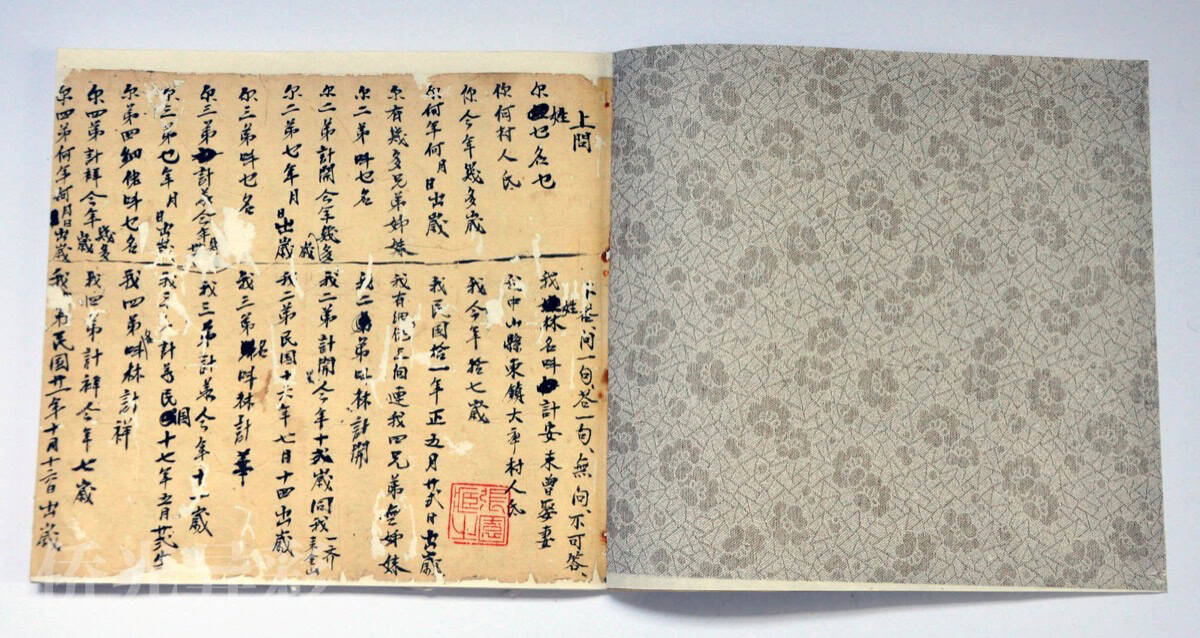
A Chinese applicant bound for San Francisco in the 1920s carried two documents. The first described a person: name, age, birthplace, the relative in America who would answer for him. The second was written by a village schoolmaster and described a conversation that had not yet happened — the questions an inspector would ask, in the order he would ask them, each with the answer the applicant was to give, ruled in two registers: 问 (wèn, question) and 答 (dá, answer), the questions stacked in a column and a reply set beside each.
That document is the coaching paper (口供纸, kǒugòngzhǐ); the applicant who bought one was a paper son (纸儿子, zhǐ érzi). The family it describes was made in Taishan — drawn as a rough sketch of a village, recited through a generation poem, vouched for by neighbours who had agreed to remember a boy who never existed. The copies that survive are mostly the ones that failed: possession was evidence of an offence, and a man who got through burned what got him through.
One term must be fixed. A coaching paper here is the Chinese text the family kept and the boy memorised. It is not the English transcript a stenographer produced at the hearing, which Chinese reporting also calls a 口供纸. One is what the family wrote; the other what the state wrote; the distance between them is this article’s subject.
What follows is how the sheet was built, what it cost, how it failed, and what it became once it stopped being contraband. Two limits hold: no fee figure survives in the record, and no rate can be derived from a corpus of failures.

The Architecture of the Sheet
The order is an inspector’s, reconstructed backwards from the desk where it was used: identity and birth date; the three generations of ancestors; the household; the village; the American relative; the voyage. Unrelated sheets follow the same six modules.
A twelve-part photographic transcription of a 1931 sheet attributed to the Jiangmen collection preserves its first panel almost entire: twenty-eight consecutive pairs, running from the applicant’s name to his mother’s village and its distance. The accession number is not established; the panel follows a sequence consistent with other described specimens.
The birth date he gives is lunar: the sixteenth of the first month, hour of the rat, fifth year of the Republic. His home he gives as 新宁 — Xinning, before the 1914 rename to Taishan, seventeen years out of date. Neither is an error. The form wanted a Gregorian date and got the village’s, and he states sixteen in 1931 for a birth in 1916, nominal age rather than full age. A place-name can date an identity, because a 1930s paper had to match whatever name the American file carried — a dating instrument, not proof of a date.
Names could be among the hardest elements to forge convincingly: registers record 名, 字 and 号 (míng, zì, hào), the file holds a Taishanese romanisation, so a 谭 becomes “Hom” and a 关 becomes “Goon,” and 台城, 端芬 and 广海 speech disagrees on the vowel.
Length indexes role. Principal applicants faced sets past a hundred questions; a wife’s was a handful — village, surname, age, bound feet, children in order. Boys of twelve to sixteen may have been among the most vulnerable. One holding runs 4.2 metres and 350 questions — a described object, not a standard.
The 1906 fire, which let citizenship be claimed without a birth record, has its own coverage. What the sheet is, in the end, is an exam paper, and what it prepares a man for is an oral examination.
The Three Generations, or Why a True Grandson Could Fail
The second module asked for facts a family does not normally transmit: the great-grandfather’s name and the grandfather’s; their 字号 (zìhào, courtesy and style names); the year and place of each death; the 坟山 (fénshān, grave hill) and which way the grave faced. Then the descent line, walked aloud.
A genuine grandson often did not know. He knew his grandfather as a man who carried him, not as a name with a grave oriented south-east. The interrogation was designed so that authenticity could fail too.
So the coach’s first act was fieldwork: before a line was set down he asked the old men who had walked the grave sites — which hill, which way it looked, what was carved. Coaching was a service the whole village needed, and that is the uncomfortable part: the trade was respectable because the village used it.
The forgery was a graft. A sheet was built outward from the clan’s real 族谱 (zúpǔ, lineage genealogy) — a book this site has its own guide to — and the fictional person inserted into it. The lie had to be more genealogically correct than the truth, because its weakest field was the one any villager could check without an archive.
Some Taishan surname materials show generation poems (班派, bānpài) administered per 房 (fáng, lineage branch), beginning at different generations in different branches: one surname carries four strings or more, one village cluster three. That is not a county-wide rule. What it establishes is narrower: a 字辈 (zìbèi, generation character) could be tested from memory by someone familiar with the branch, without a genealogy. That hearing rooms applied the test is inference; that it could have been is the mechanism.
A surname tells you little. A generation character tells you a branch.

The Village, Drawn Small
The fourth module asked for the village, sometimes drawn. What the drawing carries is coordinates, not a picture: the house, often in red; the 池塘 (chítáng, pond); the 社坛 (shètán, earth-god altar); the 祠堂 (cítáng, ancestral hall); lane names; a 碉楼 or 更楼 (diāolóu, gēnglóu — tower, watchtower); neighbours’ doorways; and an arrow for the house’s 坐向 (zuòxiàng, sitting-facing orientation). The list is the same one the site’s village atlas asks a reader to assemble before a first visit.
One surviving sheet gives the form, and it is modest: the sketch sits in the notebook’s last pages, after the text — a 簡圖, a rough sketch, placing the house in the village. The notebook is a pocket object, ten by fifteen centimetres. One specimen, not a standard: no source states a scale or orientation convention.
Village map (村图, cūntú) and house map (屋图, wūtú) were distinct, the second down to furniture. Drawing was not automatic: a government feature says an applicant “might be required” to draw on the spot, and one man refused in the 1930s said he was never asked.
Distances could not be fudged; they were relational. In the transcribed sheet the mother’s village is placed by direction and distance: six li south of our village. 里 (lǐ) is roughly half a kilometre, and the answer is useless to a forger who does not know which 墟 (xū, market town) the hamlet walked to. A hamlet with no plausible market is detectable with no archive at all. The map is demanded because a stranger can check it; the only man who can fake it is from the next village over.
The towers that give the landscape its silhouette survive in numbers — a hundred and eight buildings at Duanfen alone; here the tower is one line on a drawing.

The Men Who Wrote Them
The trade had a title: 写字先生 (xiězì xiānshēng), writing master. They sat in 台城 and in the market towns around it, 端芬 among them — the emigrant town that built a school with the money — and the best of them had been interrogated themselves. Know-how travelled backwards: a returned migrant knew the module order, the traps and the phrasing, and sold it where he had learned fear.
What was sold has a shape and no number. A deposit (定银, dìngyín) up front, balance on delivery — visible only as a trace in a specimen’s appendix; no amount survives. Then revision sessions. And often an understanding families repeated: 包过 (bāoguò), “guaranteed pass.” No document records a guarantee or a refund; it is oral testimony, what coaches claimed, not a term of service.
A cheap end existed: a Shanghai-printed manual of 1929, 《华侨写信不求人》, held by the Guangzhou overseas-Chinese museum, offers nearly a hundred templates — a household that could not afford the man bought the book.
The overlap with remittance letters is where the trade becomes infrastructure — same channel, same scribe, different document: the sheet is question and answer with no money in it, the remittance letter money with a family attached. The proof is a sheet surviving with its envelope: a 1935 paper from Dajiang in Taishan, 28.1 by 19.8 centimetres over three pages, posted to a kinsman in San Francisco, address on the front, reason for sending on the back.
That settles the channel, not the workshop. The museum’s own account of the object describes the Chinese copy being posted home so the applicant could memorise it; the Dajiang envelope runs the other way, a village paper sent out to the relative who would translate it into English and build the application from it. Both directions are attested, the split is undocumented, and this article will not choose an origin. Nor was the trade run by clan associations: some cases may have drawn on lineage-network resources, but nothing consulted here supports more.

The Village as Co-Author
A family invented from nothing was fragile: everything checkable, nothing remembered. The better device was to invent almost nothing. A household that had genuinely lost a son — in infancy, or abroad with the death vaguely recorded — became the anchor, and the paper son was attached to that absence.
Then three accounts corroborate each other because all three describe something real: neighbours remember a boy who existed, the genealogy has a gap where a son should be, the household’s account of its dead child is consistent. Nobody has to lie about the village; they agree about one person.
The fiction had to work at the level of the 房, because sponsorship, credit and remittances were branch functions rather than personal attributes.
Then it had to be maintained for decades: letters arriving with a name on them, remittances paying for a hall repair, a 祠堂 record left deliberately ambiguous, neighbours who kept agreeing as the original rememberers died. The performance was not one hearing survived but a role held for thirty years by people who had not chosen it. That is what made failure look structural: the more who knew, the more versions of the same house existed.
These were not accomplices and not heroes. They were villagers in a place where a household with no son abroad had no future, agreeing to remember a boy because the alternative was worse. The village’s own view is that a relation kept by remittances and ritual became real; the descendants’ view is that it became concealment. Both can be true of different families.
When the Paper Blows Up
爆纸 (bàozhǐ) — “the paper blew up” — is the term for a failed hearing. Men claiming to be brothers were examined separately, then brought face to face: 对质 (duìzhì), confrontation. A divergence in ages, birth order, or the house’s orientation ended the case. 爆纸 appears to have been a structural risk in that procedure, not a scandal: a cost the trade priced into what it charged.
What counted as fatal was often small, and known mostly from recall: one account blames a single extra character on the paper, another a man who could not say where a witness was from. The best-known illustration — two supposed brothers, asked separately what colour the fowl at their farewell dinner was, answering yellow and black — is not a cited case.
The colder mechanism is the inherited file. The father had testified years earlier, and his deposition fixed the facts — birth date, village, parents, the children he had declared. A son’s paper had to match a statement given before the son was born. Where it did not, the applicant answered for a document he had never read — and the sponsor’s citizenship sat upstream of the household’s other claims.
There was a second door, and it was priced. A refused applicant could appeal to the Secretary of Labor: 驳纸 (bózhǐ). In one documented case two brothers from Taishan, fifteen and fourteen, applied on 22 July 1921, were heard over three days, and were refused on 15 August, with one appeal offered. They took it. The state’s record survives as a twenty-page transcript in two bound volumes, privately held — the state’s document, not the family’s coaching sheet. Nothing in it establishes that their claim was fabricated, only that their testimony and their father’s diverged. How long they were held is not recorded.
The source adds that 驳纸 was expensive and slow and many stopped there; how many is unknown. This family did not stop.
The household arithmetic was simpler: return passage paid again, the debt to the paper family, loss of face. One reading of the record, argued from the volume rather than a single document, is that some 1930s households chose 递解 (dìjiě, deportation under escort) over an appeal they could not afford.
黄孔传 of 甘边 in 水步 bought a birth paper in 白沙’s 潮境乡 — a 黄 paper, because he was a 黄. He was refused for failing to catch a question about where a witness came from. He was held at Angel Island about four months — the station and its poems have their own history — and told his story to Taishan television in 2005. Failure was survivable and priced.
The Village’s Own Printer
A coaching script could be edited. A printed page could not. That made the village periodical — the 侨刊 (qiáokān), a hometown paper published for and often funded by emigrants — the most dangerous document in a paper son’s file.
The case the standard volume records is exact: an application filed in 1938 named as living a father whom the village paper had reported dead in 1932, in a dated obituary. Printed, mailed and archived, the notice fixed a fact on a page; the application contradicted it without an inspector or a witness. The case reaches this article through that volume’s account, not an archived file — but the mechanism does not need it: a death notice is the one village-side record a script cannot edit.
The family’s enemy was never only the inspector, but the printer in the county town.
The press’s numbers are reported, not counted. 《新宁杂志》 appeared in Taishan on 5 February 1909, while the county was still Xinning, and is described as the country’s first hometown paper — attributed, not asserted. At the 1930s peak the county is reported to have put more than 130 titles into print; the provincial federation’s own history counts 128 founded across the Republican period; thirty-five publish today, sixteen of them over ninety years old. Among the titles a reader can still hold: 《白沙侨刊》, printed in the town where one of these papers was bought — the 2025 issue shown below; 《风采月刊》, founded 1925 and still publishing. The Jiangmen city museum holds Republican-era runs including 《新宁杂志》, and the Taishan county archive its founding issues.
The columns that printed money matter as much. 鸣谢 (míngxiè, acknowledgements) and 芳名录 (fāngmínglù, donor rolls) printed a donor’s name, village and sum: the credit signal the purchase was designed to produce, converting a remittance into standing, and legible in absence. No page of one was obtained here, so the mechanism is described, not shown.
They were not buying a father. They were buying a name in print.

Three Cases and Their Limits
Three families, three kinds of source.
陈松柏, who wrote as 黎屏尘 and in English as Tung Pok Chin, was born in Taishan, bought a “document paper” (文件纸) at nineteen declaring himself a citizen’s son, and entered in 1934 under that name. 1934 is his year of entry — not a purchase year, not a publication date, and no source here fixes the purchase. His memoir, Paper Son: One Man’s Story, with Winifred C. Chin, is Temple University Press, 2000; his papers are at NYU’s Tamiment Library. It carries the interior cost in his own words: he never knew his real name or his birth date. It cannot carry the price, the coach, the village mechanics, or whether he was detained; his village is not located in the gazetteer.
余光宗 and 余光美 are the brothers behind the appeal above — from Taishan, fifteen and fourteen, applied July 1921, heard three days, refused in August, offered the one appeal they took. They survive as a state document: twenty pages, two bound volumes, Department of Labor, privately held. They are the best-evidenced refusal here and the least useful for describing what a family wrote: the transcript is the hearing, not the coaching. Nothing in it establishes that they were paper sons, only that their testimony and their father’s diverged. No detention length is recorded.
黄孔传 of 甘边 bought his 黄 paper in 白沙’s 潮境乡, was refused, and gave his account to Taishan television in 2005. Usable for procedure and affect: two hours a day, “like chatting, sometimes joking,” three days of questions, no photograph or map exercise. It is not usable for names and dates of third parties, and not typical of anything.
Archive first, then remittance letter, then genealogy, then village periodical, then oral testimony — and oral testimony here carries procedure and texture, never names and dates.
An Archive of Failures
The corpus’s shape is written into the document. One specimen volume, as read by a secondary account of its plates, carries an appendix of instructions (嘱咐, zhǔfù): never admit the paper exists; if an answer goes wrong, here is how to correct it mid-hearing; if the case collapses, here is how to appeal; and burn the paper before the ship comes alongside.
That is one documented mechanism that could contribute to survivorship bias, not the only one and not a claim about every sheet. But it explains what is left: holdings likely over-represent 爆纸 failures and confiscated files, because success destroyed its own evidence while failure left a paper in a government folder.
The bias is also the method. The same conversation survives twice — a coaching sheet kept by the village, a seized paper, transcript and ruling kept by the state — two versions of one interview that rarely match word for word. That mismatch is the best instrument this subject has: what a man was coached to say beside what he said.
The claim that the great majority of Chinese entrants used fraudulent papers cannot be derived from this corpus, because the corpus is mostly failures — the survey of the trade carries the figure and this article declines it. There is no denominator. Scale is conveyed otherwise: the deposit, the “guaranteed pass” claim, the coaching shops a county seat could support, the printed warnings a village could read.
The ten-volume 《台山历史文化集》 (2007), with its volume on the coaching papers, is the moment the sheet moved from family contraband to documented material culture (华侨文物, huáqiáo wénwù). On the trade’s meaning, Guangdong scholarship reads improvisation inside an unjust order, American scholarship mass identity fraud; this article leaves the disagreement standing.

Truth Inside the Fiction
The document’s second career begins with classification. In 1950 and 1956 household class was reset for households with income from overseas — the 侨改户 (qiáogǎihù) reclassification — which is why a Guangdong village can often be reconstructed for 1951 and not 1931.
From 1984 Guangdong moved first among provinces on 侨房清退 (qiáofáng qīngtuì); the province reports roughly thirty million square metres returned, officially reported, not audited.
The window open today is the 公证处 (gōngzhèngchù), the notary office, issuing 亲属关系 (qīnshǔ guānxì) — kinship — certificates. Requirements are documented: identity card and household register, a relationship certificate from a street or township office, the relative’s identity documents; the law bars certification on insufficient material. Whether a coaching paper counts as kinship evidence is not established by any source consulted here; it stays open.
DNA arrived as a method, not a verdict. A Y-chromosome test follows the paternal line and may suggest a county, village or lineage, but cannot prove a paper-son relationship, nor tell a grandfather from an uncle, brother or father. A mismatch establishes only that the male line does not descend from the lineage claimed — which lineage adoption (过继, guòjì), fostering, an affair or a record error also produces. No hometown-paper DNA appeal was found for this piece; the methodological argument is attributed.
The objects now sit behind glass — in the Taishan overseas-Chinese museum, opened in 2020, whose reconstructed interrogation room its publicity calls eighty per cent faithful, and in the provincial and county collections where the sheets entered as 华侨文物. The museum circuit has its own account.
No English caption was obtained, so nothing is asserted about what any museum calls it; the one English usage found — China Daily’s 2014 report on a family sheet in a New York exhibition — says “coaching book.” What can be said without a photograph is narrower: 口供 is a legal-register word for a statement taken under examination, and “confession” adds a plea of guilt it does not entail.
张国雄, who edited the volume, put the problem in four characters: 虚中有实, xū zhōng yǒu shí — truth inside the fiction. His 2007 《五邑大学学报》 argument is that the sheet is first-rate evidence for village morphology, house types, prices, food and dialect, and worthless as proof of descent: a method rather than a finding. Every fact in it is true except the one the reader cares about.
Which returns the question to a room in Taishan. A descendant stands at the glass with a DNA result in a folder and a family name on the card. The name was manufactured here, by a man with a brush, out of a real genealogy and a real dead child. The village was real; only the boy was invented.
If the file survives it survives in two places, neither the village: an archive abroad, where the case files are held, and a run of a hometown paper in a named building with a door.


Continue Reading
- Reading Qiaopi: What Remittance Letters Reveal About Wuyi Families
- Vancouver Taishan Remittance: How Qiaopi Letters Crossed the Pacific
- The Women Who Left: Chinese Female Migrants from Wuyi (1850–1940)
- How to Find Your Chinese Ancestral Village: A Practitioner’s Guide
Stay Connected
Follow RootsOfChina on Facebook and Instagram for new article updates, behind-the-scenes from Kaiping, and stories from the Chinese diaspora.
Sources
- 袁丁, 〈從新發現的「口供紙」談起〉, 《華南研究資料中心通訊》43 (2006), 26–29 — HKUST PDF
- 张国雄, 《台山历史文化集·第二编 口供纸》, 中国华侨出版社, 2007; 〈五邑侨乡”口供纸”的内容与价值〉, 《五邑大学学报》2007(4).
- 谭国渠等 编, 《台山历史文化集·台山侨刊乡讯》, 中国华侨出版社, 2007.
- 中国华侨历史博物馆, 〈(八)”口供纸”〉, 2020-05-03 — the 台山大江蔡氏 1935 and 中山 林计安 1939 objects, with measurements and provenance — ocmuseum.cn
- 广东华侨博物馆, 台山大江蔡氏 1935 口供纸, collection record with the posted envelope — gdhqbwg.org.cn
- 广州市侨务办公室, 〈勇闯”金山” 跨洋”归来”〉 — 《华侨写信不求人》, 上海华新书局, 1929, 近百种模板, 广州华侨博物馆 — gztzb.gov.cn
- 羊城晚报, 〈台山侨刊乡讯:华侨文化”活化石” “集体家书”传百载〉, 2022-03-09 — 130+ titles at the 1930s peak; 35 publishing; 16 over ninety years — ycwb.com
- 广东省归国华侨联合会, 〈台山侨刊乡讯概述〉 — 《新宁杂志》 1909-02-05; 128 titles founded 1912–1949 — gdql.org.cn
- 江门市人民政府, 〈《风采月刊》举行创刊100周年庆祝大会〉 — 1925 founding — jiangmen.gov.cn
- 台山周刊 / 台山市融媒体中心, 黄文莹、余绮华、伍超荣、邝晓雯, 〈藏品中的台山〉 — 余光宗、余光美, 驳纸, the twenty-page 英文口供纸 — sohu.com
- NYU Tamiment Library & Robert F. Wagner Labor Archives, Tung Pok Chin and Wing Fong Chin Papers, TAM 235 — finding aid; 陈松柏, Paper Son: One Man’s Story, with Winifred C. Chin, Temple University Press, 2000.
- 美华史记, 陈松柏 biographical note and memoir excerpt — usdandelion.com
- China Daily USA, Amy He, 2014-06-13 — “coaching book” as the English usage — chinadaily.com.cn
- 粤府办〔1989〕44号, 〈关于抓紧落实侨房政策工作的通知〉 — gd.gov.cn
- 国务院侨务办公室, 〈确认侨眷身份的证明材料主要有哪些?〉, 2020 — gqb.gov.cn
- 新浪微博, 刘其忠 1931 口供纸, twelve-part photographic transcription, 2021 — weibo.com
- 台山市图书馆 台山特色文化数据库, 黄孔传 testimony, 2005-04-06 (record 18837; page now offline, quoted from a preserved snippet).
- 78621.org, review of a specimen volume reproducing its 嘱咐 appendix, 2025 — https://78621.org/kougongzhi-yangyimin/
Run: 54f357ef47cd · Mode: delegated · Model: deepseek-v4-flash · Date: 2026-11-02
Suggested Reading
Is this your family’s story?
Roots Of China is built from readers’ family histories. If a story here sounds like your own — a surname, a village, a journey — leave a comment below, or share your family’s story with us and we may be able to help you find your ancestral village.
