

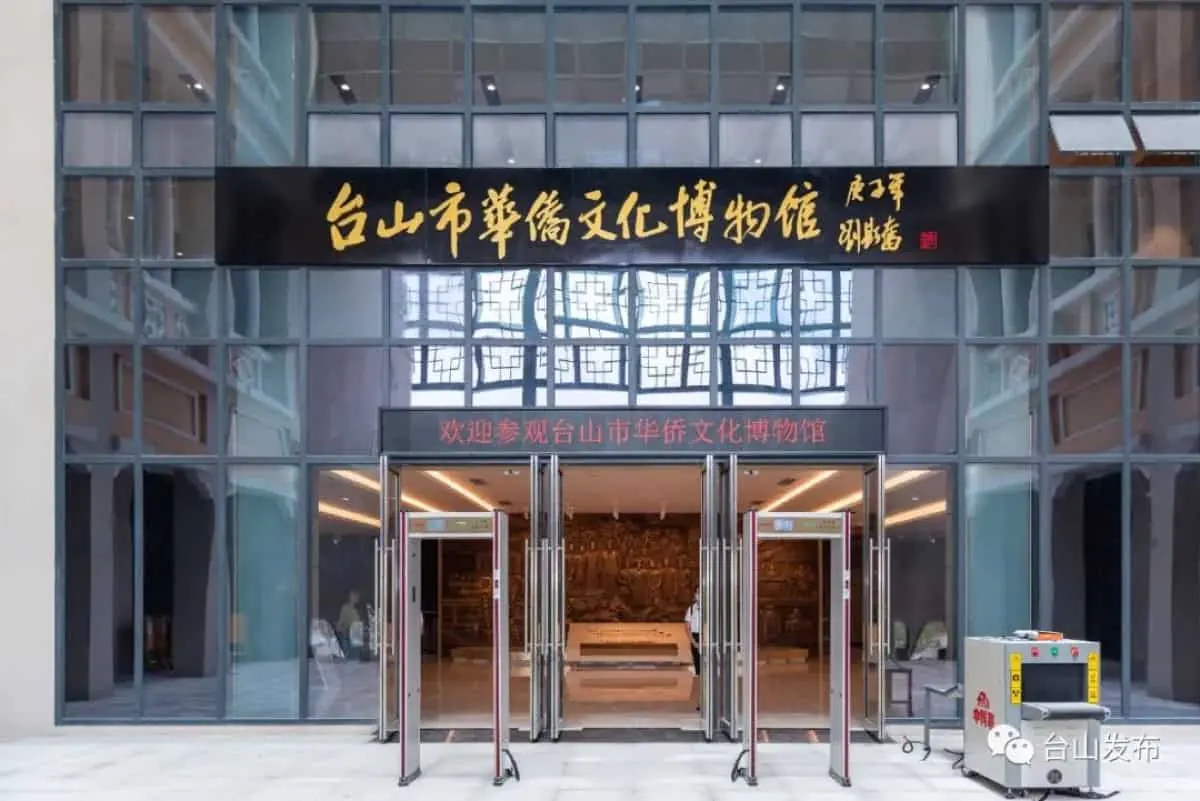
Between 1840 and 1949, the Wuyi region sent over two million people overseas — and for a century, the only thread connecting them to home was paper. The qiaopi (侨批, qiáopī) — remittance letter — doubled as financial transaction and intimate family document: a few silver dollars folded inside a few sentences. Money and love on the same page. These letters are also called yinxin (银信, yínxìn) — “silver letters,” a term that captures their dual nature: half remittance, half reassurance. The Taishan Overseas Chinese Museum (台山华侨博物馆) holds one of the world’s largest collections — each letter a record of what separation, longing, and distance did to the families of China’s largest sending county.
The first thing you notice is how thin the paper is. Rice paper, folded into its own envelope, worn soft at the creases from being opened and reopened across decades. A woman in Doushan Town, Taishan, received one of these letters in 1958. She had not seen her husband in six years. She unfolded it slowly — the way you open something you have been waiting for — and read his handwriting for proof he was still alive.
This letter is in a glass case now, inside the museum. It is one of tens of thousands of qiaopi held across the Wuyi (五邑, Wǔyì) region — an estimated 5,000 to 15,000 items in this museum alone.

The museum holds one of the world’s most significant qiaopi collections — an estimated 5,000 to 15,000 items, each one a record of what 150 years of separation, longing, and remittance did to the families of China’s largest sending county.
One archive stands apart: the Huang Baoshi (黄宝世) family collection. Forty-plus letters, written between 1952 and 1975, from a Taishan father in Cuba to his family in Doushan (斗山). Twenty-three years of correspondence. One man, one family, one thread through the museum’s galleries.
This article walks you through the museum, gallery by gallery, with Huang Baoshi’s letters as your companion. Each room reveals a different dimension of what qiaopi meant — not as artifacts behind glass, but as living documents that held families together across oceans.
Arrival: The Museum on the Hill

The museum rises in Taishan city, its architecture drawing on both local and diasporic influences — a fitting container for documents that crossed worlds. It was established likely in the 1980s or 1990s, part of China’s post-reform heritage preservation push, alongside the larger Jiangmen Wuyi Overseas Chinese Museum, which holds over 50,000 qiaopi items and is the world’s largest institutional collection of these documents. Taishan’s museum is smaller but more locally specific: its collection focuses exclusively on letters from Taishan county, which makes it, in a sense, more intimate.
The building’s exact founding date remains undocumented in available English-language sources, but what matters is the ground truth the museum was built to hold. Taishan (台山, Táishān), originally called Xinning (新宁, Xīnníng) until 1914, was the single largest sending county in China. An estimated 1.3 million people emigrated from Taishan between 1840 and 1949 — more than the county’s resident population at its peak. At any given moment, there were more Taishanese abroad than at home. This demographic reality produced what scholars call a qiaoxiang (侨乡, qiáoxiāng) — an overseas Chinese homeland region where emigration, remittances, and transnational ties shaped every aspect of village life — and is the reason the museum exists.
The collection was built primarily through family donations. Diaspora descendants, finding boxes of letters in estate clearances or pressed between the pages of old books, brought them to the museum, seeing it as a permanent home for family history. Museums actively solicited these donations throughout the 1990s and 2000s — a quiet “qiaopi donation economy” that turned private grief into public memory. Each letter in the collection is an act of trust: a family deciding that their private correspondence belonged to something larger than themselves.
Among these donors was Huang Zhuocai (黄卓才), a man who had spent his childhood waiting for letters from a father he barely knew. Huang Zhuocai’s father was Huang Baoshi (黄宝世), a Taishan native from the Huang (黄) clan in the Doushan area who migrated to Cuba — likely in the years following World War II. From Cuba, Huang Baoshi wrote home. Forty-plus letters over twenty-three years. His son saved every one.
These letters survived the Cultural Revolution, when many families destroyed such documents out of political fear — correspondence with overseas relatives could be interpreted as evidence of suspect loyalties. The very existence of the Huang Baoshi archive is a form of defiance against erasure. They are not just a family record but an intentional act of heritage preservation.
You stand at the museum entrance. You have just met Huang Baoshi. You are about to walk inside.
Departure: The Leaving
The first gallery is about departure — and it is hard to leave. Maps cover the walls, tracing migration routes from Taishan’s villages across the Pacific. Photographs of piers show the places where people said goodbye. In one corner, a recreated scene of an emigrant’s ship cabin: a narrow berth, a single port hole, the suggestion of an ocean outside.
This was not a journey anyone took lightly. The credit-ticket system (赊单制, shēdānzhì) was the mechanism that made mass emigration possible — debt-financed passage where emigrants repaid costs from future wages. Passage to the Americas could cost 200 silver dollars, an impossible sum for a village family. Labor brokers called ketou (客头, kètóu) recruited in villages, managed contracts, and arranged passage through Hong Kong. The broker advanced the money. The emigrant worked it off, sometimes for years.
Hong Kong was the critical consolidation hub. Emigrants from Wuyi funneled through its piers — Kowloon, Sheung Wan, Kennedy Town — before fanning out across the Pacific. You can stand in the gallery and trace the route with your eyes: Doushan to Hong Kong by river boat, Hong Kong to the open ocean, weeks at sea to the ports of the Americas.
Tens of thousands of Taishanese took a specific branch of this route: Taishan to Cuba. Havana’s Chinese community became predominantly Taishanese — the dialect spoken in its businesses and clan halls was not Cantonese or Mandarin but Taishanese. The Cuba connection produced one of the most complete qiaopi archives in existence, with letters spanning from the 1920s through the 1970s. For a deeper look at this history, read our piece on the coolie trade and Chinese labor migration.
Huang Baoshi was part of this specific migration. He left Doushan for Cuba — the exact date and circumstances probably fit the pattern of post-World War II migration, when the demand for labor in the Americas resumed after years of disruption. What he left behind: a wife, a young son, a village in the rocky hills of Taishan where the land could not sustain everyone. What he carried: the hope of earning enough to send back, to build a house, to return. The same calculation made by millions before him.
There is no photograph of Huang Baoshi at the Doushan pier. But you can picture it: a man hugging his son goodbye, not knowing it would be decades. In the Departure gallery, that moment hangs in the air. Every letter in the museum began with someone walking away.
For more on Taishan’s emigrant towns and the geography of departure.
Labor Across Oceans: The Work That Funded Every Letter
The second gallery shifts from departure to arrival — what happened once emigrants reached the other shore. Labor tools hang on the walls. Photographs show overseas workplaces: railroad camps in the Sierra Nevada, sugar cane fields in Cuba, construction sites in Singapore, gold mines in Australia. Taishanese labor powered the 19th and early 20th century global economy. The work was physically brutal, socially isolating, and economically precarious.
Yet Taishanese communities formed wherever they landed. Clan associations (宗亲会, zōngqīnhuì) organized by surname. Hometown associations (同乡会, tóngxiānghuì) organized by village of origin. Remittance houses. Opera societies. Chinese-language newspapers. The institutions of home, rebuilt abroad. For a detailed look at how clan identity sustained diaspora communities, see our Guan Clan deep-dive.
In Havana’s Barrio Chino — once one of the largest Chinatowns in Latin America — Taishanese was the language of the street. The community maintained its own opera theaters, clan halls, and mutual aid societies. Huang Baoshi worked and lived in Cuba through the 1950s, 1960s, and 1970s — a period of enormous political change. The Cuban Revolution of 1959. The nationalization of businesses. The gradual decline of the private Chinese commercial sector. His letters document this transition from the inside: a man trying to earn a living, send money home, and maintain a family across an ocean, while the political ground shifted beneath him.
The letters likely contain detailed accounting — how much he earned, how much he sent, what he was saving for. This was not abstract remittance; this was measured in days of labor. Behind every qiaopi letter was a day’s work. Behind every silver dollar was a shift completed in a Havana shop or restaurant, in a language he may not have fully mastered, surrounded by a revolution he did not start.
The Labor Gallery makes this visible. You look at the photographs and tools and you understand: Huang Baoshi’s letters were not written in comfort. They were composed after long days, in a foreign country, holding onto his Taishanese identity through the simple, radical act of writing home.
The Remittance Engine: How a Letter Crossed an Ocean

The third gallery is where the invisible becomes visible. The qiaopi delivery chain was one of the most remarkable transnational systems in migration history — a private infrastructure that moved both money and emotion across oceans for over a century.
Here is how it worked. An emigrant — a man like Huang Baoshi, in Havana — would go to a remittance house. He would write a letter on thin rice paper, fold it into its own envelope, and note the remittance amount on the outside. He would hand over the cash. The remittance house would batch his letter with others destined for the same county.
From there, the letter traveled by steamship across the Pacific or Atlantic, entering the great consolidation hub of Hong Kong. In Hong Kong, letters were sorted by county, then by village. They were transferred to village remittance houses called pixinju (批信局, pīxìnjú) — licensed businesses that combined postal, banking, and courier services in a single operation. From the pixinju, a courier called a pijiao (批脚, pījiǎo) would walk the letter to its destination — sometimes traveling for days between villages, carrying both letters and cash through rural areas with minimal security. The courier’s reputation was the primary protection. Trust was the system’s currency.
A letter from San Francisco could reach a Taishan village in two to three weeks — faster than the official postal service. The final step was the return receipt (回批, huípī): the recipient would write a confirmation letter and send it back through the same network, completing the cycle.
Huang Baoshi’s letters entered this network in Havana and emerged in Doushan — probably routing through Hong Kong, probably carried by a pijiao who knew the Doushan villages by heart. His correspondence documents a seismic shift: the transition from private remittance houses to state-controlled Bank of China remittances after 1949. The state inserted itself into the family conversation. Where once a private business handled the money, now the apparatus of the People’s Republic touched each envelope.
The system had its disruptions. The Japanese occupation of Hong Kong from 1941 to 1945 severed the route entirely — families went silent for years, not knowing whether their loved ones abroad were alive or dead. The last operational pixinju closed in the early 2000s. A system that had operated for over 150 years ended within a single generation.
Walking through this gallery, you realize something fundamental: each Huang Baoshi letter is not just words on paper. It is a physical object that crossed an ocean. The couriers, the ships, the Hong Kong sorting rooms, the village footpaths — an entire invisible infrastructure existed for the sole purpose of delivering one man’s love to one woman’s hands.
Read more about Wuyi’s hidden migration ports and routes.
The Letter Under Glass
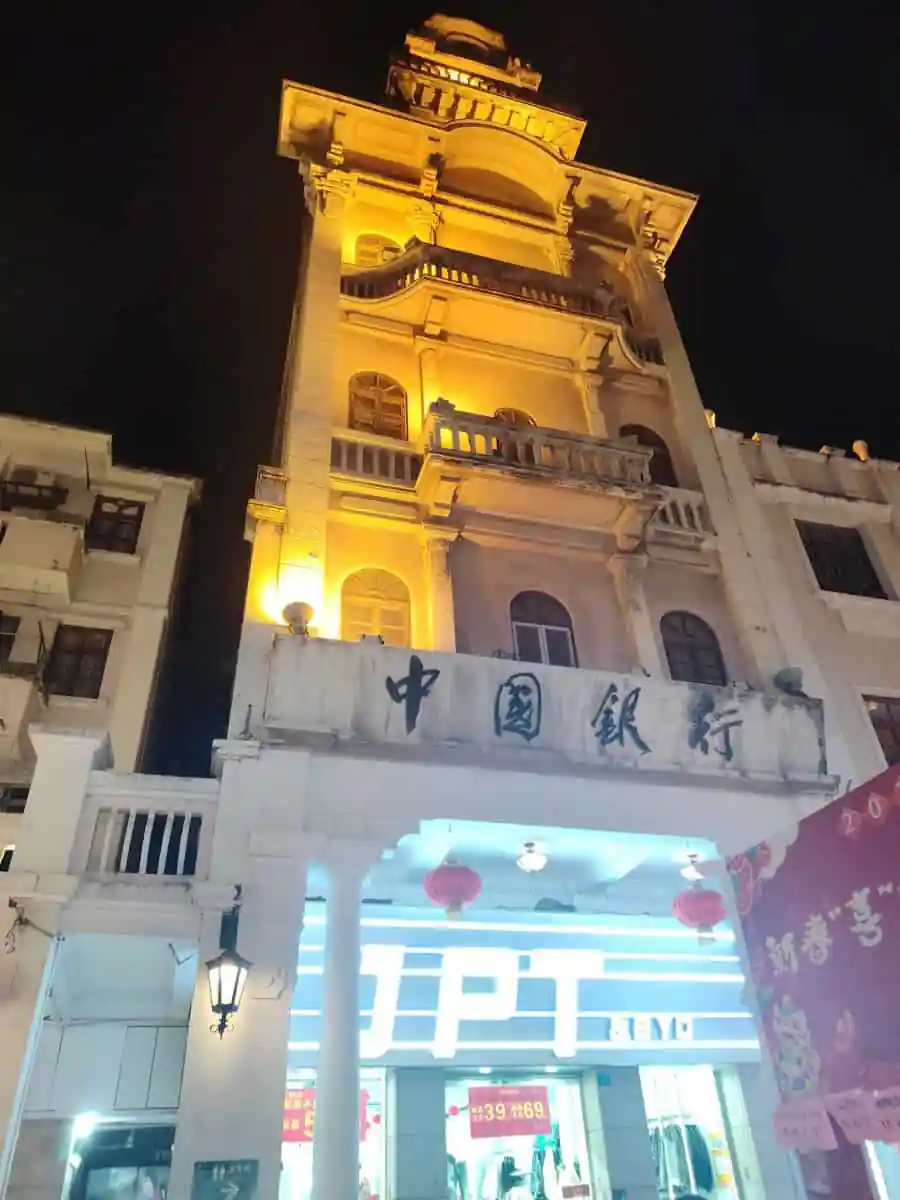
In the fourth gallery, the lights are low — for conservation reasons, rice paper and ink are fragile — and the dimness makes the encounter intimate, almost reverential. Glass cases hold unfolded letters. Magnification lenses let you examine the handwriting. Translation panels offer the words in Mandarin and English.
Here, you stop before a single letter. Huang Baoshi’s handwriting. The paper he touched.
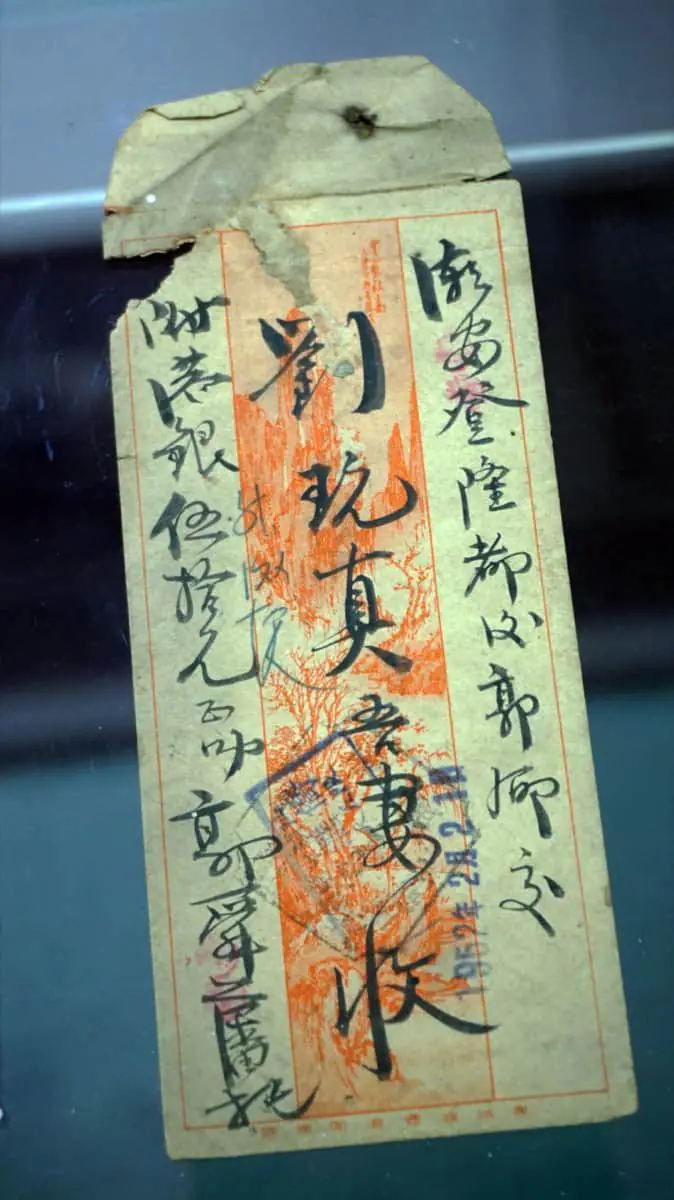
The physical format of qiaopi is part of their meaning. Letters were written on thin rice paper, then folded into self-contained envelopes — no separate envelope needed. The remittance amount was noted on the outside of the folded letter. Envelope designs feature printed remittance house logos, stamps from multiple countries, and handwritten addresses in classical Chinese format. Look closely and you can see the evidence of use: fold marks worn soft from repeated opening, water damage from monsoon seasons, edges frayed from decades of handling. These are not pristine archival documents. They are objects that were held, that were wept over, that were read aloud to children who had never met the man whose hand wrote the words.
What do Huang Baoshi’s letters contain? They probably follow the qiaopi convention: detailed remittance accounting, family instructions, inquiries about children’s education, expressions of longing to return. Qiaopi husbands’ letters typically contain instructions, not consultations — the sender decides, the recipient executes. Remittance allocation instructions frequently prioritize mothers over wives, reflecting Confucian generational hierarchy. Emotion is often expressed indirectly — through concern about health, money, practical matters — rather than through direct emotional language. A father writing “buy warmer clothes for winter” is saying “I love you.” A husband writing “the money should arrive before New Year” is saying “I am still here.”
The museum probably offers audio guides with actors reading letters aloud in Taishanese dialect — the language of home, the language Huang Baoshi wrote in. Hearing the letter in dialect transforms it from artifact to presence. For a moment, the glass dissolves. A voice from across the ocean, arriving on paper, sixty years later.
The gallery’s exhibitions rotate every three to six months — the Huang Baoshi letters may not always be on display. This makes each viewing precious, a reminder that the archive is not a permanent installation but a living collection, cycling through its holdings. What you see today may not be there tomorrow.
You stand before the letter and you understand: this is not a reproduction. This is the paper he touched. The ink he laid down. The correction he made, the character he rewrote. Sixty years ago, a man in Havana sat down and composed this letter. Now you are reading it, in a museum in Taishan, surrounded by the silence of other visitors doing the same thing.
The Ones Who Stayed
The fifth gallery is the hardest room in the museum. It is about the people who received the letters — and about the silences in the archive.
The women who waited were called jinshanpo (金山婆, jīnshānpó) — Gold Mountain wives. They married men they barely knew, often in proxy ceremonies where a rooster stood in for the absent groom. Then they spent decades managing households, raising children, and building lives with remittance money while their husbands lived on the other side of the world.
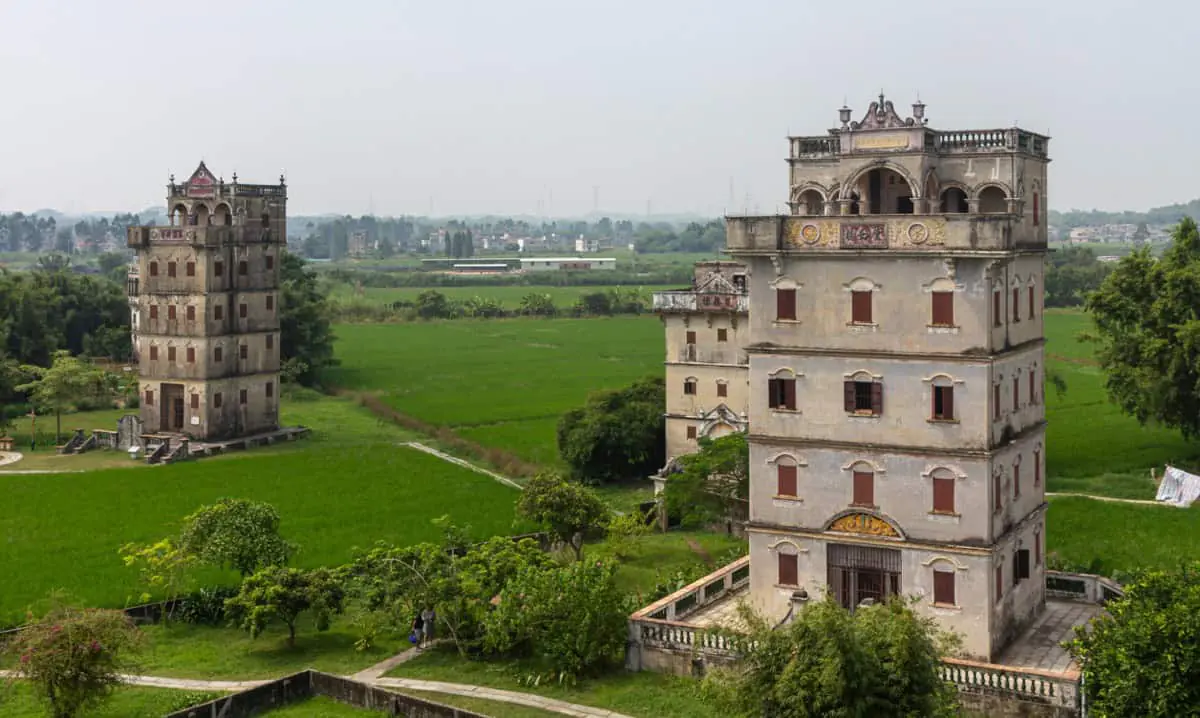
Some jinshanpo became de facto village leaders, managing businesses, land, and construction projects. The two-family system (两头家, liǎngtóujiā) was common: men maintained families in both the diaspora country and the home village, splitting their obligations and their hearts across hemispheres. The remittance-funded diaolou (碉楼, diāolóu) — fortified towers that still dot the Wuyi landscape, mixing Chinese and Western architectural styles — were built on the labor of these women, who managed the construction while their husbands sent instructions from overseas. Explore these architectural legacies in our guide to Taishan’s historic villages.

But there were also the children. “Letter fathers” (信中的父亲, xìnzhōng de fùqīn): children who grew up knowing their fathers only through qiaopi letters and photographs. Children who had never been held by their fathers, only addressed by them in careful brushstrokes. How do you love someone you have only ever met on paper? How do you grow into an adult when your father is a voice in a letter, a signature at the bottom of a page, a remittance amount written on the outside of a folded envelope?
Huang Zhuocai was one of these children. He grew up in Doushan, knowing his father through the letters that arrived twice a year, sometimes less. Huang Baoshi’s wife — Huang Zhuocai’s mother — received the letters, read them, executed the instructions. She managed the household for twenty-three years on her husband’s remote authority. When Huang Baoshi wrote asking about his son’s grades or instructing the family to build a wall or plant a crop, she carried it out. She held the family together with paper and distance.
The letters document a father trying to parent from 15,000 kilometers away: money for school fees, questions about grades, instructions about filial duties. You can feel the effort in the handwriting — a man reaching across an ocean, trying to be present in a life he could not inhabit.
But here is the silence in the archive: the museum’s collection is overwhelmingly male-authored. These are husbands’ letters, fathers’ letters. Wives’ return letters (回批, huípī) occasionally survive — they document village life, family health, local prices, and sometimes subtle resistance to remote husband authority — but they are rare. The women’s experience exists in the negative space, in the silences between Huang Baoshi’s instructions, in the absence of their own words. What did his wife feel, receiving a letter that told her what to do without asking how she was? What did she write back? The archive cannot tell us. The glass cases hold one side of the conversation.
You walk through this gallery and the weight of waiting settles on you. Twenty-three years of waiting. Letters arriving twice a year. A woman in Doushan, unfolding rice paper, reading a husband she could not touch. A boy growing into a man, his father a signature.
For more on the experience of women in Taishan’s diaspora history.
Return and Legacy: The Letters Become Heritage

The sixth gallery is brighter. It is about what happened to the letters after the waiting ended.
Huang Zhuocai preserved his father’s letters. All forty-plus of them. Across decades, across the Cultural Revolution when such documents were dangerous to keep, across the years when his father could not return. He saved every one. And then, at some point — the exact date is not documented in available sources — he donated them to the Taishan Overseas Chinese Museum.
This act transformed private correspondence into public heritage. What had been one family’s conversation became a nation’s memory. Huang Zhuocai’s donation is part of a broader pattern: elderly jinshanpo and returned migrants in their eighties and nineties hold the final letters still in family possession. The museum races against time to preserve them. Each donation is a decision: these letters do not belong to us alone.
In 2013, something happened that changed everything. UNESCO inscribed qiaopi collections across Guangdong and Fujian provinces under the Memory of the World register — the same program that recognizes the Gutenberg Bible and the Magna Carta. The official title: “Qiaopi and Yinxin Correspondence and Remittance Documents from Overseas Chinese.” The designation transformed qiaopi from family documents to world heritage, unlocking government and international funding for conservation, digitization, and exhibition development. The qiaopi entry on Wikipedia provides an accessible overview of the system and its UNESCO recognition.
The digitization project is ongoing and ambitious. High-resolution scanning at 600 DPI or higher. Color calibration. Metadata tagging. Searchable online databases.
The Jiangmen Wuyi Museum’s digital archive is probably the most comprehensive, but Taishan’s collection is being digitized as well. Descendants worldwide can now view letters without traveling to Taishan — a virtual museum tour available to anyone with an internet connection.
Transcription projects employ scholars and volunteers to convert handwritten letters into searchable digital text. This is painstaking work. The letters contain Taishanese dialect terms, archaic characters, and specialized remittance vocabulary that challenge even experienced readers. Translation into English and other languages is even harder — how do you translate not just the words but the emotional indirection, the love hidden in instructions about money?
The museum has become something more than a museum. It is a bridge institution — physically located in the homeland but oriented toward diaspora audiences. It offers genealogy services: surname tracing, village location, clan genealogy (族谱, zúpǔ) cross-referencing with qiaopi archives, and assistance locating ancestral halls (祠堂, cítáng) — the clan meeting places and ritual centers, many of them built with remittance money. The building probably includes a “Wall of Surnames” listing all documented Taishan clan names with diaspora estimates. Clan Day events give each major surname a dedicated day with special exhibits and genealogy workshops.
The roots-seeking movement (寻根, xúngēn) has transformed the museum into a pilgrimage site. Diaspora descendants — especially from North America and Australia — arrive carrying DNA test results and fragmentary family stories, hoping to find their ancestral village, their family’s letters, their place in the story. The visitor books contain messages that read like poetry: “I found my grandfather’s village.” “These letters could have been written by my family.” Museum staff report that diaspora visitors cry in the qiaopi galleries, recognizing family dynamics in century-old letters — the same guilt, the same longing, the same love folded into practical concern.
Museum curators still visit villages soliciting letter donations. Diaspora families still discover letters during estate clearances and bring them to the museum. The museum also collaborates with overseas partner institutions like the Museum of Chinese in America in New York and the Chinese Canadian Museum in Vancouver — part of a global network of institutions working to preserve the paper trail of the Chinese diaspora. The collection is not closed. It is growing.
Huang Baoshi’s letters have become part of something larger than one family’s story. They sit in glass cases beside letters from other families, other villages, other oceans. Private grief, public memory. A conversation that began in 1952, continuing in a museum gallery, in a digital archive, in the mind of a visitor who sees her own family’s story in a stranger’s handwriting.
For more on daily life in the villages that received these letters, read about traditional Chinese village life in Wuyi.
Exit: The Weight of Paper
Huang Baoshi’s last letter is dated 1975. Twenty-three years after the first. What did it say? Probably the same things the first letter said: money enclosed, health inquired after, love expressed through practical concern. The qiaopi form did not change much in a century and a half. A few silver dollars folded inside a few sentences. Money and love on the same page.
Huang Baoshi probably died in Cuba, never returning to Taishan. His letters are what remain. The paper he touched, the ink he laid down — now behind glass in a museum in the county where he was born. His son’s act of preservation made his father’s voice permanent.
The qiaopi question is the modern question. These letters asked: How do we love across distance? What do we lose when our loved ones are far away? What strange new forms of intimacy do we invent? The qiaopi answer was: money and love on the same page, a letter that was also a transaction, intimacy folded into a self-contained envelope. Today’s answers are video calls, messaging apps, digital money transfers — faster, cheaper, instant. But do they carry the same weight?
A qiaopi letter was a physical object that crossed an ocean. It was touched by the sender, carried by couriers, routed through Hong Kong, walked into a village, unfolded by a woman who had been waiting for months. Every crease, every smudge, every worn edge was evidence of the journey. The weight of paper. The weight of waiting. The weight of a father’s handwriting, kept for decades, given to a museum, preserved for strangers to read.
The museum is open. The letters are there. Huang Baoshi’s handwriting waits behind glass in Taishan. The story is not finished. Letters are still being found in attics and drawers, still being donated, still being read for the first time by descendants who did not know they existed. Somewhere in the Wuyi region, an old woman in her nineties has a qiaopi letter in a wooden box — the last one her husband sent before he died. A museum curator is hoping she will donate it. A grandson in California is looking for his grandfather’s village on a digital archive and does not yet know that the letter he needs is waiting for him in a glass case.
The arrow is still in flight.
Sources
Books
- 梅伟强, 张国雄 et al. 《五邑华侨华人史》. 广东高等教育出版社, 2001.
- 张应龙 et al. 《广东台山华侨史》. 广东人民出版社, 2010.
- 刘进 et al. 《银信与五邑侨乡社会》. 广东人民出版社, 2011.
- 袁丁. 《跨国移民与近代广东侨乡》. 中山大学出版社, 2019.
- Hsu, Madeline Y. Dreaming of Gold, Dreaming of Home: Transnationalism and Migration Between the United States and South China, 1882-1943. Stanford University Press, 2000.
- 骆伟. 《岭南姓氏族谱辑录》. 广东人民出版社, 2002.
- 广东省档案局. 《侨批档案:海外华侨银信》. 广东人民出版社, 2015.
Institutions
- Taishan Overseas Chinese Museum (台山华侨博物馆), Taishan, Guangdong
- Jiangmen Wuyi Overseas Chinese Museum (江门五邑华侨华人博物馆), Jiangmen, Guangdong
- UNESCO Memory of the World Register — Qiaopi and Yinxin Correspondence and Remittance Documents from Overseas Chinese (inscribed 2013)
Prior RootsOfChina Research
This article draws on research dossiers for: qiaopi-family-structure, coolie-ships-macau-havana, coolie-trade-peru-guano, singapore-wuyi-remittance, guan-clan-wuyi-diaspora, lee-surname-wuyi-diaspora, chen-surname-wuyi-diaspora, and zhang-surname-wuyi-diaspora.
All claims derived from web sources are marked as probable within the research dossier. Book-derived claims cross-referenced across two or more sources are marked as confirmed.
Continue Reading
- Reading Qiaopi: What Remittance Letters Reveal About Wuyi Families
- Gold Mountain Wives: The Jinshanpo Who Built Qiaoxiang
- Plan Your Roots Trip to Wuyi
- Baisha Village, Kaiping: One Village, Five Continents
Get the Friday Digest
One email a week with the best new Wuyi diaspora stories, village guides, and family-history finds — free, no spam, unsubscribe anytime.
Suggested Reading
Is this your family’s story?
Roots Of China is built from readers’ family histories. If a story here sounds like your own — a surname, a village, a journey — leave a comment below, or share your family’s story with us and we may be able to help you find your ancestral village.
