


The City With Its Wall Knocked Off Its Own Name
Most Chinese surnames arrive as a pedigree. The Yu (于, Yú) surname arrives as a spelling.
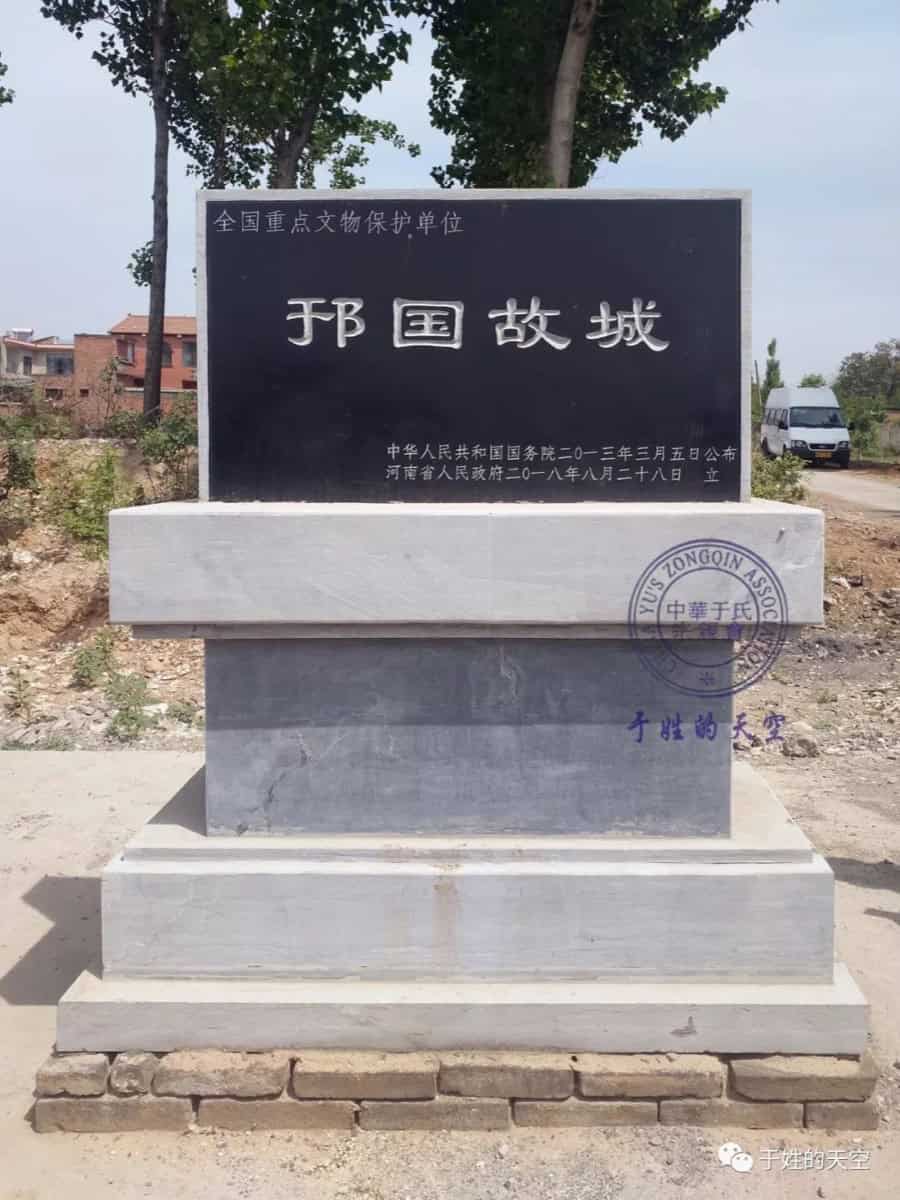
The character began as 邘 (yú): a walled fief on the Yellow River’s north bank, in northern Henan. When the fief fell, the graph shed its 邑 (yì) element — the 阝 that marks a walled settlement — and kept the sound. 邘 became 于. The name was taken at the state’s extinction, not its founding. What survives is not a scroll but 820 metres of rammed earth in a wheat field.
The grant is lineage tradition: King Wu, the Zhou founder, enfeoffed his second son 邘叔 (Yú Shū) there. The Tang genealogical table, as later sources quote it, and the modern Henan compilation 《中原寻根——源于河南千家姓》 both make that the origin. The end is gazetteer-dated. The Qinyang county monograph puts the annexation at 712 BCE and names Zheng; other references give Jin, or Qin, or no year.
One confusion first. Yu 于 is not Yu 余, “surplus,” traced here in the Yu (余) surname story. Same syllable; different character, lineage, origin, region. 于 is northern, 余 southern. It is one of a run of same-syllable entries, after He/He and Xu/Xu.
Romanisation adds noise: Yu in pinyin, Yue in Cantonese, Yü in older Wade-Giles. Add the constant confusion with 俞, and with the Hokkien and Korean forms of other characters — the trap surname identity keeps returning to. Read the record for the form your family used.
What follows: a fief become a surname; a first power base 400 kilometres east; a family that moved south by promotion and produced the man who forbade anyone else to; a verdict that scattered three people to three garrisons; a migration north by rail; and a catalogue with no overseas branch.
Four Families Wearing One Character
于 has no independent meaning. It is the phonetic of 邘. The surname does not mean anything; it remembers a place. And it is not one family. A modern Henan compilation lists three unrelated stems inside one entry. A fourth is documented in a real register.
First: the Ji-clan (姬姓, Jī xìng) grant, to 邘叔 — the second son. His descendants took the state’s name, dropped its city radical, and were later styled the orthodox Henan Yu.
Second, from the north. The 《魏书·官氏志》 records the 万忸于氏 (Wànniǔyú shì) of 代北 (Dàiběi) ordered to take the name Yu under the Northern Wei emperor Xiaowen. Later accounts make it a round trip: that clan, they say, descended from an earlier Shandong Yu family that had gone north.
Third, a taboo. Under the Tang, in the Yuanhe reign, the double surname Chun-yu (淳于) was cut to Yu, to avoid the personal name of Emperor Xianzong, Li Chun. A 避讳 (bì huì) edits other people’s surnames. This one edited a lineage’s.
Fourth, in a catalogue. The 《中国家谱总目》’s Guiyang register notes 「该族原姓俞,始迁祖旗始更姓为于」: the line was surnamed Yu 俞, and its first settler changed it. 俞 is a different surname; this is the one documented crossing the catalogue supports. A Duchang case is claimed, but the catalogue’s Duchang entries carry no such note.
The slogan 「天下于姓出邘邰」 — all the Yu of the world come from Yutai — is what villagers tell reporters at the surname’s park project. It is a claim about a prestige address, not a family fact. A 睢县 (Suīxiàn) line of 子姓 (Zǐ xìng) Yu blocks it: the site was walled in the Shang as the Meng polity (盂), and Meng and Yu are one ground under two names.
Hence the unit everything later depends on: not the surname but the branch, 支系 (zhīxì), with its own first settler ancestor (始迁祖) and its own generation poem.
What Is Actually There: 820 Metres, an Ink Date, and a Thousand Iron Tiles
The origin village never emptied, which is why it became a shrine rather than a ruin. Yutai (邘邰村, Yútái cūn) in Xiwan township (西万镇, Xīwàn zhèn) packs twelve village groups onto 1.5 square kilometres; the Henan Daily, in 2025, put the population at over ten thousand, all Han.
Yuguo Gucheng (邘国故城) has been a national protected monument (全国重点文物保护单位) only since 2013 — 7-0306-1-306, Shang–Zhou–Han — after provincial protection from 1986.
The measurements are worth keeping exact. The outer earthen city ran 820 metres east–west, 580 north–south. Only the north and part of the east wall stand. Where they survive they are 17 to 22 metres wide and 2 to 7 metres high, as the surveyed record reports. A 40-metre moat runs outside the north wall; inside is farmland, the cultural layers undisturbed. The deepest layer belongs to the Shang lord of E (鄂侯), not to the Zhou prince.

Two buildings carry the paper trail, neither a genealogy. The Jingying temple (静应庙, Jìngyìng miào), a provincial protection since 2000, has an ink inscription under its ridge purlin recording a repair in 1277 — older than any surviving Yu register. The Iron Tile Hall (铁瓦殿) has over a thousand cast-iron roof tiles, each bearing a donor’s name: a subscription register cast in metal. Local papers rank it one of China’s three great iron-tile halls; the tiles do not need the ranking.
Someone keeps the roof on. Wang Fengmei (王凤美) was 83 in 2023, having guarded the temple since she was 47 — thirty-six years — raising about a million yuan from villagers and seeing eleven buildings repaired, per the Dahe Daily profile. The gazetteer has no category for her office.

Two local claims stay tradition, not archaeology: Jiang Ziya’s fishing platform, and the temple’s seventeen centuries.
Local tradition adds a third: a 2.5-kilometre flood dyke said to date from the Western Zhou still protects the site on the Longmen river. Three millennia later a man of this county would cut the Yellow River’s dyke into li-length stretches, each with a named warden.
Donghai: A Prestige Address Is Not a Homeland
The surname’s first documented power base was not Qinyang but Donghai (东海郡), in coastal Shandong. The 《汉书·于定国传》 tells of a jailer, 于公 (Yú Gōng), who had his lane gate built taller because his handling of cases would make his descendants marquises. His son 于定国 (Yú Dìngguó) became Western Han chancellor. The family’s first story is how a jailer decided cases.
By the Han and Three Kingdoms the surname was Shandong-centred — 于禁 (Yú Jìn) of Taishan, 于吉 (Yú Jí) of Langya — eight centuries after the fief and 400 kilometres east. Yuan Yida’s tables show Donghai is no longer a Yu peak. A 郡望 (jùnwàng) records where a lineage was famous, not where its people are.
Three geographies get merged. The origin (得姓地, déxìng dì) is 河内 (Hénèi) — Qinyang, north of the river. The prestige addresses are 河南郡 (Hénán jùn, Luoyang) and Donghai. The present mass is Shandong. Henei and Henan commandery are on opposite banks; that confusion is the commonest error on Yu pages.
The archival trap sits under the toponymic one. 野王 (Yěwáng) under the Spring and Autumn and Western Han; Henei county under the Sui; Hua-qing prefecture (怀庆府) under Ming and Qing; abolished in 1913 and renamed Qinyang, a city from 1989. Henei and Hua-qing die in 1913. A register naming either points at Qinyang under a dead name — a 废府存县 (fèi fǔ cún xiǎn, “abolish the prefecture, keep the county”) reform, and it explains half the dead ends in this genealogy.

A village register shows the dead name still resolving. The Pujiang, Zhejiang register, sixteenth compilation, 1925, has first ancestor Ping moving from Henei — glossed “(present-day Qinyang county)” — to Zhejiang in the Tang. Henei meant Qinyang to a compiler; and the move south was branch migration, not refugee flight.
For scale, one authority: Yuan Yida and Qiu Jiaru’s 《中国四百大姓》 (2013, sample-derived) gives about 6.42 million, 0.48 percent, thirty-ninth, 21.8 percent in Shandong, six provinces at 71.9 percent, two centres at Shandong and Liaoning. Other tables give 28th to 40th, and 7.4 or 11 million. Not averaged here.
A Northern Surname’s Southern Enclave
Three generations before its most famous member was born, the family had already moved south for a posting and stayed.
Five generations, each stop anchored by an office. 于伯汉 (Yú Bóhàn): Shanxi, then Suzhou. 于夔 (Yú Kuí): served the Yuan. 于九思 (Yú Jiǔsī): Yuan chief administrator of Hangzhou, who retired there and settled in Taiping ward, Qiantang — a post become a domicile, the mechanism a modern family calls following the job. Then 于文 (Yú Wén), a Ministry of Works post under Hongwu; then 于仁 (Yú Rén), a generation that stayed home.
This chain is biographical tradition, and is labelled as such here. The standard biographies repeat it identically; its check is the conduct-record in his own works; the variants have not been forced into one line. 于文 is also written 文明 and 文大; 于仁 also 彦昭 — name against courtesy name.
The family finished localising in the exam hall. Yu Qian (于谦, Yú Qiān, 1398–1457) took the provincial degree in 1420 and the metropolitan in 1421 as a Qiantang-registered candidate: a northern surname’s southern enclave, four generations deep, sitting the empire’s examination as a Zhejiang man. In those years the surname is a thin frequency line in Zhejiang, never a band.
Official identity and family memory then disagree on purpose. Every Ming source registers him at Qiantang; his own collection preserves an origin in Kaocheng (考城). Under Ming household registration a migrant’s descendants could not hold both — 籍 (jí) was enrolment, 祖籍 (zǔjí) the line’s beginning — so the north was compressed into a genealogy’s opening pages.
The snag sits in the county name. Kaocheng was abolished in 1954 and merged into Lankao (兰考); the village claiming his ancestral home is in Chengzhuang township, Minquan county (民权). A reader searching either name is following a real thread out of the same abolished county. Both appear; picking one silently is the error.

What the family kept is a house: number 42, 祠堂巷 (Cítáng Xiàng), the residence become a shrine, the second courtyard holding the hall named for his posthumous title. The city renamed a street after the man it had executed.
1449: The Man Who Would Not Move South
By 1449 he was minister of war. Before that came nineteen years of other work.
From 1430 to 1448 he was regional inspector-governor (巡抚, xúnfǔ) of Henan and Shanxi — nineteen years, an eighteen-year variant in some accounts. In the Zhengtong famines he opened the granaries of Henan and Hua-qing for over two hundred thousand displaced people (流民) from Shandong and Shaanxi, ordering land, oxen and seed: relief that was also in-place resettlement, since people fed where they stand do not become migrants. It ran on accountability — from 1441 an official whose reserve granary (预备仓) fell below quota could not leave office on promotion — and he cut the Yellow River dyke into li-length stretches, each with a named warden (亭长).
The granaries he opened stood in his surname’s own prefecture — an inference, not a line in the biography.
In 1449, the emperor captive after Tumu (土木之变), a palace lecturer named 徐珵 (Xú Chéng) argued from the stars that the capital should move south. Yu Qian answered in seven characters: 言南迁者,可斩也 — whoever speaks of moving south may be beheaded. The capital is the root of the realm; had they not seen what the Song’s southern move cost? The battle is a premise; the decision is the scene.
The second decision was grain. Tongzhou held vast grain stores that could not be moved before the enemy came; by imperial order the troops drew their own grain at the gate, with surplus rice reckoned as their pay (以赢米为之直, yǐ yíng mǐ wéi zhī zhí), and nothing was left to feed the enemy. The store emptied into the army and the nine gates were fed. Beijing held.

In 1457 the restored emperor had him killed for treason at the western market, aged sixty. The confiscation is the family’s only inventory: 家无余资 (jiā wú yú zī), no surplus property in the house. The main chamber alone was sealed fast; opened, it held the imperial robe (蟒衣) and sword the emperor had given him. A colleague, 陈逵 (Chén Kuí), collected the body.
His hall name is a 堂号 (tánghào, hall designation) from the posthumous title 忠肃 — loyal and grave — granted in the Wanli reign, decades after the execution. The hall commemorates a judicial murder, not a founding ancestor, an unusual thing for an ancestral hall to do. Yu halls display verse, not property.
The irony: the man who forbade a southern move was the fourth generation of a family that had moved south.
One Verdict, Three Garrisons, and a Poem for a Thirteenth Birthday
The punishment was applied to a household, geographically.
Son 于冕 (Yú Miǎn) to Longmen in Shanxi; his wife, née Zhang, to Shanhaiguan; son-in-law 朱骥 (Zhū Jì) to Weiyuan. Three people, three garrisons, one verdict — a woman made a unit of punishment and moved to a border pass as part of a sentence. Recovery came through the affinal line: 于冕 was released in 1465 and petitioned for a title and a shrine.
The body came home first. The burial at 三台山 (Sāntái Shān) was carried out by 于康 (Yú Kāng), a sworn brother (义兄), because the son was in exile. A purge could sever a family’s ability to bury its dead; not its intention to bring the body home.
The dates that look like a dispute are a sequence. Burial in 1459; vindication in 1465; the next year the court sent officials south to perform the imperial sacrifice (谕祭); in the early Hongzhi reign came the sacrificial text, the title 肃愍 (Sùmǐn) and a shrine built before the graves. 1466 is the year the court acted, not a second funeral.

The grave field is reported locally to hold seven graves, his at the centre, with a horseshoe plan reported as 23 by 30 metres and a shrine about 50 metres south — reported dimensions, not surveyed for this article. Seven graves is the only hard evidence of how large this branch had grown.
The separation grammar came four centuries before the remittance letter. A letter reached his Shanxi post announcing his son had turned thirteen; the boy was being raised by his grandparents in Qiantang. He answered with 《示冕》, “To Mian”: keep to your books, serve your elders — then 衔命年年巡塞北,思亲夜夜梦江南, year after year I carry orders north of the passes, and dream of home every night, the dream going south. The headnote says: 时予双亲在堂,留冕代养于杭 — my parents are living, and I have left Mian in Hangzhou to care for them. What qiaopi letters were is the later version of the same instrument.
The harder text: his wife, née Dong, died in 1447 while he was on circuit; he reached neither sickbed nor funeral, and wrote a sacrifice-text opening 吾家素贫 — our house has always been poor.
The two poems hung in a Yu hall carry unequal weight. 《石灰吟》 (Shíhuī Yín, “Song of Lime”) cannot be printed as autobiography: earliest form a Song–Yuan monk’s verse, four names carrying the quatrain, and the collection edited by his son omits it — Yan Chongnian’s case in 《中国文化研究》.
What it has is 《咏煤炭》 (Yǒng Méitàn, “Ode to Coal”), whose closing couplet is the better-attested self-portrait: 但愿苍生俱饱暖,不辞辛苦出山林 — if only the common people were fed and warm, I would not shrink from coming down out of the mountain. The couplet is stable across the 《忠肃集》 tradition and current in the modern critical text, 《于谦集》, 浙江古籍出版社, 2016, 魏得良 点校.
The Map That Is Really a Timetable
This diaspora crossed no ocean. It crossed a strait, then followed a railway.
Yu’s Jiaodong core is almost exactly the county set that supplied 闯关东 (chuǎng Guāndōng), “braving the passes east.” Qing Dengzhou prefecture (登州府) held one sub-prefecture and nine counties: Penglai, Huangxian, Zhaoyuan, Qixia, Fushan, Ninghaizhou, Wendeng, Rongcheng, Laiyang, Haiyang. Popular lists drop Zhaoyuan and Ninghaizhou; ten is correct, per the Shandong civil affairs department.
Two routes, two signatures. By sea, Longkou, Yantai and Penglai face Dalian — an overnight crossing, which is why Yu in Liaoning reads as a continuation of Dengzhou, not a new settlement. By land, Shanhaiguan, Xifengkou and Gubekou led into the Liaoxi corridor, to Jinzhou, Xinmin, Tieling. The sources give no mileage, only the crossing.

Shandong first, Liaoning second, Heilongjiang third is a time gradient: Liaoning is the old short-hop sea layer, and Heilongjiang’s earliest Yu stratum dates from the 1860 opening of Hulan, reaching Suihua, Hailun and Bayan; the bulk came with the railway boom of 1904 to 1931 on the Beijing–Fengtian, South Manchuria and Chinese Eastern lines. Villages followed rail spurs, not river valleys.
For decades the move was seasonal — men north in spring, home for harvest. Permanent villages begin with land title, 占草开荒 (zhàn cǎo kāi huāng, claiming grass and breaking soil), and a claim becomes a name: Yujia Wopeng, Yujia Tun, Yujia Gang, a surname written into the landscape as a deed. The brick courtyard among mud-brick houses marks money sent home; 分家 (fēnjiā, household partition) sent younger sons north while the eldest kept the graves.

Three catalogue entries show the mechanism. A Donggang, Liaoning register (2001): first ancestor Dongjiang in early-Qing Shandong, at Dashuipo in Wendeng or Simazhuang in Rushan; sixth generation Hui moved in the Qianlong–Jiaqing period to Tangjiatun and is the branch’s first settler. A Wuchang, Heilongjiang register (1998) announces the split in its own name: a Rushan branch and its Qixingpao sub-branch.
What follows is an application: Lu Yu’s county-level study of the migration, applied to Yu. The study contains no surname data.
Two tests. Suffix: names in 疃 (tuǎn, an enclosed hamlet) mark Jiaodong; 窝棚, 堡 or 沟 — shanty, stockade, gully — mark the frontier. Misspelling: descendants write Qixia as “Qi county,” Rongcheng as “Yongcheng county,” Haiyang with the wrong yang. A note saying “Qi county” is a Dengzhou origin with a copying error baked in.
One corroboration, labelled: the commercial database 23魔方 (23Mofang) puts a Jiaodong Haiyang Yu cluster at about 1.1 percent of local males in Heilongjiang, 1.2 in Jilin, 0.5 in Liaoning, 0.65 in Shandong — a gradient measurable in DNA as well as registers. Corroboration only; the same report concedes most Jiaodong branches trace only to the Jin and Yuan.
The study ends at 1949. Nothing from the post-1958 state-farm settlement belongs here.
No Letters, No Hall, No 侨乡 (Qiáoxiāng) — and Why That Is the Answer
The 《中国家谱总目》, a union catalogue of more than fifty thousand genealogies, holds about 88 Yu titles; earlier counts of the same corpus say 84. By province: Zhejiang 34, Shandong 15, Jiangsu 10, then a descending tail from Hunan and Sichuan at 4 to Shanxi and Heilongjiang at 1 — and Guangdong 0, Fujian 0, Guangxi 0, Taiwan 0, Yunnan 0. Nanyang, Singapore and Malaya appear zero times; “America” and “Japan” only as holding libraries.
No register in the catalogue carries an overseas branch. That is a claim about a catalogue, not about people; it is not a claim that no Yu ever emigrated.
The corpus’s centre of gravity is the finding. Thirty-four of roughly eighty-eight titles are Zhejiang registers — Pujiang, Lanxi, Xiaoshan, Shengzhou, Jinhua. The Yu genealogy corpus is Jiangnan; the Yu population is Shandong. Stationarity produced the population; a compiling habit produced the books.
The boundary explains it. Yuan Yida puts Yu at trace frequency across the Fujian and Guangdong provinces that seeded the overseas Chinese world: the surname sits north of the Wuyi–Nanling line, its mass inland, its diaspora continental — no coolie-ship history, only a passport history. Nor is there an institution: searches for a world Yu clan association, or any overseas 于 association, returned nothing. 余 has a world body; 于, so far as this search reached, does not. Searched and not found, not absent. And the most famous Yu of all left no genealogy: no Qiantang register among the titles, while village lines at Zhenjiang, Yixing, Xiaoshan and Tongxu have books.
What carried continuity was 过继 (guòjì), lineage adoption — 于冕 had no son, and a kinsman was adopted into the line — and 字辈 (zìbèi), the generation poem. The 1919 Guiyang register gives twenty characters, one per generation: 世崇先宗志 心法克永敦 洪廷丕显启 建正学乃纯. Recite yours and you know your place in a line without owning the book. The same block turns up in a Jiaozhou, Shandong line claiming a Yunnan origin, so it is shared text rather than a fingerprint: read a zupu for the technique, and take this as the portable version. A Haiyang branch prints a longer one — twenty-four characters, generations 17 to 40 — and it is below.

The surname’s practice shows what it does with a famous ancestor. In 栅川 (Zhàchuān) village, Jinhua, a Yu lineage sharing a Qiantang ancestor with the minister did not inherit him; it fetched him — brought him into the family shrine and installed him as a humanistic ancestor (人文先祖) in a hall built in 1468 to sacrifice to him. A village that chose its exemplar rather than inheriting him: this article’s argument, documented.
The present tense is strong. Yutai has been in a sworn-village alliance (社亲, shèqīn) with Daxinzhuang in Bo’ai county since the Zhengde reign — five centuries, begun when a Yutai man who had become a Shanxi magistrate rescued a Daxinzhuang villager in a lawsuit. It keeps a trading hall let at preferential rents, and mutual New Year visits; in 2019 both villages received national recognition. The site and surname cultural parks, broken ground in 2020, are in progress, not finished. Wang Fengmei’s temple still has a custodian.
Whether any Yu line left the north-east for Vladivostok, Korea or Japan in the railway era is plausible and undocumented. It stays a gap.
What a reader can do costs nothing. If the family says Henei or Hua-qing, it points at Qinyang under a dead name; “Qi county” or “Yongcheng” points at Qixia or Rongcheng; a village ending in tuan is Jiaodong, one ending in wopeng, bao or gou is frontier. Three questions to an elder — then a roots trip to the ancestral village.
It ends where it began, in no document: 820 metres of rammed earth in a wheat field, its city deleted from its own name; a temple with an ink date older than any register; a roof of tiles carrying donors nobody else recorded; four families in one character; a crossing you can make overnight; a catalogue whose zeroes are the answer.
Continue Reading
- The Yu (余) Surname: From Shaoguan Statesmen to the Wuyi Diaspora — the other Yu: same syllable, different character, different lineage, different half of China.
- The Xu (徐) Surname: From the State of Xu to the Wuyi Tanka and Overseas Diaspora — the previous entry in this series’ run of same-syllable disambiguations.
- Mao Surname (毛): The Hundred Thousand Who Were Never There — a second surname whose argument is a counted absence rather than a lineage.
- Your Surname is Your Compass: How to Trace Your Wuyi Roots Starting With Just a Family Name — the surname-archive hub, whichever province the line sits in.
Stay Connected
Follow RootsOfChina on Facebook and Instagram for new article updates, behind-the-scenes from Kaiping, and stories from the Chinese diaspora.
Sources
Canonical texts and editions
- 《汉书·于定国传》 — 于公’s raised lane-gate, 于定国’s chancellorship, the 东海 origin.
- 《魏书·官氏志》 — the 万忸于氏 clan’s change of name to 于.
- 《明史》 卷一百七十, 于谦传 — the 1449 grain order, 家无余资, the confiscated robe and sword. Full text, 识典古籍.
- 于谦, 《忠肃集》 卷十一 — 《咏煤炭》 and 《示冕》 with its headnote.
- 《于谦集》, 浙江古籍出版社, 2016, 魏得良 点校 — modern critical text, collated against the Siku 《忠肃集》.
Gazetteers, official records, catalogues
- 《沁阳市志》 — the 712 BCE annexation; 静应庙 and 铁瓦殿.
- 国务院 第七批 全国重点文物保护单位 名录 (2013-03-05), 编号 7-0306-1-306 — 邘国故城. 文化和旅游部 notice.
- 沈阳市民政局, 《河南千年古县之沁阳》(2022) — 野王 → 河内 → 怀庆府 → 1913 沁阳 → 1989 市.
- 山东省民政厅, 《浅谈「登州府」区划历史》(2024-12-31) — the 一州九县 list, the 登郡十属 count, and the 齐县 / 永城县 / 海洋 misspellings. 齐鲁风韵, 山东省地名网.
- 杭州市文物遗产与历史建筑保护中心, 「于谦墓」 — 1459 归葬, 1465 昭雪, 1466 谕祭, 1490 谕祭文 and 谥肃愍. 云端档案.
- 杭州市文化和旅游推广中心, 「杭州Discovery·西湖:乌龟潭畔于谦祠」(2024-01-12) — 祠堂巷42号, the 于谦祠 halls, and the 相传 framing of 《石灰吟》. wgly.hangzhou.gov.cn.
- 杭州西湖博物馆, 「于谦故居」 — 祠堂巷42号, 怜忠祠, 忠肃堂.
- 浙江省纪委省监委网站, 「栅川于氏」(2024-12-25) — 星聚堂 1468, 人文先祖.
- 钱国莲, 《于谦归葬杭州考》.
- 阎崇年, 「于谦《石灰吟》指疑」, 《中国文化研究》.
- 《中国家谱总目》 于姓 section — the ~88 titles, the province tally, the Guiyang 俞→于 note, and the Pujiang / Donggang / Wuchang entries.
- 袁义达、邱家儒, 《中国四百大姓》(2013) — 6.42 million, 0.48 percent, 39th.
- 路遇, county-level study of the 闯关东 migration (to 1949).
Reporting
- 大河报·豫视频, 「83岁的王凤美…」(2023-07-07).
- 河南日报客户端, 「大新庄村、邘邰村:同名路盛开『团结花』」(2025-02-28).
- 澎湃新闻, 「邘国古城遗址公园和中华于姓文化园…开建」(2020).
- 杭州政协网, 「留得清白在人间——于谦」(2024-12-09) — the confiscation and 陈逵.
- 23魔方 祖源, 「胶东海阳于氏家族」 — commercial database, corroboration only.
Images — each caption states what its frame shows and where the file came from; fig_01 and fig_02 carry in-pixel credit marks from 于姓的天空 / 中华于氏宗亲会, and no licence statement was retrievable for any file. Provenance is recorded per figure in the front matter.
Suggested Reading
Is this your family’s story?
Roots Of China is built from readers’ family histories. If a story here sounds like your own — a surname, a village, a journey — leave a comment below, or share your family’s story with us and we may be able to help you find your ancestral village.
