

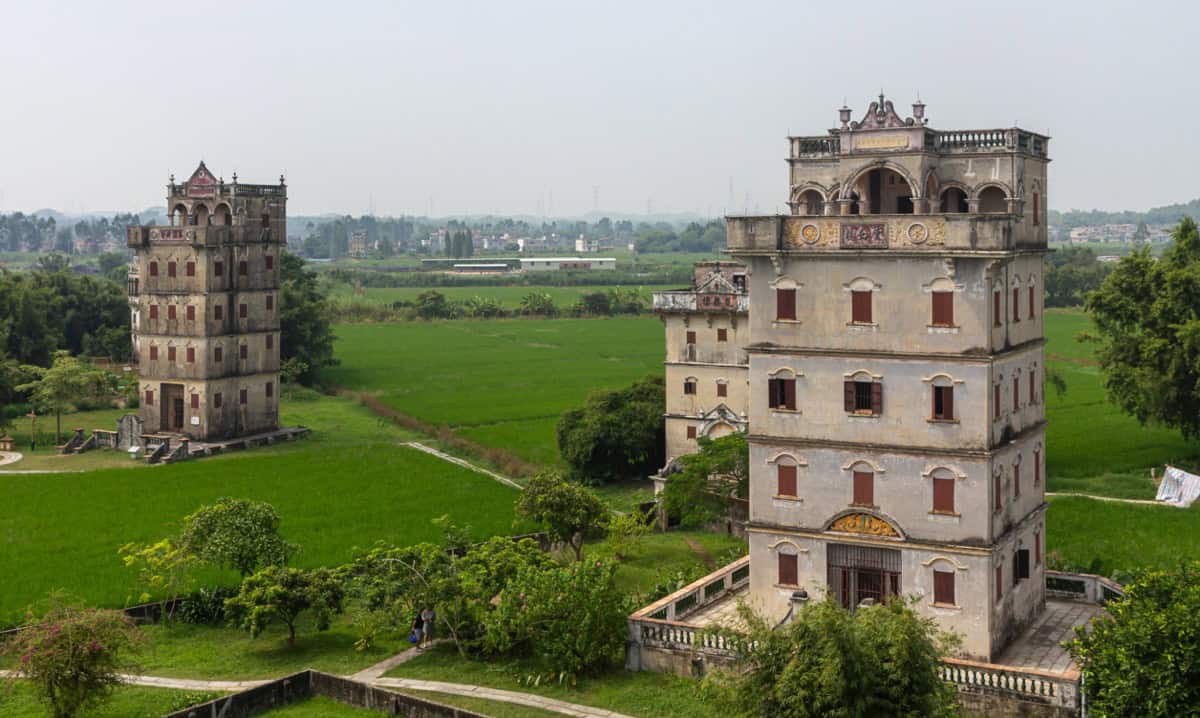
For over 150 years, the Wuyi region (五邑, Wǔyì) of southern Guangdong — the five counties of Taishan, Kaiping, Xinhui, Enping, and Heshan — has sent more overseas Chinese across the Pacific than any other place on earth. Today their descendants number in the millions, scattered across North America, Southeast Asia, Australia, and Latin America. And the vast majority of those descendants know exactly two things about their ancestral origins: their Chinese surname, and perhaps the name of a county their grandparents mentioned at the dinner table.
They do not know the village. They do not know the house. They do not know whether anyone still lives there, whether the ancestral hall still stands, or whether their name appears in any surviving record at all.
This fragmented knowledge is not a personal failure. It is the structural consequence of the split-family pattern (分离家庭, fēnlí jiātíng) that defined Wuyi emigration for over a century — husbands abroad for decades, wives and children in the village, letters crossing the Pacific at intervals of months, and then, after 1949, three decades of near-total severance during which no letters crossed at all. The interruption of village knowledge is the predictable legacy of exclusion laws, Cold War politics, and intergenerational distance. It is not something any descendant should apologize for.
But the central argument of this article is this: the surname you carry is not a dead end. It is a key. And the lock was built into the landscape of southern Guangdong eight centuries ago.

The single-surname village settlement pattern (单姓村, dānxìng cūn) means that the majority of Wuyi villages were founded and occupied by a single patrilineal clan, creating a structural one-to-one relationship between surname and place. This is not folklore — it is demography, recorded in local gazetteers and clan genealogies with the precision of a land registry. The Zhang (张) surname is not scattered randomly across Kaiping; Zhang concentrates in Zhangqiao (张桥), Shadi, Sijiu, and Shagang. The Guan (关) clan clusters in Chikan’s Tuotuo Dawu village. The Mei (梅) surname concentrates in Taishan’s Duanfen township. The Liang (梁) surname — Kaiping’s largest — anchors Beitan, Dasha Jiaoyuan, and Changsha. Nearly all of Kaiping’s 292 recorded surnames trace their entry through the same migration corridor: south from Nanxiong’s Zhuji Lane (珠玑巷, Zhūjī Xiàng) during the Southern Song dynasty, through Xinhui, and into the river valleys of what became the Five Counties. Guangdong provincial records document over 143 surnames and 797 families migrating from Zhuji Lane into the Pearl River Delta.
The surname also maps onto chain migration corridors that connect specific Wuyi villages to specific overseas destinations. These corridors are documented on both sides of the Pacific, giving the researcher two ends of a bridge to work from. Taishan’s Mei (梅) surname concentrated in Chicago. The Huang (黄) surname spread across the American West. Kaiping’s Guan (关) surname anchored San Francisco’s Chinatown. Kaiping’s Xie (谢) surname anchored Cangdong village — and every deep-dive in the series is collected in the Surname Archive. Xinhui’s Chen (陈) surname dominated early Kuala Lumpur. Taishan’s Lei (雷) and Liu (刘) surnames populated Melbourne’s Chinese-Australian community from the 1850s gold rush onward. These corridors are not coincidental. They are the structural residue of clan-based chain migration — the process by which a pioneer sponsored successive waves of kinsmen, each new arrival obligated to the sponsor and the village, each departure documented in the genealogy. The Surname Compass hub organizes this surname-specific knowledge as the first step in the discovery process — the infrastructure that makes the journey possible.
For many diaspora descendants, the ancestral village name has functioned across generations as a kind of heirloom — a word repeated at the dinner table, sometimes the only Chinese word their grandparents ever spoke to them, preserved because the people who carried it understood its importance even when they could no longer explain why. Perhaps you know the feeling. Your grandfather said “Taishan” but never the village. Your grandmother wrote three characters on a scrap of paper that you keep in a drawer and cannot read. Your parent shrugs when you ask — “I don’t know, they never told me.” This is not neglect. This is what the split-family pattern produced: generations of descendants who carry a surname as their only inheritance, a name that feels at once deeply significant and frustratingly vague. The village name was passed down not as practical information but as a fragment of identity, a talisman against complete forgetting. And it turns out that fragment is enough.
Your surname is not a fragment of lost heritage. It is a geographic coordinate, set down in the Southern Song and hardened by eight centuries of patrilineal settlement. The question is not whether the map exists — it is whether you know how to read it — and for the step-by-step practitioner’s method, see How to Find Your Chinese Ancestral Village.
Reading the Map in Your Name
If the surname is the key, the clan genealogy (族谱, zúpǔ, also 家谱, jiāpǔ) is the door it opens. And a zupu is not a book about the past. It is a map of the present village, organized by blood.

The standard Chinese clan genealogy is simultaneously a migration chronicle, a kinship map, and a property register. Its sections — lineage charts (世系图), biographical records (行传), ancestral hall records (祠堂记), and property registers (族产记) — collectively record not just who lived in a village but when they departed, where they went, which branch they belonged to, and where their ancestral hall and grave sites are located. For the roots-trip researcher, the most practically important content is the record of “those who went out” — entries that sometimes read only “went to Nanyang” but sometimes specify a city, a business name, even a street address. As the Wong surname deep-dive demonstrates, clan genealogies trace migration corridors and fang branches with documentary precision, creating a bridge between the diaspora present and the village past.
The fang system (房, fáng) is the spatial organizer that transforms “visiting the ancestral village” from a vague geographic concept into a precise itinerary. Each son of a founding ancestor establishes a branch that subdivides across generations, creating a nested hierarchy that maps every clan member onto a specific village neighborhood, house cluster, and branch ancestral hall (支祠). In the physical landscape of Wuyi villages, fang-based residential clusters surround their respective ancestral halls — the genealogy and the geography are the same document, written in different media. If you know your fang, you can walk to the correct section of the village, enter the correct branch ancestral hall, and find your specific household in the genealogy. This is not metaphor. This is how the village was laid out.
Generation poems (字辈, zìbèi, also 辈分诗, bèifēn shī) provide a genealogical positioning technology that is uniquely Chinese. These 20-to-40-character poems — where each successive character names a successive generation — allow any clan member to immediately locate their generational position within a lineage spanning centuries. If your grandfather was named with the 19th character of a 32-character poem, you know exactly where you sit in the generational hierarchy: which ancestor tablets in the ancestral hall correspond to your direct line, how many generations separate you from the founding ancestor, and precisely how you are related to every other living clan member you will meet in the village. The generation poem transforms an anonymous encounter into structured kinship. You will know who to call uncle, who to call cousin, and who to address with the formal deference due to a senior generation.
The triangulation methodology is essential because no single source tells the whole story. The Chinese historian Feng Erkang, author of the definitive study on clan systems and genealogy compilation, insists on cross-referencing three categories of evidence: genealogical texts, physical evidence (ancestral halls, grave sites, diaolou inscriptions), and oral history. This is not academic fastidiousness — it is practical necessity. Some clan genealogies contain fabricated origin claims, including invented connections to Zhuji Lane designed to confer prestige on a lineage that may have arrived by a different route. The only way to separate authentic from fabricated genealogy is to test it against physical evidence that cannot be rewritten and oral history that preserves what the texts chose to omit.
Qiaopi remittance letters (侨批, qiáopī) are the documentary smoking guns. These letters accompanied money sent from overseas laborers to Wuyi villages through sophisticated credit networks that could deliver funds from San Francisco to a Taishan village within two to four weeks. A qiaopi envelope bears the sender’s name, the recipient’s name, and — crucially — a village address. The letter inside contains instructions for how the money should be distributed among family members, sometimes including detailed specifications for construction projects. A single qiaopi letter can simultaneously prove that a specific ancestor lived at a specific address, sent money to specific relatives, and maintained an active relationship with the village at a specific moment in time. For the roots-trip researcher, finding your ancestor’s qiaopi letters is the genealogical equivalent of discovering a signed confession.
The good news is that you do not need to do this alone. An extensive institutional infrastructure already exists. The Returned Overseas Chinese Federation (侨联, qiáolián) and Foreign and Overseas Chinese Affairs Bureaus (外事侨务局) at county and municipal levels actively assist diaspora descendants with genealogy lookup, village verification, and family reunions. Taishan’s “Qiaoshi Tong” (侨事通) platform includes a dedicated roots-tracing column with an online request form; Kaiping’s municipal archives provide genealogical record access to overseas Chinese who present their documentation. Clan associations (宗亲会, zōngqīn huì) — dozens of which operate across the Wuyi diaspora, from the Huang Clan Association (江夏堂) to the Li Clan Association (陇西堂) to the Guan Clan Association (关陇西堂) — maintain archives, organize conventions, and serve as transnational bridges between diaspora descendants and their ancestral villages. The Guan clan’s history illustrates how these associations sustain diaspora-village ties across generations, maintaining the institutional memory that makes individual roots-trips possible.
Digital platforms are transforming the research process. The Jiangmen “Qiaodu Genyuan” (侨都根源) digital genealogy platform serves over 5.3 million Wuyi diaspora descendants with clan genealogy digital lookup — the first such platform in Guangdong province. WeChat-based clan groups, often organized by specific surname and village, provide real-time communication between diaspora descendants and village residents. The researcher who begins with a surname and an internet connection is already further along than any previous generation of roots-seekers could have imagined.
The Journey Before the Journey
Before you book a flight, there is something you need to understand. This is not a vacation.
The ancestral village you are planning to visit is not a tourist destination. It is a moral community (道德社区, dàodé shèqū) — a space where diaspora descendants inherit obligations that their ancestors never discharged, where giving is not charity but fulfillment of filial duty (光宗耀祖, guāng zōng yào zǔ, to bring glory to clan and ancestors), and where your presence will be interpreted through a framework of reciprocal responsibility that has been waiting for you for over a century.

To understand what you are walking into, you need to know which emigration wave carried your ancestors out of Wuyi — because each of the four waves produced a fundamentally different roots-trip experience for contemporary descendants.
The pre-1848 pioneers — traders, artisans, and sailors who ventured to Southeast Asia — left thin paper trails. For their descendants, archaeological and architectural evidence becomes disproportionately important. The villages they left may be older, their ancestral halls reconstructed multiple times, their genealogical records thinner but perhaps more ancient.
The 1848–1882 gold-rush and railroad generation is the largest wave, and the one that created the richest documentary record. These were the men who built the Central Pacific Railroad, who panned the streams of California and the goldfields of Australia, who were funded by the credit-ticket system (赊单制) — a financial arrangement in which labor brokers advanced passage costs using kinship obligations as collateral, requiring three to seven years of labor to repay. This means the reader’s ancestor was not simply “seeking opportunity.” They were embedded in a specific financial arrangement with specific people in a specific village, and some of those obligations followed them for life. Those same villages, transformed by the infrastructure their remittances built, waited in a state of suspended anticipation — neither pre-migration villages nor fully modern towns, but something in between that scholars call the qiaoxiang condition.
The 1882–1943 Exclusion Era generation faced legal barriers to return. The U.S. Chinese Exclusion Act of 1882 and similar laws in Australia and Canada created the split-family pattern in its most extreme form: husbands abroad for twenty or thirty years, visiting their wives once or twice a decade if at all, their children raised in father-absent households. For descendants of this wave, the village may hold no grave to visit — because their ancestors never returned. The return-migration threshold was sharp: emigrants who accumulated sufficient savings within ten to fifteen years were most likely to return and retire in Wuyi. Those who stayed abroad beyond twenty years typically never came back, and their graves are in overseas cemeteries. This absence is not failure — it is information, part of the story the village tells.
The post-1943 generation, and particularly those who emigrated after the 1965 U.S. Immigration Act, includes many who made return visits during their lifetimes. Their descendants are more likely to find living relatives in the village, more likely to have recent photographs, more likely to encounter elders who remember their grandparents. But they are also more likely to encounter the hollow village phenomenon — villages depopulated by emigration and domestic rural-to-urban migration, where ancestral homes stand empty and young people have moved to the cities.
Identifying which wave your ancestor belonged to determines everything: what records to expect, what architecture to look for, what kind of emotional frame the visit carries, and whether you are searching for a grave that exists in Wuyi or one that exists only in a cemetery across the Pacific.
And then there are the women. This is a history usually told through men — the laborers, the railroad workers, the gold miners — but the custodians of Wuyi villages during the decades of male absence were women. They managed households, raised children, directed remittance-funded construction projects, maintained ancestral rites, and preserved the family stories. They were the transmitters of village names and kinship knowledge across generations. In many diaspora families, the grandmother or great-grandmother was the person who kept the village name alive — the one who whispered it at the dinner table, who insisted it be written down somewhere, who understood its importance even when no one else seemed to. In contemporary roots-tourism, women are often the practical organizers of return visits, the genealogists who compile family records, and the emotional bridge between diaspora generations and village elders. The reader’s grandmother was likely the person who made this journey possible before the reader even knew it existed.
Your ancestor did not leave Wuyi as an individual seeking fortune. They left as a branch of a clan, funded by the clan, obligated to the clan, remembered by the clan. When you walk into that village, you walk into a web of obligation that has been waiting for over a century. This is not a burden — it is the shape of belonging.
Standing in the Village
This is the section that cannot be written. It can only be approximated, because the moment of physical arrival — when the village name your grandmother whispered becomes a place with gates, streets, and people — is not a reading experience. It is an embodied one. But here is what awaits you.

The ancestral hall (祠堂, cítáng) is the primary destination and the ritual center of the visit. Inside, spirit tablets are arranged hierarchically: the founding ancestor at the center-top, subsequent generations by fang branch and seniority, the entire lineage made visible in wood and calligraphy. The hall functions simultaneously as a temple where rites are performed, an archive where genealogies and clan documents are stored in specially constructed cabinets, and a gathering space where village elders meet and receive visitors. The fang system becomes spatial here: you can follow the layout of the ancestor tablets to locate your branch, then walk to the corresponding neighborhood of the village. The hall is not a museum — it is an active ritual space, and you enter it not as a spectator but as a returning member of the lineage. If the hall has been restored with diaspora funding, you may see donor plaques recognizing contributions by branch and generation — a visible record of the ongoing relationship between the village and its overseas descendants.
The ancestral house (祖屋, zǔwū) is the emotional climax of the visit. Even if vacant, dilapidated, or structurally unsound — and in the hollow villages (空心村, kōngxīn cūn) of contemporary Wuyi, many are all three — the ancestral house is the primary symbol of lineage identity. Entering it transforms abstract heritage into embodied experience. Documented case studies consistently show this as the moment when roots-trip visitors become emotional: the American-born descendant who collected soil from the ancestral home as a memento; the Australian family who, finding the house still standing, immediately began planning a return visit with extended relatives; the Seattle Chinese-American woman who located her maternal grandfather’s ancestral home in Kaiping through the Guan Clan Library and wept at the doorway because her grandfather had described it to her forty years earlier and she had never believed she would see it. The house may be empty. The emptiness is not failure — it is evidence of the economic forces that drove emigration in the first place and continue to reshape rural China.


Remittance architecture makes diaspora connection visible in the built landscape. The diaolou (碉楼, diāolóu) — the fortified watchtowers that dot the Kaiping and Taishan countryside — are material records of transnational wealth and architectural hybridity, combining Chinese defensive features with European columns, Mediterranean arcades, Islamic domes, and Art Deco patterns absorbed during decades of overseas labor. Each diaolou represents the accumulated savings of a decade or more of work abroad. Their inscriptions — auspicious characters, clan mottos, reign-year dates — provide precise chronological evidence readable by visitors who know what to look for. Western-style mansions, arcade shop-houses (骑楼), and remittance-funded schools and roads create a legible landscape. Taishan’s villages display this remittance-funded architecture in every diaolou, arcade, and ancestral hall — the built record of the diaspora connection. UNESCO inscription in 2007 transformed some of these villages into heritage tourism destinations, which means improved roads, interpretation, and infrastructure — but also the tension between authentic encounter and packaged experience.
Village elders are living repositories of unwritten knowledge. They know who lived in which house, which fang branch maintained which ancestral hall, which families sent emigrants to which countries, and which graves belong to which lineages. No amount of pre-trip research can replace a conversation with an elder who remembers. The documented cases are consistent: the Kaiping Guan clan visitor who, with the help of the Guan Clan Library curator and village elders, found living relatives within hours of arrival; the Australian Lei family whose breakthrough came from consulting elders who recognized names the written genealogy had omitted. Elders are not optional encounters — they are the oral component of triangulation, the living memory that completes the documentary record. When the village recognizes you, you belong to centuries of continuous lineage — not just to a moment of tourism.
You should also prepare for what you may not find. The post-1949 disruption — when ancestral halls were confiscated and converted to granaries or schools, clan rituals suppressed, and travel banned — followed by the post-1980s revival, created the exact landscape you will encounter today: a mixture of restored and unrestored buildings, revived and simplified rituals, living and hollow villages. The village you find may not match the village you imagined. Inherited memory carries idealization, and the gap between that memory and present reality is not a failure of the trip — it is part of its meaning. Some graves are not findable. Decades of land reform, agricultural expansion, and infrastructure development have destroyed, relocated, or obscured many ancestral graves. The search itself, guided by elders and genealogical clues, often yields unexpected discoveries — distant relatives, oral histories, alternative sites — that enrich the experience even when the specific grave remains unfound.
The ancestral hall is not a museum. Spirit tablets are arranged by generation and branch, and if you can read the hierarchy, you can find your line. The ancestral house may be empty — the hollow village is not a failure, it is evidence of the forces that scattered your family. And the elder sitting in the doorway may be the only person alive who knows which house was yours.
The Return That Never Ends
The journey does not end when you board the flight home. The roots-trip is not a one-time event — it is the beginning of a cyclical relationship that started before you were born and will continue after you are gone.

Your visit is the latest expression of a two-century pattern of diaspora-hometown engagement. It was preceded by remittance-funded construction in the late nineteenth and early twentieth centuries, when overseas laborers sent money home to build houses, schools, roads, and ancestral halls. It was preceded by revolutionary funding in the early 1900s, when Wuyi overseas Chinese bankrolled Sun Yat-sen‘s movement. It was followed by Cold War severance, post-reform reinvestment, and now heritage tourism and cyclical return. Each phase was shaped by the political and economic conditions of its era, but the underlying rhythm — departure, obligation, return, reinvestment, departure again — has never stopped. You are not an anomaly. You are a participant in a deeply established pattern.

Diaspora identity is transformed through physical return. Inherited identity — the stories, the photographs, the village names — becomes experiential identity: the memory of standing in the ancestral hall, performing rites, touching the wall of the ancestral house. The documented case studies are consistent: visitors who arrive anxious about recognition leave committed to return, often planning multi-generational family trips within the same year. The initial visit is reconnaissance. The second visit is reunion.
The Qingming festival (清明, Qīngmíng) — the spring tomb-sweeping festival — is the peak temporal anchor for the ongoing relationship. Since the 1980s, overseas Chinese have increasingly returned for Qingming, when village ritual life is most active. Lineage organizations charter buses for collective grave visits. Families clear vegetation, make offerings, burn incense, and share food at the graveside. Qingming is simultaneously a ritual event, a family reunion, and the richest possible temporal window for roots-tourism.
For those seeking a collective entry point, clan conventions (恳亲大会, kěnqīn dàhuì) offer a structured path. The World Mei Clan convention at Meijia Dayuan in Duanfen drew over 2,000 attendees from the United States, Canada, and Brazil. The World Wu Clan convention has operated for 39 continuous years. These events provide organized genealogy workshops, group ancestral hall visits, and ceremonial 认祖归宗 (rèn zǔ guī zōng) — recognize ancestors, return to the clan — rituals that transform individual roots-trips into collective experiences.
Digital technology sustains the connection between visits. WeChat clan groups provide real-time communication between diaspora descendants and village residents. Digitized qiaokan periodicals (侨刊, qiáokān) — the historical print medium that connected diaspora to villages — are being preserved and made searchable by the Jiangmen Archives. Preserving Siyi dialect is one way diaspora descendants maintain living connection to ancestral villages between visits — the language itself is a bridge. DNA testing and AI-powered genealogy matching are emerging tools that may help where textual records fail. These technologies do not replace physical return. They sustain the relationship between returns, creating a “virtual qiaoxiang” — a digitally mediated hometown that never fully disconnects.
Ancestral hall restoration deserves honesty. Diaspora funding creates both connection and tension. The visitor who chooses to contribute enters ongoing negotiations about control, authenticity, and recognition. Different fang branches may compete for recognition or ritual precedence. This is not a reason to avoid contributing — it is the natural complexity of a living relationship.
And here is a horizon you may not have considered. The same-surname marriage prohibition (同姓不婚) means that every reader with a paternal surname village also has maternal ancestors in different surname villages — through their mother, their grandmother, their great-grandmother. The roots-trip that begins with one surname may expand to encompass a web of kinship villages. The patrilineal journey leads to one village; the matrilineal journey leads to several more. The surname that brought you here was the beginning, not the end.
The entire journey can be reframed in a single arc: from “I know my surname” to “I am in relationship with my ancestral place and people.” The surname you carried, which once felt like a fragment of loss — a word you could not read, a place you could not find, a connection you could not prove — has proven to be the key to a living connection that extends backward eight centuries and forward into every Qingming that follows. The roots-trip is not a question you answered once. It is a compass that points home. And home is a place that now knows you have returned.
Continue Reading
-
Your Surname, Your Compass: A Wuyi Roots Discovery Hub — The central discovery infrastructure that establishes the surname-as-key premise. Start here to understand how your family name connects to the Wuyi diaspora.
-
The Wong Surname: Tracing Its Noble Origins and Global Legacy — A deep-dive into one Wuyi surname’s history, migration corridors, and clan organization — the model for what surname research can reveal.
-
Plan Your Roots Trip: A First-Timer’s Guide to Taishan and Kaiping Villages — Practical logistics: transport, accommodation, language tips, and what to expect on the ground once you know your ancestral village. The natural next step after this article.
-
Taishan Villages: History, Architecture, Heritage — Explore the remittance-funded built landscape — diaolou, ancestral halls, arcade shop-houses — that makes Wuyi villages legible records of diaspora connection.
Sources
Books
- 梅伟强, 张国雄. 五邑华侨华人史 [History of Wuyi Overseas Chinese]. 广东高等教育出版社, 2001. ISBN 978-7-5361-2610-3.
- 冯尔康. 中国宗族制度与谱牒编纂 [Chinese Clan System and Genealogy Compilation]. 天津古籍出版社, 2011. ISBN 978-7-80696-896-3.
- 张国雄. 岭南五邑 [The Five Counties of Lingnan] (2nd ed.). 三联书店, 2015. ISBN 978-7-108-05401-2.
- 张国雄. 开平碉楼与村落 [Kaiping Diaolou and Villages]. 中国华侨出版社, 2008. ISBN 978-7-80222-678-0.
- Yow Cheun Hoe. Guangdong and Chinese Diaspora: The Changing Landscape of Qiaoxiang. Routledge, 2013. ISBN 978-0-415-64222-4.
- Kuah-Pearce, Khun Eng. Rebuilding the Ancestral Village: Singaporeans in China (2nd ed.). NUS Press, 2011. ISBN 978-9971-69-525-5.
Web Sources
- Guangdong Provincial Government — Zhuji Lane Cultural Heritage
- China News — Zhuji Lane: 143 Surnames, 797 Families Migrated South
- Taishan Government — Qiaoshi Tong Roots-Tracing Platform Launch
- Guangdong Overseas Chinese Affairs — Digital Genealogy Platforms Overview
- Taishan Government — US Chinese-American Roots-Trip Case Study
- Guangdong Overseas Chinese Affairs — Kaiping Guan Clan Roots-Tracing Success Case
- Kaiping Broadcasting (WeChat) — 292 Kaiping Surnames, Village-Level Distribution
- Kaiping Government — Archives Genealogy Access Procedures for Overseas Chinese
- The Paper — Shantou Digital Genealogy: AI-Powered Lineage Charts
Is this your family’s story?
Roots Of China is built from readers’ family histories. If a story here sounds like your own — a surname, a village, a journey — leave a comment below, or share your family’s story with us and we may be able to help you find your ancestral village.
