


Yamen 1279: The Battle That Ended the Song Dynasty
The End of a Dynasty
For three hundred years the Song dynasty (宋朝, Sòng cháo) had been the most advanced state of its age — the world’s largest cities, the invention of movable type and gunpowder, a civil service that prized learning over birth. And when it ended, it ended not in a palace or a capital city, but in a shallow bay at the mouth of a river, where an eight-year-old emperor was carried into the sea on the back of his chancellor. The place was Yamen (崖山/崖门, Yáshān/Yámén), in Xinhui (新会, Xīnhuì) — one of the five Wuyi counties of Guangdong, the very region that would later send millions of its people across the same waters the Song court had sailed.
The fall of the Song is usually dated to a single day, 19 March 1279, and to a single battle fought between the rocks and the tide. But the story that matters is longer than a battle. It is the story of how a dynasty’s end became a region’s memory — and how that memory was packed into the luggage of every emigrant who left Wuyi for Gold Mountain, and carried, still warm, into the overseas communities that now search for where it all began.
The Last Court of the Song
The Song had already lost its capital three years before Yamen. In 1276 the Mongol armies of Kublai Khan took Lin’an (临安, Lín’ān) — present-day Hangzhou — and the child emperor Gong was carried north into captivity. It could have ended there. Instead, a remnant of the court refused to surrender, and around two infant half-brothers it kept the dynasty alive for three more years, retreating south along the coast from Fuzhou toward Guangdong.
The first of the two boys, Zhao Shi (赵昰, Zhào Shì), was enthroned as Emperor Duanzong (端宗, Duānzōng) in 1276, and died of illness in 1278 during the flight. The second, Zhao Bing (赵昺, Zhào Bǐng), was enthroned in 1278 at a place called Gangzhou (碙洲, Gāngzhōu) — often associated with the Xinhui–Jiangmen coast, though its precise identification remains debated — becoming the last emperor of the Song, aged about seven. The court that gathered around him was less a government than a floating procession of loyalists, scholars, soldiers, and their families, drifting along the edge of a sea that had become their only road.
What held that procession together was not territory — it had none left — but the conviction that the dynasty was a thing worth carrying. Every stop along the coast was a smaller, poorer version of the last; every harbor a gamble on how long the pursuit would take to arrive. The refugees moved through exactly the country that would later empty itself into the same sea for a different reason: the coast of Taishan and Xinhui, the estuaries and hidden ports, the villages that would become the point of departure for one of the greatest emigrations in Chinese history.

Yamen: The Geography of a Last Stand
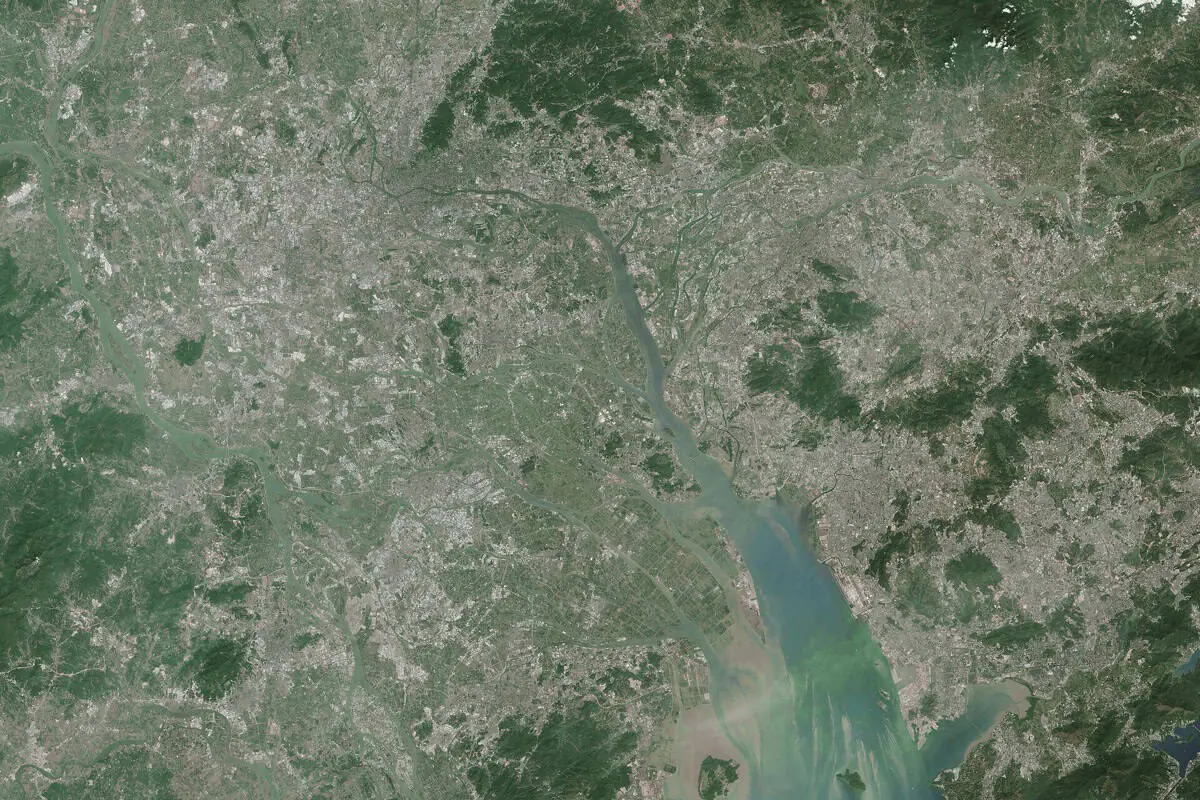
Yamen sits where the West River meets the South China Sea, at the far western edge of the Pearl River estuary. The name means “cliff gate” — the narrow mouth where the river pours between rising rocks into open water. Nearby lies Lingdingyang (伶仃洋, Língdīngyáng), the stretch of estuary whose name would be tied to the dynasty’s most famous poem.
Why fight here? Because by 1279 there was nowhere left to go. The Song’s strength had always been maritime — its cities, its grain, its trade all moved by water — and so its last stand was a naval one. The court had been pushed to the very southern edge of the empire, into a region that would one day be called Wuyi (五邑, Wǔyì), the “five counties” of Taishan, Xinhui, Kaiping, Enping, and Heshan. It was, in a literal sense, the end of China — the place where the land ran out.
That geography was both refuge and trap. The estuary offered shelter, fresh water, and a defensible position. But it also offered no escape route if the line broke — only open water in one direction and the pursuing fleet in the other. The same coast that had once been the Song’s granary and its ports would now witness its extinction.
The Battle: Chained Ships and the Turning Tide
The Song commander, Zhang Shijie (张世杰, Zhāng Shìjié), made a fateful decision. He chained his roughly one thousand ships together, side by side, into a single floating fortress — traditional estimates put the number of people aboard at about two hundred thousand, though the precise figure is unreliable. Chaining prevented desertion and presented a solid wall of ships. But it also surrendered the one thing a fleet needs: the freedom to move.
Against them came a Yuan (元, Yuán) fleet under Zhang Hongfan (张弘范, Zhāng Hóngfàn), a commander who was himself of Han descent — a reminder that the Mongol conquest mobilized Chinese subjects on both sides. His fleet’s exact size is not well recorded, though it was probably smaller and more maneuverable. Zhang Hongfan did not need to outnumber the Song. He blockaded the shore, cutting off the fresh-water springs the chained fleet depended on, then waited. When the tide turned, he attacked — with fire ships first, then a coordinated assault from two directions that the fixed Song line could not answer.
The two hundred thousand people aboard were not an army. They were a government, a court, and a civilian population — scholars, clerks, cooks, families, children — lashed to a military formation they could not leave. When the line broke, the slaughter was not a battle between soldiers so much as the drowning of a whole society. On 19 March 1279 the Song dynasty, as a political fact, came to an end.

Lu Xiufu and the Child Emperor
It was in that collapse that the battle’s defining act occurred — the act for which Yamen is remembered when every other detail is forgotten. The chancellor Lu Xiufu (陆秀夫, Lù Xiùfū), seeing that defeat was certain, took the child emperor Zhao Bing on his back and leapt into the sea, drowning them both. He chose drowning over capture, and he chose to take the emperor with him rather than let the last heir of the Song fall into enemy hands.
The choice was deliberate. Lu Xiufu had spent years as the guardian and tutor of the two child emperors, shepherding them through a collapsing world. In the end he treated the emperor’s person as the dynasty itself — a thing that could not be allowed to be taken, only to end. The histories record that he first ensured his own family would not survive the fall, then turned to the boy and stepped into the water.
He was not alone. The dowager empress Yang (杨太后, Yáng tàihòu), the child emperor’s mother, threw herself into the sea when she heard of his death. Traditional accounts report that many others — officials, soldiers, civilians — perhaps thousands, drowned themselves rather than submit; the exact numbers are unknown. Zhang Shijie escaped with a remnant of the fleet but drowned days later when his ship capsized in a storm off the Guangdong coast.
What happened at Yamen was not merely a military defeat, and the loyalists knew it even as they died. It was the moment a dynasty passed from a political fact into a moral one — from a state that had lost a war into an example that would be taught for centuries. The histories that record the battle do not linger on the tactics, which were desperate and failed, but on the choice to drown rather than submit. In that choice, the Song lost its throne and won something else: a permanent place in the moral imagination of the people who would later call themselves its heirs. For the region that witnessed it, and for the descendants who would one day leave that region, the lesson was simple and unforgettable — that there are endings one chooses, and those are the ones that outlast everything.

Wen Tianxiang and the Poem
One of the most famous figures connected to Yamen was not there at all. Wen Tianxiang (文天祥, Wén Tiānxiáng), the scholar-official and poet who had organized resistance against the Mongols, had already been captured. He was brought to Yamen as a prisoner, in the company of the Yuan fleet, and asked to write a letter urging the Song court to surrender. He refused.
What he wrote instead became the dynasty’s epitaph. In the poem Crossing the Lingding Ocean (过零丁洋, Guò Língdīngyáng), composed around this period and in this stretch of water — its exact date is not firmly fixed — he set down the lines that would outlive the Song by eight hundred years:
人生自古谁无死,留取丹心照汗青。
“Since ancient times, who has not died? Leave a loyal heart to shine on the annals of history.”
The line is worth reading closely. It is not a cry of defiance but a statement of arithmetic: everyone dies; the only question is whether one’s death leaves a mark on the records that outlast it — the “green history” (汗青, hànqīng), named for the green bamboo strips that were scraped and strung into early books. Wen Tianxiang was writing not for victory, which was impossible, but for the archive.
Wen Tianxiang was carried north to the Mongol capital at Dadu (大都, Dàdū), held for years, offered rank and pardon, and executed in 1283, having refused them all. The dynasty he refused to betray died before him. The line he left behind did not.

After Yamen: “No More China”
Yamen did not stay a battlefield. It became a shrine. In the centuries after the battle, the site was marked by the Ciyuan Temple (慈元庙, Cíyuán miào), honoring the dowager empress and the loyalist dead, maintained across the Ming and Qing with the support of officials, local gentry, and ordinary worshippers. Stelae and poems accumulated at the cliffs, and Yamen became a place southern scholars visited to mourn — a literary landmark as much as a ritual one.
Later dynasties had their own reasons to remember it. Scholars have read the Ming dynasty’s revival of Yamen commemoration as connected to its own founding project of restoring Chinese rule after the Mongol Yuan — an interpretation rather than a proven chain of cause, but a suggestive one. A site where loyalty had triumphed over defeat was useful to a new dynasty that needed to teach exactly that lesson. The temple was rebuilt, the sacrifices renewed, the poems recopied, each generation adding its own layer to the memory the way each dynasty added a stone to a wall.
The literary record of Yamen is itself a kind of monument. Generations of southern scholars made the pilgrimage to the cliffs and left verses behind — poems of mourning, of indignation, of the strange consolation that comes from visiting a place where the worst has already happened and been survived. These poems do not agree on every detail, but they agree on the essential thing: that Yamen is not a place you visit to learn what happened, but a place you visit to feel what it meant. That feeling is what the phrase “after Yamen, no more China” tries, clumsily, to name.
In our own time a different phrase has attached itself to Yamen: 崖山之后无中国, “after Yamen, no more China.” The slogan is a modern construction, not a Song-era text — it appears in no classical source — and many historians reject it as ahistorical. It is best understood not as a statement of fact but as cultural memory: the conviction, held with real emotion, that something essential to Chinese civilization was lost in that bay and never fully recovered. Whether or not one accepts the claim, its persistence is itself the proof that Yamen still matters.

Yamen in Wuyi Memory
For the region that surrounds it, Yamen is not distant history. It is part of the landscape’s self-understanding. Some Wuyi genealogies claim descent from Song-era officials or loyalists who stayed in the south after the dynasty fell — claims best read as lineage self-understanding rather than verified descent. The region’s founding stories carry the same register: the Zhuji Lane (珠玑巷, Zhūjīxiàng) motif, which traces Wuyi families to a remembered passage south, and the “lost consort” legend of a fleeing Song emperor’s concubine. These are widespread and deeply felt migration narratives, but their literal historicity is uncertain. What they reliably record is not a settlement date but a feeling: that Wuyi is a place people came to because somewhere else was lost.
That feeling is the deeper meaning of Yamen for this region. The Song court came south and died at the water’s edge, and the region absorbed the memory of that ending. Six centuries later the region’s young men would leave the same coasts by the tens of thousands. The two departures rhyme: the loyalists fleeing a fallen north, the emigrants fleeing poverty and war and closed futures. Both carried their homes with them, and both left behind a shoreline that never stopped being a point of departure.

What Yamen Means for the Diaspora
From the 1840s onward, Wuyi became among the most important emigrant-sending regions of China. The machinery of departure is well documented: the credit-ticket system (赊单, shēdān) that financed passage on debt, the chain migration that moved village after village, and the split household (两头家, liǎngtóujiā) held together across the Pacific by remittance letters (银信, yínxìn) — the “silver letters” that fused money and message into a single document. A wife left behind, the 金山婆 (jīnshān pó, “Gold Mountain wife”), often ran the farm, the household, and the ancestral rites alone, waiting on letters that might stop at any time.
The routes themselves were old. The estuaries and hidden ports of Wuyi had carried ships long before the emigrants used them — the same water the Song court had crossed, the same coastal towns that had shipped men abroad for generations. The 1882 Exclusion Act redirected much of the flow toward Australia and Southeast Asia, while the paper-son system became a means of evading the American restrictions; 1949 largely froze ties for three decades; and reconnection after 1978 revived the genealogies and the returns.
Through all of it, regional memory traveled with the emigrants. Overseas Wuyi communities reproduced the institutions of home — clan associations (宗亲会, zōngqīn huì), temples, opera, festival ritual — and with them the stories. A villager who left Xinhui in 1880 for San Francisco or Melbourne carried, whether or not he could have named the battle, the sense that his homeland was a place where an empire had ended and a people had endured. The women who stayed behind, waiting in the villages, were themselves part of that endurance — the Wuyi women whose waiting held the region together. That is not a coincidence of geography. It is the reason the memory was worth carrying.
The Memory Carried Home
The Song dynasty ended on 19 March 1279, but Yamen did not end with it. A temple still stands near the water; a poem is still quoted; a phrase still provokes argument; and a descendant, somewhere in Toronto or Vancouver or Sydney, still types 崖山 or “Yamen” into a search box, trying to understand the place their family came from.
That search is the reason this article exists, and the reason the site you are reading now — a project devoted to the Wuyi diaspora — treats a thirteenth-century battle as its own history. If you want to follow the thread further, your surname is the compass that points back to a village; learning to read a zupu can open the family record; and the wider story of how a region like Wuyi shaped China’s identity begins in the same water where the Song ended. What it means to come from the south — the spirit of Lingnan — is, in part, the memory of this ending.
A dynasty is a large thing to lose, and it is hard to hold in the mind. But every family carries some smaller version of the same shape — a place that was home, a departure, a memory kept. Yamen is one of the places where the two meet: an empire’s last stand, and a people’s first departure. Eight hundred years on, the sea has not stopped receiving the ones who went into it, and the ones who left across it are still coming home.
Sources
Books
- 脱脱 等,《宋史》(History of Song, 1345) — annals of the young emperors and the biographies of 陆秀夫, 张世杰, and 文天祥.
- 黄淳 辑,《崖山志》(Yamen Gazetteer, Ming, 1563) — the battle’s geography and commemoration.
- 梅伟强、张国雄,《五邑华侨华人史》(广东高等教育出版社, 2001).
- 张应龙,《广东台山华侨史》(广东人民出版社, 2010).
- Frederick W. Mote, Imperial China 900–1800 (Harvard University Press, 1999).
- Madeline Y. Hsu, Dreaming of Gold, Dreaming of Home (Stanford University Press, 2000).
Web sources
- Battle of Yamen — Wikipedia
- Wen Tianxiang — Wikipedia
- Lu Xiufu — Wikipedia
- 崖山海战 — 百度百科
- Jiangmen Municipal Government (jiangmen.gov.cn) — Xinhui and the Yamen Sea Battle memorial site.
Images — sourced from Wikimedia Commons (real photographs; EXIF-verified camera data). Featured image: Kaiping diaolou at Zili Village.
Continue Reading
- The Five Counties of Guangdong: A Cultural and Historical Overview
- Legacy of Wuyi: The Untold Story of How a Region Ended the Qing Dynasty
- The Spirit of Lingnan: What It Means to Come from the South
- How Xinhui’s 19th-Century Migration Boom Shaped Generations
Suggested Reading
Is this your family’s story?
Roots Of China is built from readers’ family histories. If a story here sounds like your own — a surname, a village, a journey — leave a comment below, or share your family’s story with us and we may be able to help you find your ancestral village.
