

The Fall of the Song Dynasty: Yamen, Mongol Conquest, and Wuyi’s Origins
The Battle at the Doorstep
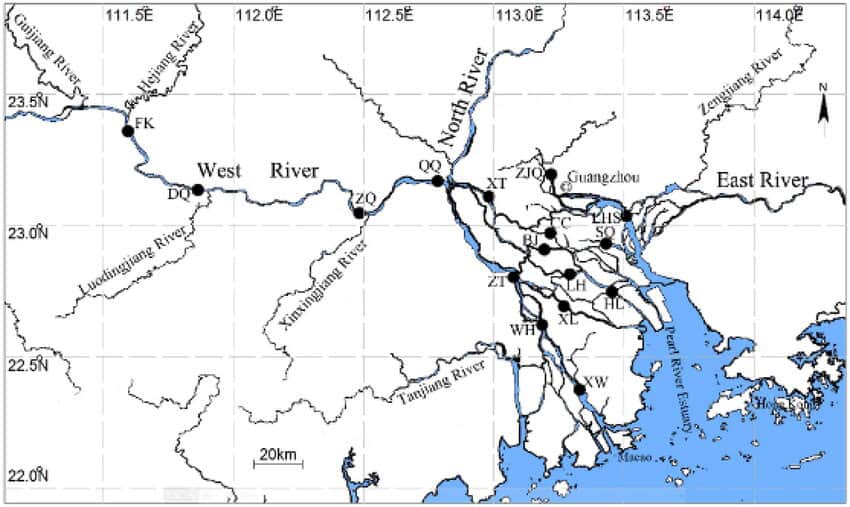
The battle that ended the Song dynasty was fought within sight of the villages that would one day send their people across the world. For more than three centuries the Song (宋朝, Sòng cháo) had ruled the most prosperous and literate state of its age — a civilization of print, gunpowder, and ocean-spanning trade — and its fall was no quiet abdication in a distant capital. The final act of the fall of the Song dynasty was a naval battle fought in March 1279 at Yamen (崖山, Yáshān), the narrow estuary where Guangdong’s waters meet the South China Sea. Yamen lies inside today’s Xinhui (新会, Xīnhuì) district of Jiangmen — at the doorstep of Wuyi (五邑, Wǔyì), the five counties of Guangdong that later became China’s first great emigrant region.
When the Song fell, its court, its armies, and its civilian population scattered south into the Pearl River Delta, and among the places they settled were the counties whose descendants would later cross the Pacific by the hundreds of thousands. The empire ended at Wuyi’s waterline — and the memory of that ending became part of how Wuyi explained itself: who its people were, where they had come from, and why they had arrived.
This article does not retell the battle itself. It follows what the battle set loose — a war fought over a generation, a refugee dispersal through a remembered gateway called Zhuji Lane, the genealogies in which that passage was written down, and the letters through which overseas descendants still claim it. The question underneath is simple: how does a national catastrophe become a family’s founding story?
The Long Fall, 1234–1276
The Mongol conquest of the Song was not a sudden collapse but a war of roughly forty-five years, fought across the length of China before it reached the southern coast.
One conventional trigger for the war is the episode historians call 端平入洛 (Duānpíng rù Luò), the “advance on Luoyang” of 1234. That year the Song allied with the Mongols to destroy the Jin dynasty, which had ruled the old Song heartland for a century — then, tempted to reclaim its ancient capitals, sent troops to occupy Luoyang. The move failed and handed the Mongols a pretext for war; whether war would have come anyway is debated. Either way, 端平入洛 is the conventional opening of a forty-five-year conflict.
For four decades the war moved in waves along China’s river lines. The turning point came in 1273, when the fortress city of Xiangyang (襄阳, Xiāngyáng) — the hinge of the Song’s middle-Yangtze defense — fell after a prolonged siege; the door it opened never closed. Three years later, in 1276, the capital Lin’an (临安, Lín’ān), the city now called Hangzhou, surrendered. The child emperor and his guardians had already slipped out, carrying the dynasty south in a desperate procession of loyalists, officials, soldiers, and families — down the coast through Fujian toward Guangdong, toward the region whose villages would one day claim the fall as their own beginning.
1279: Yamen and the Child Emperor
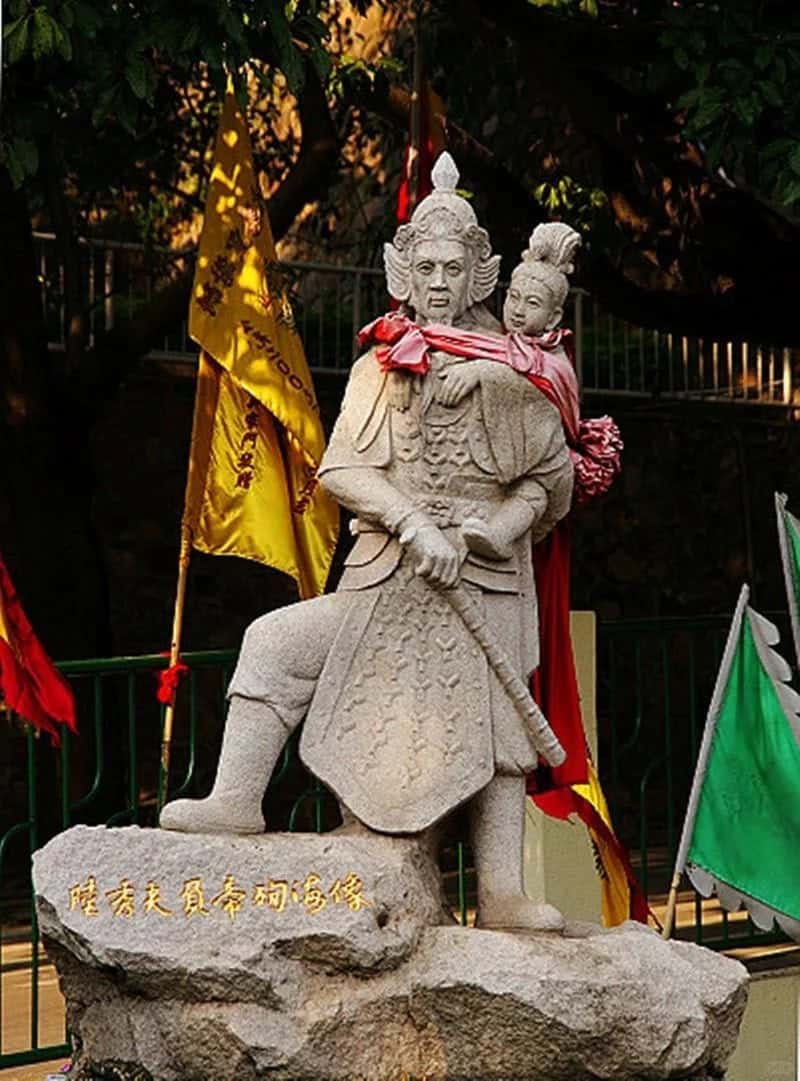
The remnant court made its stand at the sea’s edge. By 1278 the boy emperor Zhao Bing (赵昺, Zhào Bǐng), a son of the late Emperor Duzong, had been enthroned on an island off the coast recorded as Gangzhou (碙洲, Gāngzhōu), and the floating court anchored at Yamen, chaining its ships together in the bay while the pursuing Yuan (元, Yuán) fleet closed in. On 19 March 1279 the decisive battle ended the dynasty. The traditional account — repeated in histories, schoolbooks, and family stories — holds that when the Song line broke, the chancellor Lu Xiufu (陆秀夫, Lù Xiùfū) carried the eight-year-old emperor on his back into the sea rather than let him be captured. It is the standard account; the words supposedly exchanged between the two men were certainly added by later writers, and scholars treat such scenes as narrative elaboration. The battle itself — the chained fleet, the turning tide, the drowned commander Zhang Shijie (张世杰, Zhāng Shìjié) — is told in full in the story of the battle of Yamen.
What matters is what three men around that defeat represent. Lu Xiufu, Zhang Shijie, and Wen Tianxiang (文天祥, Wén Tiānxiáng) — the scholar-official captured in 1278 who refused every pardon and was executed in 1283 — are remembered together as the 宋末三杰 (Sòngmò Sānjié), the “Three Loyalists of the late Song.” Their deaths became the template of a distinctly southern memory of loyalty: that the dynasty was a moral thing, worth dying for even when it could not be saved.
Tradition adds that the child emperor’s body drifted to Chiwan (赤湾, Chìwān) on what is now Shenzhen’s coast, where he is said to rest at the Song Emperor’s Tomb (宋少帝陵, Sòng Shàodì Líng) — a later, reverent tradition. Its existence makes the point: the defeated dynasty did not vanish from the landscape. It left graves, shrines, and a shore full of people who had watched an empire die on their own water.
The Dispersal: War Becomes Migration
The war that ended at Yamen did more than kill a dynasty; it set a population in motion. When the court fled south in 1276, the Yuan armies were close behind, and one of the regions they struck was northern Guangdong. In that same year — the second of the Deyou era (德祐二年, Déyòu èr nián) — Yuan forces under the general Lü Shikui (吕师夔, Lǚ Shīkuí) attacked the prefecture of Nanxiong (南雄, Nánxióng), and residents of the market town gathered around its famous lane, Zhuji Lane (珠玑巷, Zhūjī Xiàng), fled south to escape the soldiers.
This claim anchors Wuyi’s origin stories, and it must be stated carefully. No Song-era bureau counted refugees on the road south. What exists is a repeated, consistent record across hundreds of Guangdong genealogies and local traditions: that when the Song fell, their ancestors left Nanxiong and went down into the delta. Scholars read it as genuine collective memory and documented tradition — real displacement, remembered in family documents — while conceding that it cannot be dated to the day or counted to the person.
The remembered route ran along the rivers. From Zhuji Lane, families followed the Zhen River (浈水, Zhēn Shuǐ) south past Shixing and Qujiang, joined the North River (北江, Běi Jiāng), and rode its current into the Pearl River Delta — dispersing into Guangzhou, Foshan, Shunde, Zhongshan, and, prominently, Xinhui and Kaiping, the counties of Wuyi. The geography explains the outcome: the delta sat at the end of a natural corridor of flat, watery, still-underpopulated land — and the last stretch of that corridor opened onto the coast where the dynasty had just died.
Nor should the timing be flattened into a single exodus. Genealogies record layers: families who came in the early Southern Song, fleeing the Jin invasions of the 1120s in the 靖康南渡 (Jìngkāng nándù), the “southward crossing” after the 1127 fall of Kaifeng; families who came later, in the Xianchun (咸淳, 1265–1274) and Deyou (1275–1276) years of the Mongol war; and the families of the final dispersal itself — the Fang surname’s story of the Song court’s fall is one version of these layers. What the war years added was a sharp final surge, arriving just as the old order ended — and that surge left the deepest mark on the region’s memory of itself.
The Zhuji Lane Funnel and the Luo Gui Legend
Zhuji Lane in Nanxiong, just south of the Dayu mountain pass, was a real staging town on the great north-south road — but over the centuries it became the shared origin-memory of the region: the remembered gate through which a people claimed to have entered the south. The historian Liu Zhiwei (刘志伟) has argued that the legend functions as a collective identity claim as much as a migration record — a way for lineages to attach themselves to a common, respectable origin — and that is the right frame for reading it.
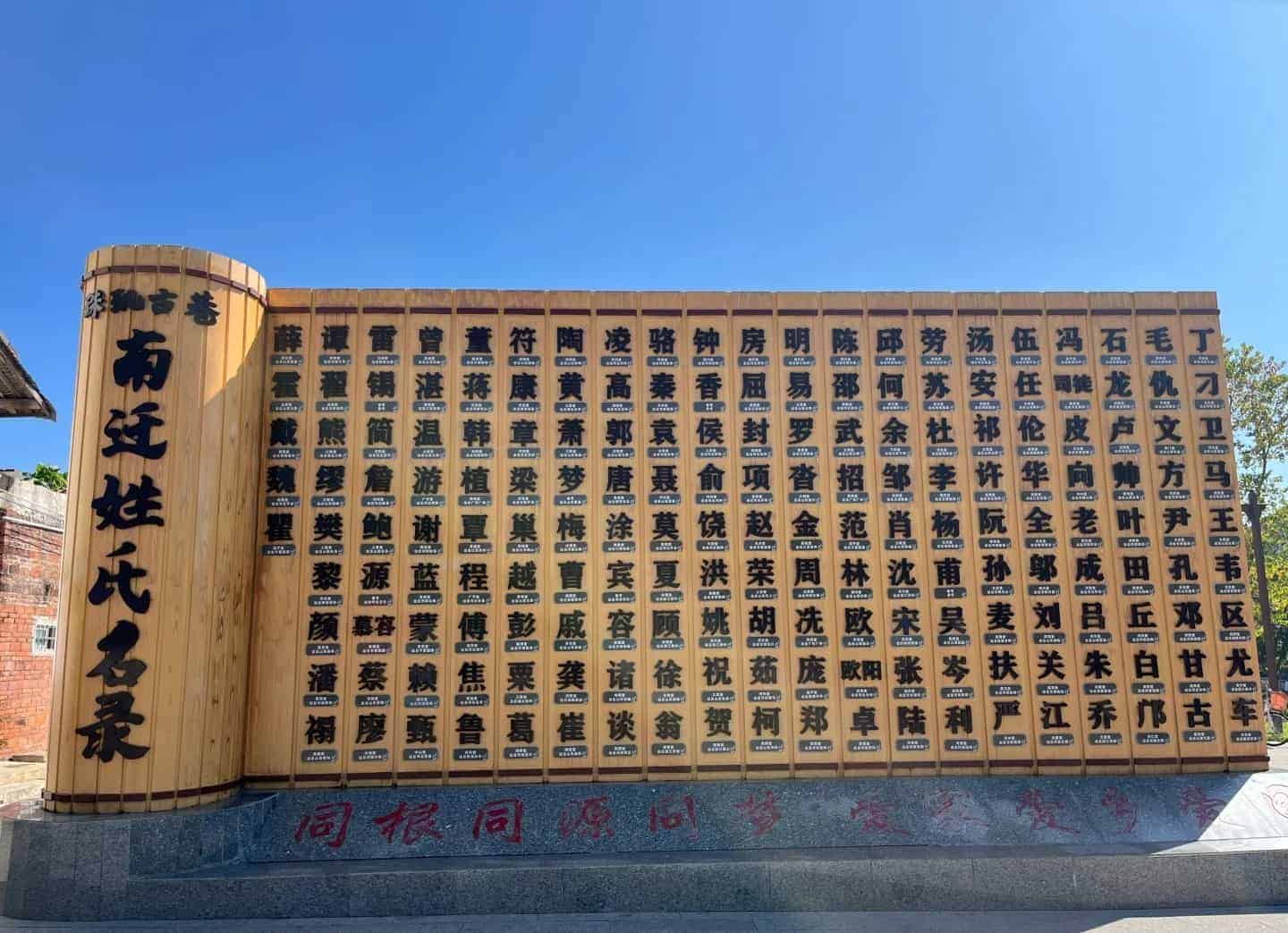
At the heart of the story stands a named figure: Luo Gui (罗贵, Luó Guì). According to the tradition, preserved across many surname genealogies and in the records of Liangxi village (良溪村, Liángxī Cūn) in what is now Jiangmen’s Pengjiang district, Luo Gui led a collective petition to migrate south: 97 households and 33 surnames, moving together under the protection of a consort of the imperial house — remembered variously as Consort Hu or Consort Su (胡妃, Hú Fēi; 苏妃, Sū Fēi) — who had taken refuge in the lane. No hard contemporary evidence confirms the count of households, the roster of surnames, or the consort’s role. Even the date is contested, with different genealogies placing the migration in the Shaoxing era (绍兴, 1131–1162) or the Xianchun era (1265–1274) — a gap of more than a century that no amount of local pride has reconciled. The Luo Gui tradition is best understood as the region itself understands it: a founding story, durable and beloved, whose year and numbers remain genuinely uncertain.
What is not in doubt is the story’s institutional weight. In May 2022 the tale of the Zhuji Lane southward migration (珠玑巷人南迁传说) was designated provincial intangible cultural heritage of Guangdong — its eighth batch — on the strength of documentation from the Jiangmen and Shaoguan governments. Liangxi village still preserves the tomb of Luo Gui and the Luo ancestral hall (罗氏大宗祠, Luó shì dàzōngcí), and the village is remembered as the migration’s endpoint. Whatever the historical Luo Gui counted in 97s and 33s, the lane and its legend are officially — and emotionally — the region’s common door.
The scale of the claim deserves plain labeling. It is often said that roughly 70 percent of Cantonese people — an estimated fifty million — claim descent from Zhuji Lane migrants. That figure is a popular estimate of identity — how many people tell themselves this story — not a census, a genetic survey, or a historical count. And it must not be over-generalized: many Guangdong lineages make no Zhuji Lane claim at all, and no responsible account would suggest that every Cantonese or Wuyi family descends from Song refugees. Yet as a statement of how a region remembers its origins, the estimate is revealing — which is why the Tang surname’s genealogies, the Ye surname’s records, and dozens of others open with the same line about the lane.
Reading the Genealogies: What the Records Actually Say
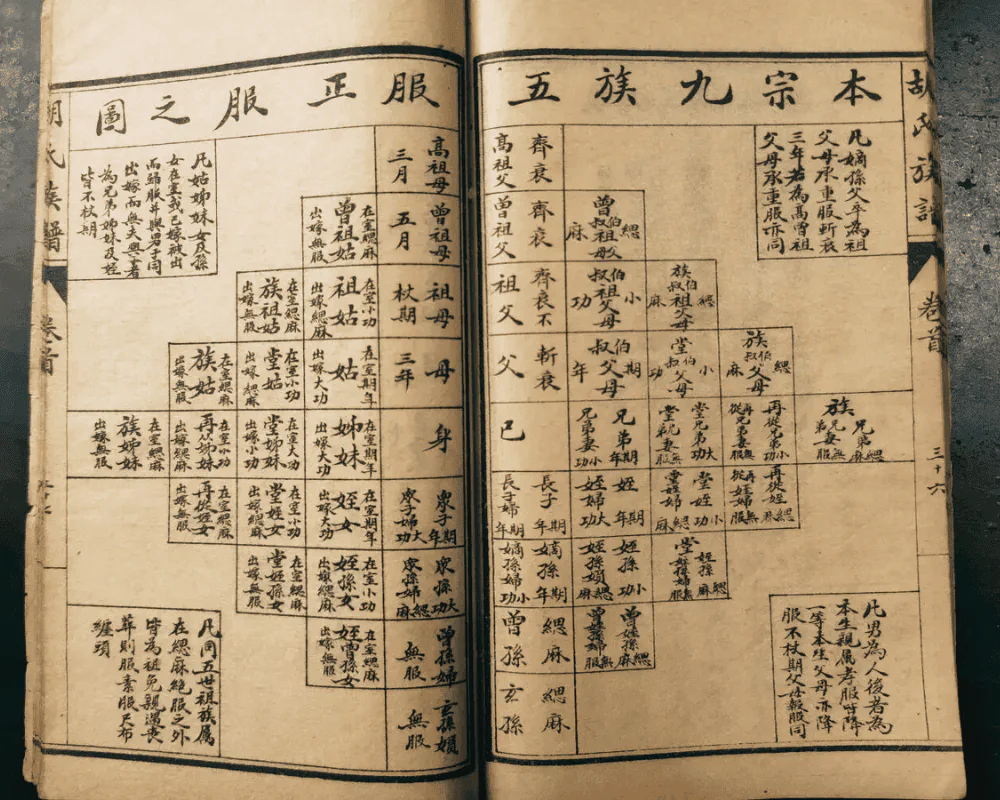
For anyone whose family carries the phrase “our ancestors came south when the Song fell,” the evidence lives in one genre of document: the family genealogy, 族谱 (zúpǔ). A Wuyi genealogy is not one book but a growing shelf — prefaces, name lists, biographies, land records, and ritual instructions, compiled and recopied over centuries —
The key section is the preface, 谱序 (pǔxù), where each generation’s compilers explained who the family was and where it had come from. It is in the prefaces, not the long name lists, that the migration stories live: the home village left behind, the route taken, the reason for leaving. And it is in the prefaces that the pivotal figure of every Wuyi origin story appears: the 入粤始祖 (rùyuè shǐzǔ), the “first-arrival ancestor,” the first of the line recorded as entering Guangdong, given a name, a generation, and a date. When the Taishan gazetteer records that the Zeng lineage of Qile village in Doushan township descends from an ancestor called Gengshen gong (耕莘公, Gēngshēn gōng), who left Zhuji Lane in 1135; that the Yuan lineage of Fu’an village descends from Yuan Runweng (袁润翁, Yuán Rùnwēng), the family’s recorded Taishan founding ancestor; or that the Liao lineage of Changtang was founded in 1574 from Zhuji Lane stock — the 入粤始祖 convention is doing the work, pinning a family’s arrival to a name and a year.
The 1135 date for Gengshen gong falls in the Shaoxing era — more than a century before Yamen. It records a family that came south in the earlier wave, or possibly one whose compilers assigned an early date to dignify the line; the date is a genealogy claim, not an independently verified fact. Even the Yuan genealogy naming Yuan Runweng is a modern recompilation, finished in 1997. This is the normal condition of the evidence, which is why the Yuan surname’s Wuyi history and the Liao surname’s arrival must be read by the same rule: the genealogies record what families believed and asserted about their origins, generation by generation — and that belief is historical evidence of the highest value, evidence about memory, even where the literal facts cannot be verified.
The critical caveat: genealogies can be wrong. They were compiled late, copied with errors, and in the worst cases fabricated — scholars use the term 伪谱 (wěipǔ), fabricated genealogies, for books whose descent claims are invented. Claims of descent from famous ancestors, ancient states, or imperial houses are so conventional in the genre that they require automatic skepticism. A lineage that traces itself to a Tang minister or a Song emperor is not necessarily lying; it is participating in a convention in which ancestry was honor and honor was written down. The honest way to read any of these documents — including the imperial-descendant villages of the next section — is to treat an origin story as memory and construction as much as fact.
The Defeated Dynasty’s Descendants
The dynasty that fell at Yamen left descendants who became ordinary Wuyi villagers — and in at least two places they are still identified as such. Fushi village (浮石村, Fúshí Cūn) in Taishan is documented by the Taishan municipal government as a 赵宋皇族村 (Zhào Sòng huángzú cūn), a “Zhao-Song imperial-clan village”: a settlement of families claiming descent from the Song imperial house of Zhao, said to have settled in Taishan after the dynasty’s fall. Across in Xinhui, Xialu village in Gujing township (古井霞路村, Gǔjǐng Xiálù Cūn) carries a similar designation as a settlement of Song imperial descendants (宋室后裔, Sòng shì hòuyì).
That Fushi and Xialu are officially recognized — and locally honored — as Song imperial-descendant villages is a matter of record: the designation comes from government documentation and the villages’ own genealogies, and it shapes how the villages present themselves today. Whether the villagers are, biologically, the thirteenth-century emperors’ descendants is a different question, and no genealogy or government plaque can settle it. Descent from an imperial house is exactly the claim scholars treat with most caution: the imperial surname Zhao is common in China, and imperial descent was a favorite genealogical embellishment. The honest statement is that these villages carry an official and cultural designation of imperial descent, supported by their genealogies — a claim about identity, powerful, honored, and unproven as biology.
The Zhao surname’s own Wuyi history, from imperial origins to the diaspora, tells the wider version. But the sharpest point is simpler and more human. Of everyone scattered by the Song’s fall, the most poignant are the emperor’s own kin — princes, cousins, and court families who within a generation or two were farming the delta like everyone else, keeping ancestral halls and seasonal rites instead of palaces. An empire’s ending and a people’s beginning happened on the same ground. What it means to come from the south — the spirit of Lingnan — was forged, in part, in exactly this memory of loyalty and loss turning into ordinary, enduring life.
From Refugees to Villagers: Building the Delta
Refugees become villagers by building villages, and the Song-era arrivals did it so thoroughly that the settlement pattern they laid down still maps the region. Taishan’s countryside is a geography of surnames: township after township dominated by a single lineage, each cluster of hamlets bearing one family name around its ancestral hall. This pattern of single-surname lineage hamlets — which emigrants would later reproduce abroad as clan associations — dates in its essentials to the Southern Song arrival layers of the twelfth and thirteenth centuries. A refugee family that won a plot of delta land did not scatter; it held together, married among itself, and grew into a named place — the “village of the X family” of every emigrant’s letters.
The building was physical as well as social. Much of the delta the migrants entered was marsh and tidal flat, and turning it into rice country was a monumental labor: they built dikes, drained marsh, and enclosed fields behind earthen walls — the technique called 围田 (wéitián, “enclosed fields”) — reclaiming farmland acre by acre. The surplus that later paid for passage tickets and clan schools rested on land Song-era refugees had helped wrest from the tide.
Not everyone came through the same door. The Cantonese-majority lineages whose prefaces mention Zhuji Lane arrived by the north-south river corridor, but Wuyi’s Hakka communities followed different routes out of inland Fujian and Jiangxi, and their genealogies tell another story of arrival. Even among Cantonese lineages, arrival dates span more than a century and several distinct crises. The delta was built by layers of migration — Tang, Song, Ming, and later — and the Song layer, though the most storied, was never the only one.
The Memory Travels Overseas
The origin memory did not stay in the delta; it went abroad with the diaspora and persisted in the most durable documents of emigrant life, the remittance letters. From the mid-nineteenth century Wuyi’s emigrants kept their families alive across the ocean with 侨批 (qiáopī), “overseas letters” bundling money orders with family news in a single folded document. The letters are famous for their remittances; less noticed is what else they carried. Because they were often written down by scribes who knew the family records, the qiaopi became informal genealogical documents — the channel through which origin claims, including descent from Song-era migrants, were written, repeated, and passed to children who had never seen home. Archives like the Taishan Overseas Chinese Museum, which preserves tens of thousands of these letters, read them today as financial records and family memory at once.
The memory also became institutional. Overseas associations formed around the Zhuji Lane claim — most prominently the overseas friendship association of Zhuji Lane descendants of the Cantonese Guangfu people (广府人珠玑巷后裔海外联谊会), supported by Guangdong’s overseas-affairs authorities — and they still convene descendants, fund repairs to ancestral halls, and organize return pilgrimages. A descendant in Toronto, Kuala Lumpur, or Melbourne who has never seen Nanxiong can join an association whose charter begins with the lane. The origin story is not merely history Wuyi people know; it is identity they carry — the same way the two hundred years of the Wuyi diaspora carried village rites and surname solidarities abroad.
The phrase a Roots Seeker most often hears from an elder — “our ancestors came south when the Song fell” — is doing several kinds of work at once. It is a family fact, or believed to be one. It is a badge of belonging to the region’s great story. And it is a portable inheritance, small enough to fit in a letter, sturdy enough to survive a century of separation. That combination is why the memory has outlived every other detail of the dynasty that produced it.
What a 1279 Defeat Became
The Song dynasty ended on 19 March 1279 in a bay off the coast of what is now Jiangmen. Eight centuries later that defeat is still claimed — as an inheritance — by people who have never seen the bay. Somewhere between a child emperor’s drowning and a village’s founding, between a genealogy preface written in the lane and a remittance letter posted from Vancouver, a national catastrophe was converted into a regional identity. The dispersed became a region; the region became a diaspora; and the diaspora still tells the story of the Song’s fall as its own.
One phrase from our own time tries to sum up the weight of Yamen: 崖山之后无中国 (Yáshān zhīhòu wú Zhōngguó), “after Yamen, no China.” The slogan should be understood for what it is — a modern and contested framing, popular in nationalist commentary, rejected by most historians as ahistorical. This article does not endorse it. A dynasty fell at Yamen; a civilization did not. The persistence of the region that rose from the dispersal — its farmland, its lineage halls, its globe-spanning families — is evidence that the story after 1279 was not an ending but a beginning.
Yet the slogan’s persistence is itself worth noting, for it testifies to how much weight this defeat still carries in the south. Yamen is where the largest version of that shape meets the smallest — an empire’s last stand and a family’s first field, an emperor carried into the sea and a village ancestor who walked south with his household, a court that drowned and a people who rebuilt. The sea that received the last Song emperor is the same sea that carried Wuyi’s emigrants outward. In that water the fall of the Song dynasty and the origins of Wuyi are one story: loss at one end, inheritance at the other, and between them the long work of turning an ending into a beginning.
Sources
Books
- 陈世松 等,《宋元战争史》(History of the Song–Yuan Wars), 内蒙古人民出版社, 2010 — the war’s military-political arc, 1234–1279.
- 曾昭璇、曾宪珊,《宋代珠玑巷迁民与珠江三角洲农业发展》(Song-Era Zhuji Lane Migration and the Agricultural Development of the Pearl River Delta), 暨南大学出版社, 1995 — the keystone regional study; 44 surnames / 100+ migrant branches in the Jiangmen area.
- 张明扬,《崖山》(Yamen), 中信出版集团, 2024 — modern battle monograph.
- 刘志伟,《在国家与社会之间》(Between State and Society) — the Zhuji Lane legend as collective-identity construction.
- Frederick W. Mote, Imperial China 900–1800 (Harvard University Press, 1999) — the Song–Yuan transition in English.
Web sources
- Battle of Yamen — Wikipedia
- Lu Xiufu — Wikipedia
- Wen Tianxiang — Wikipedia
- 赵昺 — 百度百科 — the last emperor’s dates and enthronement.
- Jiangmen Municipal Government (jiangmen.gov.cn) — 珠玑巷人南迁传说 provincial intangible-heritage designation (May 2022) and the Liangxi Luo Gui sites.
- Taishan Municipal Government (cnts.gov.cn) — Fushi village’s 赵宋皇族村 designation.
- Shaoguan Municipal Government (sg.gov.cn) — Zhuji Lane heritage records.
Continue Reading
- Yamen 1279: The Battle That Ended the Song Dynasty
- The Spirit of Lingnan: What It Means to Come from the South
- The Five Counties of Guangdong: A Cultural and Historical Overview
- The Zhao Surname: 3,100 Years from Imperial China to the Wuyi Diaspora
- The Yuan (袁) Surname: From the State of Chen to the Wuyi Diaspora
- From Haikou Port to the World: 200 Years of Wuyi Diaspora
Stay Connected
Follow RootsOfChina on Facebook and Instagram for new article updates, behind-the-scenes from Kaiping, and stories from the Chinese diaspora.
Suggested Reading
Is this your family’s story?
Roots Of China is built from readers’ family histories. If a story here sounds like your own — a surname, a village, a journey — leave a comment below, or share your family’s story with us and we may be able to help you find your ancestral village.
