


Chinese Railroad Workers: The Wuyi Villages That Built the Transcontinental
Between 1865 and 1869, approximately 12,000 Chinese workers laid the track that connected America from coast to coast. More than eighty percent came from a cluster of four counties in Guangdong province — an area smaller than Connecticut. Their wages built diaolou towers, their letters became UNESCO heritage, and their photographs — or rather, their absence from them — became a century-long silence. This is the story of the Wuyi villages they left, and the villages their remittances rebuilt.
1. The Men Who Built Half a Continent
Between 1865 and 1869, approximately 12,000 Chinese workers laid the track that connected America from coast to coast. More than eighty percent came from a cluster of four counties in Guangdong’s Pearl River Delta — an area smaller than Connecticut — whose sons had been crossing the Pacific since the 1840s. The region was called Siyi (四邑 — Four Counties): Taishan (台山), Kaiping (开平), Enping (恩平), and Xinhui (新会). Later, with the addition of Heshan, it became Wuyi (五邑 — Five Counties). The diaspora these five counties produced would reshape communities on five continents.
These were not professional railroad builders. They were farmers, fishermen, and village laborers who had grown up in a landscape of rice paddies and clan halls. What they had in common was a region that could no longer support them. By 1850, the average Taishan peasant had access to 0.3 mu of land — roughly 200 square meters, far below subsistence level. Between the Taiping Rebellion (1850-1864), the Hakka-Punti civil wars that ravaged the Pearl River Delta, and a series of typhoons and droughts in the 1850s, the villages of Wuyi were emptying.
America, in the 1860s, needed labor — specifically, labor that would work for half the wages of white workers in conditions that killed one in ten. The Central Pacific Railroad, building eastward from Sacramento, had struggled to retain white workers who abandoned railroad work for the Nevada silver mines after a few weeks. In 1865, construction superintendent Charles Crocker made the decision that would define the railroad: he hired 50 Chinese workers as an experiment. Within two years, Chinese workers made up 80-90% of the Central Pacific workforce.

2. Why These Villages Sent Their Sons
To understand why Wuyi — and not Fujian, not Zhejiang, not the countless other regions with surplus labor — became the primary source of railroad workers, you have to understand the chain migration system that had been building for two decades before the first rail was laid.
The Gold Rush of 1849 had already established a pipeline. San Francisco’s Chinese population grew from a few hundred in 1848 to over 25,000 by 1852, and the great majority were from the Siyi region. They had come on the credit-ticket system (赊单制 — shēdān zhì): a labor broker in the village would advance the $50-75 passage fare — equivalent to three to five years of peasant income — and the emigrant would work it off, with interest, once he reached America. This system, which predated the coolie trade by a decade, was fundamentally different: these were free laborers contracting their future earnings, not kidnapped victims of human trafficking.
This system created a built-in sojourn cycle. A young man, typically 18-25, would borrow the fare, work 3-5 years on the railroad or in the gold fields, repay the debt, save some money, and return to his village to marry and buy land. His younger brother or cousin would then take his place. Villages developed specialized knowledge of American migration routes, English phrases, and the names of labor contractors in San Francisco. A single returned worker could sponsor three to five relatives over a decade. By 1880, some Taishan villages had 40-60% of working-age men abroad.
The labor brokers (客头 — kètóu) operated with remarkable efficiency. They knew which villages had men seeking passage, which San Francisco merchants needed workers, and which contractors were hiring for the railroad. They arranged everything: the two-to-three-month Pacific crossing in the crowded steerage of a steamship, the processing at San Francisco’s docks, and the onward journey to the Sierra Nevada construction camps. Their fee was folded into the credit-ticket loan, deducted from the worker’s first year of wages.

3. The Village Map — Duanfen, Guanghai, Doushan, Baisha
Not all Taishan villages sent workers to the railroad in equal measure. The geography of recruitment was shaped by clan networks, broker connections, and the simple fact that once one man from a village succeeded, his entire lineage followed. Taishan’s villages were organized by surname — single-clan settlements where everyone shared an ancestor, a temple, and a network of contacts abroad.
Duanfen (端芬) — the Mei (梅) clan heartland — was among the largest sending townships. The Mei surname dominated the town of Meijia Courtyard (梅家大院), an architectural cluster that would later be rebuilt with railroad and laundry remittances. Duanfen’s Jinjiang (锦江) and Haiyang (海洋) villages appear repeatedly in qiaopi return addresses. The Mei clan’s Sze Yup Association presence in San Francisco was strong, and the association functioned as an informal employment agency for new arrivals.
Guanghai (广海) was the port town where many departed. Located on Taishan’s southern coast, Guanghai had been a maritime hub since the Ming Dynasty. In the 1860s, emigrants gathered here before boarding coastal vessels that took them to Hong Kong, where they transferred to Pacific steamers. The port’s role meant that Guanghai’s own population also joined the migration — fishermen and dockworkers who heard about railroad wages from departing travelers.
Doushan (斗山) and Baisha (白沙) — inland townships — were also major sending regions. Doushan’s Fulong (浮龙) and Nancun (南村) villages were dominated by Huang (黄) and Li (李) clans. Baisha, in Taishan’s northwest, sent Liu (刘) and Ma (马) clan workers. The county gazetteer records show that certain villages lost 50% or more of their young men between 1865 and 1880.
This was not a random diaspora. It was a surname-organized migration, channeled through clan halls, ancestral obligations, and the promise that wages sent home would build a better house, educate a younger brother, or expand the family’s rice fields. The clan genealogies (家谱 — jiāpǔ) compiled in subsequent decades recorded who went to the “Gold Mountain railroad” (金山铁路 — Jīnshān tiělù) and who came back. The entries are terse — “Went to America, 1868. Built house, 1875. Died in village, 1903” — but they constitute the most granular record of who these workers were.

4. A Dollar a Day — Wages, Remittances, and the Qiaopi Letters
Chinese railroad workers on the Central Pacific earned $30-35 per month — approximately $1.00-1.50 per working day, compared to $2-3 per day for white workers. From this, $15-20 was deducted monthly for food, supplies, and camp fees. The worker who survived the season might save $10-15 a month.
Most of that savings went home. The qiaopi (侨批) — literally “overseas Chinese letter” — system was the financial infrastructure of the diaspora. In a Sierra Nevada work camp, a worker would hand his cash and a letter to the camp headman, who forwarded it to a remittance house (批局 — pījú) in San Francisco. The piju bundled dozens of remittances and shipped them to Hong Kong, where they were routed to Jiangmen or Taicheng and delivered to villages by a local courier (批脚 — pījiǎo) who knew every household by name.
A typical qiaopi letter contained $30-50 and was sent two to four times per year. Over the course of a railroad career, a single worker might send $300-800 to his village — enough to buy rice for a family for a decade, build a small house, or pay bride prices for several weddings.
The letters themselves are the closest thing we have to the workers’ voices. From published collections and the Stanford Chinese Railroad Workers Project, certain themes recur. There is the cold: “The snow here is deeper than a man is tall. We dig tunnels through it like moles.” There is the loneliness: “I dream of the smell of rice cooking in mother’s kitchen.” There is the accounting — meticulous lists of wages earned, expenses deducted, and amounts enclosed. And there is death: “Third Uncle was buried by the snow at Donner Summit. The company sent $50 compensation. Please tell his wife.”
One surviving letter from a worker surnamed Chen, dated 1867, discusses the great strike of that year: “All the workers have stopped. We ask for $40 a month and shorter hours. The company says no. We have no rice. I do not know how this will end. Do not worry — I will write again when there is news.”

5. Tea and Explosives — Daily Life in the Sierra Nevada Camps
In 2012, archaeologists from Stanford University began excavating Chinese railroad worker camps in the Sierra Nevada. What they found rewrote the understanding of how these workers lived.
The dominant artifacts were not tools or railroad equipment — they were food containers. Rice bowls in blue-and-white porcelain patterns. Soy sauce bottles in stoneware and glass. Yixing-style clay teapots. Woks. Animal bones with Chinese butchering patterns showing pork and chicken. The workers ate as they had eaten in their villages, supplied by Chinese merchants in San Francisco who shipped provisions to the camps by wagon.
Medicine bottles tell a story of hybridity. Chinese herbal medicine vials — small glass bottles with cork stoppers — sit alongside Western patent medicine bottles. Opium pipe fragments and opium tin containers appear in every camp, reflecting both recreational use and self-medication for pain in an era before workplace safety regulations.
Leisure artifacts include bone and ceramic gambling tokens for fan-tan (番摊) and other games. Chinese Qing Dynasty copper coins, still in circulation among the workers, have been found scattered across camp floors. Porcelain liquor cups suggest that the workers maintained their drinking customs — rice wine or whiskey, depending on what was available.
What the archaeology definitively disproves is the old narrative of assimilation. These were not workers who adopted American ways and shed their Chinese identity. They built autonomous Chinese spaces within the brutal American labor system — cooking their own food, practicing their own medicine, maintaining their own social hierarchies, and sending their wages home through a financial infrastructure they had built themselves. The Sierra Nevada work camp was, in a very real sense, a temporary Taishan village transplanted to the mountains.

6. The Strike, the Snow, and the Silence
In June 1867, approximately 5,000 Chinese railroad workers walked off the job. It was the largest labor action by Chinese workers in 19th-century America — and it is almost entirely absent from standard American labor histories.
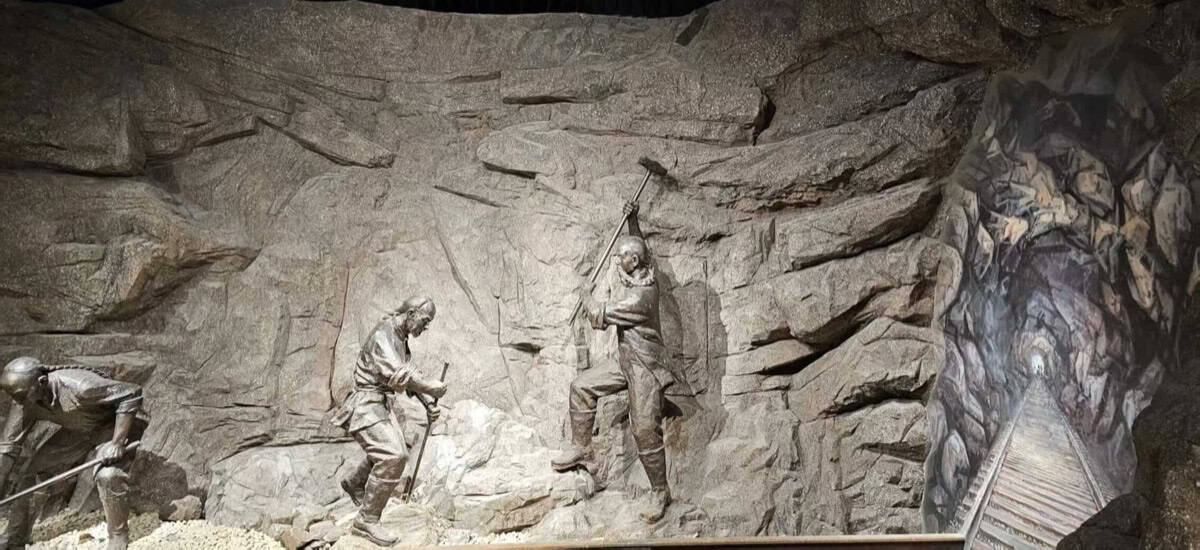
The workers had three demands: a wage increase from $35 to $40 per month, a reduction of the workday from twelve-plus hours to ten, and shorter shifts for those doing the most dangerous assignments — tunnel blasting, nitroglycerin handling, and cliff-face work suspended in baskets. These were reasonable demands. White workers earned $52-78 per month for comparable work and were rarely assigned to the most lethal tasks.
Charles Crocker, the Central Pacific’s construction superintendent, responded by cutting off food supplies to the camps. The strike lasted about a week. The workers received a partial wage increase — to $35 per month, which some were already receiving — but no reduction in hours or reassignment from dangerous work. The strike failed to achieve its core demands, but it proved something that contemporary observers refused to acknowledge: these workers could organize, coordinate across camps and language groups, and bargain collectively in a context where they had no legal protections whatsoever.
The dangers that prompted the strike were real. Workers drilled tunnels through the granite of Donner Summit at rates of inches per day. At Cape Horn, they were lowered in wicker baskets over a cliff face to blast a ledge into the sheer rock — documented in a famous 1868 engraving that, tellingly, omits the Chinese workers doing the actual work. The 1866 Dutch Flat avalanche buried an entire camp. Nitroglycerin, newly adopted for blasting, was unstable and unpredictable — a single dropped vial could kill ten men.
An estimated 1,200 or more Chinese workers died during Central Pacific construction. On May 10, 1869, at Promontory Summit in Utah, the ceremonial Golden Spike was driven to complete the transcontinental railroad. A.J. Russell’s iconic photograph shows executives, engineers, and white workers celebrating. No Chinese worker appears in the frame.
They were present. They had laid the final rails. In two of Russell’s other photographs from that day, Chinese workers are visible at the edges. But in the photograph that entered American memory, the men who had built half the railroad simply do not exist.
7. The Towers Their Wages Built
The railroad workers who survived returned to Wuyi, or sent money back to families who had waited. And with that money, they built.
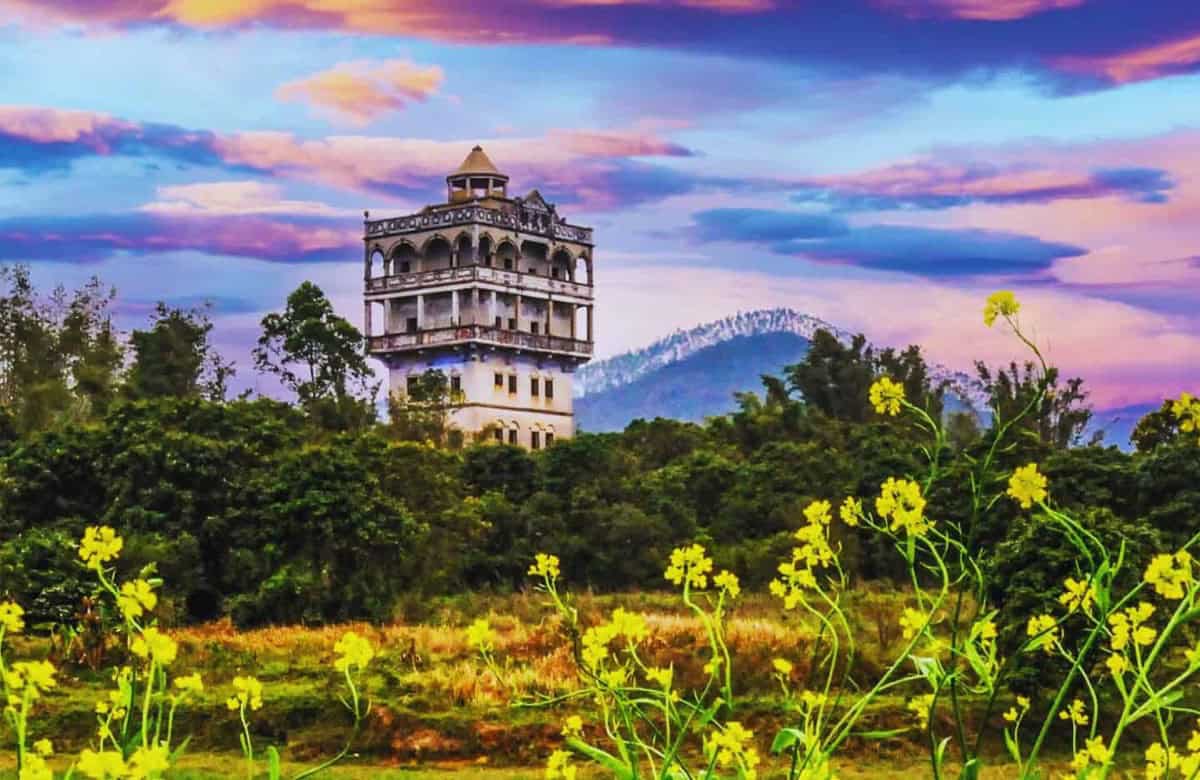
The most visible legacy is the diaolou (碉楼) — fortified multi-story towers that rise from Kaiping’s rice fields like castles from another country. Kaiping alone has 1,833 surviving diaolou, most constructed between 1900 and 1930 with overseas Chinese remittances. The towers combine Western architectural elements — Roman columns, Baroque domes, Gothic arched windows — with Chinese defensive features: iron gates, gun ports, and flood-resistant elevated entrances.
The Ruishi Lou (瑞石楼) in Jinjiangli Village, built in 1923 by a returnee named Huang Birun, rises nine stories with a Byzantine-style dome and classical columns. It is the tallest diaolou in Kaiping, and its builder had worked in America — not on the transcontinental railroad directly, but in the laundry and restaurant economy that the railroad generation had established. The money that built it, ultimately, traced back to the track that connected Omaha to Sacramento.
Ancestral halls (祠堂 — cítáng) were rebuilt with overseas donations. Stone tablets embedded in hall walls record donor names and amounts: “Chen A-Fu — $5,” “Huang Jinrong — $10,” sums that represented a month or more of a laborer’s wages. These stone donor lists are among the only records that name individual workers who never appeared in any American archive.
The most remarkable circularity was the Sunning Railway (新宁铁路). Built between 1906 and 1920, this 138-kilometer railroad connected Taishan’s interior towns to the coast. Its builder, Chen Yixi (陈宜禧), had worked on American railroads as a young man. He returned to Taishan, raised capital from overseas Chinese communities, and built a railroad through his homeland using returnee labor — many of whom had also worked on American railroads. Wuyi men built America’s railroad; then they came home and built their own.

8. “Gold Mountain Wives” — The Women Who Stayed
For every man who left, a woman stayed. By 1900, some Taishan villages were 70-80% female. These women were called jinshanpo (金山婆) — “Gold Mountain wives” — and they managed households, land, finances, and children alone for years, often decades. The story of Wuyi’s women is the hidden half of the diaspora narrative — without their labor holding villages together, the remittance economy would have collapsed.
The remittance economy made this possible. A husband in America sent $60-200 per year. His wife in Taishan converted that into rice, school fees, house repairs, and temple donations. She managed the family’s land, hired laborers during planting and harvest, negotiated with the clan elders, and raised children who might not see their father until they were teenagers — or might never see him at all.
Some marriages were conducted entirely by proxy — the “married to a photograph” phenomenon, where a woman married a man she had never met, whose face she knew only from a studio portrait sent with a qiaopi letter. In some villages, the wedding ceremony used a rooster to stand in for the absent groom.
The Chinese Exclusion Act of 1882 transformed this arrangement from temporary separation into permanent family fracture. Before 1882, railroad workers could return home after a few years, visit their families, and then come back to America when funds ran low. After 1882, a worker who left America could not legally return. Men who might have gone home after five years stayed for twenty, thirty, forty — or never came back at all.
The “paper son” system emerged as the workaround. American citizens of Chinese descent would claim fictitious children, selling the immigration “slots” for $200-500. Villages developed coaching books (口供簿 — kǒugòng bù) with detailed, memorized family histories that paper sons would recite to immigration officials at Angel Island. A young man from Taishan might spend months memorizing the names of a San Francisco family’s dead children, their birthdates, and the layout of a house he had never seen — all to answer questions at the detention barracks.

9. The Bones That Came Home
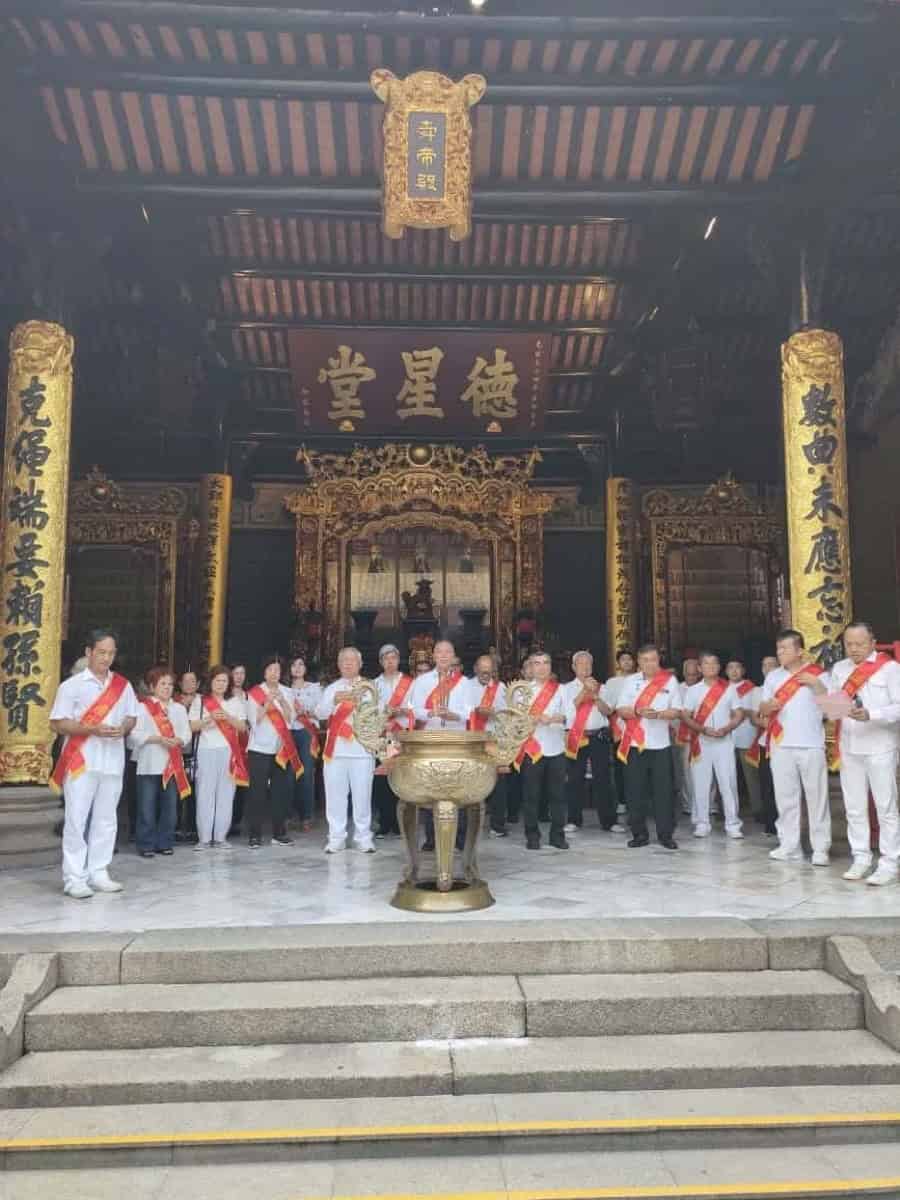
Death on the railroad was common, but death without proper burial was a spiritual catastrophe. In Chinese tradition, the soul of a person buried in the wrong place cannot rest. For the railroad workers, returning bones to the village was a sacred obligation — one that the annual Qingming (清明) festival made visible each spring, when descendants swept the graves of ancestors both local and overseas.
Chinese workers joined burial societies that guaranteed repatriation. After burial in temporary graves near the tracks, workers’ remains were exhumed after seven to ten years — once the flesh had decomposed — cleaned, placed in ceramic urns or zinc-lined boxes, and shipped from San Francisco to Hong Kong to Taishan. The Sze Yup Association in San Francisco coordinated the logistics, maintaining records of who had died, where they were buried, and which village should receive their remains.
At the village, the bones received a second burial in the clan ancestral cemetery. Grave inscriptions on railroad worker tombs sometimes recorded the circumstances: “perished in the snow at Donner Summit” or “died in the tunnel at Cape Horn.” The specific, terrible details were preserved because they mattered — they were evidence that the dead man had not been forgotten, that his suffering had been witnessed, and that his bones had come home.
Many never did. The Stanford project estimates that 40-60% of Chinese railroad worker remains were never recovered. They were buried by avalanches, lost in rivers, or interred in unmarked graves along thousands of miles of track. These “missing dead” created a permanent spiritual wound in qiaoxiang villages — ancestral halls with no graves to tend, families who lit incense for men whose bones they would never recover.
10. What the Photograph Left Out
A.J. Russell took three photographs at Promontory Summit on May 10, 1869. In two of them, Chinese workers are visible at the edge of the crowd — standing beside a locomotive, standing among the crowd of workers. In the third, the one that entered every history textbook, they are simply not there.
That erasure became a metaphor. For over a century, the standard narrative of the transcontinental railroad mentioned Chinese workers as a footnote — “coolie labor,” unnamed, interchangeable, present only as a quantity of manpower. American labor history, with its deep tradition of documenting white working-class struggle, had no vocabulary for Chinese workers who organized strikes and maintained autonomous communities. The Chinese Exclusion Act, by making these workers legally invisible for 61 years, reinforced their historical invisibility.
Recovery began in the 1960s with the rise of Asian-American studies. The 2014 induction of Chinese railroad workers into the US Department of Labor Hall of Honor marked a shift in official recognition. The 2019 150th anniversary of the transcontinental railroad brought new scholarship, museum exhibitions, and public commemorations — including, at Promontory Summit, a ceremony where descendants of Chinese railroad workers finally stood where their ancestors had been excluded from the photograph.
In Wuyi, the evidence has been there all along. The qiaopi letters, inscribed as UNESCO Memory of the World in 2013, preserve the workers’ voices. The Kaiping diaolou, a UNESCO World Heritage site since 2007, stand as monuments to what their wages built. The clan genealogies, the stone donor lists, the ancestral halls, and the oral histories passed down in village families — these are the archives that the American historical record never kept. For descendants tracing their roots today, these village records are often the only evidence that an ancestor was ever there — and your surname is your compass for finding them.
Between a small region of Guangdong and the granite spine of the Sierra Nevada, thousands of ordinary men built something extraordinary while being told they did not count. The towers their wages built still stand. So do their letters. So do their names, carved in stone in village halls, if you know where to look.
Sources
- Chang, Gordon H. and Fishkin, Shelley Fisher (eds.). The Chinese Railroad Workers in North America: Recovery and Representation. Stanford University Press, 2019.
- Hsu, Madeline Y. Dreaming of Gold, Dreaming of Home: Transnationalism and Migration Between the United States and South China, 1882-1943. Stanford University Press, 2000.
- 梅伟强, 张国雄. 《五邑华侨华人史》. 广东高等教育出版社, 2001.
- 梅伟强. 《广东台山华侨史》. 中国华侨出版社, 2010.
- Stanford Chinese Railroad Workers in North America Project — web.stanford.edu/group/chineserailroad
- Chinese Exclusion Act (1882) — U.S. National Archives
- Qiaopi and Yinxin Correspondence — UNESCO Memory of the World (2013)
- Kaiping Diaolou and Villages — UNESCO World Heritage (2007)
Continue Reading
- What Wuyi Workers Built: A Labor Migration Atlas
- Coolie Trade: History and Impact on Chinese Laborers
- Sze Yup / Wuyi Diaspora: Guangdong’s Five Counties
- Your Surname Is Your Compass: Wuyi Roots Search
Stay Connected
Follow RootsOfChina on Facebook and Instagram for new article updates, behind-the-scenes from Kaiping, and stories from the Chinese diaspora.
Suggested Reading
Is this your family’s story?
Roots Of China is built from readers’ family histories. If a story here sounds like your own — a surname, a village, a journey — leave a comment below, or share your family’s story with us and we may be able to help you find your ancestral village.
