


Gao (高) Surname: From the State of Gao to the Wuyi Diaspora
A Thousand Years on One Page
One surname. One village. One book that claims a thousand years.
The register in question — the genealogy of the Gao (高, Gāo) family of Nafu Village (那伏村, Nàfú Cūn) in Shadui Township, Xinhui District (沙堆镇, 新会区), Guangdong — records a single lineage from 949 to 2006: more than a millennium in one place. Those are the lineage’s own claims: the family holds that this branch descends from Gao Xi (高傒), surname-founding ancestor of the ancient State of Qi, through the Bohai Gao (渤海高氏) trunk lineage, past the imperial zenith of the Northern Qi dynasty, and down the southern migration corridor via Zhuji Lane (珠玑巷) into the Wuyi (五邑, Wǔyì) region. None of it is independently verified; we read the family’s account with respect and care.
A surname that once sat on a throne became, a thousand years later, a working surname of the Gold Mountain (金山, Jīnshān) diaspora. Gao men and women crossed the Pacific to California, Canada, Cuba, and Australia, while others moved into Southeast Asia — and the name split into the spellings on today’s shopfronts and headstones: Ko and Kao from the Taishanese speech of the Wuyi counties, Goh and Koh in the Chinese communities of Singapore and Malaysia, 고 — romanized Ko — in Korea. One character, many spellings: the name became a migration map.
Across the ocean, the family held together by money letters (银信, yínxìn) and lineage institutions — ancestral halls, clan associations, genealogies that kept being continued: a name that outlived dynasties, and the people who carried it.
Many Origins, One Name: The Gao Surname’s Contested Beginnings
Where does the Gao surname begin? In several places at once — and the debate is not settled.
The dominant account, in gazetteers and surname histories alike, traces Gao to the ducal house of Qi (齐国). After the Zhou king enfeoffed his minister Jiang Taigong at Qi, a descendant was granted lands at Gao — now Yucheng, Shandong — and became Prince Gao (公子高, Gōngzǐ Gāo). The prince’s grandson took the place-name as his family name: Gao Xi (高傒, Gāo Xī), who died in 637 BCE. Xi was a statesman of the first rank: he helped place Duke Huan of Qi on the throne, served as senior minister, and worked beside Guan Zhong to build Qi’s hegemony. Histories call him Gaozi, the Master Gao — the surname’s 得姓始祖 (déxìng shǐzǔ), its surname-founding ancestor.
The histories also record descent from Gao Yuan, an ancient minister said to have invented the house, folding in the Gao Yi people and the Gaoyang and Gaoxin lines. A third stream flows from outside the Han heartland — Xiongnu leaders who took the name Gao, Jurchen clans of the Jin, Manchu Bannermen of the Qing whose Gaojia lineages were sinicized into Gao. None cancels another.
The most contested question sits at the story’s edge: the royal house of Goguryeo (高句丽, Gāogōulì) — a kingdom ruling much of northeast Asia from 37 BCE to 668 CE — also bore the surname Gao, while the later Goryeo dynasty of the peninsula was a separate, Wang-ruled state. Chinese and Korean historiography answer differently; Tang-dynasty tombstones of Goguryeo royals excavated in Xi’an and Luoyang make the dispute physical. This article takes no side: the Korean link (고/Ko) is real, its genealogical relationship to mainland Gao unresolved.
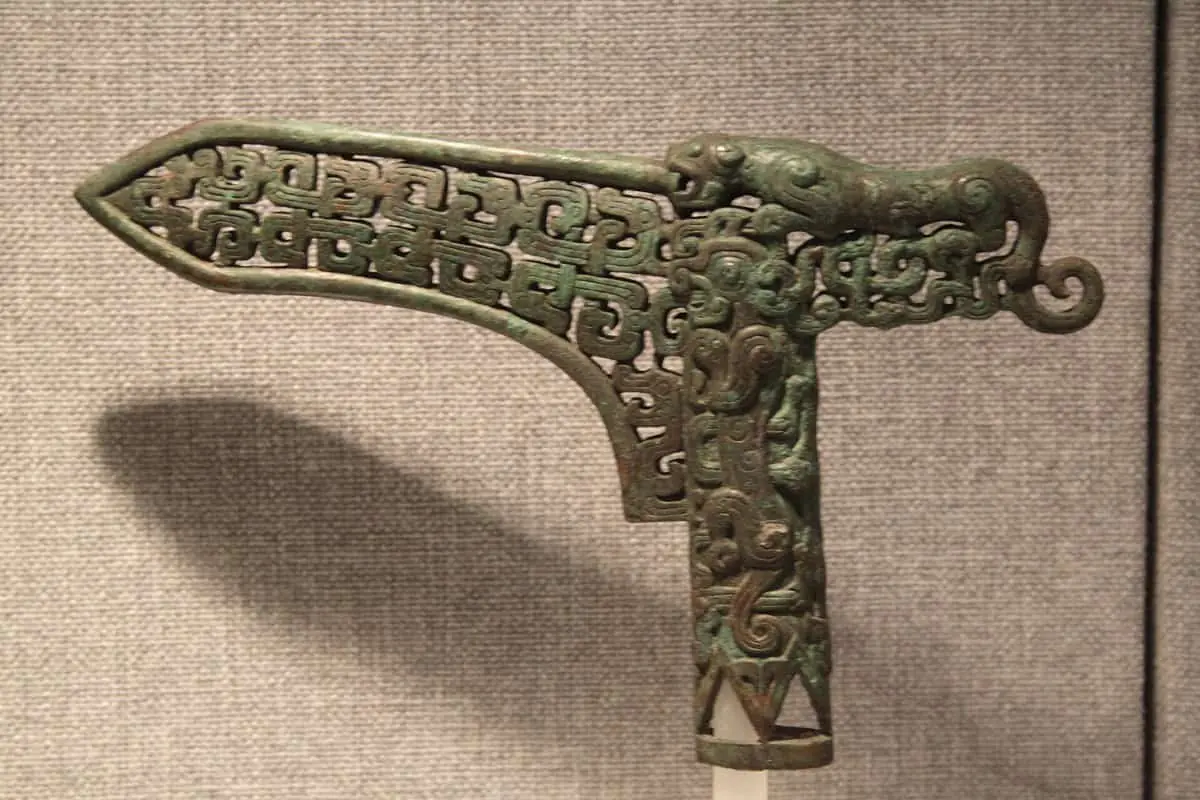
The surname has a place it can point to: Gao Xi lies buried on the west bank of the Zi River in Linzi, Shandong, at Baituqiu Village in Jingzhong Township (敬仲镇白兔丘村). A protected provincial heritage site, the tomb yielded a bronze dagger-axe inscribed “Gaozi” in 1970. The origins may be plural; the oldest stone is singular.
The Bohai Trunk and the Imperial Peak
If the origins are plural, the trunk is not: for most Gao lineages, the core line is the Bohai Gao (渤海高氏, Bóhǎi Gāoshì), named for the commandery of Bohai — the surname’s ancestral prestige address, its 郡望 (jùnwàng). The anchor is Gao Hong, an Eastern Han governor of Bohai who settled his family there; from his time the hall name (堂号, tánghào) became Bohai Hall (渤海堂, Bóhǎi Táng), with lesser branches at Yuyang, Guangling, and Henan.
The zenith came in the sixth century: Gao Huan (高欢), powerbroker of the Eastern Wei, built an army and a state, and in 550 his son Gao Yang (高洋) founded the Northern Qi (北齐, Běi Qí). Six emperors reigned in twenty-eight years, until 577. Gao rulers and king-makers appear fourteen times across later history, from Gao Yun of the Northern Yan to Gao Jixing of Jingnan.
The lineage also produced the durable canon: Gao Shi the frontier poet, Gao Pian the late-Tang general, Gao Qiong and Gao Huaide the Song founding generals. 476 men named Gao appear in a standard dictionary of historical figures — about one percent of the total.
After 577, “imperial Gao” became a deployable lineage resource — a stored inheritance of throne, hall, and canon for later southern branches. That emperors’ descendants became, a millennium later, migrants is this story’s arc.
The Southern Road: From Fujian to the Zhuji Lane Corridor
The southern road is better documented than the origins, at least on its Fujian leg, beginning with Gao Gang (高钢, 844–936), styled Yiqing, of the Bohai branch, from Gushi in Henan — the 入闽始祖, the founding ancestor of the Gao in Fujian, per government-published clan histories. When the Tang collapsed into the Huang Chao rebellion’s chaos, Gao Gang traveled south with Wang Shenzhi, founder-to-be of the Min kingdom, settling at Chaoyang, then Zhangpu, finally Huai’an near Fuzhou.
The great Fujian hub grew at Anhai in Jinjiang: Gao Gang’s fifth-generation descendant died defending Quanzhou in the tenth century, and his two sons settled at Anping — today’s Anhai — where the Ming-dynasty Gao ancestral hall stands protected. The Anping genealogy preserves a 1042 self-narrative: “the Bohai Gao entered Fujian in the Tang.” From such bases the Gao fanned outward — including, the Guangdong genealogies claim, to Putian (莆田), the most common prestigious-origin claim in Lingnan records. A register that names Putian participates in a regional pattern; it proves no unique route.
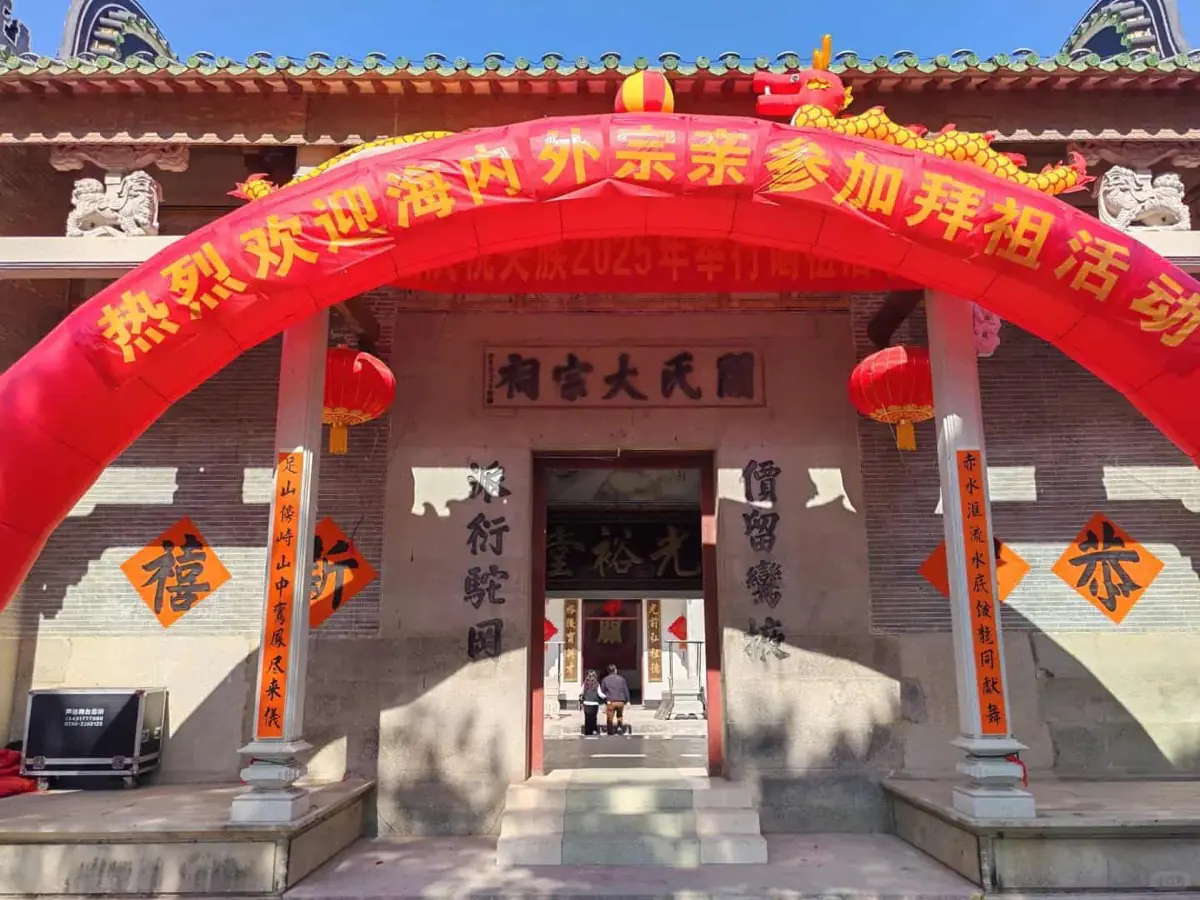
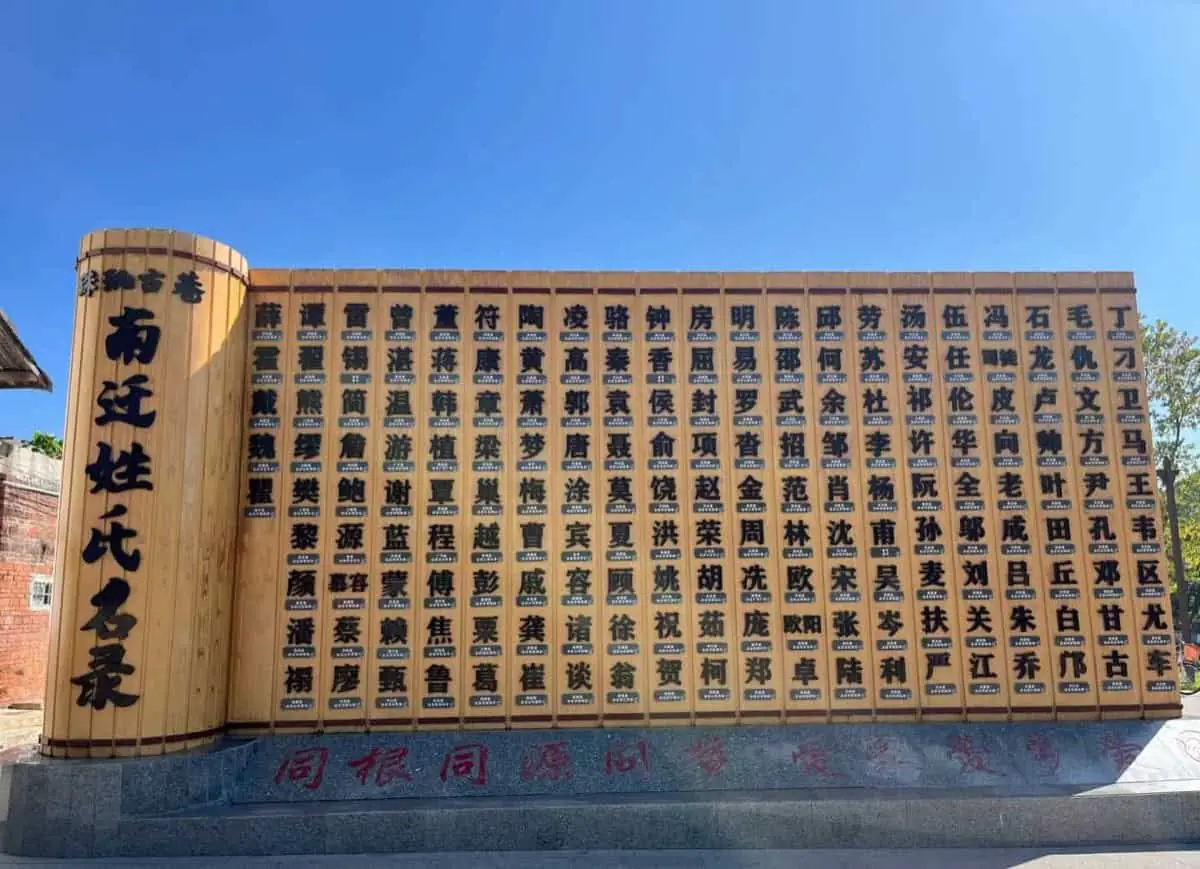
For the Gao who reached the Pearl River delta, the canonical path ran through Zhuji Lane (珠玑巷, Zhūjī Xiàng) in Nanxiong, over Meiling Pass (梅岭, Méi Lǐng), and on through Baochang County (保昌县, Bǎochāng Xiàn). Zhuji Lane is both a physical road and a founding narrative: thousands of Guangdong lineages, not only the Gao, tell the same story of descent through this lane — a pattern in Chinese surname history that runs far beyond any single family. A catalog of 125 Xinhui genealogies shows the pattern in volume: Liang, Lu, Zhang, Wu, and Tang families all record the same stopover at Baochang before settling in Xinhui.
Here the record narrows to what the family says: the distance between “ancestors came from Fujian” in the Tang and the Southern Song move into Xinhui may compress centuries in family memory — the register’s account of that final leg is the lineage’s telling of itself.
The Register That Outlived Dynasties: Nafu and the Sizetang Hall
Nafu Village (那伏村) sits in Shadui Township (沙堆镇), in the southeastern corner of Xinhui District (新会区), in Jiangmen. Today it is a working agricultural village: nearly a thousand mu of Xinhui tangerines (新会柑) grow in the surrounding fields, and a couplet over the village gate celebrates its hills and springs. The Gao are still here: in 2021, a Mr. Gao of Tianxin Lane, demolishing his old house, found a Qing-dynasty cannon buried in a wall — proof that a surname which once ruled a dynasty still has its feet in this soil.
The book that anchors the whole arc is 《广东新会那伏高氏族谱》 — the Genealogy of the Gao Family of Nafu, Xinhui, Guangdong. It carries the hall name Sizetang (思则堂, Sīzé Táng) — roughly “follow the ancestors’ rules” — and its 2006 continuation (续修, xùxiū), overseen by the elder Gao Weian, was printed as a single unbound volume. The register is listed in the Xinhui district catalog of 125 family genealogies and in Luo Wei’s Lingnan compilation of surname registers: a findable, cataloged object.
The register’s account of its own past must be read in that spirit: cataloged, but not independently verified. It records that the founding ancestor, Gao Shizeng — said to have held the judicial office of 大理寺评事 (Dali ping shi) — moved from Putian in Fujian to Baochang County in Nanxiong Prefecture; that his eldest son, Gao Weijiao (高维峤, Wéiqiáo), styled Nanyin, moved south again in the Southern Song to Nafu Village; and that from him descend the Gao branches of Xinhui, Sihui, Guangning, and Huaiji. The register traces the lineage from 949 to 2006: over a thousand years in one book.
Scholars of Guangdong genealogies counsel caution here. The court post and the Putian origin are exactly the status claims — a 功名 (gōngmíng) credential, a prestigious birthplace — that recur across Lingnan registers as legitimacy markers; compilers warn against taking every credential at face value. None of this diminishes the register: what a family believes about itself is real, and that belief is the engine of a continuity that outlasted dynasties, wars, and oceans.
The catalog adds one curious wrinkle: an earlier Gao genealogy from Shadui Township dated 1960, under the same Sizetang name — compiled in the middle of the collectivist era, when genealogy practice was officially suppressed. Quiet local practice surviving the suppression, or an older register reprinted and re-dated, the ambiguity is noted, not resolved; the catalog even spells the founding ancestor’s name in two variant characters, 高维峤 and 高维㠐.


The Qiaoxiang World: A Surname’s Map of the Pacific
The Wuyi (五邑, Wǔyì) — the Five Counties: Xinhui, Taishan, Kaiping, Enping, and Heshan — is one emigrant region with one dialect and one migration culture (a primer on the Five Counties). Nafu’s county, Xinhui, sits squarely inside it — an officially recognized 侨乡 (qiáoxiang, emigrant hometown) whose overseas kin are said to live in seventy-five countries. In the second half of the nineteenth century, the promise of the Gold Mountain — California gold, then railroad wages, then a hundred trades — drew Wuyi men by the tens of thousands, and Xinhui’s migration boom remade the county. Remittances built market towns and village houses; the expectation of return framed the enterprise. Movement ran along chains: one successful migrant sponsored the next.
For the Gao, the diaspora’s geography is written in the surname’s spellings: Wuyi Gao who went to North America carried a name pronounced in Taishanese, not Mandarin — hence Ko and Kao on the census rolls of San Francisco and Vancouver. The Gao of Southeast Asia — Singapore, Malaysia, Indonesia — spelled themselves Goh and Koh, the Hokkien forms of the character. In Korea, the same 高 became 고, romanized Ko — a track whose genealogical link to mainland Gao remains contested. One character, four spellings: the name is a map of where its bearers went.
Five diaspora zones are documented for the Wuyi as a whole — California, Canada, Cuba and Latin America, Southeast Asia, Australia — with Gao families in each. Two cautions keep the map honest. First, the best-documented Gao tracks outside the mainland are Fujian, not Wuyi: the Qing-era Gao who crossed from Zhangzhou’s Haicheng, Pinghe, and Zhao’an counties to Taiwan are recorded with named ancestors in a 1991 Taipei genealogy; and the Filipino guerrilla commander Gao Huayue — deputy commander of the Philippine Chinese anti-Japanese force, killed in 1943 — was a Nan’an man from Quanzhou; Gao Mingxuan, later vice-chairman of the All-China Federation of Returned Overseas Chinese, was a fellow Quanzhou man, from Jinjiang. Those are Fujian diaspora stories — the Goh/Koh world, not the Wuyi story. Second, the Wuyi Gao story centers on Xinhui: in Taishan, the surname appears only as thin roster entries in a single compilation — Guanghai and Chixi towns — with no documented Gao villages or halls. The map is honest about its blank spaces. Overseas, the surname and clan associations of the diaspora were where a stranger named Gao found kin.

Under Exclusion: How Wuyi Gao Families Moved
The Gold Mountain was a gate to be slipped through, not a door that opened. The United States Exclusion Act of 1882 barred Chinese laborers outright; Canada followed with an 1885 head tax and a near-total 1923 ban. Yet exclusion did not end Wuyi emigration — it restructured it, and in a paradox that shaped the diaspora, deepened transnational ties by keeping families and wealth oriented homeward.
The mechanisms are documented for the Wuyi as a whole. Paper identities (契纸, qìzhǐ) — purchased documents asserting citizenship or family connection — let “paper sons” pass inspection at Angel Island; smugglers ran others through Hong Kong and Macau. Passage was often bought on credit (赊单制, shēdān zhì), the fare repaid from future wages. The labor regimes were brutal: Chinese railroad crews with appalling mortality, Cuban sugar plantations, then the urban niches of laundry and restaurant work, staffed through clan networks that told a young man where to go and who would take him in. Marriage, schooling, and finance were negotiated across oceans in letters; the divided family — husband abroad, wife and children at home — was not a breakdown of strategy but the strategy itself.
One honest caveat: for the Gao specifically, no exclusion-era primary evidence has surfaced — no Gao paper-son file, no Gao railroad roster. These are documented Wuyi patterns that Gao families — a documented Wuyi surname — may well have experienced, presented as pattern, not instance. If a Gao from Nafu rode the Central Pacific, no record we have found names him — the record names the pattern, and the pattern is the story.

The Money Letter: Yin-xin as the Connective Tissue
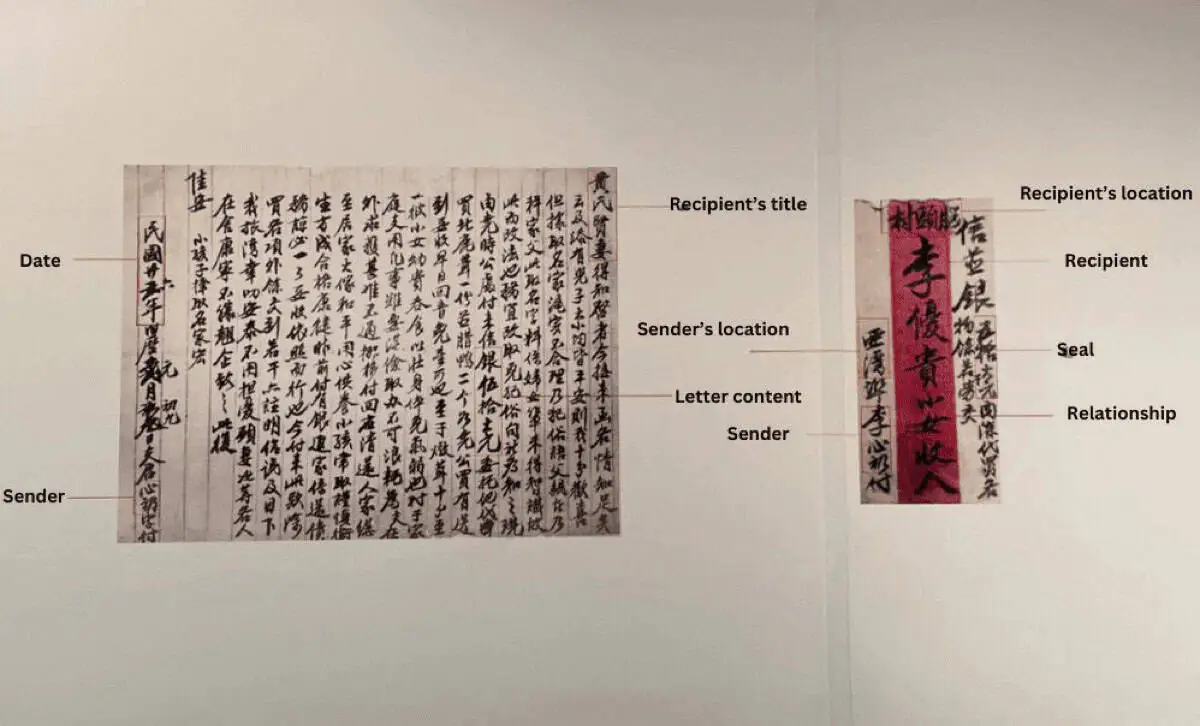
The connective tissue of the divided family was the money letter — 银信 (yínxìn), also 侨批 (qiáopī), the overseas remittance letter. It was a money order fused with a letter: coins and banknotes wrapped in paper and words. Money, information, and emotion traveled in one envelope — the primary document of family life across the Pacific (a form with its own beginner’s guide).
Delivery ran on trust: remittance houses (批局, pījú) in Hong Kong and the treaty ports forwarded the mail; village carriers (批脚, pījiǎo) walked the last miles, so reliable that a letter’s arrival was assumed and its absence a family catastrophe. The corpus is so large that UNESCO inscribed qiaopi on its Memory of the World Asia-Pacific register in 2013; the Wuyi Overseas Chinese Museum and the county archives hold thousands of envelopes and remittance slips — the letters still speak to readers today.
No Gao-surname letter has been identified among them — honesty matters here. A San Francisco Gao migrant’s letter to Nafu might have read, in the pattern of thousands like it: the remittance figure, the roof repair, the children’s New Year clothes, the apology for absence. That is a reconstruction of a documented pattern, explicitly hypothetical — not a recovered Gao artifact. The pattern itself is well evidenced: letters carried health and earnings, plans for return and guilt for delay, concealing the brutality of labor, the loneliness, the dying hope of going home. The money they carried did institutional work: it repaired ancestral halls, funded the 祭祖 (jìzǔ) rites, bought land, and paid for genealogies’ recompilation. The Nafu register’s survival across the twentieth century is partly a remittance-funded survival — a lineage kept alive from abroad.
Then the letters stopped. In the 1950s the channels closed, and the silence was its own rupture: “we will hear from him” became “we have not heard.”
The Gold Mountain Wives
Behind so many of those letters stood a woman — reading them aloud, guarding them, answering them. The 金山婆 (Jīnshān Pó) — the Gold Mountain wives — ran the households their husbands left behind, often for decades. They farmed the family plots, raised the children, kept the ancestor rites, and oversaw the remittance-funded houses and halls that still line Wuyi lanes. They were, in every practical sense, heads of household — the system ran on their labor.
The double edge of the dream belonged to them most of all: some husbands returned, with money and stories, and the family was remade; many never did. Wives waited out their lives for men who had become names on envelopes; the dream’s power depended on not knowing which awaited — and women bore that uncertainty longest.
The record is honest about its own shape: the 银信 corpus is overwhelmingly men-written, and the genealogies — registers like Nafu’s included — marginalize women to a surname and a village. Yet the letters were addressed to women, about households women ran, and women appear as writers and negotiators — wives managing money, widows demanding accounts, mothers telling absent sons what the village knew. We need not invent their voices; the pattern of the letters recovers them. The freight the pattern documents — homesickness, guilt, apology for absence, parents who died unseen — recurs in letter after letter: the shared vocabulary of a generation of split families.

Rupture, Revival, and the Lineage Still Writing Itself
The arc nearly broke in the middle of the twentieth century. After 1949, remittance channels closed, land reform dismantled the qiaoxiang’s economic base, and genealogy practice was suppressed for three decades — an eight-book scholarly consensus documents the rupture. And yet the Xinhui catalog lists a Gao register dated 1960, from the heart of that era. Whether a quiet local compilation survived the suppression or an older register was reprinted and re-dated, the entry stands as an anomaly — the lineage’s paperwork never entirely stopped.
Reform and Opening (改革开放, Gǎigé Kāifàng) in 1978–79 reopened the channels — visits, letters, reconnection — and a nationwide 修谱 (xiūpǔ) revival followed. The Nafu register’s 2006 continuation (续修) is a product of that wave, Gao Weian its adviser. Clan media report a World Gao Surname Fraternal Congress held triennially since 2008 — Xiamen, then Taipei, then Zhengzhou — under the motto “exalt ancestral virtue, honor ancestors and unite kin,” a Gao history and culture research society around Gao Lujia, author of the surname’s comprehensive history, and a Gao Xi culture committee under the Chinese Culture Promotion Society — all from clan and community media, genealogy websites and WeChat public accounts.
The most concrete anchor is a grave: the tomb of Gao Xi at Jingzhong Township — the heritage site where the Gaozi dagger-axe was found — rebuilt with roughly 1.5 million yuan raised by clan associations (a clan-media claim), the township now branding itself “the homeland of Gao Xi” in its rural-revitalization program. It has become the surname’s living 认祖归宗 (rènzǔ guīzōng) anchor — the oldest ground a diaspora Gao can stand on.
How many people carry this name? Census-era figures put it at about 14.5 million — roughly 1.21 percent of China’s population, around the fifteenth most common surname — with newer estimates toward 17 million. By any count, a top-twenty name with a thousand-year register behind it.
The register is the last word. A lineage that counted its years from 949 was still writing itself in 2006 — and its diaspora descendants, using the finding aids that catalogued it, can still find the village, the hall, and the book. The same character that sat on the Northern Qi throne is the name on a laundry’s sign, a Manila war memorial, a Toronto headstone — and on the spine of a register still being continued. The surname that outlived dynasties is still being written.


Continue Reading
- Your Surname is Your Compass: How to Trace Your Wuyi Roots
- Cao Surname: Meaning, Origin, and Three Thousand Years from Zhou to Gold Mountain
- The Guo (郭) Surname: From Zhou Dynasty Nobility to the Wuyi Diaspora
- Wong Surname: Meaning, Origin, and the Two Ancient Lineages Behind It
Stay Connected
Follow RootsOfChina on Facebook and Instagram for new article updates, behind-the-scenes from Kaiping, and stories from the Chinese diaspora.
Sources
- 《广东新会那伏高氏族谱》(思则堂), 顾问高维安, 2006年续修印行, 不分卷 — The Nafu register that anchors this article; its self-account runs 949–2006, and it is catalogued in the Xinhui district list of 125 family genealogies.
- 骆伟, 《岭南姓氏族谱辑录》, 广东人民出版社, 2002 — Lingnan surname-register compilation that lists the Nafu Gao genealogy.
- 刘进, 《银信与五邑侨乡社会》, 广东人民出版社, 2011 — Definitive study of qiaopi remittance letters and their role in Wuyi society.
- 梅伟强、张国雄, 《五邑华侨华人史》, 广东高等教育出版社, 2001 — Foundational regional history of Wuyi emigration and the qiaoxiang.
- Madeline Y. Hsu, Dreaming of Gold, Dreaming of Home: Transnationalism and Migration Between the United States and South China, 1882–1943, Stanford University Press, 2000 — English-language study of Taishan transnational migration.
- 高路加, 《高姓全史》, 广东旅游出版社, 2008 — Comprehensive surname history covering Gao origins, branches, and diaspora; claims resting on it alone are treated as probable where uncorroborated.
- 杨群红, 《中华姓氏通史·高姓》, 东方出版社, 2000 — Surname monograph on Gao origins, the Bohai trunk, and the Northern Qi zenith.
External Resources:
- 苍南县人民政府, “高姓 — 高姓始祖高傒” — Government gazetteer on Gao origins, the Bohai hall name, Northern Qi rulers, and census population figures.
- 临淄区人民政府, “临淄墓群” — Record of the Gao Xi tomb at Baituqiu Village, a protected provincial heritage site.
- 晋江市纪委监察委, “安海高氏宗祠与高氏家族史” — Account of Gao Gang’s entry into Fujian and the Anhai ancestral hall.
- 致公党中央委员会, “菲律宾华侨抗日游击支队” — Record of the Philippine Chinese anti-Japanese guerrilla force, including deputy commander Gao Huayue.
- UNESCO Memory of the World, “Qiaopi and Yinxin Correspondence” — 2013 inscription of the remittance letters that held diaspora families together.
Suggested Reading
Is this your family’s story?
Roots Of China is built from readers’ family histories. If a story here sounds like your own — a surname, a village, a journey — leave a comment below, or share your family’s story with us and we may be able to help you find your ancestral village.
