

The Lei (雷) Surname: From Ancient Fangshan to the Wuyi Diaspora
Roughly 3.7 million people in the world today answer to the surname Lei (雷) — a name that means “thunder” and, in the oldest stories, carries the weight of it. It is not among China’s largest surnames; by population it sits somewhere around the eightieth rank, small enough that a Lei who meets another Lei abroad will often pause, ask a village name, and try to thread a connection. But few names of its size have left fingerprints in as many places: in the court of the Yellow Emperor, in the imperial workshops that drew the Forbidden City, and in the goldfields and railroad camps where Wuyi’s emigrants remade their lives on the far side of the Pacific.
This is a surname story, but it is also a Wuyi story — because one branch of the Lei family put down roots in Taishan (台山) more than seven centuries ago, and from those villages came some of the first Chinese to set foot on the goldfields of California and Australia. To understand the name is to follow a thread from an ancient fief in Henan, through the imperial court at Beijing, down the Tan River delta of Guangdong, and out across the ocean.
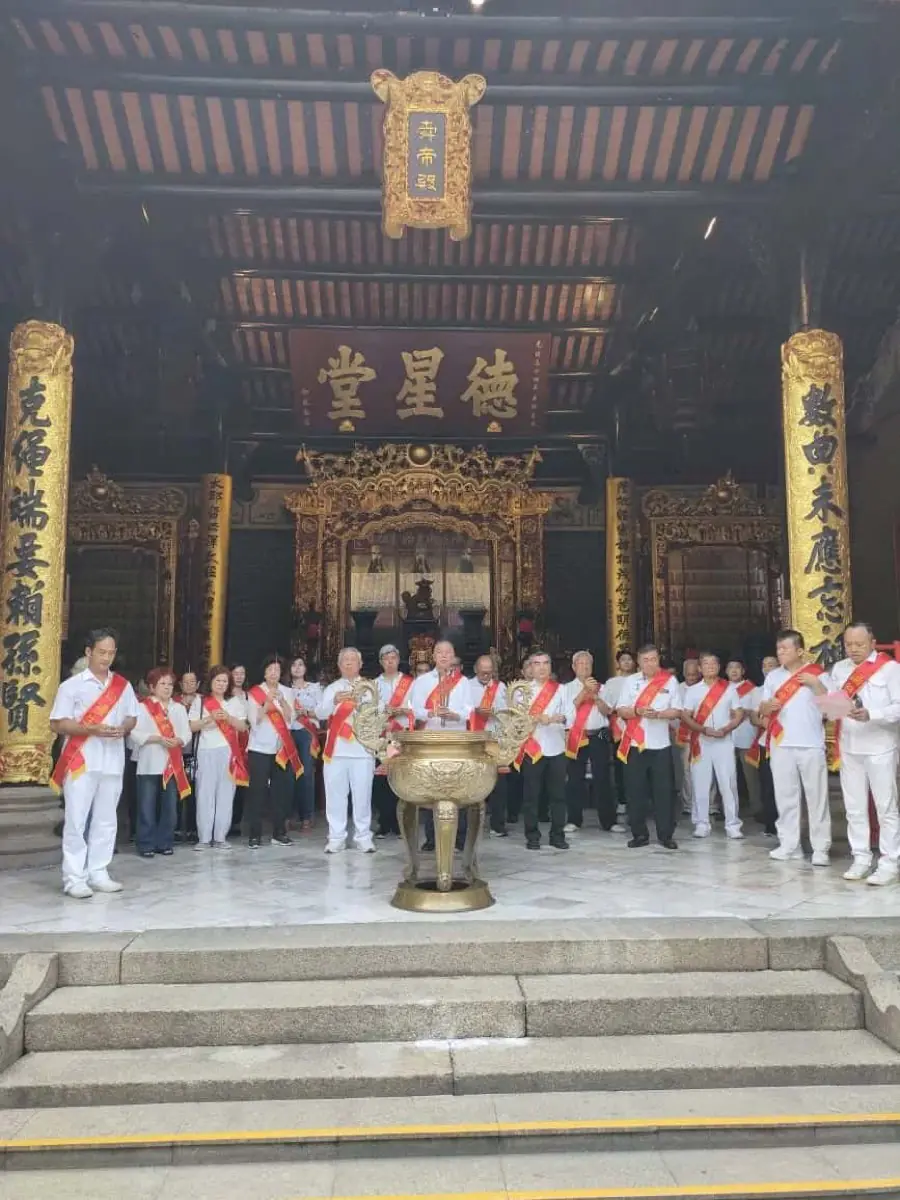
A Name from the Yellow Emperor’s Court
Every surname has an origin story, and Lei’s is older than most — it does not begin with a feudal state of the Zhou dynasty, as surnames like Pan (潘), Yuan (袁), and Hu (胡) do. It begins with a clan called Fang Lei (方雷氏), whose name would eventually split in two.
According to the classical genealogies compiled in the Yuanhe Xingzuan (元和姓纂) and the Tongzhi (通志·氏族略), the Lei line descends from the Yan Emperor (炎帝), the legendary culture-hero — often paired with the Yellow Emperor (黄帝) — from whom a great many Chinese surnames claim descent. The two emperors together stand at the head of Chinese identity itself: the Yan Emperor taught agriculture and medicine, the Yellow Emperor unified the tribes and became the ancestor of the Han people. To claim descent from either is to claim a place in the oldest story the culture tells about itself.
A descendant of the Yan Emperor’s line, remembered simply as Lei, served the Yellow Emperor and fought beside him at the Battle of Zhuolu (涿鹿之战), the mythic clash in which the Yellow Emperor’s coalition defeated the rebel chieftain Chi You (蚩尤). For his valor, Lei was enfeoffed at Fangshan (方山) — a place in what is today Yuzhou (禹州) in Henan province — where he established a small vassal state. The sources differ on the exact generational distance — some make Lei the eighth-generation descendant of the Yan Emperor, others the ninth — but the shape of the story is stable across the old genealogies: a man of the Yan Emperor’s line, rewarded for courage in battle, given a mountain and a people, and remembered by the name that became a surname.
His descendants took the compound name Fang Lei. Later, the two characters parted ways: one branch kept Fang (方), the other kept Lei (雷). That is why, to this day, Fang and Lei are treated as sibling surnames, sharing a single founding ancestor named Fang Lei. In Taishan, the connection is remembered explicitly — the county’s own genealogical records group the Lei, Fang, and Kuang (邝) lineages together as kin, a fact that still shapes marriage customs and ancestral-hall rituals in the villages.
A Surname of Many Roots
Lei, like many old surnames, is more braided than a single origin can hold. A second tradition traces the name to Lei Gong (雷公), a minister of the Yellow Emperor whom traditional medicine honors as a legendary ancestor of acupuncture (针灸之祖). A third points to Lei Kai (雷开), a minister at the Shang-dynasty court. And across two thousand years, the name quietly absorbed outsiders: Qiang (羌) and Di (氐) clans from the northwest, Manchu (满族) households from the northeast who rendered clan names like Adian (阿典) and Wulu (乌噜) into the single syllable “Lei,” and Mongol families from the steppe.
This is worth saying plainly, because it matters to anyone tracing a Lei family line. Not every Lei descends from Fang Lei. A Lei from Sichuan may descend from a different source than a Lei from Taishan. The honesty of the record — its multiple, documented origins — is part of what makes the surname’s history real rather than tidy. A family’s zupu (族谱), its written genealogy, is the only way to know which branch is yours.
Across the dynasties, the name kept producing figures worth remembering. Lei Xiao (雷敩), a physician of the Tang, wrote on the preparation of medicinal drugs. Lei Xueqi (雷学淇), a scholar of the Qing, devoted himself to textual study of the classics. Neither is a household name, but both belong to the quiet, steady record of a surname that produced physicians and scholars as readily as warriors and builders.
The Long Migration South
Lei began in the central plain — the Zhongyuan (中原) of Henan — and moved outward in the slow, patient way Chinese surnames do. During the Qin and Han dynasties the name spread east into Anhui and south into Jiangxi, where it took root strongly enough to form a celebrated commandery lineage at Yuzhang (豫章), in what is now Nanchang. Over the Tang and Song dynasties, Lei families pushed further south and southeast, into Fujian and Guangdong, following the same routes of river, pass, and road that carried millions of migrants out of the north. In the early Ming, some Lei households moved west into Shaanxi and Gansu; at the turn of the Ming and Qing, others crossed the strait to Taiwan.
That southern drift is the deep background to the Lei presence in Guangdong. But the specific, documented arrival of Lei in the Wuyi region — the Five Counties around the Tan River — happened at a precise moment, and it is one of the cleanest genealogical records in the region.
Seven Hundred and Twenty Years in Taishan
In 1273, as the Southern Song dynasty crumbled under the Mongol advance that would soon end it, a man remembered in the clan records as Fu Gong (复公) — the second-generation ancestor — made his way to Dajiang Tangmian (大江塘面乡), in what is now the town of Dajiang (大江镇) in Taishan. The date matters: 1273 sits at the very edge of the dynasty, and the Lei arrival in Taishan belongs to the great southward flight that the Song-Yuan transition set in motion — the same wave of refugees that repopulated the Lingnan (岭南) coast and, over generations, turned the Pearl River delta into the most densely settled region of southern China.
From that single household, the Lei clan of Taishan grew for more than seven centuries. Today its descendants number more than twenty thousand, spread across roughly 123 natural villages. The county gazetteer traces them village by village: through the eight districts of Dajiang (石桥, 河木, 大塘, 棠棣, 新大江, 拱桥, 里坳, 陈边), through Gongyi (公益) and Shuibu (水步), and out to Sijiu (四九), Taicheng (台城), Sanhe (三合), Chonglou (冲蒌), and Doushan (斗山). A seventh-generation branch, descended from Ang Gong (昂公), settled the coastal town of Haiyan (海宴) and the Wencun (汶村) shore, in villages named Shapu (沙浦) and Leixu (雷许村) — “Lei’s village,” the name itself a small monument to the clan’s long tenure.
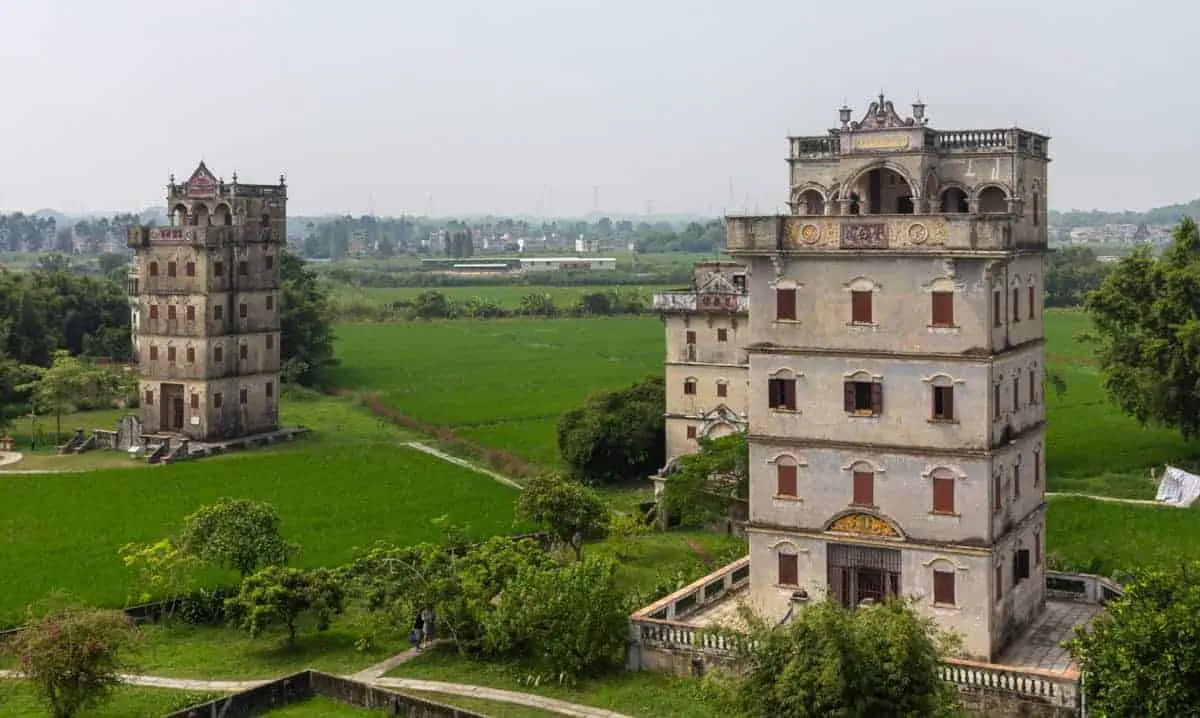
In these villages the familiar architecture of the qiaoxiang (侨乡) — the emigrant hometowns — still stands: ancestral halls (祠堂) with their carved altars and incense, and the occasional diaolou (碉楼), the fortified watchtowers built with remittance money from overseas. For a surname ranked only around eightieth in China, this is a remarkable concentration: a substantial, well-documented Lei presence in exactly the county that would become, a few centuries later, the most famous emigrant region in the country.
The Architects Who Drew the Forbidden City
Before turning to the emigration, the Lei name deserves one more chapter of its broader history — because it explains why the surname carries a quiet architectural pride that has nothing to do with Guangdong.
In the late seventeenth century, a craftsman from Yongxiu (永修) in Jiangxi named Lei Fada (雷发达) arrived in Beijing to work on the imperial palaces. He was good enough that the Qing court kept his family on. For the next two hundred years, eight generations of Lei — Lei Jinyu (雷金玉), Lei Shengcheng (雷声澂), Lei Jiaxi (雷家玺), Lei Siqi (雷思起), Lei Tingchang (雷廷昌) among them — served as the yangshifang zhang’an (样式房掌案), the chief architects of the imperial building office. The court called them the “Yangshi Lei” (样式雷), the “Lei of the style office,” and entrusted them with the design of the Forbidden City (故宫), the Summer Palace (颐和园), the Temple of Heaven (天坛), the Yuanmingyuan (圆明园) gardens, and the imperial tombs.

Their work accounts for roughly one-fifth of China’s ancient architecture inscribed on UNESCO’s World Heritage list. Their drawings and models — the Yangshi Lei tu dang (样式雷图档), including three-dimensional tangyang (烫样) models — were inscribed in UNESCO’s Memory of the World register in 2007. It is a different Lei line from the Taishan clan, springing from Jiangxi rather than Guangdong, but the two branches together tell the surname’s range: the same two characters built a palace and tilled a rice paddy.

The Gold Mountain Sojourners
The Lei of Taishan, though, left their deepest mark not in stone but in motion.
The Wuyi counties — Taishan, Kaiping, Xinhui, Enping, Heshan — sent their people across the Pacific in a way no other part of Guangdong did. Most Chinese emigration flowed to Southeast Asia; the Wuyi instead turned east, toward North America and Australia. The twentieth-century politician and scholar Lei Jieqiong (雷洁琼), born in Guangzhou to a family of Taishan Lei, put the geography plainly: nearly half of Taishan’s population, she recalled, ended up in the United States, Canada, and Australia.
The reason for the exodus was as old as the delta itself: land. The Tan River delta was fertile but crowded, and by the nineteenth century the villages of the Wuyi could no longer feed their young men. When gold was discovered in California in 1848, and in Victoria in 1851, the news traveled back through the qiaoxiang villages faster than any official decree. Young men who had never seen the sea began to leave.
Her own family is the human thread of this story. Lei Jieqiong’s grandfather, Lei Songxue (雷嵩学), was a poor young man who signed on as a contract laborer — a qiyuegong (契约工) — in the 1840s, the earliest wave of the Gold Mountain (金山) migration, and sailed the forty-odd days from Hong Kong to California to work the gold mines. She described that first generation bluntly: the first Chinese laborers, she said, were deceived into mining gold in those countries. When she spoke of it, she was speaking about her own grandfather.
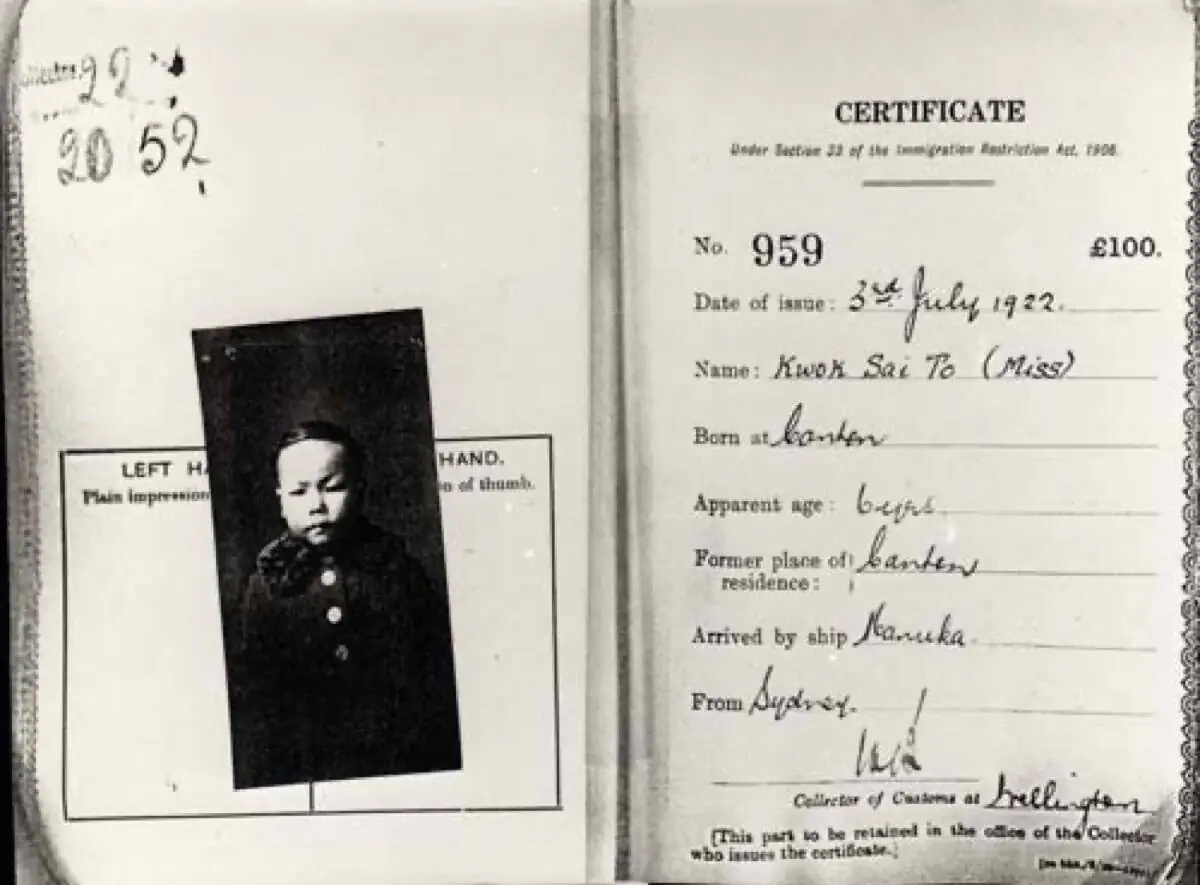
The journey she described was the shared experience of thousands. A young man said goodbye to his village, boarded a crowded ship in Hong Kong or Macau, and spent six weeks at sea. Many did not survive the passage. Those who did found work that was backbreaking and dangerous: panning and sluicing the Sierra foothills, then, when the gold thinned, grading and blasting the transcontinental railroads that would bind the American West together. The Central Pacific, built largely by Chinese labor, ran through snowdrifts and granite; the men who laid its track were paid less than white workers and asked to do the work no one else would take, and a great many of them were Taishanese, carrying surnames like Lei.
That labor came at a price beyond the physical. The Chinese who built the American West were met with the Chinese Exclusion Act of 1882 — the first federal law to bar an entire nationality by race — and with the violence of the frontier. Yet they kept sending money home, and the villages of the Wuyi were rebuilt, one remittance at a time, into the qiaoxiang of today: brick houses, schools, watchtowers, and ancestral halls, all raised on gold and railroad wages from across the sea.
Through all of it, the wages traveled home the way every Wuyi emigrant’s did: folded into a qiaopi (侨批) letter — part remittance, part letter, the silver and the words wrapped in a single envelope — addressed to a wife or a mother who had stayed behind. Those letters, more than any monument, are the record of the Gold Mountain generation: “I have arrived,” the letters say, “I am working,” “here is what I have saved,” “do not worry.”
On the other side of the Pacific, another Taishan Lei became a different kind of first. Lei Amei (雷亚妹), known to Australian history as Louis Ah Mouy, arrived in the colony of Victoria in 1851, at the very start of its gold rush, and became the first Chinese resident of Melbourne. From a young Taishan emigrant he rose to become a merchant and a leading figure among the earliest Chinese Australians — a man whose name appears in the founding records of a community that now numbers more than a million.
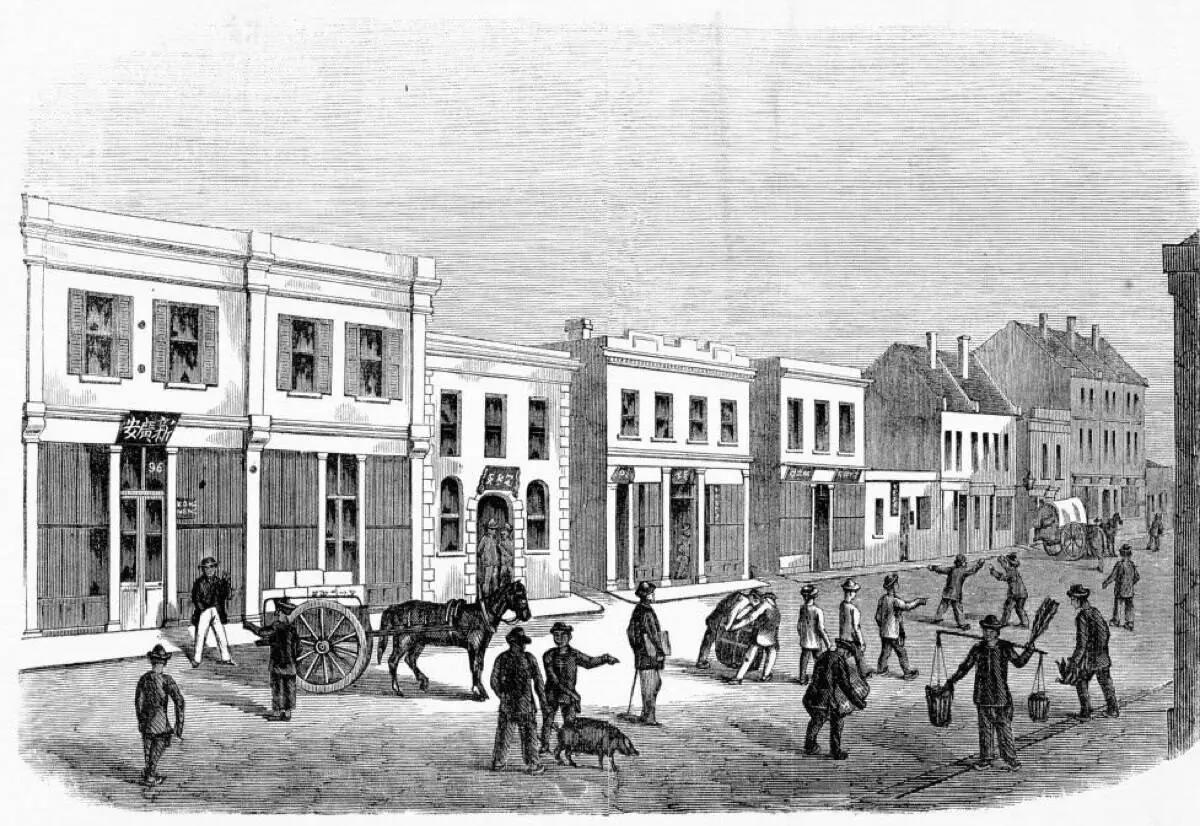
These two men, Lei Songxue and Louis Ah Mouy, bracketed the same decade and the same journey: from the villages of Taishan to the goldfields of two hemispheres, carrying little more than a family name and the obligation to send something back.
A Diaspora of Builders, Healers, and Merchants
The chain migration that began with men like Lei Songxue — each arrival writing home to summon a brother or a cousin — produced, over generations, a Taishan Lei diaspora that reached into every profession.
Lei Gancheng, known in English as Steven G. Louie, born to a family from Fulin village (福林村) in Dajiang, became a condensed-matter physicist elected to the U.S. National Academy of Sciences and the Chinese Academy of Sciences. Lei Binglin (雷炳林), from Long’an village (龙安村) in Dajiang, became a pioneer of China’s textile engineering, holding patents that shaped the modern textile industry. Lei Liang (雷亮), born Lei Hongwei, co-founded Hong Kong’s Kowloon Motor Bus (九巴) and gave the city the “Lui Seng Chun” (雷生春) tong lau that still stands. And in the San Francisco Bay Area, Lei Rongchang (雷荣畅), from Kengwei village (坑尾村) in Dajiang, became a quiet force in the movement to reunite Chinese communities across the Taiwan Strait.

Beyond Taishan, the name kept generating firsts. Lei Lütai (雷履泰) founded the Rishengchang (日升昌) draft bank in Shanxi — China’s first piaohao (票号), the institution that invented the remittance draft, the same financial instrument that would later let a Taishan laborer’s wages travel home as a qiaopi letter. And Lei Feng (雷锋), the young PLA soldier who died in 1962, became the most famous Lei of all — the namesake of a national campaign that taught millions to serve without seeking reward.
Where Lei Lives Today
Today the Lei surname is anchored in the interior provinces — Sichuan, Hubei, and Shaanxi together hold more than half of China’s Lei population — with strong communities in Guangdong and Fujian as well. The Taishan clan remains one of the name’s most concentrated and best-documented branches, its 123 villages a living genealogy that runs back to Fu Gong’s arrival in 1273.
And the diaspora keeps spreading. In the late Qing, Lei families emigrated through Southeast Asia — to Vietnam, Cambodia, Thailand, Singapore, Malaysia, Indonesia, and the Philippines — and in the 1970s the Chinese-Lei community of Saigon scattered as refugees across the world. Today Lei descendants live in the United States, the United Kingdom, France, Germany, Sweden, and the Netherlands. The thunder-name that began in a Henan fief now echoes in more countries than most surnames could name.
Tracing Your Lei Roots
If the name is yours, the path back is more concrete than most people imagine — especially for the Wuyi branch, whose records are unusually complete.
Begin with the village. Surname genealogies are organized by place, not by person, so the single most valuable fact you can recover is your grandfather’s village name — the compass point of every Wuyi roots search — the cun (村) where the family lived before emigration. For a Taishan Lei, the answer is likely to be one of the Dajiang villages, and the county’s genealogical offices still hold the village-by-village maps of the past seven centuries. The three-character clue is worth knowing too: if the family records mention Fang (方) or Kuang (邝) as kin, that is a sign of the old Fang Lei lineage, and it narrows the search considerably.
The next step is the zupu, the clan genealogy. These handwritten or woodblock books record generations of births, marriages, and migrations, and many Taishan zupu survived the twentieth century’s upheavals in the care of overseas clan associations. If you are a Louie or a Lui — the romanizations the name picked up in Cantonese-speaking communities — that is the same surname, transcribed differently on the other side of the ocean.
Finally, the surname associations (宗亲会) that organized the diaspora are still active in San Francisco, New York, Vancouver, Melbourne, and Hong Kong. They hold records, photographs, and the institutional memory of who came from which village. The thread the Gold Mountain generation carried across the Pacific did not break; it was simply tied, carefully, at both ends.
The Thread That Holds
A surname is a strange kind of inheritance. It is not property; it cannot be spent or divided. What it carries is a question: where did we come from, and how far have we come?
For the Lei, the answer is unusually long. It begins with a man who fought beside the Yellow Emperor and was given a mountain in Henan. It passes through a workshop in Beijing where, for two hundred years, the men who bore the name drew the outlines of the world’s most famous palace. It settles, for one branch, in the rice paddies and ancestral halls of Taishan, where it has lived since 1273. And it crosses the ocean, in the hands of a contract laborer who mined gold so his granddaughter could one day rise to the highest councils of a nation — and in the footsteps of a young emigrant who became the first Chinese to call Melbourne home.
If you are a Lei — or a Louie, or a Lui — the thread runs all the way back. Somewhere along it is your village, your ancestral hall, and a story that has not finished being told.
Continue Reading
- The Pan (潘) Surname: From the State of Pan to the Wuyi Diaspora — a sibling surname of the ancient Fang Lei line.
- What Is Qiaopi? A Beginner’s Guide to Chinese Remittance Letters — the letters that carried Gold Mountain wages home.
- The 1850s Gold Rush: How Siyi Gold Miners Built a Town in Australia — the Victoria goldfields where Louis Ah Mouy arrived in 1851.
- New Gold Mountain: Wuyi Pioneers in Australia 1850-1901 — the full story of the Wuyi-Australia connection.
- Your Surname is Your Compass: How to Trace Your Wuyi Roots — the step-by-step path from surname to ancestral village.
Sources
- Louis Ah Mouy — Chinese-Australian pioneer (Wikipedia) — the first Chinese resident of Melbourne, born Lei Amei (雷亚妹) in Taishan.
- Yangshi Lei — the Qing imperial architecture dynasty (Wikipedia) — eight generations of Lei master architects; their archive is inscribed in UNESCO’s Memory of the World.
- Lei Jieqiong — scholar and stateswoman (Wikipedia) — her accounts of her grandfather Lei Songxue’s Gold Mountain labor.
- UNESCO World Heritage — Imperial Palaces of the Ming and Qing, Beijing (Forbidden City) — designed and maintained for two centuries by the Yangshi Lei office.
- UNESCO World Heritage — Temple of Heaven, Beijing — another imperial complex built under the Yangshi Lei.
- Chinese Exclusion Act of 1882 (Wikipedia) — the first federal law barring an entire nationality, faced by the Gold Mountain generation.
This article is part of the Roots of China Surname Archive, which traces the families of the Wuyi diaspora back to their origins. To begin tracing your own Lei family line, start with your grandfather’s village name — in Taishan, the Lei clan’s records begin in Dajiang, and the county’s genealogical offices still hold the village-by-village maps of the past seven centuries.
Suggested Reading
Is this your family’s story?
Roots Of China is built from readers’ family histories. If a story here sounds like your own — a surname, a village, a journey — leave a comment below, or share your family’s story with us and we may be able to help you find your ancestral village.
