


ntt
The Wuyi (五) region of Guangdong Province sent over two million people overseas between 1840 and 1940 — and every single one of them came from a specific village. Not a city, not a county, but a village. A place with a name, a founding ancestor, a clan genealogy, and a cluster of houses that overseas remittances would transform into something the world had never seen before.
n
These are the qiaoxiang villages (侨村) — diaspora hometowns built with Gold Mountain money, managed by the women left behind, and connected to San Francisco, Vancouver, Singapore, and Sydney through letters, photographs, and the slow accumulation of 150 years of migration. Each village is different. Each village tells a distinct story. And each village is still here — waiting to be found by the descendants of the people who left.
n
This is the village atlas. It maps where the diaspora came from, what they built with what they sent home, and how you can find your own ancestral village in the landscape of southern Guangdong.
n

n
Geography Is Destiny
n
The five counties of Wuyi — Taishan (台), Kaiping (开), Xinhui (新), Enping (恩), and Heshan (鹤) — sit where the mountains of southern Guangdong meet the South China Sea. It is not rich farmland. The soil is thin, the hills are rocky, and until the 20th century, the region produced barely enough rice to feed its population.
n
But geography is destiny in Wuyi, and here, the geography that made farming hard made migration easy.
n
Taishan’s 649 kilometers of coastline created communities of sailors and fishermen who knew the South China Sea routes long before the first gold-seeker boarded a ship for San Francisco. These coastal villages — Guanghai (广), Haiyan (海), and dozens of smaller fishing settlements — sent their sons to Southeast Asian ports first, working the shipping routes between Hong Kong, Singapore, and Penang. From there, they followed the news of gold in California and Australia, moving onward when opportunity called.
n
Inland villages took a different path. The Tan River (潭) wound through Kaiping and northern Taishan, connecting market towns to the Pearl River Delta and, beyond it, to Hong Kong and the wider world. Villages along the Tan — and the road networks that followed it — had better access to emigration agents (客, kedou), shipping offices, and the information networks that told you where work could be found. These river-valley villages sent more migrants, and sent them further, than villages isolated in the hills.
n
The result was a geography of migration as precise as any map: Duanfen (端) township in southern Taishan concentrated its migrants in San Francisco. Baisha (白) in northern Taishan built a pipeline to New York’s garment district and Chinese restaurants. Guanghai’s deep-water port funneled migrants toward Australia and Canada. Haiyan’s maritime villages sent sailors to every port in Southeast Asia before they settled. The village you came from determined the country you went to — and the country you went to determined the architecture you would one day send home.
n

n
What Is a Qiaoxiang Village?
n
A qiaoxiang village was not a normal Chinese village. Normal villages farmed. Qiaoxiang villages received remittances.
n
Between 1860 and 1949, overseas remittances fundamentally restructured Wuyi’s village economy. A typical household received 2-4 remittances per year totaling 100-300 silver dollars — equivalent to a year’s farming income. Multiply by hundreds of households, and the annual cash inflow to a single large village could exceed 50,000 silver dollars.
n
This money transformed everything. Paved roads replaced dirt paths. Electric lights appeared in the 1920s — decades before neighboring non-qiaoxiang villages saw them. Over 1,000 diaspora-funded schools operated across Taishan by the 1930s, producing literacy rates of 60-70% for men, compared to 30-40% in non-qiaoxiang Guangdong. Fourteen diaspora-funded hospitals provided Western maternity care. Movie theaters opened in market towns. Bicycles — brought back by returning migrants — became status symbols.
n
The economic multiplier was dramatic: every silver dollar in remittances generated $2-3 in local activity, supporting construction workers, merchants selling imported goods, and farmers growing food for non-farming remittance households. Villages with strong overseas connections had economies 3-5 times larger than their agricultural base alone could support.
n
But this prosperity came with a cost. With 60-80% of working-age men overseas — working in San Francisco laundries, New York restaurants, Vancouver canneries, and Sydney market gardens — the villages became women’s communities. The jinshanpo (金婆), or “Gold Mountain wives,” managed property, employed farm laborers, negotiated with local officials, paid taxes, and raised children alone for years or decades. Some husbands never returned. The 1932 Taishan census recorded 1.2 million Taishanese in the county — and an estimated 1.5 million overseas. More Taishanese lived outside the county than inside, and the ones who stayed were disproportionately the women, the elderly, and the children.
n

n
Reading a Village
n
You can read a qiaoxiang village like a book. Every building is a document.
n
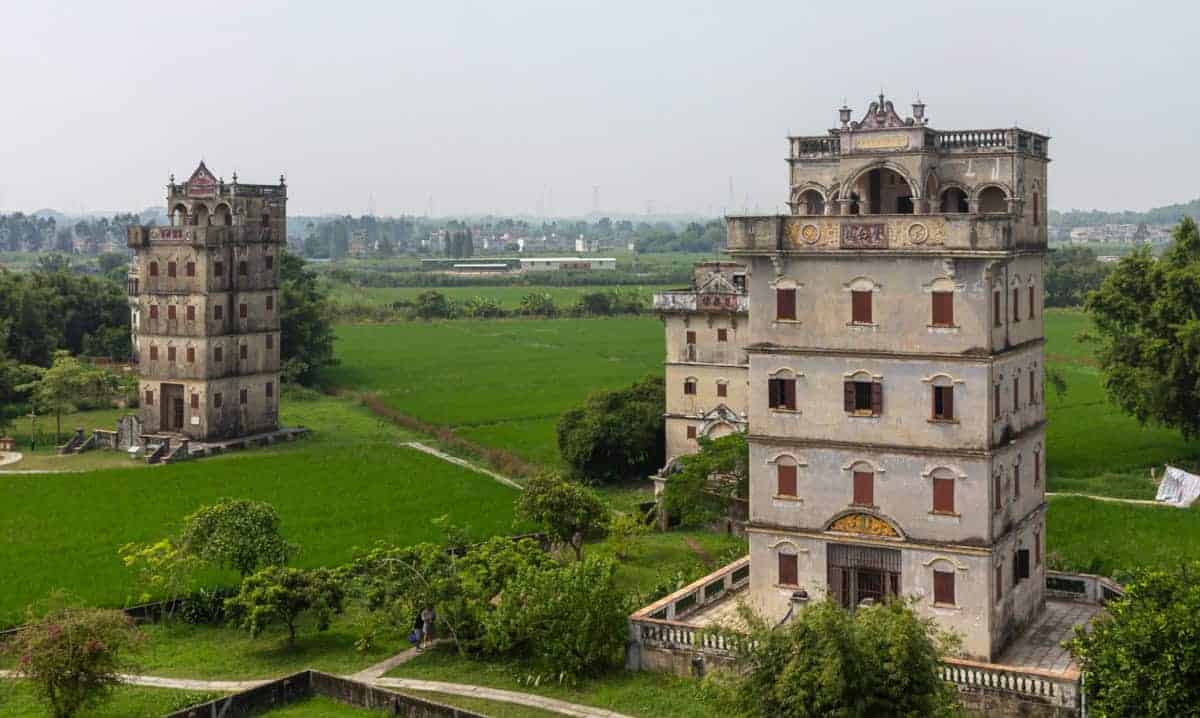
Start with the skyline. The diaolou (碉) — fortified watchtowers three to seven stories tall, built of reinforced concrete between 1900 and 1930 — dominate the landscape. Over 3,000 were constructed across Kaiping alone, each one funded by a specific overseas migrant or clan association. The donor’s name and overseas location are often inscribed on the building itself. Look at the architectural details: a Gothic window suggests a migrant who worked in British Hong Kong or Australia. Classical columns point toward San Francisco. Southeast Asian decorative motifs — fretwork, ceramic tiles — mean the money came from Singapore or Penang.
n
The diaolou were defensive architecture, built against the banditry that plagued wealthy qiaoxiang communities. Thick walls, gun ports, iron gates, and elevated firing positions made them fortresses. But they were also statements — the taller the tower, the more elaborate the decoration, the greater the migrant’s overseas success. A diaolou was a letter home made permanent in concrete.
n
Behind the towers, find the ancestral hall (祠, citang). Every significant Wuyi village had at least one — the spiritual, administrative, and social center of clan life. Diaspora wealth rebuilt these halls on grander scales, with imported timber, carved stone, and elaborate rooflines. The ancestral hall was where emigration decisions were made, where qiaopi (侨) remittance letters were read aloud, and where returning migrants were welcomed home. It was the village’s heart.
n
Walk through the residential streets. The Western-style mansions (洋, yanglou) announce themselves with verandas, stained glass windows, and imported bathroom fixtures — houses that could have stood in San Francisco’s Richmond District, transplanted to rural Guangdong. The arcaded shop-houses (骑, qilou) of market towns like Doushan and Chixi combine Chinese commercial layouts with European colonnades, creating covered walkways that shelter shoppers from subtropical rain. The village gate (村), often an elaborate archway funded by an overseas clan association, marks the transition from agricultural land to community space.
n
n

n
The Clan Map
n
In Wuyi, the village and the clan were often the same thing. Single-clan villages — where everyone shared a surname and traced descent to a common ancestor — were the norm. Finding your ancestral village means finding your clan’s village.
n
Major Wuyi clans are organized into branches (房, fang) corresponding to specific villages. The Mei (梅) clan is concentrated in Duanfen township in southern Taishan. The Huang (黄) clan has deep roots in Baisha. The Chen (陈) clan — one of China’s largest surnames — is distributed across multiple townships, each branch occupying its own village cluster. The Liu (刘) and Xie (谢) clans anchor their own village clusters, and the Lee (李) clan — among the most numerous in Taishan — is documented in its own deep-dive. Each is traced in the Surname Archive.
n
The key to locating your ancestral village is the clan genealogy (族, zupu). These hand-written or printed books — some centuries old — record generational name poems (字诗, zibei shi), the poetic sequences of characters used for each generation’s given names. If your grandfather or great-grandfather had a generational name character, and you know the county he came from, a clan genealogy can often trace that character to a specific village.
n
Clan genealogies also record migration events: when a branch moved from one village to another, who sponsored whom overseas, and where ancestral halls and graves are located. During the Cultural Revolution (1966-1976), families hid genealogies in walls, buried them in fields, or smuggled copies overseas to protect them. The genealogies that survived are now being digitized by universities and clan associations, making it possible for diaspora descendants in San Francisco, Vancouver, or Sydney to trace their lineage to a specific Wuyi village without speaking Chinese or traveling to Guangdong.
n
The clan association is your best on-the-ground resource. Organizations like the Duanfen Mei Clan Association operate branches in multiple countries and maintain records, ancestral halls, and contacts in home villages. If you know your surname and county of origin, a clan association can often tell you which village to visit and who to contact when you arrive.
n

n
Five Villages That Tell the Story
n
No two qiaoxiang villages are the same. These five — all covered in depth on RootsOfChina — show the range of what’s out there.
n
Duanfen (端) is the heartland of the Mei clan in southern Taishan. Its signature landmark is the Meijia Courtyard (梅大) — 108 two-story qilou arcades built in 1931 by overseas Mei clan members from 16 countries. Walk through the courtyard and you can read the architecture: this building was funded from San Francisco, that one from Singapore, this one from Vancouver. Each unit is a different overseas story.
n
Haiyan (海) sits on Taishan’s southern coast. Its maritime heritage is written in its architecture — Southeast Asian colonial influences blended with Cantonese village traditions, reflecting generations of sailors who worked the Singapore-Penang-Jakarta shipping routes before settling overseas. The town’s “overseas Chinese farm” (华农) was established for returned migrants, a living record of circular migration.
n
Guanghai (广) was the departure point. Its deep-water harbor — connected directly to Hong Kong and Macau — was the last Chinese soil for an estimated 200,000 or more Wuyi migrants between 1850 and 1949. The port infrastructure — warehouses, inns, shipping offices, money changers — was built and rebuilt with diaspora capital across multiple migration waves.
n
Baisha (白) looks more American than any other Wuyi township. Its two-story wooden houses with front porches could have been airlifted from Queens, New York — and in a sense, they were. Baisha migrants concentrated in New York’s garment industry and Chinese restaurants, and the architecture they sent home reflects it. The Baisha-to-New York pipeline was one of the most concentrated single-destination flows in qiaoxiang history.
n
Meijia Courtyard (梅大) deserves its own entry. It is the single most dramatic example of diaspora-funded architecture in the entire Wuyi region. Built in 1931, the 108-unit arcaded complex demonstrates everything the qiaoxiang system could achieve: clan organization at global scale, overseas wealth concentrated into a single project, and architectural ambition that produced something genuinely unique. It appears in films, draws tourists, and stands as the physical proof of what diaspora money built.
n
Deeper dives on each village are available on the site: Taishan Villages, Duanfen’s Meijia Courtyard, Haiyan, Guanghai, and the county of Enping — the Wuyi corner few diaspora know.
n

n
The Paper Trail
n
If the buildings are the skeletal record of qiaoxiang life, the letters are its flesh and blood.
n
Qiaopi (侨) — remittance letters sent from overseas Chinese to their home villages — are the single richest primary source for village-level migration history. By the 1930s, an estimated one to two million qiaopi letters passed through Hong Kong annually en route to Wuyi villages. A single large village might receive 500 to 1,000 letters per year. Each letter is a household-level record: the remittance amount, the sender’s overseas location and occupation, the recipient’s village, family instructions, and often village news and political commentary.
n
Qiaopi letters follow a revealing format. Remittance instructions come first — how much money, through which agent, for what purpose. Family inquiries come second: “Is mother well? Has younger brother started school? Is the new house finished?” Village news comes third — marriages, deaths, land purchases, disputes. The format reveals qiaoxiang priorities: money, family, information, in that order.
n
But the letters also carry emotion, often in formulaic language that barely contains deep feeling. A migrant writing “I dream of the village well every night” or “tell mother I am eating well” reveals the loneliness, homesickness, and anxiety of life separated by an ocean. Letters from overseas husbands to their jinshanpo wives express anxiety about fidelity — “guard your virtue, do not let other men visit the house” — that reveals the emotional cost of the system for both sides.
n
In 2013, UNESCO added qiaopi to the Memory of the World Register, recognizing its global significance as one of the largest and most detailed documentary records of a transnational migration system. Major digitization projects now make thousands of letters available online — searchable, cross-referenced, and accessible to diaspora descendants who may not read Chinese but can now find their ancestors in the record.
n
The paper trail also includes clan genealogies (族), as discussed above, and immigration records. Angel Island in San Francisco Bay — the Ellis Island of the West — processed hundreds of thousands of Chinese immigrants between 1910 and 1940 under the restrictive Chinese Exclusion Act. Interrogation records name specific Taishan villages, documenting exactly which families attempted US entry, when, and with what outcome. Cross-referencing Angel Island records with village sources is one of the most powerful methods for reconstructing a family’s migration story.
n

n
What Happened to the Villages?
n
The 20th century was a series of disruptions for qiaoxiang villages — and a testament to their resilience.
n
The Great Depression (1929-1933) cut overseas remittances by 50 to 70 percent. Villages that had abandoned agricultural self-sufficiency for remittance dependence faced starvation. The Japanese occupation of Taishan (1939-1945) severed all overseas connections and destroyed village infrastructure — many diaolou became resistance strongholds, and many jinshanpo fled or were killed.
n
The 1949 revolution and subsequent land reform (1950-1952) targeted qiaoxiang villages specifically. Overseas-owned property was confiscated and redistributed. Clan halls became government offices or granaries. Jinshanpo who had managed family property for decades were labeled “landlords” and persecuted. The Cultural Revolution (1966-1976) systematically destroyed the physical record — ancestral tablets smashed, clan genealogies burned, diaolou defaced, overseas letters hidden or destroyed.
n
And yet the connection survived. Underground qiaopi networks operated through Hong Kong intermediaries during the Mao era. When Deng Xiaoping’s 1978 reforms welcomed overseas Chinese investment, qiaoxiang villages were the first beneficiaries — property was returned, remittances resumed, and diaspora-funded construction began again. The 1980s were a second golden age of qiaoxiang building, as overseas Chinese funded the first wave of post-reform modernization.
n
Today, the villages face a new kind of challenge. Young people leave not for San Francisco but for Guangzhou, Shenzhen, and Zhuhai — China’s own internal migration drawing them away from ancestral homes. Villages that survived 150 years of overseas emigration are being hollowed out by domestic urbanization. Elderly residents remain. Returned retirees come back. But the working-age population — the generation that would maintain the buildings, record the oral histories, and sustain village life — is increasingly absent.
n

n
Planning Your Roots Trip
n
If you want to see these villages yourself, here is how to start.
n
Getting there: Wuyi is accessible from Guangzhou by high-speed rail — two to three hours to Taishan or Kaiping stations. From Zhuhai or Macau, buses take about 90 minutes. From Hong Kong, take a ferry to Zhuhai or Shenzhen, then a bus or train. The region is well-connected but not heavily touristed — plan for a multi-day trip if you want to visit multiple villages.
n
Where to stay: Kaiping has international hotels near the diaolou clusters, as well as guesthouses in restored village buildings. Taishan City offers mid-range hotels. Village guesthouses are emerging — advance booking and a local contact are recommended.
n
What to see: The UNESCO-listed Kaiping diaolou clusters at Zili Village (自村), Majianglong (马龙), and Jinjiangli (锦里) have the best visitor infrastructure. In Taishan, Meijia Courtyard in Duanfen is open to visitors. Ancestral halls throughout the region welcome diaspora descendants — bring a family record or a name and they will often help you search.
n
Finding your village: Start with your surname and county of origin from family records. Contact the relevant clan association — most county seats have a federation of clan associations that maintain records. Bring any documents: an old letter, a photograph with a village name on the back, a generational poem. Even a surname and a vague idea of the county can be enough for a motivated genealogist or clan elder to work with.
n
When to go: Qingming Festival (清, early April) is the traditional time for diaspora return and tomb-sweeping. Chinese New Year (late January or February) brings many overseas Chinese home. October and November offer pleasant weather for exploring — less rain, comfortable temperatures, and fewer crowds.
n
For more detailed trip-planning guidance, see our Wuyi Roots Trip: A Visa and Planning Guide, How to Find Your Chinese Ancestral Village, and Your Surname is Your Compass.
n

n
The Atlas Is a Rescue Mission
n
The physical record of qiaoxiang village life is being lost. Every year, diaolou walls crack and crumble. Qiaopi letters decay in humid Guangdong attics. Elderly residents — the last generation with direct memory of the migration era — pass away, taking their oral histories with them. Clan genealogies, the single most important tool for connecting diaspora descendants to specific villages, are lost in inheritance or discarded by families that no longer see their value.
n
The village atlas is a rescue mission. It documents what remains — the architecture, the genealogies, the letters, the stories — before they are gone. Digital tools are helping: 3D scanning preserves buildings that may not survive physically; GIS mapping records village layouts and landscape changes; WeChat groups maintain village identity across continents; DNA databases and digital genealogy connect descendants to places their ancestors left four or five generations ago.
n
But technology is only as good as the information it captures. The real work is on the ground: interviewing elders, photographing buildings, scanning genealogies, and translating the knowledge embedded in village life into accessible forms for diaspora descendants who may not speak the dialect or read the characters.
n
These villages sent over two million people into the world between 1840 and 1940. Their descendants — in San Francisco, Vancouver, New York, Sydney, Singapore, and everywhere the diaspora spread — number in the tens of millions today. The villages are still here. The ancestral halls still stand. The qiaopi letters still exist, waiting for someone to read them and find a family name.
n
Start your search. Contact your clan association. Visit your ancestral village. Add your family’s story to the atlas. The villages are waiting.
n
n
Continue Reading
n
- n
- Taishan Villages: History and Architecture That Define a Diaspora
- Duanfen’s Meijia Courtyard: 108 Arcades Built by Overseas Chinese from 16 Countries
- Your Surname is Your Compass: Planning a Wuyi Roots Trip
- Reading Qiaopi: What Remittance Letters Reveal About Wuyi Families
n
n
n
n
n
Stay Connected
n
Follow RootsOfChina on Facebook and Instagram for new article updates, behind-the-scenes from Kaiping, and stories from the Chinese diaspora.
n
Sources
n
- n
- 梅强, 张雄 et al. 《邑侨人》. 广高教出社, 2001.
- 梅强. 《东山侨》. 中华出社, 2010.
- 刘. 《信五侨社》. 广人出社, 2011.
- Hsu, Madeline Y. Dreaming of Gold, Dreaming of Home. Stanford University Press, 2000.
- UNESCO World Heritage Centre. “Kaiping Diaolou and Villages.” whc.unesco.org.
- UNESCO Memory of the World. “Qiaopi and Yinxin Correspondence.” 2013.
- Stanford University. “Chinese Railroad Workers in North America Project.” web.stanford.edu.
- Taishan Overseas Chinese Museum (台华博馆). Taishan City, Guangdong.
- Wuyi University (五大). Qiaoxiang Culture Research Center. Guangdong, China.
- National Archives (US). Angel Island Immigration Station Records, 1910-1940.
n
n
n
n
n
n
n
n
n
n
n
Suggested Reading
Suggested Reading
Is this your family’s story?
Roots Of China is built from readers’ family histories. If a story here sounds like your own — a surname, a village, a journey — leave a comment below, or share your family’s story with us and we may be able to help you find your ancestral village.

Join the Roots Of China newsletter
One email a week — the stories of the Wuyi diaspora, straight from the villages.