

In the spring of 1885, a Hakka woman of the Yuan clan (源, Yuán Shì) stood at the edge of Xiaoxiang Village (霄村) and watched her eldest son walk toward the Xijiang River (西). He was sixteen. He carried a cloth bundle containing three changes of clothing, a small pouch of ground tea leaves (擂, léichá), and a letter of introduction from the clan association addressed to a cousin in Kuala Lumpur. She had fed him stuffed tofu (酿腐, niàng dòufu) that morning — the same dish her grandmother had taught her, made from recipes Hakka women had carried south for centuries, across Fujian, across eastern Guangdong, to this patch of Crane Mountain that the Qing magistrate had carved from Xinhui County in 1732 and named Heshan (鹤, Hèshān).
n
Her feet were bare and unbound — 天 (tiānzú), sky-piercing, the Hakka called them — and the mud of the Pearl River Delta clung to her ankles. Around her, the village spoke Hakka dialect (客话, Kèjiāhuà), but beyond the hills, the world spoke Cantonese. She did not cry. Hakka women worked; Hakka women sent sons across oceans; Hakka women held the world together with remittance letters and clan couriers and prayers to the Three Mountain Kings (三国, Sān Shān Guówáng). Her son would join the chain that ran from Xiaoxiang Village to the tin-mining towns of Malaya — one more link in a diaspora that had nothing to do with the Cantonese Siyi counties whose names filled the history books, and everything to do with survival.
n
No archive records her name. No photograph captures her face. But her stuffed tofu still appears on tables in Kuala Lumpur kitchens, her unbound footprints mark the migration path her descendants walked, and the temple incense she lit before the Three Mountain Kings still burns — if you know where to look.
n
n
A County Built for Guests
n
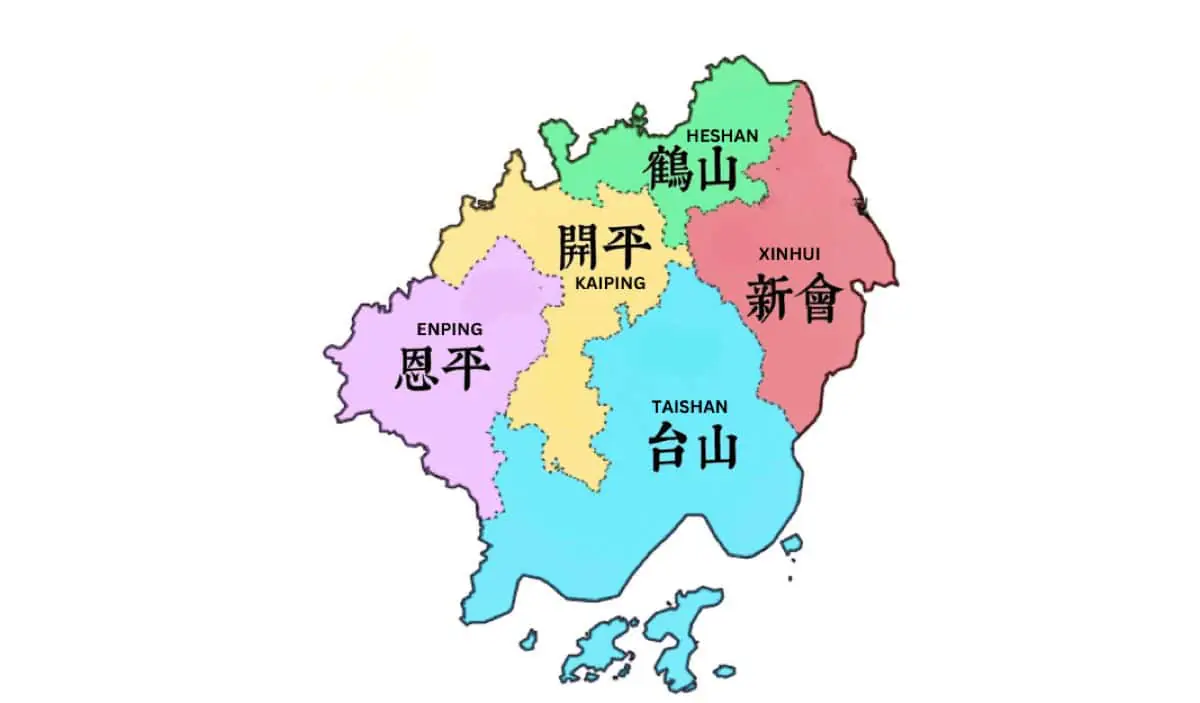
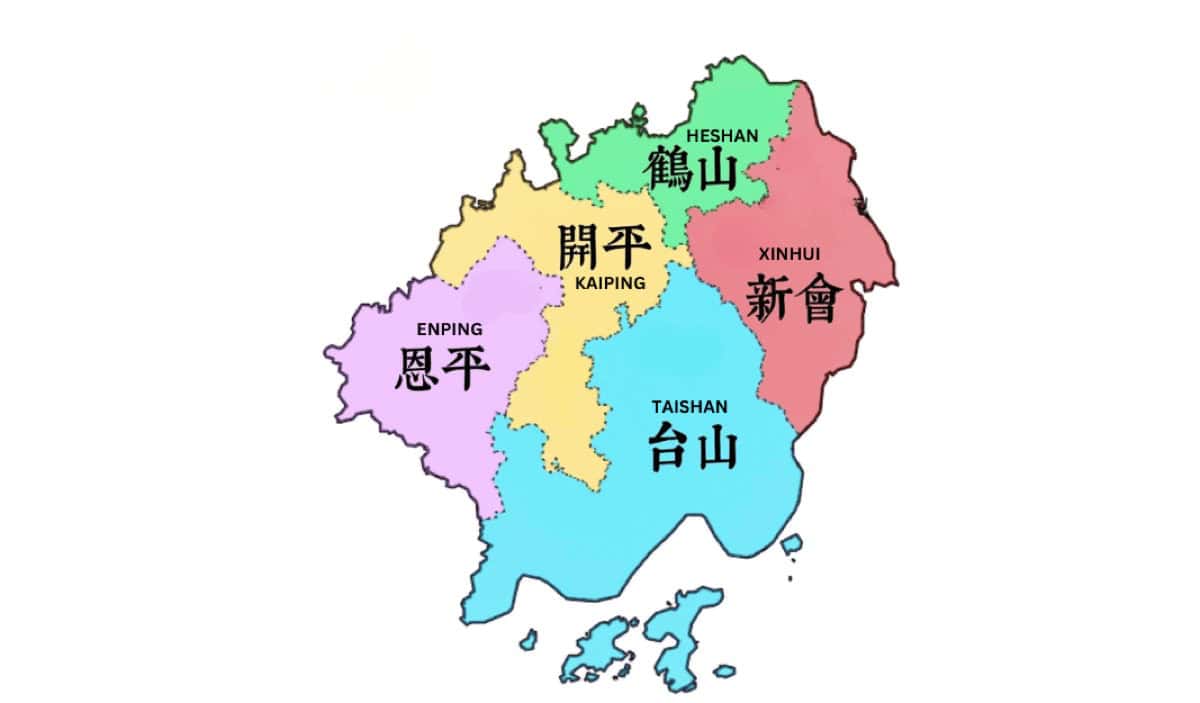
How does a county get built for a single ethnic group? In the tenth year of the Yongzheng reign — 雍十, 1732 — a Qing magistrate named Huang Dapeng (黄鹏) carved a new administrative territory from the edges of Xinhui (新) and Kaiping (开) counties. The official rationale was crisp: “兴利遏源” — develop the land and suppress the sources of banditry. But the unspoken logic was demographic. The Qing state needed to settle Hakka (客, Kèjiā — literally “guest people”) migrants from the crowded prefectures of Huizhou and Chaozhou in eastern Guangdong. Heshan would be their designated homeland, as documented in official county histories.
n
The land was described in official reports as an empty wilderness: “空蒙…瑶土藏之” — empty mountains covered in vegetation, a hiding place for Yao bandits — “二余,人有居” — for over two hundred years, no settled population had existed there. This “empty mountain” (空) narrative was politically useful: it framed Hakka settlement as filling unused land rather than displacing anyone. But mountains are rarely as empty as official documents claim.
n
n
The recruitment was systematic. A Guangdong provincial official named Tao Zhengzhong (陶中) surveyed more than 33,000 mu of reclaimable wasteland. The Two-Source Governor-General Emida (鄂达) reported to the emperor that over 300 households from Huizhou and Chaozhou had already settled. Incentives were generous: each household received housing, rations, start-up capital, and five mu of hereditary land — land the original landlord could never reclaim. Five households formed a jia (甲), the basic unit of Qing rural administration. Huang Dapeng himself wrote that “惠来,至市” — migrants arrived carrying infants on their backs like a market crowd — and “荷求者以计” — those arriving with hoes seeking land numbered in the hundreds daily.
n
n
The first county seat was Hocheng (鹤) — Crane City — named for a crane-shaped mountain to its north. The total population at founding was barely 8,800. But Heshan’s geography contained a structural force that would shape its entire future: it sat on the Xijiang River (西) watershed, while the other four counties that would become known as the Siyi (四, Four Counties) — Taishan, Kaiping, Xinhui, and Enping — shared the Tan River (潭) system. Water divided what ethnicity would reinforce. For 250 years, Heshan’s rivers flowed one way and its people another.
n
n
The Five Who Descended
n
Every community needs an origin story, and Heshan’s Hakka told theirs through the Five Founders — 五下山 (Wǔ Zǐ Xià Hèshān), the Five Founders Descending to Heshan. The narrative is seductive in its symmetry: five men, each bearing the character 子 (zi) in their given name, led Hakka migration into Heshan. But the seduction is the point. The Five Founders story is not literal history — it is a myth that made a colony feel like a destiny.
n
The competing versions are the real evidence. The news outlet The Paper (澎新) listed five names in 2023: Chen Ziting (陈亭), Yang Zihan (杨汉), Lü Ziliang (吕良), Xie Zigeng (谢耕), and Huang Zicheng (黄成). But the official heshan.gov.cn portal notes seven or eight names with the zi character and admits openly: “口相的’五’就几版,衷是” — the oral transmission of the Five Founders has several versions, impossible to reconcile. A Qianlong-period clan genealogy — the oldest documented version — lists yet another set: Chen Ziheng (陈亨) to Yunxiang, Yang Zihan to Changtan, Lü Ziliang to Xiaoguantian, Huang Zicheng to Henan Huang Village, and Xie Zigeng to Sanbao Yuexiashan.
n

n
The details humanize the myth. Lü Ziliang arrived in 1741 — the sixth year of the Qianlong reign — leading five sons from Yong’an County (modern Zijin County, 紫县) to Xiaoguantian’s Fengtang Hamlet. His family preserved a stone mortar (石臼) carried from their old home — a migration relic, heavy with memory. Xie Zigeng, a thirteenth-generation descendant of a Ming-dynasty Fujian migrant, first scouted the area in 1724, found his preferred settlement site in 1728, and returned in 1732 to bring his father and brothers. That no central authority controlled the narrative — that each village produced its own version of who arrived first — is itself the finding. The Five Founders were not five. They were a story every Hakka village told about itself.
n
n
The War That Split the World
n
For twelve years, from 1854 to 1867, a war raged across seventeen counties in Guangdong and Guangxi that most history books overlook. The Hakka-Punti War (土械, Tǔkè Xièdòu — literally “native-guest armed conflict”) may have killed hundreds of thousands. Captured prisoners were sold into the coolie trade — “被猪” (sold as piglets). And when it ended, Heshan’s Hakka communities stood intact while Hakka populations in Taishan, Kaiping, Xinhui, and Enping were expelled, killed, or forcibly concentrated into designated zones. The divergence would define the next century and a half.
n
The war reached Heshan in 1854, during the Xianfeng Emperor’s reign. Red Turban rebels (红军) — part of the wider Taiping-era upheaval — captured the Heshan county seat and killed the magistrate. Hakka gentry, including provincial graduate Ma Conglong (马龙) and Zhang Baoming (张铭), organized Hakka militia (客, kèyǒng) under the authority of Governor-General Ye Mingchen (叶琛). Officially, they were suppressing rebels. But the militia also looted local Punti (Cantonese) villages, generating the accusation that still echoes: “客挟铲” — Hakkas using official authority to exterminate the locals. Punti landlords mobilized retaliation. The conflict spiraled into full ethnic war, consuming seventeen counties before government forces finally suppressed it.
n

n
Why did Heshan’s Hakka survive? Four factors converged. First, geographic concentration: by the 1850s, Heshan’s Hakka occupied forty fortified settlements (堡, bǎo) in continuous territory — not scattered villages vulnerable to piecemeal attack. Second, defensive architecture: each bao had watchtowers (碉) and signal towers (更) enabling rapid mobilization. Third, clan solidarity: the bao system organized nearly ten thousand militia from a population of fifty to sixty thousand. Fourth, critical mass: Heshan’s Hakka were simply too numerous and too concentrated to dislodge. By contrast, the Hakka villages of the Shuangqiao district (双都) were destroyed by Punti forces by 1863 — their survivors, some fifty thousand, fled to refuge in Gaoming County.
n
The psychological legacy was permanent. Surviving while neighboring Hakka were destroyed taught Heshan’s Hakka that they were both resilient and permanently separate. The war ended in 1867, but the walls it built never came down.
n
n
Four Counties, Not Five: 200 Years of Exclusion
n
For two centuries — from 1732 until 1983 — overseas Chinese from the region identified as Siyi (四, Four Counties) people. The four were Taishan, Kaiping, Xinhui, and Enping. Heshan was the fifth that didn’t count. The exclusion was not administrative oversight; it was ethnic, maintained through separate temples, separate marriage networks, separate foodways, and separate diaspora institutions on four continents.
n
The evidence of separation is institutional. In 1939, Heshan Hakka in Singapore established their own association — the Singapore Heshan Association (新坡山馆), originally called Heyi Yiyitang (鹤怡堂) for spring and autumn ancestral worship. Its founders included men named Zhang Zifang (张方), Ren Zhaolin (任林), Wen Maozhi (温之), and Yuan Guancao (源曹) — surnames concentrated in Heshan’s Hakka villages. Lee Kuan Yew attended its twenty-fifth anniversary in 1964. The association’s address at 21 Kreta Ayer Road placed it in the heart of Singapore’s Chinatown — physically proximate to Siyi associations but institutionally separate. The same pattern replicated across Malaysia: Penang’s North Malaysia Heshan Association (北鹤会), Johor Kulai’s Heshan Association (柔古鹤会), Ulu Tiram’s Heshan Association (乌地鹤会) — all connected through a rotating Singapore-Malaysia Heshan Federation (星鹤联会).
n

n
Then came 1983. Jiangmen was upgraded to a prefecture-level city, Heshan was placed under its administration alongside the Siyi counties, and “Wuyi” (五, Five Counties) became official government and tourism branding. The scholar Zhang Guoxiong (张雄), Vice President of the Chinese Overseas Chinese History Association and co-author of Lingnan: The Five Counties (《南邑), argues that “Wuyi” is fundamentally a post-1983 administrative construction that does not reflect historical social reality. He is right — and also not entirely right. Administrative categories, once established, create new realities. Diaspora associations have merged or rebranded. Siyi histories now include Heshan in footnotes. But the walls are still there, visible in temple architecture, marriage patterns, and the language spoken in diaspora kitchens. As explored in our deep-dive on Duanfen: Heart of Taishan’s Qiaoxiang Diaspora, the Siyi identity that defined overseas Cantonese self-understanding was built on precisely the exclusion that Heshan’s Hakka experienced — and survived.
n
n
The Nanyang Road
n
While Taishan’s sons sailed east to San Francisco, Heshan’s walked southwest — to Singapore, Kuala Lumpur, Penang. An estimated seventy percent of overseas Heshan Chinese settled in Southeast Asia (南, Nányáng — the South Seas), the inverse of Taishan’s North America-dominant pattern. Nearly 490,000 people of Heshan origin live across eighty-three countries — close to a one-to-one diaspora-to-homeland ratio, one of the most balanced of any Guangdong qiaoxiang. And the routes they followed were remarkably specific.
n
The chains were village-to-destination, not county-to-country. From Gulao Town (古镇), migrants went to Singapore. From Xiaoxiang Village, to Kuala Lumpur. From Longkou Town (龙镇), to Penang. From Shaping (沙), the county’s commercial center, to Hong Kong, which served as the transshipment hub — as it did for migrants across the Wuyi region, through the hidden ports of departure that dotted the Pearl River Delta. The Shaping-to-Hong Kong migration corridor was Heshan’s specific artery to the world, different from the Tan River ports used by Siyi migrants.
n

n
Why Nanyang first? Three factors converged. Earlier Hakka maritime networks, built through Chaozhou and Fujian connections, oriented Heshan migrants toward Southeast Asian ports rather than the transpacific routes that Siyi Cantonese developed with American labor contractors. Different colonial labor markets: Malaya’s tin mines and rubber plantations absorbed Hakka labor, while North America’s railroads drew from Taishan’s Cantonese chain. And timing: mass Heshan emigration accelerated after the Hakka-Punti War in the 1860s, precisely when Southeast Asia was the accessible destination and American exclusion laws were closing the Pacific door.
n
The Singapore hub crystallized this geography. The Singapore Heshan Association at 21 Kreta Ayer Road was not the only one — but it was the anchor. Malaysian associations in Penang, Johor, and Ulu Tiram connected through federation meetings. Even the outlier — the Peru Heshan Association (秘鹤会), established in Lima in 1928 — demonstrated the global reach of these village-to-destination chains, though Singapore’s Taishan-dominated Chinatown tells a different story of how Cantonese migration shaped the same city.
n
n
Clan Chains, Not Coolie Ships
n
Heshan’s Hakka built a migration machine that ran on trust, not contracts. Where Taishan and Enping emigration relied heavily on the commercial coolie trade — laborers sold into debt bondage to brokers — Heshan Hakka used clan-based credit-ticket systems through lineage associations. The difference was not marginal. It shaped who left, how they traveled, where they arrived, and whether they ever came back.
n
The institutional backbone was the “Heshan Guesthouse” (鹤大, Hèshān Dàshà) network — clan-based lodging houses in overseas Chinatowns. At 21 Kreta Ayer Road in Singapore, the guesthouse doubled as association headquarters and arrival infrastructure. At 126C Transfer Road in Penang, a shop house donated rent-free in 1979 provided the same. These guesthouses offered temporary housing, job placement through clan apprenticeship, remittance forwarding, and social integration — all within the trust radius of the lineage. For the broader institutional infrastructure of diaspora, clan associations were not sentimental relics but operational systems.
n
n
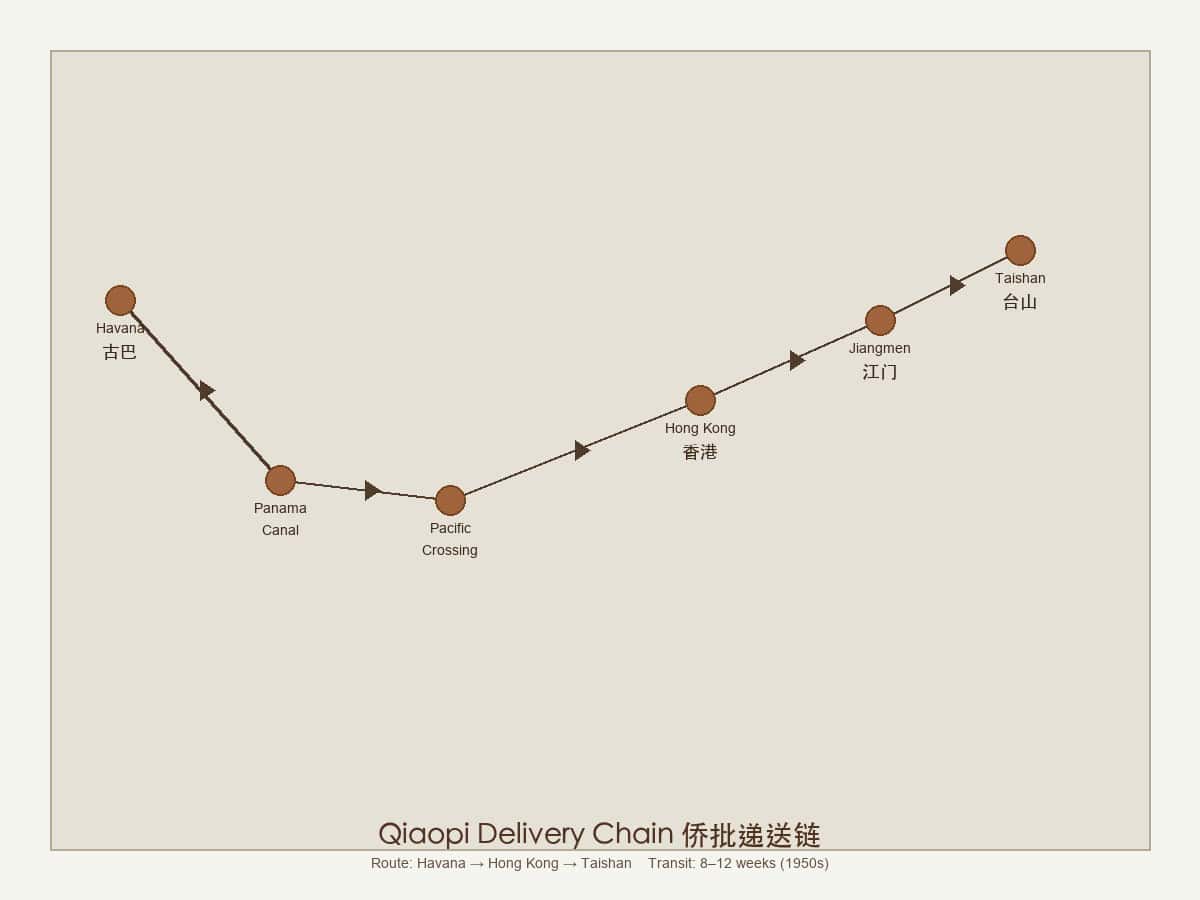
The remittance channel reveals the difference most starkly. Heshan Hakka favored returning villagers and clan association couriers as trusted remittance carriers — not the commercial qiaopi (侨) shops that dominated Taishan’s remittance economy. In Xiaoxiang Village, the envelope did not arrive through a shopfront with a ledger. It came through a returning villager — someone who had seen her husband at the tin mine, who could answer her questions about his health, who carried not just money but presence. The trust premium was real: clan-based migration was slower and smaller-scale than the commercial coolie trade, but it was also more humane — no “piglet” (猪) conditions, no debt bondage to brokers, and families could track their members through channels they controlled.
n
The occupational niche reinforced the system. Heshan Hakka concentrated in the “Three Knives” (三刀) trades — barbering, tailoring, and cooking — portable skills that clan networks could place efficiently. A young man from Gulao arriving at the Singapore guesthouse would be apprenticed to a clan uncle’s barbershop or restaurant, his wages tracked, his remittances forwarded through the same network. The system was not capitalism without friction. It was capitalism with a surname.
n
n
The Women Who Walked Barefoot
n
No bound feet. No waiting at home. Hakka women worked the fields, ran the household finances, and crossed oceans — a different kind of Chinese womanhood that shocked outside observers and sustained the diaspora.
n
Among all Han Chinese sub-groups, the Hakka were unique in their near-universal rejection of foot-binding. The practice was called 天 (tiānzú) — sky-piercing feet — and it was not a fashion choice but an economic necessity. As CCTV documented in 2004, Hakka women’s agricultural labor — rice planting, tea cultivation, carrying loads — required mobility that bound feet made impossible. Scholars cite three reinforcing reasons: the essential economic role of women’s labor, Hakka settlement in mountainous areas distant from court orthodoxy, and the influence of neighboring She (畲) and Yao (瑶) ethnic minorities who never practiced binding. American missionary Robert Smith and British scholar E.J. Eitel both documented Hakka women’s unbound feet as a distinctive cultural marker in the nineteenth century. In Hakka communities, bound feet were a marriage impediment — families needed working daughters-in-law, not ornamental wives.
n
n
The contrast with Taishan’s jinshanpo (金婆, Gold Mountain wives) is instructive — and our pieces on Gold Mountain wives and the broader story of the women who stayed and the women who left explore this split in depth. Taishan Cantonese women were often left behind for decades, managing remittance households alone, waiting for letters that never came. Heshan Hakka women were more likely to emigrate themselves or work as equal economic partners — domestic workers from Wuyi represent yet another migration model. A Hakka folk song captures the difference: “若有刁妹阿带走洋” — If someone makes trouble for you, your brother will take you to Nanyang. Emigration was a female option, not just a male prerogative.
n
The Yuan clan woman from our opening — her unbound feet in the mud of the Pearl River Delta, her stuffed tofu on the stove, her decision about whether her son stays or goes — was not a jinshanpo waiting for a remittance. She was an economic actor managing a transnational household. Hakka women’s labor built the fields that fed the villages, the kitchens that preserved the foodways, and the family structures that made chain migration possible. The history books rarely name them. The diaspora they built is their monument.
n
n
The Xianbei Surname: The Yuan Clan of Xiaoxiang
n
In the fourth century CE, a steppe prince fled his fallen kingdom and rode to the court of a rival emperor. Fifteen hundred years later, his descendants were making stuffed tofu in a Heshan village. The Yuan (源) clan of Xiaoxiang is the rarest surname concentration in the entire Wuyi region — and a living reminder that “Hakka” and “Han” are not as simple as they seem.
n
The origin ancestor was Yuan He (源, 403–479 CE), originally named Tufa Poqiang (秃破), a prince of the Southern Liang kingdom (南国). The Tufa (秃) clan were Xianbei (鲜) — steppe people from the Mongolian-Manchurian borderlands who ruled northern China during the Northern Wei dynasty (北, 386–535 CE). In 414, the Southern Liang fell to the Western Qin. Tufa Poqiang fled to the Northern Wei court, where Emperor Taiwu (太帝跋) granted him a new surname: 源, meaning “source” — because, the emperor said, “you and I share the same ancestral source” (同). Yuan He rose to become Grand Commandant (太), the highest military position in the dynasty. The Book of Wei (《书) confirms: “源,署西秃傉之也” — Yuan He, self-declared son of Tufa Nutan, King of Hexi.
n

n
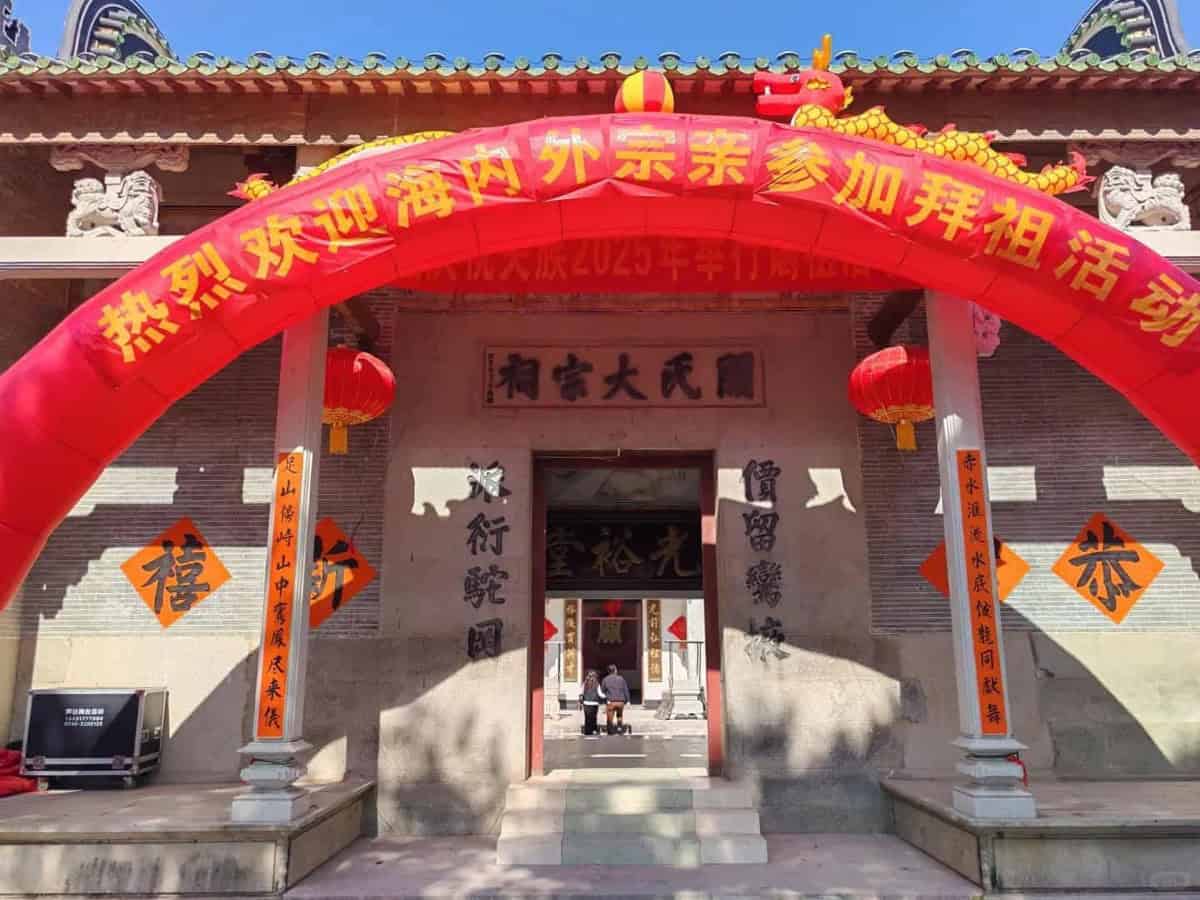
The clan’s journey to Heshan took another eight hundred years. After Yuan He, the family settled in Luoyang (洛). In 1274 — the tenth year of the Xianchun reign in the Southern Song — they migrated south to Guangdong, settling in Xiaoxiang Village. They have been there for over seven hundred years. Today, roughly a thousand people with the surname Yuan live in Xiaoxiang, with perhaps four thousand worldwide — and virtually no other concentrations exist outside Heshan. In 1997, the rediscovery of the Yuan Clan Genealogy (《氏宗谱) confirmed the Xianbei origins that oral tradition had preserved.
n
Village head Yuan Zhixiong (源雄), interviewed by People’s Daily in 2013, put it with characteristic pragmatism: “Among the current 56 ethnic groups, there is no Xianbei. Therefore, we are all Han.” But the lineage remains visible — in the rare surname, in the genealogy, in the faces of Xiaoxiang villagers whose ancestors rode with steppe chieftains. For those tracing their roots, the surname-to-roots connection runs deeper than most family stories can reach.
n
n
The Fist from Gulao: Wing Chun’s Heshan Roots
n
Before Bruce Lee, before Ip Man, before the global Wing Chun (咏, Yǒngchūn) movement with its estimated twenty million practitioners — there was a Gulao village and a master who came home.
n
Liang Zan (梁, 1826–1901), known as “Mr. Zan of Foshan” (佛赞生), was born in Gulao Town, Heshan. He built his reputation in Foshan’s martial arts world, then returned to Gulao in old age and created a Heshan-specific variant: Pian Shen Wing Chun (偏咏拳, Side-Body Wing Chun). Ip Man (叶, Yè Wèn, 1893–1972) was Liang Zan’s grand-student through Chen Huashun (陈顺). Ip Man taught in Hong Kong; his student Bruce Lee globalized the art.
n

n
Contemporary Gulao takes this heritage seriously. Wing Chun is declared one of Heshan’s “three treasures” (三之), alongside lion dance and Hakka culture. Almost every household in Gulao practices Wing Chun; schools teach Wing Chun calisthenics. The Heshan Pian Shen Wing Chun was listed as a provincial intangible cultural heritage in 2007. A government martial arts sports management center coordinates preservation and promotion.
n
The paradox is sharp: more people know Wing Chun than know Heshan exists. A martial art from a Hakka village became a global brand — but the Hakka story behind it remains invisible. The unanswered question lingers: did Wing Chun’s Hakka origins shape its philosophy? The emphasis on efficiency, adaptability, and indirect force resonates with Hakka survival strategies forged through centuries of migration, discrimination, and defensive warfare. This connection is under-researched — but the parallels are hard to dismiss. Like diaspora-funded infrastructure, Wing Chun represents a different kind of cultural legacy — one that traveled not through remittance ledgers but through bodies, stances, and lineages.
n
n
What the Crane Mountain Built
n
The temples, the food, the houses, the language — these are the enduring markers of Heshan’s Hakka diaspora, and they are fading. The question they pose is one every diaspora faces: how to be counted without being erased.
n
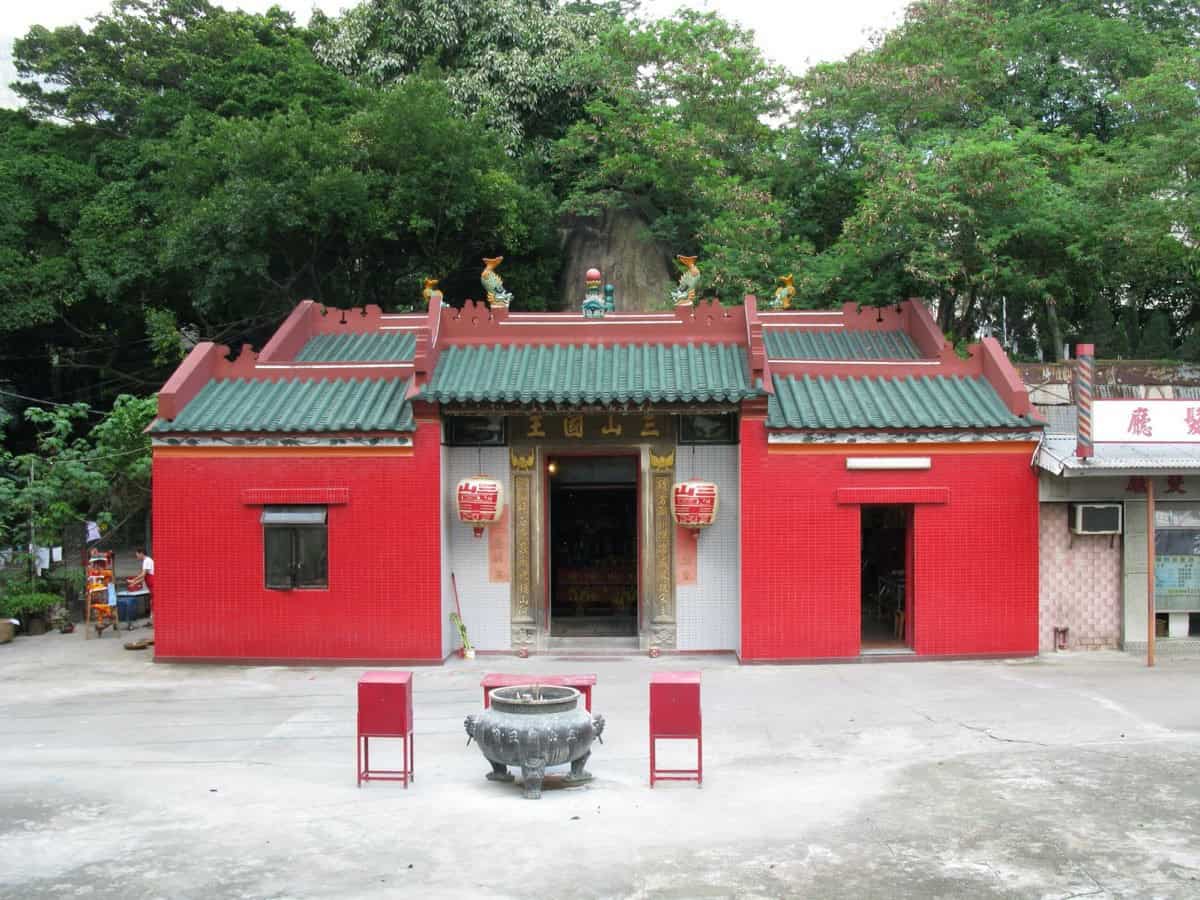
Start with the temples. The Three Mountain Kings — San Shan Guo Wang (三国) — are a Hakka-specific deity pantheon originating from Chaozhou’s Jieyang County. Three deified mountains — Jin (巾), Ming (明), Du (独) — were granted royal titles by Song Emperor Taizong. Worshipped almost exclusively by Hakka and Teochew communities, they are absent from Cantonese temples. The presence or absence of a San Shan Guo Wang temple in an overseas Chinatown is a reliable marker of Hakka versus Cantonese community origin. Across eastern Guangdong, over 360 temples; in Taiwan, over 500 more; diaspora temples in Malaysia, Thailand, and Singapore. To continue worshiping the Three Mountain Kings is an act of identity maintenance — declining Hakka populations in some regions have replaced these deities with mainstream Chinese gods, and with each replacement, a layer of Hakka distinctiveness disappears.
n
The food persists longer than the language. Stuffed tofu (酿腐), salt-baked chicken (盐鸡), ground tea (擂) — these dishes mark Hakka identity in diaspora kitchens across Southeast Asia long after Hakka dialect has been lost. By the fourth generation, language is largely gone; foodways and temple incense remain. The enclosed dragon houses (围屋, wéilóngwū) — traditional Hakka fortified residences — were excluded from the UNESCO world heritage designation that elevated the diaolou towers that define Kaiping’s skyline. Architectural exclusion, mirroring social exclusion.
n
The contemporary picture is one of decline. Post-2000, diaspora-homeland ties are weakening: fewer remittances, fewer roots-seeking visits. The qiaoxiang (侨, emigrant homeland) model that sustained Heshan villages for 150 years is fraying. The Yuan clan woman from Xiaoxiang — her great-grandchildren in Kuala Lumpur may not speak Hakka, may never have visited the village, but they may still know the taste of stuffed tofu. Somewhere in a family archive, a yellowed remittance letter likely still exists. The San Shan Guo Wang temple where she lit incense — does it still burn? Do her descendants know which mountain the Third King guards?
n
Every “we” is built on an excluded “they.” The Wuyi story — five counties, one people, shared diaspora — is a post-1983 administrative construction layered over two centuries of ethnic division, separate migration corridors, and mutual exclusion. Heshan’s Hakka diaspora is a case study in how identity is constructed, enforced, and erased. The Crane Mountain built a parallel universe — and it is still there, if you know where to look.
n
n
Sources
n
Books
n
- n
- Wen Weiqiang (温强). Heshan Hakka History (《山家》). ~2013.
- Heshan Municipal People’s Government (鹤市民府). Heshan Overseas Chinese Gazetteer (《山侨》). 2004.
- Zhang Guoxiong (张雄) and Li Yuxiang (李祥). Lingnan: The Five Counties (《南邑). 2005.
- Mei Weiqiang (梅强) et al. History of Wuyi Overseas Chinese (《邑侨人》). 2001.
- Zhang Yunhua (张华). Wuyi Qiaoxiang Historical and Cultural Overview (《邑乡史化要). 2007.
- Hsu, Madeline Y. Dreaming of Gold, Dreaming of Home: Transnationalism and Migration Between the United States and South China, 1882–1943. Stanford University Press, 2000.
n
n
n
n
n
n
n
Government and Gazetteer Sources
n
- n
- heshan.gov.cn — Heshan Municipal Government portal. Settlement history, Hakka population surveys, Yuan clan documentation, Wing Chun heritage records.
- jiangmen.gov.cn — Jiangmen Prefectural Government portal. Hakka architecture profiles, overseas association histories, Wuyi cultural heritage listings.
- Heshan County Gazetteer (《山志) — cited via heshan.gov.cn excerpts.
n
n
n
n
News, Academic, and Documentary Sources
n
- n
- The Paper / 澎新. “鹤客花会” (Heshan Hakka Firecracker Festival), by Ling Weixin (凌新), 2023.
- People’s Daily / 人日. Interview with Xiaoxiang Village head Yuan Zhixiong (源雄), 2013.
- Li Dan (李). “鹤宵源族家考” (Study of Heshan Xiaoxiang Yuan Clan Origins), 2017.
- Sohu. “被忘战:丰治间东客械研 1854–1867” (The Forgotten War: A Study of the Guangdong Hakka-Punti Conflict, 1854–1867), by Liu Ping (刘).
- CCTV. “客女为不足” (Why Hakka Women Did Not Bind Their Feet), 2004.
n
n
n
n
n
n
Prior Dossier
n
- n
- Heshan Clan Genealogy Guide research dossier (2026-03-06). 20 cross-book foundations, 7 research blocks.
n
n
n
Continue Reading
n
- n
- Wuyi Diaspora: How Clans and Brotherhoods Built Survival Networks
- Taishan Villages: History, Architecture, and Heritage
- Women of Wuyi: Jinshanpo, Amahs, and the Ones Who Left
- Gold Mountain Wives: Jinshanpo and the Hidden Architecture of Qiaoxiang
n
n
n
n
nn
Further reading: Exploring Taishan: The First Home of Overseas Chinese — a deep dive into Taishan’s history and diaspora legacy.
Suggested Reading
Is this your family’s story?
Roots Of China is built from readers’ family histories. If a story here sounds like your own — a surname, a village, a journey — leave a comment below, or share your family’s story with us and we may be able to help you find your ancestral village.
