

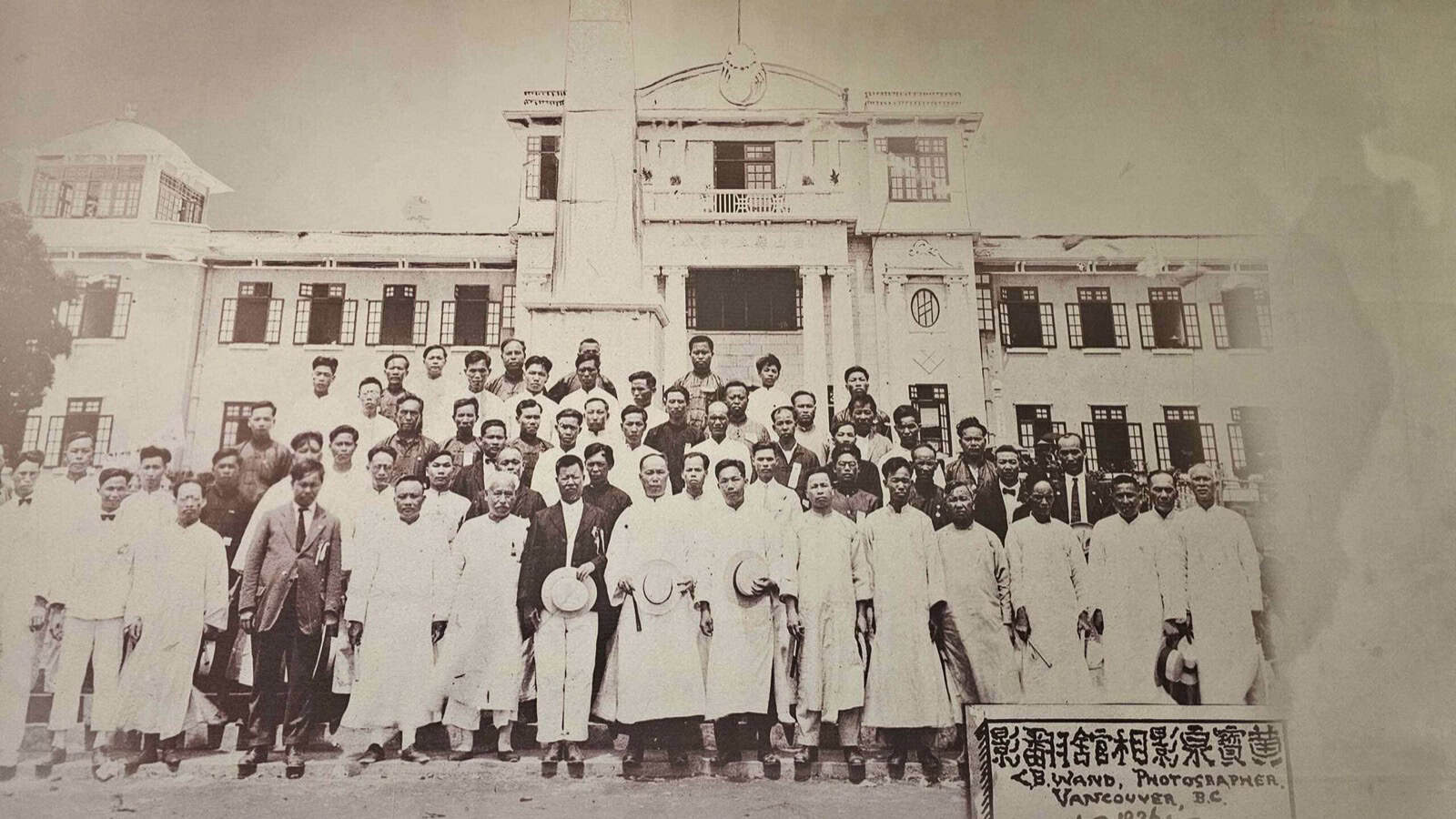
Chinese National Day: How the Diaspora Marks October 1
On October 1, 1949, Mao Zedong stood on the Tiananmen rostrum in Beijing and proclaimed the founding of the People’s Republic of China. Seventy-seven years later, that date — 国庆节 (Guóqìngjié, “National Celebration Festival”) — is marked not only in Tiananmen Square but in the Chinatowns, city halls, and suburban banquet rooms of the global Chinese diaspora, most of whose roots run back to the five counties of Guangdong known as Wuyi.
National Day is the one major Chinese holiday that is not a lunar festival. There is no harvest to give thanks for, no ancestral grave to sweep, no moon to reunite under. It is a founding — a political birthday — and for the diaspora it lands differently than 中秋 (Zhōngqiū, Mid-Autumn) or 春节 (Chūnjié, Chinese New Year). It is about status and belonging rather than reunion and food. To understand how and why millions of overseas Chinese raise the flag on October 1, you have to start with what happened on that first October morning.
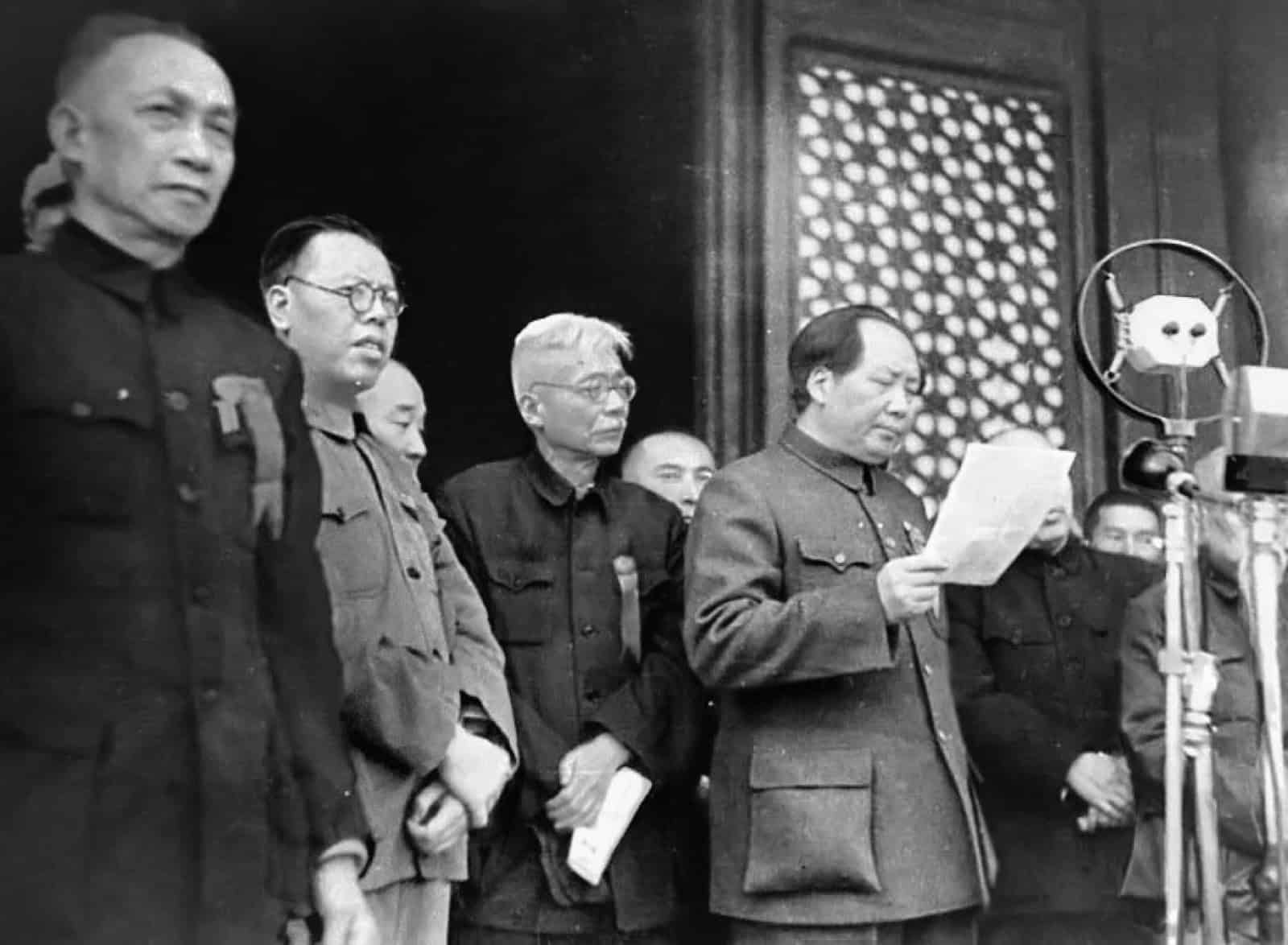
A nation is born
The ceremony was held at three in the afternoon. Official accounts say some 300,000 soldiers and civilians gathered in Tiananmen Square. Mao climbed the rostrum beneath the Tiananmen gate tower and read out the proclamation: the Central People’s Government of the People’s Republic of China had been established.
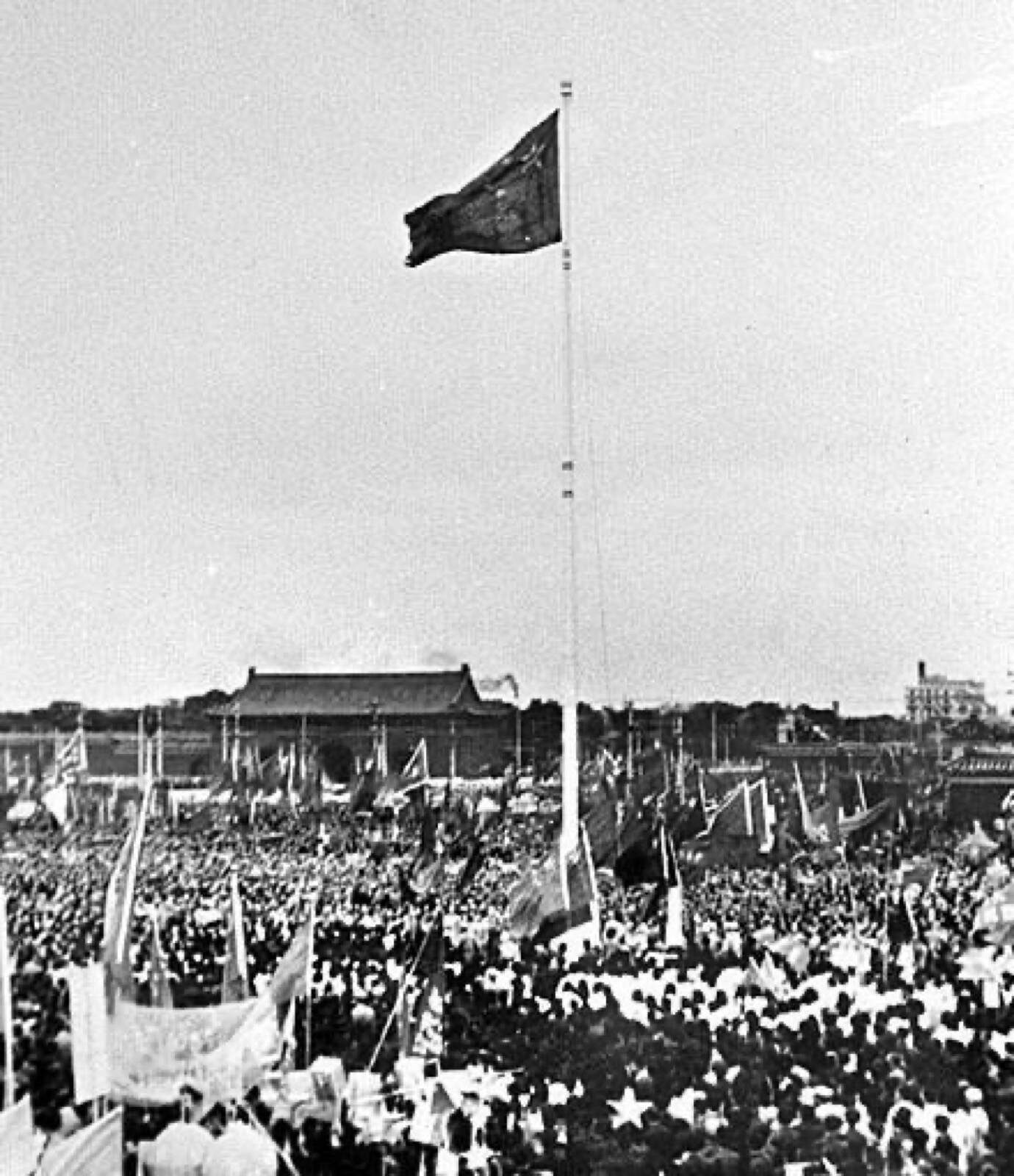
Then came the flag. Mao pressed an electric button, and the first five-star red flag — 五星红旗 (Wǔxīng Hóngqí) — rose up a white pole in the center of the square. The band struck up 《义勇军进行曲》 (Yìyǒngjūn Jìnxíngqǔ, “March of the Volunteers”), the anthem written by the poet Tian Han (田汉, Tián Hàn) and composer Nie Er (聂耳, Niè Ěr) in 1935 for the film Children of Troubled Times. Fifty-four cannons fired twenty-eight salvoes — a number official accounts interpret as symbolizing the Communist Party’s twenty-eight years of struggle since its founding in 1921. Then the parade: infantry, cavalry, artillery, and a flyover of aircraft, reviewed by the army’s commander-in-chief, Zhu De (朱德, Zhū Dé).
None of it was improvised. In the weeks before, the first plenary session of the Chinese People’s Political Consultative Conference had fixed the capital at Beijing, adopted the Gregorian calendar for official use, chosen the flag from a field of public submissions, and settled the anthem — with delegates including the poet Ma Xulun (马叙伦) proposing 《义勇军进行曲》 as a provisional anthem and figures like the painter Xu Beihong (徐悲鸿) and the writer Guo Moruo (郭沫若) seconding it. The song’s opening line, “Arise, ye who refuse to be slaves,” was already famous from the film Children of Troubled Times, released in 1935, the year of its composition. A founding, in other words, was assembled with the deliberate care of a state inventing its own symbols from scratch.
That single afternoon is the seed of everything that follows. But the date did not become a holiday that day. It took two more months.
From proclamation to holiday
On December 2, 1949, the Central People’s Government Committee met in Beijing and passed a resolution fixing October 1 as National Day (国庆节). The flag, the anthem, the capital, and even the switch to the Gregorian calendar for official use had all been settled weeks earlier at the first plenary session of the Chinese People’s Political Consultative Conference.
The flag is worth a moment. The large star in the corner stands for leadership; the four smaller stars, arranged in an arc, stand for the people — workers, peasants, petty bourgeoisie, and national bourgeoisie — gathered together. It is a design selected from public submissions, and it has become the single most recognizable symbol of the date, flown from the pole in Tiananmen to the awnings of shops in San Francisco.
The anthem matters too, because it is not a hymn of victory but a call to resist. Its lyrics — “Arise, ye who refuse to be slaves” — were written in 1935, when the country was under invasion, and they carry the memory of that struggle into every flag-raising. When overseas communities sing it on October 1, they are singing a song older than the holiday itself.
The week that changed travel: Golden Week
For its first fifty years, National Day was a one-day observance. That changed in 1999.
On September 18, 1999, the State Council revised the country’s holiday regulations, making National Day a three-day statutory holiday. Combined with the weekends on either side, it became a seven-day break — the first 黄金周 (Huángjīnzhōu, “Golden Week”). The name is reported to have been borrowed from Japan’s practice of week-long spring holidays, and the effect was immediate: the 1999 Golden Week was followed by a reported surge in holiday travel that caught planners off guard. The following year, in June 2000, the State Council formally established the Golden Week system, and National Day became, in effect, China’s autumn travel week.
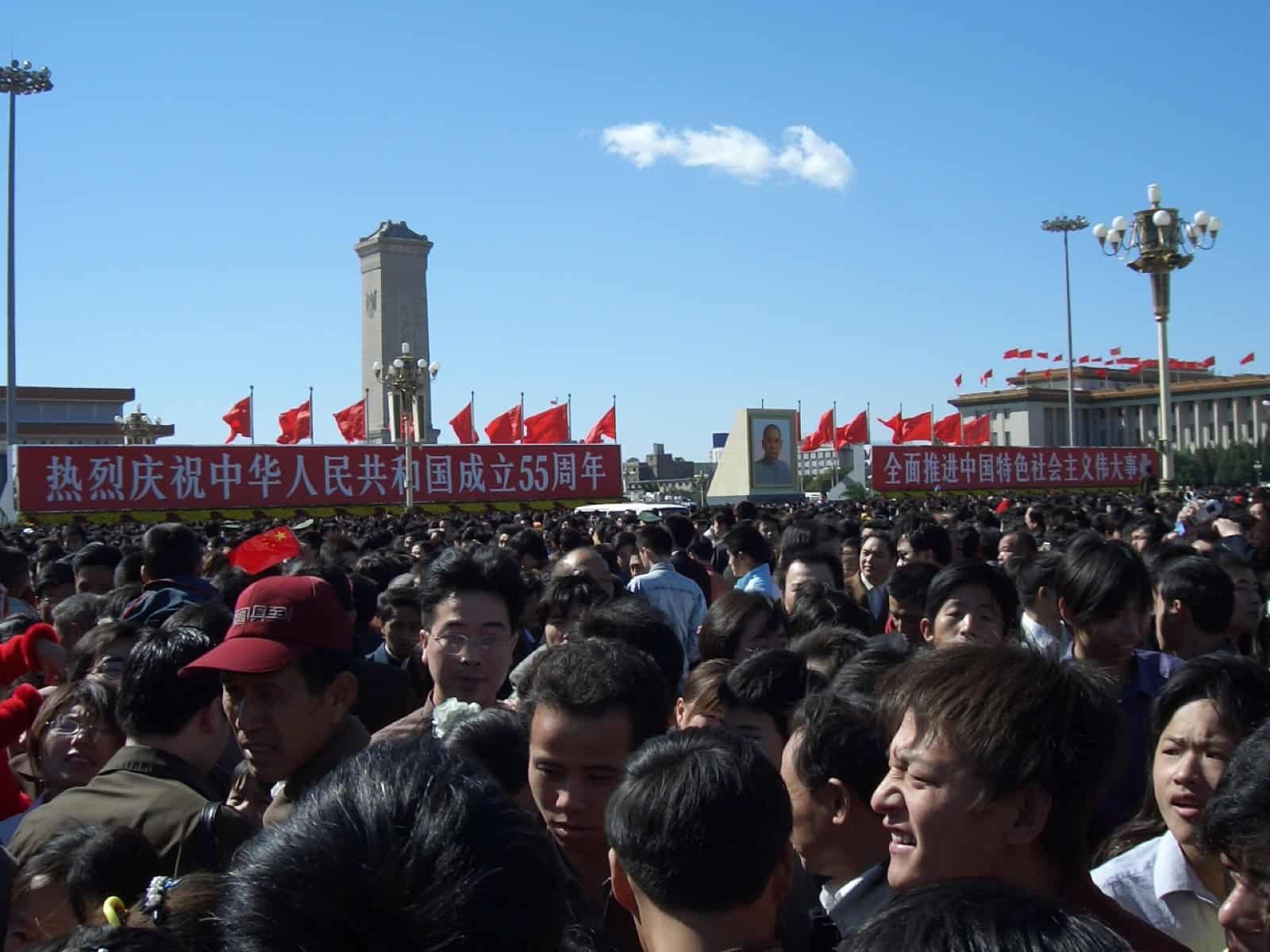
For the diaspora, Golden Week changed the meaning of the date. October 1 was no longer only a day to raise a flag; it became a window — a stretch of seven days when a family could fly home to a village in Taishan or Kaiping, walk the ancestral hall, and be back at work in a Vancouver office or a New York kitchen ten days later. It is the modern echo of an older pattern, in which remittances and return visits were timed to festivals — money and homecomings arriving before 清明 (Qīngmíng), 中元 (Zhōngyuán), and the Lunar New Year.
Golden Week has shifted shape since. In 2008 the country trimmed its holiday calendar, dropping the May Day Golden Week and leaving National Day and the Spring Festival as the two full week-long breaks of the year. National Day has kept its seven-day span since, and for the tourism economy it remains one of the busiest travel periods in the world — a national movement of hundreds of millions of people over the course of a week. For the diaspora, that means October is crowded, festive, and expensive: the price of coming home during the birthday.
A flag raised in a foreign city
On September 30, 2016, something happened in Vancouver that had never happened there before: Chinese community organizations, led by the Canadian Chinese Community Association (加拿大华人社团联席会), raised the Chinese flag in front of Vancouver City Hall to mark National Day. It was reported as the first such ceremony at City Hall, and more than three hundred people — waving both Chinese and Canadian flags — gathered for it.
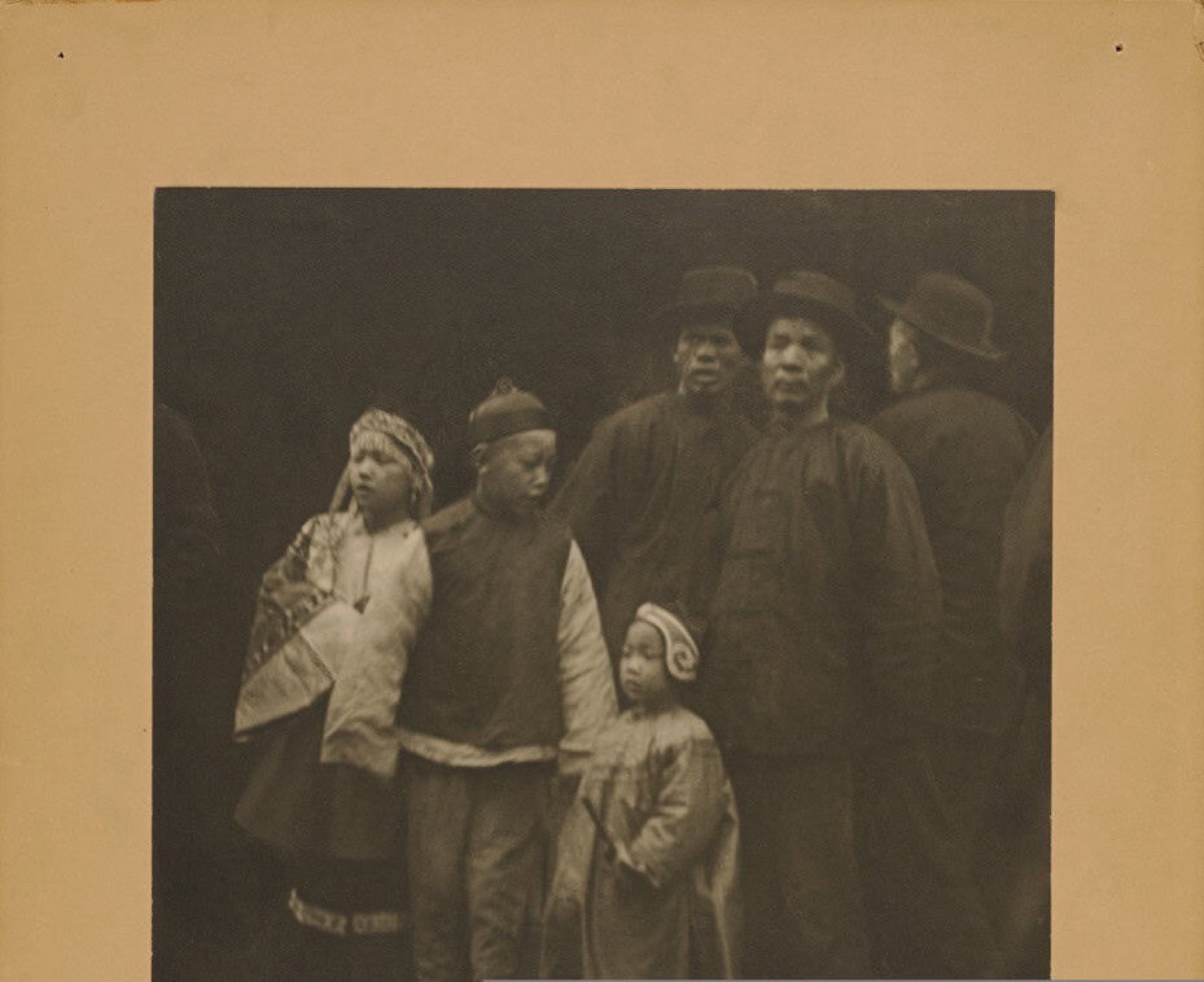
Vancouver was not alone. That same autumn, in New York, a flag-raising was held in Manhattan’s Chinatown; one resident told a reporter it was the first time in fourteen years of living in the United States that he had watched the five-star flag rise in the neighborhood. In 2009, for the sixtieth anniversary, the United States Fujian Fellowship Association won approval to raise the flag on the Ellipse in front of the White House — an event its president, Chen Ronghua (陈荣华), attributed to China’s rising international standing. San Francisco’s Bay Area celebration committee ran flag-raisings, special editions, and a “National Day Cup” volleyball tournament.
These are not isolated curiosities. For the seventy-fifth anniversary in 2024, reported celebrations stretched from Bangkok to Malta’s Chinese Garden to Charlottetown on Canada’s Prince Edward Island, where Chinese children raised the flag. The song 《我和我的祖国》 (Wǒ Hé Wǒ De Zǔguó, “My Motherland and I”) featured in some of these gatherings — a tune that has become a kind of unofficial anthem of diaspora National Day.
Why October 1 matters to the diaspora
There is a reason the flag-raising is the centerpiece rather than the feast. National Day is about recognition.
For a century before 1949, Chinese people abroad carried the weight of a weak state. The Wuyi counties sent their people out across the Pacific and beyond — a migration told in full in 200 Years of Wuyi Diaspora — and those emigrants — miners, railroad builders, laundrymen, cooks — lived under exclusion acts, head taxes, and the daily insult of being from a country that could not protect them. The founding of the People’s Republic changed that calculus, at least in feeling. One returned emigrant, the publisher Huang Shuhai (黄书海), put it plainly: his generation was “most grateful to New China and the Party,” and the new state was “like a big magnet” — 一块大磁铁 — drawing scattered overseas Chinese back toward a homeland that finally stood up.
That bond was not abstract. Overseas Chinese — including the Wuyi and Taishan emigrants whose remittances had built the qiaoxiang villages — had been funding the homeland for decades: Sun Yat-sen’s 1911 revolution, and later the Anti-Japanese War fundraising and “buy a plane” campaigns of the 1930s and 1940s. Raising the flag on October 1 was, for many, the same instinct in peacetime: an affirmation that the sacrifice had landed somewhere.
The magnet worked in the other direction too. In the 1950s, thousands of overseas Chinese youth left their parents’ shops and laundries and returned to help build the new state; those who came back were settled, in some cases, on state-managed 华侨农场 (huáqiáo nóngchǎng, “overseas-Chinese farms”), a distinct chapter in the diaspora’s relationship with the homeland. One such community survives near Taishan itself — the Haiyan Overseas Chinese Farm, a town built specifically to house returned emigrants and their families. National Day, for that generation, was not a distant ceremony but the birthday of the country they had chosen to come home to.
The Wuyi connection
If you trace the diaspora that celebrates National Day back to its source, you arrive, more often than not, in a small corner of Guangdong.
The region is Wuyi (五邑), the “five counties” — Taishan (台山), Kaiping (开平), Xinhui (新会), Enping (恩平), and Heshan (鹤山). It is often described as China’s foremost qiaoxiang (侨乡, “overseas-Chinese hometown”), a place whose overseas population has at times rivaled the population that stayed. A common saying holds that half of American Chinese trace their roots to Taishan alone. When a flag rises in a North American Chinatown on October 1, a large share of the hands holding the pole descend from these five counties.
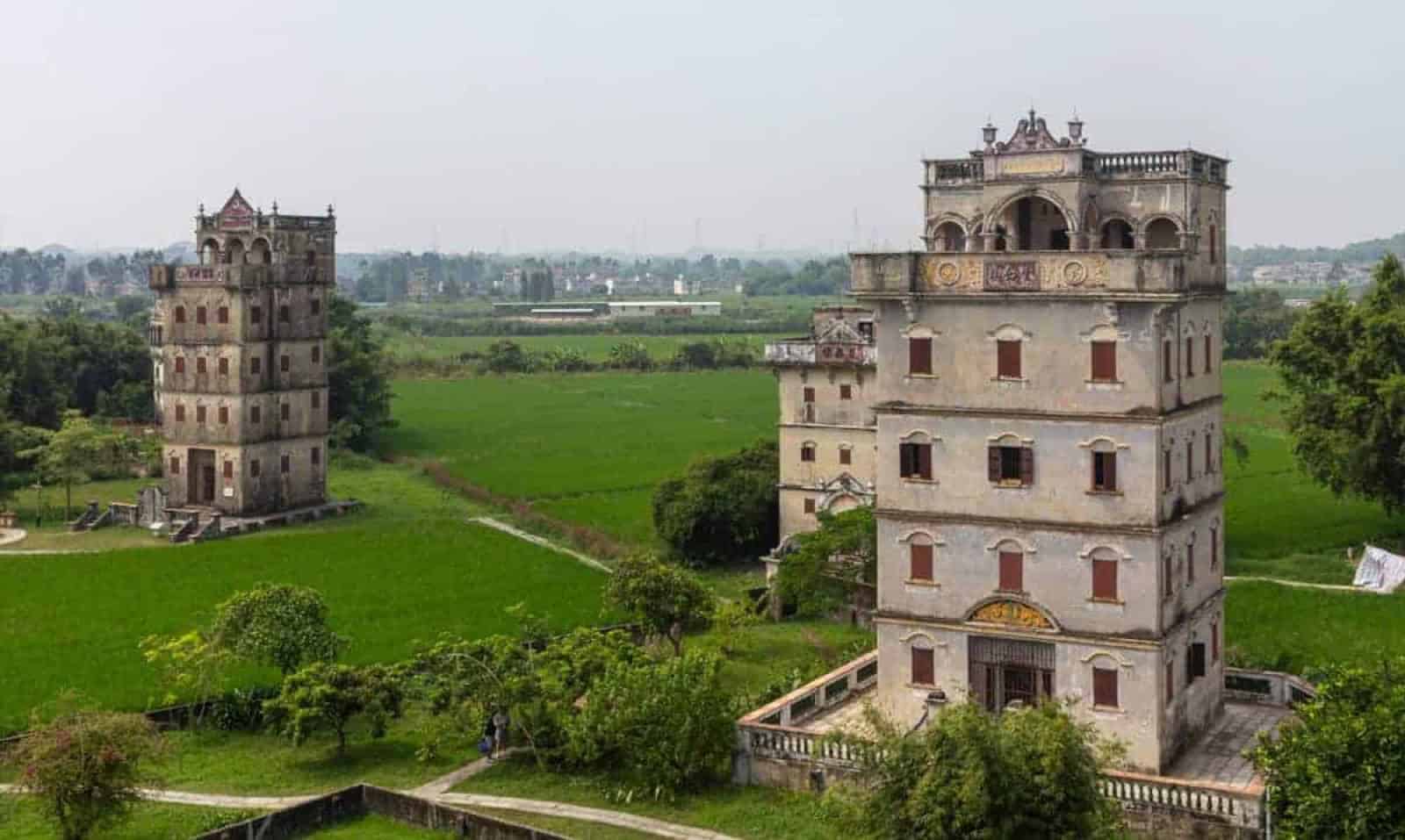
The link runs through the landscape itself. The Kaiping diaolou, those fortified watchtowers now listed as UNESCO World Heritage, were built with overseas money; so were the schools, the roads, and the ancestral halls. National Day, for a Wuyi family, is inseparable from this geography — the date is the homeland’s birthday, and the homeland is a specific village, a specific hall, a specific grave.
That bond was interrupted, not ended, in 1949. For roughly thirty years, the border closure disrupted and restricted the old ties; remittances were rerouted through Hong Kong, and families were separated across the Pacific. Then, with the reform era after 1978, the channels reopened — return visits, remittances, the restitution of confiscated family homes, and a 寻根 (xúngēn, “roots-seeking”) movement that has been sending diaspora descendants back to their ancestral villages ever since. National Day sits inside that reopening: it is the one week of the year when the trip home and the holiday coincide.
The homecoming is an institution as much as an impulse. Wuyi and Taishan hold 恳亲大会 (kěnqīn dàhuì, “kinship conventions”) that bring overseas emigrants and their descendants home in large numbers — reunions organized by clan and county associations that have their roots in the same native-place halls the first emigrants built abroad. A National Day spent in a Wuyi village is not a stranger’s holiday; it is a family event, timed to a calendar the family has kept across three generations and two continents.
Watching from abroad
For most of the diaspora, October 1 begins not with a flag but with a screen.
The military parade — 阅兵 (yuèbīng) — has been the great public ritual of National Day since the founding in 1949, staged again at major anniversaries: 1959, 1984, 1999, 2009, and 2019. Overseas communities have watched these ceremonies remotely from the earliest televised broadcasts to today’s live streams, and the experience has not lost its pull. For the sixtieth anniversary in 2009, diaspora groups in Thailand, the United Kingdom, Spain, Malaysia, New Zealand, and Australia reported gathering to watch the parade and the Tiananmen flag-raising, singing the anthem and waving flags.
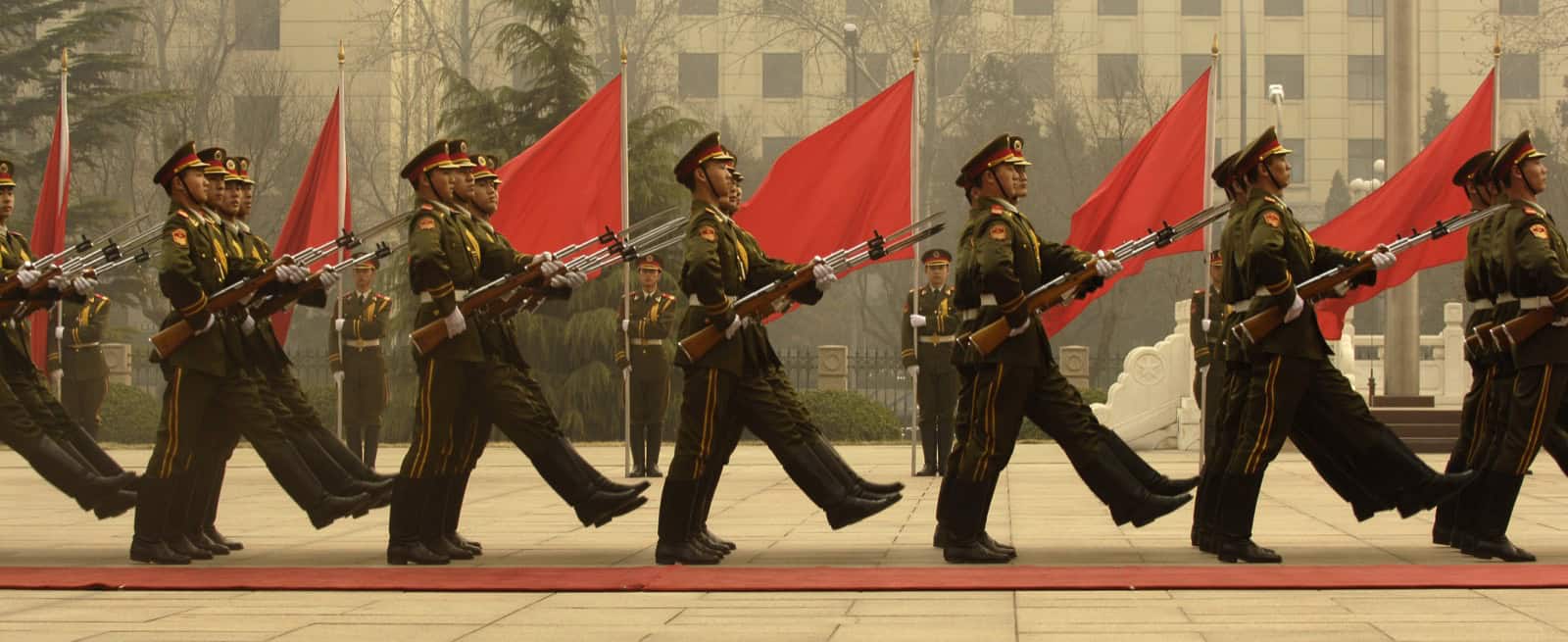
There is a ritual symmetry in this. The flag-raising at Tiananmen each October 1 is the homeland’s center of gravity; the flag-raisings in Vancouver, San Francisco, and New York are its far-flung echoes. Watching the parade is how a person in Sydney, who has never set foot in Beijing, participates in the same morning.
The next generation
The harder question for the diaspora is not how to mark October 1 but whether the children will.
The shift from 华侨 (huáqiáo, “overseas Chinese sojourner”) to 华人 (huárén, “ethnic Chinese”) — from a temporary sojourn to a settled, naturalized identity — is the diaspora’s long-running story. National Day sits precisely on that fault line. For the generation that naturalized, October 1 can feel like someone else’s holiday. For their parents and grandparents, it is the proof that the sacrifice was worth it.
And so the date has become, in many families, a teaching moment: a Brazilian mother and daughter who taught Chinese school students to sing about the motherland; the Charlottetown children who raised the flag; the teenagers at Bangkok celebrations who sang 《我和我的祖国》 in unison. Whether the next generation keeps the date is an open question — but National Day is, at minimum, one of the few occasions that forces the question into the open: what, if anything, do we still belong to?
It is a question the earlier generations never had to ask. For the sojourner, the answer was obvious: home was the village, and the adopted country was a workplace. For the naturalized citizen, the question has no single answer, and October 1 is where the two answers meet. Some families answer by raising a flag in a Vancouver park; some by watching the parade on a tablet in a kitchen in Melbourne; some by simply sending a message home — a text, a photograph, a red-envelope transfer — on the morning of the first. None of these is the “right” way. What they share is the recognition that the date still asks to be marked.
Golden Week as a roots-trip window
For the diaspora, Golden Week is where the holiday becomes practical.
If you have ever wanted to stand in the village your great-grandfather left, October is one of the best times to do it. The weather in Guangdong has cooled from its summer peak, the holiday has freed up a full week, and the ancestral halls are busy. A roots trip during Golden Week can be folded into the broader planning that the site’s own roots-trip itineraries walk through step by step — how to locate the village from a surname, how to get there, where to stay.
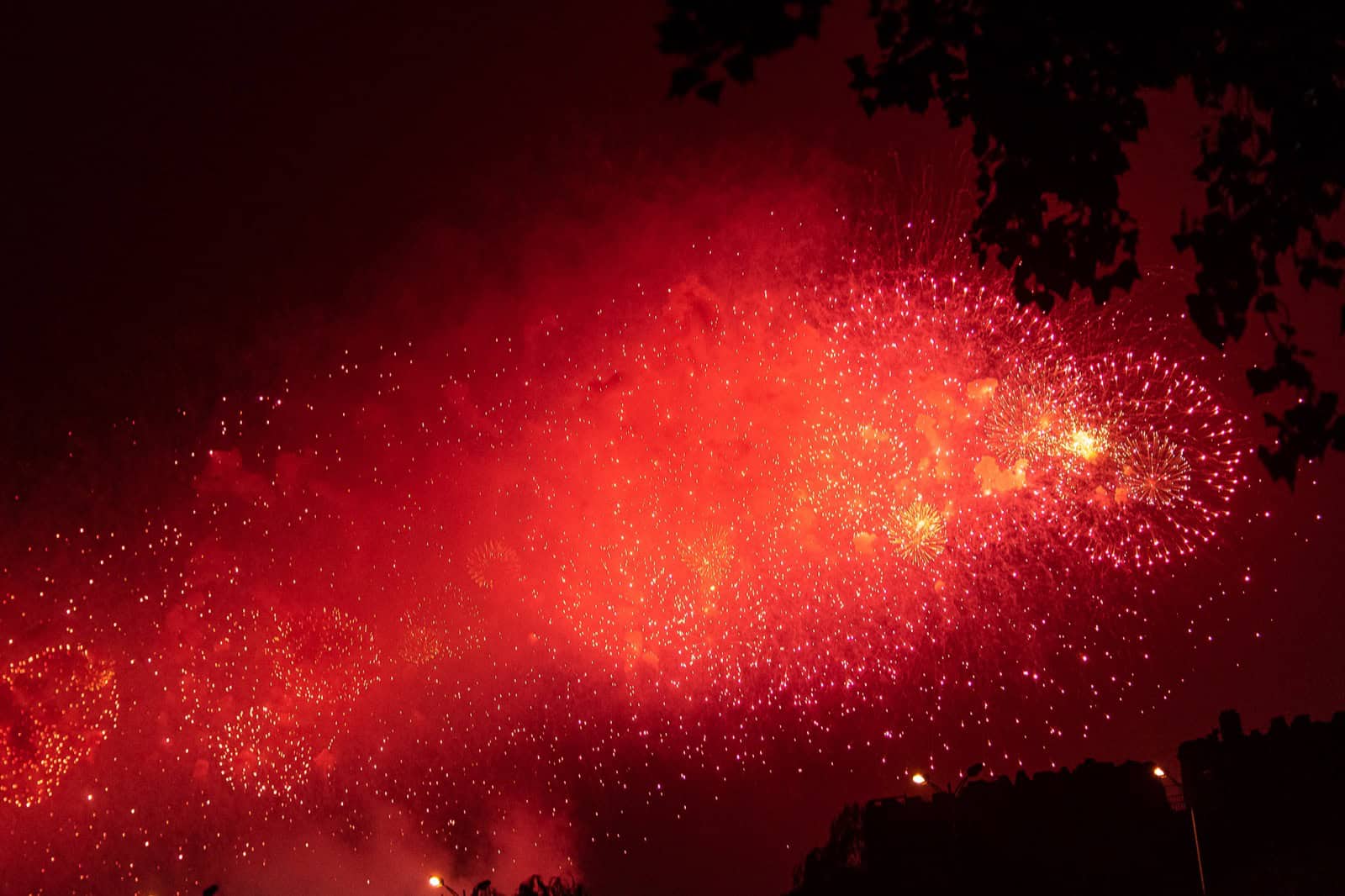
The older festival calendar offers the same rhythm. Just as families once timed money and return visits to Qingming, Ghost Month, and Mid-Autumn, so the modern family can time a trip to October 1. The difference is that National Day is not an ancestor festival — it is a state festival, and arriving in the village during it means arriving while the flag is flying and the town is dressed for the birthday. It is a different kind of homecoming: not a visit to the dead, but a visit to the living country the ancestors helped to fund.
Practicalities, if you are tempted: the roads are busy and the hotels fill early, so book transport and rooms well ahead — the site’s transport guide covers trains, buses, and hiring a driver across the five counties, and its itinerary guide lays out a ten-day plan that can be compressed into a Golden Week. The museums and ancestral halls are generally open through the holiday, but small village offices can keep shorter hours. And if the crowds feel like too much, know that the surrounding weeks — late September, mid-October — offer the same weather with a fraction of the traffic.
One date, two homelands
National Day does not ask the diaspora to choose. It asks them to remember.
The five counties sent their people out across the Pacific and beyond; those people built railroads and laundries and restaurants; they sent money home to build the watchtowers and schools and ancestral halls; and when the homeland finally stood up, they raised the flag in the cities where they had landed. October 1 threads all of it together — the founding in Beijing, the watchtower in Kaiping, the flag-pole in Vancouver, the child in Charlottetown singing a song from 1935.
It is, in the end, a holiday about a specific claim: that a people scattered across a hundred countries can still share one date. Whether you mark it by raising a flag, by watching a parade on a screen, or by booking a flight to a village you have never seen, you are answering the same question — where is home? — and on the first of October, for a few hours, the answer can be two places at once.
Seventy-seven years on, the ceremony has grown beyond anything the delegates of 1949 could have imagined: a parade watched around the world, a flag raised in a hundred cities, a week-long exodus of travelers, and a child in a Canadian province singing a song written before the holiday existed. The date has outlived the men who made it. What keeps it alive, year after year, is not the government that declared it but the people who refused to let it lapse — in Beijing, in Kaiping, in Vancouver, and in every place where a five-star flag rises on the morning of the first and a family, for a moment, stops to remember where it began.
Sources
- Chinese government record of the founding ceremony, “1949年10月1日,中华人民共和国成立” — gov.cn
- Founding-ceremony detail (flag, anthem, 54-gun salute, parade), “中华人民共和国中央人民政府成立典礼” — gov.cn
- Overseas Chinese celebrations, “我驻外使领馆、海外华侨华人…为祖国庆生” (Vancouver City Hall flag-raising) — gov.cn
- White House and San Francisco flag-raisings, “五星红旗 我的骄傲” — 国务院侨办 侨务工作研究
- Returned emigrants’ bond with the new state, “新中国成立后的华侨政策与爱国华侨的回归” — 侨务工作研究
- 75th-anniversary diaspora celebrations, “华侨华人’花式’庆祝国庆” — henan.gov.cn
- Golden Week holiday derivation — baike.baidu.com
- Golden Week’s first twenty years — news.qq.com
Read next
- Mid-Autumn Festival 2026: Mooncakes, Reunion, and How the Wuyi Diaspora Keeps the Date
- The Chung Yeung Festival: Autumn Grave-Sweeping and Ancestor Veneration in the Wuyi Diaspora
- Ghost Month 2026: A Guide to Zhongyuan for Diaspora Families
- Kaiping Diaolou: China’s UNESCO Heritage Towers
- From Haikou Port to the World: 200 Years of Wuyi Diaspora
Do you have a National Day memory from your own family? Tell us your story — we read every submission.
Suggested Reading
Is this your family’s story?
Roots Of China is built from readers’ family histories. If a story here sounds like your own — a surname, a village, a journey — leave a comment below, or share your family’s story with us and we may be able to help you find your ancestral village.
