

Mid-Autumn Festival 2026: The Reunion Festival of the Separated
Of all the festivals on the Chinese calendar, the Mid-Autumn Festival (中秋节, Zhōngqiū Jié) is the one built around a single shape. The full moon (满月, mǎnyuè) is round. The mooncake (月饼, yuèbǐng) is round. The table a family gathers around is round — and in Chinese, a family at a round table is the definition of reunion (团圆, tuányuán). So complete is that equation that the festival carries a second name: the Reunion Festival (团圆节, Tuányuán Jié).
It is also the festival that one corner of southern Guangdong has kept from a distance for a century and a half. The Wuyi (五邑, wǔyì) — the five counties of Taishan, Kaiping, Xinhui, Enping, and Heshan — sent millions of people overseas from the mid-1800s onward, and they carried the date with them, from village courtyards to Chinatown halls on three continents. That makes Mid-Autumn, quietly, the reunion festival of the separated. Its defining image is the one thing both sides of the ocean can see at once: the same full moon. The eighth-century poet Zhang Jiuling fixed the feeling in a couplet that still opens Jiangmen’s festival coverage each year: 海上生明月,天涯共此时 — “the moon rises over the sea; we share this moment though a thousand miles apart.”
This guide walks the festival end to end — the legend, the mooncakes, the hometown rites, the diaspora’s ways of keeping the date from abroad — so that wherever this finds you on the night of Friday, September 25, 2026 (lunar 8/15, 八月十五), you know what is being celebrated, and why it has always been about people like us. In Cantonese practice the celebration continues the next night, September 26, in a custom called chasing the moon (追月, zhuīyuè).
Round Moon, Round Mooncake, Round Table: Why the Full Moon Means Family
The festival’s stories are the culture’s own, and they are told lightly. In the best-known, the goddess Chang’e (嫦娥) drinks the elixir of immortality and floats to the moon, where she lives with only the jade rabbit (玉兔) for company; there, too, the woodcutter Wu Gang (吴刚) endlessly chops a cassia tree that heals itself. The moon in these tellings is not cold rock but a lit house. Moon-gazing (赏月, shǎngyuè) became a fashion among Tang dynasty poets and a full festival by the Song; scholars disagree about how deep the roots go — some trace the rite to ancient harvest sacrifices recorded in the Zhou-era 《周礼》, others hold that the festival proper formed only in the Tang–Song centuries. Both versions agree on what the date is for: giving thanks for the autumn harvest, and keeping company with the brightest moon of the year.
Two moon rites sit side by side. The first, 祭月 (jìyuè), is the formal sacrifice to the Moon Sovereign (太阴星君, Tàiyīn Xīngjūn), deity of the full moon. The second, 拜月 (bàiyuè), is the family version — an incense table set out in the evening light, loaded with the season’s food. Some sources describe moon worship as traditionally led by women, with a saying that “men do not bow to the moon” (男不拜月); it is a traditional norm reported in parts of the region, not a universal rule today. Either way, the rite completes the roundness chain: round moon, round mooncake, round table, full family. That chain is why Mid-Autumn is commonly described as the year’s second great family festival, after Spring Festival — the second peak of the reunion calendar.
Festival scholarship frames Mid-Autumn as the 人伦之节, the festival of human bonds — the gathering festival of the living. That makes it the structural opposite of the ghost month a month earlier, when the same families tend the dead; our guide to Zhongyuan Festival and the Ghost Month covers that side of the year. Mid-Autumn also closes the women’s festival sequence that opens with Qixi in August.

September 24–26, 2026: Three Days, Two Festival Nights
The 2026 date is fixed by the lunar calendar, and it is exact: the eighth lunar month begins September 11, and the fifteenth day — 八月十五 — falls on Friday, September 25, 2026, confirmed against the Hong Kong Observatory’s 2026 Gregorian–Lunar conversion table and China’s official holiday notice. The fifteenth lands on a Friday, so the official holiday runs September 25–27.
| Lunar date | Gregorian 2026 | What happens |
|---|---|---|
| 8/14 | Thu, Sep 24 | Preparation and gift-giving day (送月饼, sòng yuèbǐng). In Taishan and Enping, households make 芋头包 and 芋头糍 — taro buns and taro cakes — for tomorrow’s offering table. |
| 8/15 | Fri, Sep 25 | Mid-Autumn Festival (中秋节) — the night itself: the reunion dinner (团圆饭, tuányuán fàn), the family moon rite, children’s lanterns. |
| 8/16 | Sat, Sep 26 | Chasing the moon (追月, zhuīyuè) — the Cantonese second night of celebration. |
| 8/17 | Sun, Sep 27 | Official holiday ends. |
| — | Mon–Wed, Sep 28–30 | Working days between the festival and Golden Week. |
| 8/21 | Thu, Oct 1 | National Day Golden Week (国庆黄金周, Guóqìng Huángjīnzhōu), October 1–7, begins. |
| 9/9 | Sun, Oct 18 | Double Ninth (重阳, Chóngyáng) — the autumn festival block runs 中秋→重阳. |
Chasing the moon deserves a gloss: it is the most Cantonese thing about the festival. A Qing dynasty collector, Chen Zihou, recorded it in his 《岭南杂事钞》: on the night of the sixteenth, “the pleasure-lovers of Guangdong gather relatives and friends with wine and dishes to admire the moon — this is called chasing the moon.” One official-media account from Kaiping says the practice is rarely seen now, while a Jiangmen survey presents it as a living invitation. The honest summary: 追月 is a historical regional custom of the Lingnan area whose current observance varies by place and family — and this year both festival nights fall inside the official holiday, giving the custom a Saturday to happen on.
One caution from the research: folk sayings like “the fifteenth’s moon is not always the fullest” (十五的月亮十六圆) describe a shifting pattern — in any given year the full moon can peak on the 15th or the 16th, and the festival follows the calendar date, not the astronomy. Dragon Boat Festival opened the year’s festival cycle; with Qixi and Zhongyuan, Mid-Autumn closes the autumn run.
The Mooncake: A Portable Taste of Home
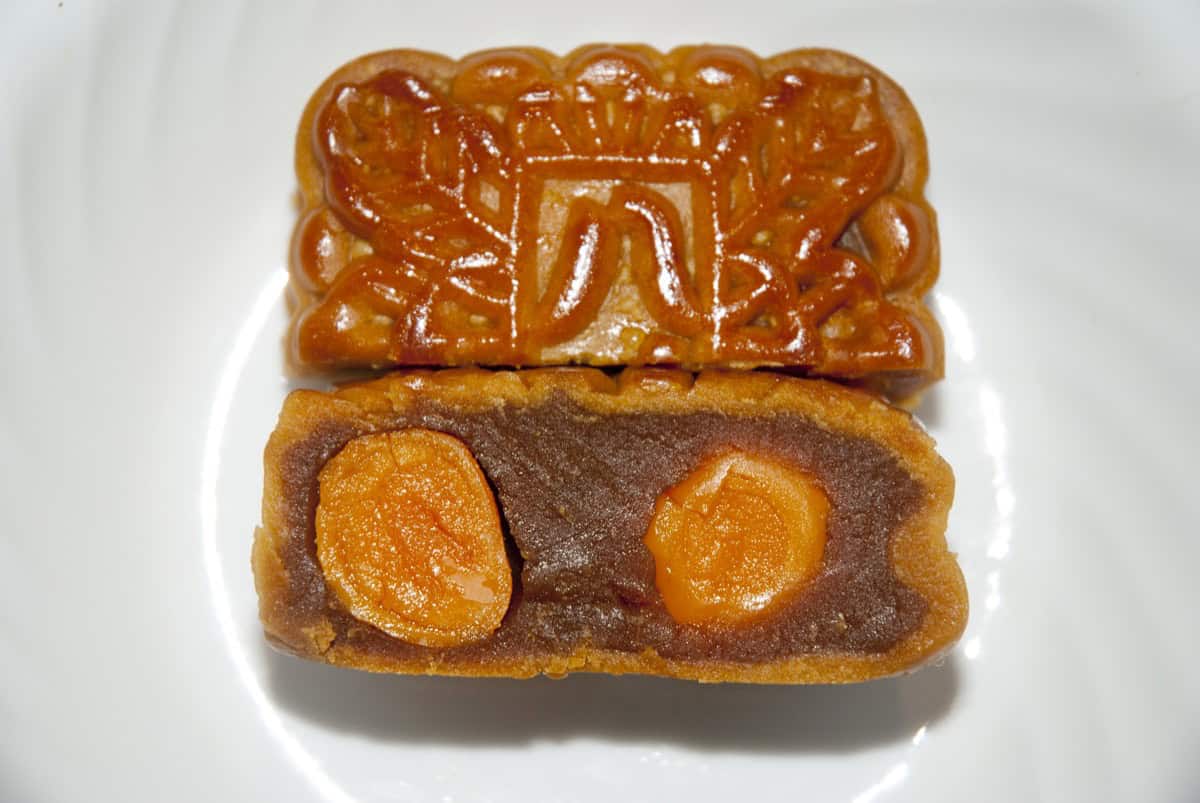
If the moon is the festival’s light, the mooncake is its luggage. The Wuyi table belongs to the Cantonese lineage, 广式 (guǎngshì). The classics are lotus seed paste (莲蓉, liánróng), five-kernel (五仁, wǔrén), and double egg yolk (双黄, shuānghuáng), with 双黄白莲蓉, the double-yolk white lotus, as flagship. The snow-skin mooncake (冰皮月饼, bīngpí yuèbǐng), a refrigerated 1980s Hong Kong invention, added a cool modern branch.
The county specialties follow. The best-documented Wuyi mooncake is Taishan’s winter-melon-paste mooncake (冬蓉月饼, dōngróng yuèbǐng), made from the local grey-skin winter melon, with Haiyan town (海宴) as its production heartland; it became a municipal intangible-heritage craft in 2017 and a provincial one in 2018. Sources differ on when the recipe emerged — the 1920s–30s or the 1950s–60s — so the safe description is a mid-20th-century Taishan craft whose official recognition is the solid date. Producers report orders from the United States and Canada: the winter-melon mooncake has become the diaspora’s shippable homesickness, made literal. Xinhui’s dried-tangerine-peel mooncake (陈皮月饼, chénpí yuèbǐng) and Muzhou’s red-bean-paste version round out the county table, per local media. For the children there is the pig-cage cake (猪笼饼, zhūlóngbǐng): an unfilled pig-shaped cake in a bamboo cage, made from mooncake trimmings or oven-test pieces, bought beside real mooncakes so the gift arrived “in pairs.” Largely vanished from bakeries, it is now revived by nostalgia brands; Guangdong records treat it as a province-wide classic with reported Heshan observance.
Mooncakes are also a scheduled gift economy: giving mooncakes (送月饼) moves through kin, teachers, friends, and employers — so embedded in the calendar that remittance letters from overseas itemized “mooncake money” (月饼钱, yuèbǐng qián) (more below). It has modern debates: sky-high gift boxes (天价月饼) drew crackdowns, and a 2022 national packaging standard limits mooncake boxes to three layers and bans precious-metal casings.
One legend needs its label: a popular origin story has late-Yuan mooncakes carrying secret messages that sparked an uprising against the Mongol court — the “kill the Tartars on the fifteenth of the eighth month” tale (八月十五杀鞑子). Festival scholarship lists five competing origin theories; this is one — a legend, not documented history.
Most families have a mooncake rule, and the rules are the real ingredient. In one, nobody cuts the mooncake until the moon is up — the knife waits while the children stand at the window, and the first silver edge over the rooftops is the signal to begin. A memory that surfaces whole at this time of year: a kitchen warm with lotus paste, a grandmother’s hand on the knife, the moon finally clearing the neighbor’s roof. The mooncake is the argument for this guide: a round object a family can split and share, even when the family is not in the same room. Our Wuyi food guide for returning diaspora goes deeper into the region’s table, and the qiaopi primer explains the letters that carried mooncake money home; Taishan’s municipal records trace the winter-melon mooncake’s hold on the local table.
In the Five Counties: Moonlight, Fire Towers, and the Taste of Taro
The hometown night is richly documented in Chinese official and local media, thinly in English — so what follows is faithful translation of those reports, not a claim that every Wuyi village does the same thing. The shared center is 拜月光 (bài yuèguāng), “worship the moonlight”: after the reunion dinner, families set an eight-immortal table (八仙桌) on the rooftop or before the house door, burn incense toward the moon, and load it with mooncakes, pomelo, and taro. Kaiping media describe the senior leading with a bow, then family members bowing in age order. Some accounts note the rite as traditionally led by women — the same “men do not bow to the moon” norm reported in parts of the region.
The table is a pun dictionary. Taro (芋头, yùtou) sounds like “protect the head” (护头), so eating it wards off harm — which is why on the 14th, in Taishan and Enping, households prepare 芋头包 and 芋头糍, taro buns and cakes, for the next day’s offering table. Pomelo (柚子, yòuzi) means roundness and echoes 佑 (“bless”) and 有 (“have”); in Kaiping the peel is cut in one long strip and hung at the door to keep ill fortune away. Water caltrop (菱角, língjiǎo) makes children clever. River snails (田螺, tiánluó) are stir-fried for the old saying “sip snail meat toward the moon and your eyes grow sharp” — the snail’s name puns on 攞, “to obtain.” Jiangmen’s media survey gathers most of these details in one place.
The children own the light. In Jiangmen, reports describe 耍禄仔 (shuǎ lù zǎi): pomelo-skin lanterns carved openwork with a candle inside, paraded to a counting song; the 树中秋 (shù Zhōngqiū) custom raises lanterns on tall bamboo poles. Then the fire comes out, village by village. In Kaiping, the villages of Hulong, Xiabian, and Dawu in Chikan town are reported locally to stage fire-dragon and straw-dragon dances (舞火龙/舞草龙, wǔ huǒlóng/wǔ cǎolóng) — rice-straw dragons stuck with burning incense, drums, and firecrackers; county media describe the custom as long-standing. In the Shihai village cluster under Sanbu subdistrict, reports say brick towers are lit around 9pm on Mid-Autumn night — some 2,500 bricks on a sand base, salt in the flames for the crackle — a rite of burning brick towers (烧番塔, shāo fāntǎ) listed in Kaiping’s intangible-heritage register since 2000. Heshan’s signature is the incense fire dragon of Chenshan village in Yayao town. Xinhui reports fish lanterns (新会鱼灯) with more than four hundred years of history and a Mid-Autumn kite-fighting tradition (斗风筝, dòu fēngzhēng) at Huicheng’s Elephant Hill, kite lines glassed with egg-white glue to saw rivals’ strings — both single-source local reports. Enping and Kaiping’s Magang area are known for rice noodles (濑粉, làifěn): “eat laifun, pass Mid-Autumn,” the long noodles standing for long life. Magang-area accounts say many households make them, the craft carried from central China by their ancestors some three hundred years ago. And across the region, some families recall the nursery rhyme 《月光光》 — “Moonlight, Moonlight, shine on the courtyard floor” — a Cantonese childhood sound cited in local media and remembered by some families rather than by every household.
None of this is unique to Wuyi, and it does not need to be: burning towers also persist in Chaozhou, Foshan, and Zhaoqing, and 拜月光 is shared Guangdong practice. The honest gap stands: county customs are far better documented in Chinese than in English, so treat each of the above as reported texture; the five counties each keep their own version of the night.


The Empty Chair: How a Reunion Festival Was Kept by the Separated
Here is the tension the festival has always carried in the emigrant counties: the reunion festival is kept, year after year, by families that are not reunited. Under the exclusion era, a Wuyi household was often a split family — a Gold Mountain husband (金山伯, Jīnshān bó) abroad, wife and children holding the village, reunion deferred year after year, the eighth-month moon the annual peak of longing. Our account of the Gold Mountain wives who waited tells that story from the home side.
The rite that held the tension was the mooncake rule. Kaiping official media document it: the mooncake is cut into angular pieces, one for each person at the table — and a piece is kept for anyone absent, so the family can say it is whole (以示合家团圆). The saved piece is documented in Kaiping sources as a gesture toward deferred reunion; read that way, it is the festival’s most precise invention. The table is round; the family is not; the mooncake pretends otherwise for one night.
The letters show the pretense was shared. In 1959, a man named 黎南辉 (Li Nanhui) wrote home from abroad to his mother 刘美成 (Liu Meicheng); his letter is held in the collection of the Chinese Overseas Chinese History Museum. Mid-Autumn was coming, he wrote; he could not return; but he had arranged for a box of lotus-paste mooncakes to be brought from Hong Kong. A man sending mooncakes instead of himself — the same shape as the saved piece, drawn across an ocean. These remittance letters (侨批, qiáopī / 银信, yínxìn) fused letter and money in one document, “one letter, two silver dollars” (批一封、银二元) — and the whole archive was inscribed in UNESCO’s Memory of the World register in 2013. Festival money was itemized in them: mooncake money, holiday allowances, the emigrant’s share of a feast that would go on without him. Our guides to what qiaopi are, reading them, and the Singapore–Wuyi remittance corridor trace the machinery; the Taishan Overseas Chinese Museum holds the letters themselves, and Duanfen runs a yinxin museum.
The rhythm was seasonal: several sources record recurring pre-Mid-Autumn remittance increases — a pattern, not a fixed law. A 2019 report from the Overseas Chinese affairs office describes Taishan bank counters busy before the festival, elders recalling the crowds outside the old money houses, and relatives wiring money home to buy mooncakes; treat it as a 2019 snapshot of a long-standing pattern. On the ritual side, families practiced worship from afar (遥祭, yáojì) and set offerings in the emigrant’s name — present at the altar if not at the table. It is the same remittance pattern the ghost month shows, with the frame flipped: Mid-Autumn money gathers the living toward reunion, where Zhongyuan money tended the dead — the same machinery, opposite emotion; a Qixi proxy-ritual parallel runs alongside.

From Chinatown Halls to Lantern Parades: How the Diaspora Kept the Date
Abroad, the festival was kept by the institutions the diaspora already ran. District and clan associations (会馆, huìguǎn) and native-place societies (同乡会, tóngxiānghuì) — the same bodies that ran community life, credit, and burial funds — organized the banquets, moon festivals, and lantern parades; for the single emigrant with family a continent away, the association table stood in for the family table. Many overseas Wuyi communities mark the date this way; the pattern is consistent across sources, though no honest account would claim every community did.
The best-documented overseas form is the street fair. A 2014 report describes the Chinese Chamber of Commerce’s Mid-Autumn celebration turning San Francisco’s Chinatown (唐人街, Tángrénjiē) into an open-air fair with more than two hundred craft and food booths and stage shows; the Chinatown Mid-Autumn street fair (华埠中秋街会) resumed in 2021 with traditional music, lion dance, and mooncake tasting. Official-media roundups fill in the map: Singapore’s Chinatown (牛车水) hanging lantern displays themed on mooncakes and the Jade Rabbit, Malaysia’s lantern-making contests, a temple fair in Buenos Aires, parades and fireworks in New York, overseas-Chinese supermarkets reporting mooncakes as their seasonal bestseller, and cross-border “mooncake-passing” campaigns that moved more than twenty thousand gift boxes in the United Kingdom and Spain. The repertoire — dragon and lion dances, floats, costume processions — is the hometowns’ own, transplanted.
A word of historical honesty: web sources document these modern forms (2010s–2020s) richly; the older huiguan-banquet tradition rests on the book literature of the Wuyi migration, and the 1959 letter above is the era’s best web-verifiable artifact. The region’s broader story is told in our pieces on the Guangdong Five Counties diaspora legacy, Wuyi migration heritage, and how the region ended the Qing dynasty; the festival was one more thing the network carried.

Two Tables Under the Same Moon: Keeping the Date Anywhere
What can a descendant actually do this year? The toolkit is layered, and none of it requires a flight. The video-call reunion dinner is now a common practice — one table in a Western city, one in Wuyi, the phone propped against the teapot, the same moon in the window of both. No statistics exist for how many families do this, and none are needed: it is simply what families do, the modern form of the saved mooncake piece. The call is short, the moon is slow, and both sides get to watch the same silver edge clear the rooftops.
The mooncake can be real even from far away: Chinatown bakeries stock the Cantonese canon every September; Taishan winter-melon mooncakes are shipped and imported, with producers reporting orders from the United States and Canada; online ordering brings hometown brands to most addresses. Where families observe it, worship from afar (遥祭) keeps the altar side of the rite. Community gatherings do the rest: native-place associations hold Mid-Autumn events — one reported example, the Guangzhou Taishan Chamber of Commerce, serves 冬蓉月饼 at its festival networking teas — and children’s lantern walks carry the light to the next generation. For the descendant with no surviving family ties, the community table stands in for the family table; that is a way of understanding the diaspora’s festival, a framing offered here rather than a universal fact. Even the simplest observance — one mooncake, one lantern, one look up at the sky — keeps the date.
A practical note on shipping from North America: a 2014 report said the US Postal Service barred mailing mooncakes containing egg yolk or meat — a 2014 report, not a reading of current law. American bakers long ago filled the gap, which is why in the United States mooncakes are bought, not mailed: order local, order early, and the festival arrives on time.

If You Go: A Mid-Autumn Visit to the Hometown
For the reader planning a roots trip, the 2026 calendar is unusually kind. Land by Friday, September 25 for the 拜月光 night, catch chasing the moon on Saturday the 26th — both nights inside the official three-day holiday — and then either head home before Golden Week, or take leave for the 28th–30th and bridge into a thirteen-day span through October 7. Holiday-window train and air tickets are high-demand; book the moment the window opens. Late-September Guangdong is still summer-warm, at the tail of typhoon season — pack accordingly, and check the forecast closer to the date.
What a visit looks like, from the reported texture: the reunion dinner (团圆饭) with relatives; children parading pomelo-skin lanterns; village fire rituals — in the named Kaiping villages, reports say Hulong’s fire-dragon dance and Shihai’s brick towers are lit around 9pm on the 25th, one village cluster rather than a regional schedule; and ancestral halls lit for festival ancestor worship (中秋祭祖, Zhōngqiū jìzǔ) in the remittance-built landscape of 祠堂 (cítáng) halls. Kaiping official media name Chikan old town, the diaolou towers, Liangjin Mountain, and the banks of the Tan River as local moon-viewing spots — suggestive texture from county media, worth confirming on the ground. Etiquette is simple: bring mooncakes. Giving them (送月饼) is expected of returning kin, and the local specialty is the appreciated choice — 冬蓉 for Taishan-side relatives, 陈皮 for Xinhui-side. County food-festival programming has run around the holiday in past years — Taishan held crab, eel, and leitang-hu events in 2023 — but that is pattern evidence, not a promise of 2026 programming; confirm closer to the date. The roots-trip planning guide and the Qingming festival-trip guide cover the trip logistics this section assumes.
The Same Moon: Spring Sweeps the Graves, Autumn Gathers the Living
The diaspora year has two poles, and they are mirrors. In spring, Qingming (清明, Qīngmíng) sweeps the graves — the dead-side reunion, covered in our guides to Qingming’s traditions and Qingming in the five counties. In autumn, Mid-Autumn gathers the living. A family that keeps one already knows the grammar of the other: the same travel, the same phone calls, the same counting of who is missing.
And the continuity is the proof. A diaspora that kept the reunion festival from every corner of the world — association banquets in one generation, street fairs in the next, a mooncake bought in a foreign bakery, a video call that puts two tables under one moon — demonstrates something quietly extraordinary: home is portable, and the full moon is the proof. The roundness chain has held for a hundred and fifty years of separation. It holds for one more night.
This year, on September 25, look up. The moon over your roof is the same moon over a courtyard in Taishan, over a Chinatown hall in San Francisco, over the table where someone is keeping a piece of mooncake for you. The reunion festival of the separated is kept by the looking. That is the whole custom, and it has never needed an ocean to work.
Sources
Government and archival sources
- Hong Kong Observatory — 2026 Gregorian–Lunar Calendar Conversion Table
- Taishan Municipal Government — the winter-melon mooncake’s place on the local table
- Kaiping Municipal Government — brick-tower burning on the intangible-heritage register
- Chinese Overseas Chinese History Museum — Li Nanhui’s 1959 mooncake letter
- State Council Overseas Chinese Affairs Office — pre-Mid-Autumn remittance activity in Taishan, 2019
- State Council of China (English) — San Francisco Chinatown’s Mid-Autumn street fair, 2014
- Guangdong Overseas Chinese Affairs Office — how diaspora Chinatowns keep Mid-Autumn
News and cultural reporting
Scholarship
- Li Rixing (李日星). 《江门五邑风俗叙录》. China Books Publishing House (中国书籍出版社), 2012.
- Liu Jin (刘进). 《银信与五邑侨乡社会》. Guangdong People’s Publishing House (广东人民出版社), 2011.
- Mei Weiqiang (梅伟强) & Zhang Guoxiong (张国雄). 《五邑华侨华人史》. Guangdong Higher Education Press (广东高等教育出版社), 2001.
- Hsu, Madeline Y. Dreaming of Gold, Dreaming of Home: Transnationalism and Migration Between the United States and South China, 1882–1943. Stanford University Press, 2000.
Continue Reading
- Zhongyuan Festival: How the Wuyi Diaspora Honors the Dead
- Ghost Month 2026: A Guide to Zhongyuan for Diaspora Families
- Qixi Festival: How the Wuyi Diaspora Kept Love Alive Across the Ocean
- Qingming in the Five Counties: A Diaspora Descendant’s Guide to Tomb-Sweeping in Wuyi
Stay Connected
Follow RootsOfChina on Facebook and Instagram for new article updates, behind-the-scenes from Kaiping, and stories from the Chinese diaspora.
Get the Friday Digest
One email a week with the best new Wuyi diaspora stories, village guides, and family-history finds — free, no spam, unsubscribe anytime.
Suggested Reading
Is this your family’s story?
Roots Of China is built from readers’ family histories. If a story here sounds like your own — a surname, a village, a journey — leave a comment below, or share your family’s story with us and we may be able to help you find your ancestral village.
