


The Hu (胡) Surname: From the State of Hu to the Wuyi Diaspora
The State That Became a Name
The Hu surname (胡, Hú) was born in the year a state died. In 495 BC the armies of Chu marched on the small Gui-clan (归姓, Guī xìng) state of Hu (胡子国, Húzǐ Guó), near what is now Fuyang (阜阳), Anhui, and extinguished it. The Spring and Autumn Annals (《春秋》, Chūnqiū) give the event a single clause under Duke Ding’s fifteenth year: “Chu destroyed Hu and carried its ruler Hu Zibao away” (楚灭胡,以胡子豹归是也). That is the whole obituary of a polity. But its people did something remarkable: they took the fallen state’s name as their own surname — 以国为氏 (yǐ guó wéi shì, “surname taken from a destroyed state”) — and carried it south across a thousand years of migration, then overseas. A state reduced to a name; a name that outlived its state.
The defeated ruler refused to bend. Tradition records Hu Zibao (胡子豹) declaring “存亡有命,事楚何为?” — “Life and death are fate; why serve Chu?” — the defiant last word clan literature still retells. A caution before we go on: some sources conflate two different Hu states — a Ji-clan (姬姓) state near Luohe in Henan, destroyed by Zheng in 745 BC, and the Gui-clan state at Fuyang destroyed by Chu in 495 BC. We anchor on the 495 BC destruction, the one fixed in the classical text. (A few clan sources date it 494 BC by the Zhou king’s reign calendar — 周敬王二十六年 — a one-year variant worth knowing when reading the originals.)
By the twelfth century the encyclopedist Zheng Qiao (郑樵) recorded both of the surname’s origin streams in his Comprehensive Treatise on Clans (《通志·氏族略》): the Hu of the fallen state, and the Hu of a duke’s posthumous title. Most of the world’s Hu families descend through that second door — and it opens, improbably, with the sage-king Shun.

A Duke’s Posthumous Title
Around 1046 BC, soon after the Zhou dynasty was founded, King Wu enfeoffed a descendant of the sage-king Shun at the state of Chen (陈), in what is now Huaiyang (淮阳), Henan. That man was Gui Man (妫满, Guī Mǎn); the Records of the Grand Historian (《史记·陈杞世家》) add that he married the king’s eldest daughter. At his death the Zhou rules of posthumous naming (谥法, shìfǎ) awarded him the title “Hu” — the formula runs “弥年寿考曰胡,” long of years and just, therefore Hu. History knows him as Duke Hu of Chen (陈胡公, Chén Hú Gōng; also 胡公满, Hú Gōng Mǎn).
His descendants split his name. Some took Chen, after the state; others took Hu, after his posthumous title — 以谥为姓 (yǐ shì wéi xìng, “surname from a posthumous title”). This is why Hu and Chen families call each other kin to this day: both are branches of one 舜裔 (Shùn yì, “Shun descendant”) family, a cluster that also embraces Yuan, Yao, and Yu, and through later branchings Tian, Sun, and Che. The medieval word for that solidarity is 联宗 (liánzōng, “cross-lineage unity”) — and it will matter again when we reach the overseas fraternities.
The mechanism even lives inside the genealogy genre: the earliest surviving preface to a Hu genealogy, written by the Song philosopher Zhu Xi (朱熹《胡氏族谱序》), opens “Hu’s ancestors begin when King Wu of Zhou enfeoffed Shun’s descendant Duke Hu at Chen, and his descendants took the posthumous title as their surname.” At the center of the 舜裔 world stands a tomb: the Chen-Hu Duke cemetery (陈胡公陵园) on the southeast shore of Dragon Lake in Huaiyang, whose mound — the Iron Tomb (胡公铁墓) — is said to have been sealed with molten iron. Rebuilt in 1995 and host to a grand rite in 2006, it will close our story. One name, two doors into history — a destroyed state and a duke’s title — and a genuine scholarly disagreement about which came first.

Two Streams, One Surname
Surname histories do not agree on how to weight the two streams. Some treat 以国为氏 as the oldest stratum of Chinese surname formation and make the 495 BC State of Hu the surname’s foundational event; others treat the 以谥为姓 line through Duke Hu of Chen as primary, since it accounts for most Hu families; a third camp flags the debate as unresolved. We present both and do not silently choose. What is certain is that by the Han dynasty the streams were already woven together: the Eastern Han statesman Hu Guang’s tomb inscription, written by Cai Yong, traces his line to the Gui clan “who founded a state in the south called Hu.”
Identity beyond origin was fixed by two markers: 郡望 (jùnwàng, “commandery of origin”) and 堂号 (tánghào, “hall name”). The premier Hu commandery is Anding (安定郡), established 114 BC with its seat near modern Guyuan (固原), Ningxia; Xincai (新蔡郡) ranks second. The folk saying runs “天下胡氏出安定” — under heaven, all Hu come from Anding. The dominant hall, 安定堂 (Āndìng táng), commemorates the Song educator Hu Yuan (胡瑗, 993–1059), “Master Anding”; other halls — Guangyu, Zhongyi, Xincai, Luling — mark branches. In the Northern Dynasties the Anding line reached its political peak, producing Empress Dowager Hu of the Northern Wei (北魏胡太后) and a run of generals and governors. A hall name is an identity marker, though, not proof of residence — a claim of origin, not a deed to property.
The surname also absorbed newcomers: compound names like Humu (胡母氏), imperial gifts of the name, and non-Han lines — Xiongnu, Khitan, Mongol, Manchu, Hui, Zhuang — who became Hu over the centuries. Noted, then left aside, because our road leads south.
In Guangdong the markers are alive: the Yangjiang and Lianzhou Hu branches both carry the Anding hall name, and the Hu ancestral hall at Zhuji Lane displays the couplet “文武世家源流远;帝裔宗枝翼叶长” — “a literary-and-martial lineage with a long source; imperial descendants with spreading branches.” One honest gap: no Wuyi hall name has surfaced in web sources — the Kaiping branch we are about to meet uses its branch name, Ruliang, not a hall name. By population, the 2021 Ministry of Public Security name report ranks Hu about fifteenth in China — a very large family spread very wide. For a sibling story told the same way, see the Wong surname’s origins and global legacy.
The Long Road South
Hu reached Guangdong by migration, not by ancient residence: in Song census data the province was thin-Hu (Jiangxi ranked first), and the surname’s southern presence is a story of the 衣冠南渡 (yīguān nándù, “robed caps crossing south”) waves of the Tang, Song, and Yuan periods.
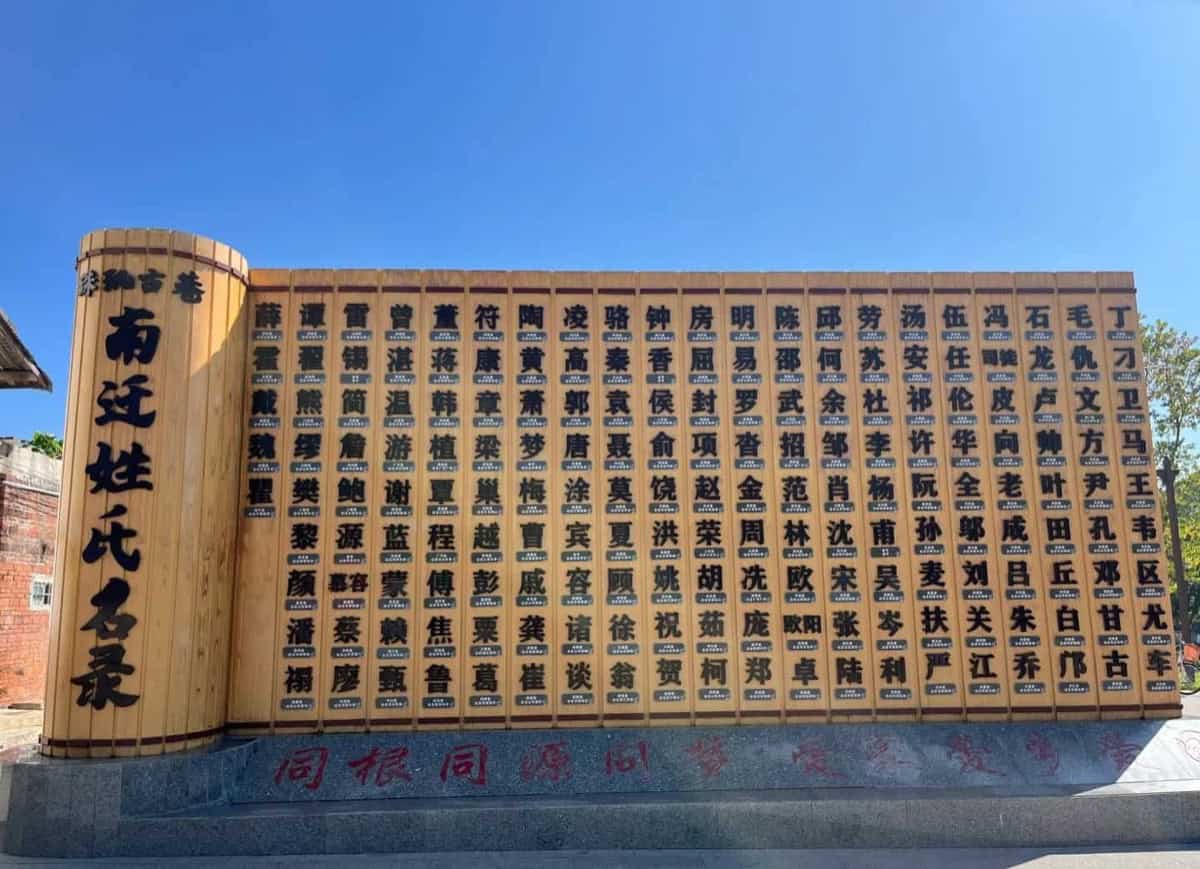
The canonical memory of that journey is Zhuji Lane (珠玑巷, Zhūjī Xiàng) at Nanxiong (南雄) in northern Guangdong — the pass through which, the founding legend runs, scores of surname groups (the best-known version counts ninety-seven households under one Luo Gui) descended into the Pearl River Delta. The story is listed as Guangdong intangible cultural heritage (2022), and a Hu ancestral hall stands at the site. If your Hu family comes from Wuyi, the branch records almost certainly tell some version of this: an ancestor from the north, pausing at Zhuji Lane, then fanning out into the delta.
The Wuyi Hu trunk is remembered through one man. The branch records tell of 扶摇公 (Fúyáo Gōng) — Hu Kun (胡鲲), courtesy name Qipeng, styled Fuyao — said to be a seventy-fourth-generation descendant of Duke Hu of Chen. They narrate his journey from the Northern Song capital Bianjing (汴京, today’s Kaifeng) to Nanxiong’s Baochang county, where he served as intendant of the Guangnan circuit and prefectural judge (广南路廉访使/韶州判官); then the dispersal of his sons — Mengheng to Shunde’s Ganzhu, Mengzhen to Changsha (in today’s Kaiping), Mengqian to Nanhai’s Baiteng and onward to Heshan’s Guchan. The Taishan Hu genealogy records its founding ancestor as Hu Kun, “originally a man of Bian” (原系汴人), consistent with the Kaifeng memory. These are the family’s own accounts of how it came south — hedged as such, not asserted as verified history. A single-source list of Zhuji Lane descendant clans places Kaiping’s Hu at Changsha Zhou among the county’s sixteen surname-clans and twenty lineages — a roster claim we repeat only with that caveat. For the wider journey, see Taishanese migration history and Wuyi’s hidden ports.
Hu Surname Lines in Wuyi
Now the ancient story gains an address. Two Kaiping Hu branches are documented in the county’s surname survey, the 《开平姓氏源流考》 (Origins of Kaiping Surnames), published by the Kaiping Local Chronicles Office (开平市地方志办公室) in 2023 — branch-level lineage records, which we treat as probable rather than proven, as with most genealogical accounts.
The first is the Ruliang Hu lineage (儒良胡族). Its founding ancestor, the survey records, was Junhu (均祜), a man of Maishan in Nanchang, Jiangxi, who served as prefect of Guangdong (知广东府事) in the Song and settled in Guangzhou; his son Liangfu (良甫) moved to Yuliang in Xinhui — today’s Ruliang Lane in Baihe town (百合镇), Kaiping, now the villages of Rudong and Tangbian (儒东村/汤边村). Here the sources fork, and we flag rather than fuse: another genealogy makes Liangfu a fourteenth-generation descendant of the Jiangxi ancestor Dang (珰公), without mentioning Junhu. Two chains, same branch, unreconciled — only the clan genealogies themselves can settle it.
The second is the Haixin Hu lineage (海心胡族): the same Fuyao line, via his son Mengzhen (蒙贞), settling at Changsha Zhou in Kaiping and moving, after ten generations, to Haixin (海心) in Changsha. A place-name note: the Taishan genealogy calls the settlement “Changsha village in Xinhui” (新会长沙村); the Kaiping gazetteer calls it “Changsha Zhou in Kaiping” (开平长沙洲). They are presumed the same locality — the Changsha area passed from Xinhui to the newly created Kaiping county at its founding in 1649 — but the identification is unverified, and we give both names as the records do.
Beyond these branches the web widens: the Taishan Hu genealogy roots through the same Fuyao line; the Heshan branch at Guchan descends from Mengqian’s move; the Enping Hu at Shangjinhu trace their founding ancestor to Ruliang Lane in Kaiping and share its generation-name frame. One trunk, many villages. (A parallel surname story with its own Wuyi footprint: the Cao surname and the Wuyi diaspora.)
The living detail survives in Tangbian village, which preserves Hu Gentian’s former residence, an old well, and the Tangbian ancestral hall — heritage the local government now promotes as 胡氏儒良文化, “Ruliang culture of the Hu lineage.” It is the same village-scale heritage catalogued in our survey of Taishan villages: history, architecture, and heritage. We will meet Hu Gentian properly in a moment.
The paper record is unusually addressable. A Wuyi Hu genealogy is a 谱牒 (pǔdié) built on 世系 (shìxì, descent lines), generation-name poems, family instructions, and — in diaspora times — appendices recording overseas branches. The branches compiled jointly as early as 1605, when Ganzhu, Changsha, Guchan, and Baiteng co-published a genealogy. The Taishan Hu genealogy was first compiled in 1800, re-engraved in 1864 by the Guangqing Hall (光庆堂) in twenty-two volumes, revised in a 1968 manuscript by Hu Ende covering Heshan, Xinhui, and Hong Kong, and copied again at Heshan’s Guchan in 1994. Copies survive at the Sun Yat-sen Library in Guangzhou, the University of Hong Kong’s Fung Ping Shan Library, and on FamilySearch microfilm in Utah. Even a Taishan Chen genealogy carries the echo: the Wencun Chen family book records its surname-founding ancestor as “Duke Hu of Zhou” — the Shun-descendant kinship inscribed inside an actual local genealogy.
Two honesty notes. No Hu-specific case of remittance-funded genealogy compilation has surfaced, though the mechanism is well documented for Wuyi generally. And the surviving genealogies are a biased sample — the wars and revolutions of the twentieth century destroyed unknown numbers of others. What remains is partial, and priceless.

Crossing to Gold Mountain and the Nanyang
The Wuyi counties — the five counties of Guangdong — sent more than two million people overseas between the mid-nineteenth and mid-twentieth centuries, in four great waves: a pre-1840s flow to Southeast Asia; the Gold Mountain surge of 1848–1882, fired by the California gold rush; the exclusion era of 1882–1943; and the post-war, post-1978 movements that rebuilt the diaspora as a global one. The full frame is laid out in our Taishanese migration history.
The motivating dream had a name: 金山 (Jīnshān, “Gold Mountain”). The reality was 侨乡 (qiáoxiāng, “emigrant homeland”) — villages, economies, and family structures remade by absence and remittance. Hu families moved the way everyone moved: through the surname. Chain migration ran along kinship lines — one brother sending for the next — so whole villages transplanted themselves into specific Chinatown neighborhoods, the lineage functioning as migration infrastructure, financing passages, housing newcomers, arranging work. Labor markets differed by region: laundry, restaurants, and railroads in North America; mining, rubber, and trade in Southeast Asia. Different worlds, same surname.
An honest limitation: no Hu-specific roster of overseas migrants has surfaced in verifiable sources. The scale of the Wuyi Hu diaspora rests on the general Taishan and Kaiping demographic frame, not on Hu-specific lists — so we describe the experience as the Wuyi experience it was, without inventing names the records do not give. What we do have, documented by the Kaiping government, is one family: the artist Hu Gentian’s father was among the 旅美侨工 (lǚměi qiáogōng, overseas laborers in America) — and that story, in the next section, carries the human weight of the exclusion era.

Exclusion, Paper Sons, and Letters Across the Sea
The exclusion era was a machinery of separation. The United States barred Chinese laborers in 1882; Canada imposed a $500 head tax in 1885 and then, in 1923, shut the door almost entirely until 1947; the US repeal of 1943 replaced exclusion with a stingy quota. Families already split by the ocean froze in that split for decades. For the labor history, see the Chinese railroad workers and the exclusion era.
Against this machinery, families fought with paperwork and memory. Paper sons (纸儿子, zhǐ érzi) entered under identities purchased from relatives or brokers — and surviving interrogation at Angel Island depended on knowing the invented family’s lineage cold: village geography, ancestral halls, generations of names. The genealogy books (族谱, zúpǔ) that recorded emigrants became a lifeline document; coaching books smuggled to the ports rehearsed the details examiners would demand. Lineage knowledge, encoded in paper, was survival itself.
Between the halves of every split household flowed the 银信 (yínxìn, “silver letters”; also 侨批, qiáopī) — remittance letters on UNESCO’s Memory of the World register (2013). Money and longing traveled in one envelope: the wage packet, the letter to the wife, the instruction about schooling. The relay ran from the Gold Mountain firms (金山庄) in Hong Kong, through the money exchanges of Jiangmen, to village couriers (派批) who walked the letters to the door. The household was a 两头家 (liǎngtóu jiā, “two-headed family”): the man abroad, the family in the village, where the 金山婆 (Jīnshān pó, “Gold Mountain wife”) ran the farm, the budget, and the children alone, for decades at a stretch. For the texture of those ties, see Echoes of Home: Kaiping & Taishan.
Here the Hu story becomes one family’s story. Hu Gentian (胡根天, 1892–1985), born in Tangbian village of Ruliang, Baihe town, Kaiping, was the son of a 旅美侨工. In the early twentieth century his father lost his work in America — the exclusion-era unemployment that stalked Chinese laborers — and the remittances stopped. The boy left school and became a shop boy in the market town of Baihe Xu (百合墟). Not a statistic: a father out of work in San Francisco, a child behind a counter in a Guangdong market town. And it is from that counter that the art came — in his own memoir, Hu Gentian names the Huang Shoushan painting shop (黄寿山画店) in Baihe Xu as his childhood window to art. The village market town, not the metropolis, was his origin.
From that window he went to the Tokyo School of Fine Arts in 1915, one of the pioneering Wuyi overseas students who took Chinese education abroad, co-founded the Chinese Fine Arts Association with fellow returned students, founded the Chishe (赤社) Fine Arts Research Society — the first Western-painting society in Guangdong — and in 1922 founded the Guangzhou Municipal School of Fine Arts (广州市立美术学校), the first public art school in South China, whose campus sign was inscribed by the revolutionary statesman Liao Zhongkai (廖仲恺). He later directed the Guangzhou Museum; the Kaiping city government’s biography of Hu Gentian traces the whole career. Fellow Baihe Hu artists — Hu Shanyu (胡善馀), Hu Juzhan (胡钜湛), Hu Chaozhi (胡朝植) — kept the village’s name in the galleries. A Wuyi Hu life shaped by exclusion, channeled into building a nation’s art education.
One honesty note: no Hu-surname-specific collection of 银信 has surfaced in public sources. The emotional economy is documented from the general Wuyi corpus — real, but not Hu-exclusive — and we do not fabricate a Hu letter where the records are silent.


The Fraternity and the Overseas Pantheon
Overseas, the Shun-descendant kinship of Section 2 organized itself into institutions. The premier one is the 至孝笃亲公所 (Zhìxiào Dǔqīn Gōngsuǒ, “Gee How Oak Tin” in Cantonese) — the trans-surname fraternity of the Chen, Hu, Yuan, Yao, and Yu families, named from the Book of Rites (“至孝近乎王,” supreme filial piety approaches kingliness) and the Analects (“君子笃于亲,” the noble person is steadfast toward kin). Founded in Seattle (舍路) in 1900 by Chen Chengxue with Chen, Hu, and Yuan members, it federated in 1920 as the Americas Gee How Oak Tin General Association, grew chapters in thirty-five North American cities, and holds a triennial kinship convention (恳亲大会, kěnqīn dàhuì) — the 34th in Zhaoqing, Guangdong (2019), the 35th in New York (2022), as reported by the Chinese Consulate General in New York.
The Wuyi tie is documented, not assumed: the New York chapter appears among the American Taishan associations saluting Taishan on its thirtieth anniversary of city status (2022), and the 1964 fraternity anniversary publication (美洲至孝笃亲特刊) sits in the Taishan genealogy corpus. The wider umbrella, the World Shun Descendants Federation, spans Chen, Hu, Yuan, Yao, Yu, Tian, Sun, Lu, Wang, and Che. Hu-specific bodies run alongside: overseas Hu clan associations (胡氏宗亲会) with welfare functions across the United States, Singapore, Thailand, Italy, and the Netherlands; a World Hu Kinship General Federation founded in 2006; a third World Hu Kinship convention in Huidong, Guangdong (2016). For the institutional landscape, see The Wuyi Diaspora: Clans, Brotherhoods, and Survival.
No account of the overseas Hu pantheon is complete without its two emblematic figures — and both, plainly, are not Wuyi. Hu Wenhu (胡文虎, Aw Boon Haw, 1882–1954) was born in Rangoon to a Hakka family from Yongding (永定), Fujian — itself a famous emigrant homeland — and built the Tiger Balm fortune (虎标万金油) with his brother, a rise profiled by The Paper, before moving his headquarters to Singapore in 1920. Hu Yaji (胡亚基, Hoo Ah Kay, 1816–1880), “Mr Whampoa” (黄埔先生) of colonial Singapore, supplied provisions to the British navy and in 1867 became China’s first overseas consul, a story The Paper recounts in full. His home lineage, from Huangpu village in Guangzhou, shares the Zhuji Lane migration memory with the Wuyi branches — its Hu ancestral hall carries a couplet tracing the line from Chong’an in Fujian through Nanxiong — which makes the contrast instructive rather than confusing. These two anchor the diaspora’s Hu story; the Wuyi Hu story is carried, instead, by families like Hu Gentian’s.

Falling Leaves, Returning Roots
The diaspora’s closing arc runs through two idioms: 落叶归根 (luòyè guīgēn, “falling leaves return to roots”) — the sojourner’s promise to come home, even in death, with remains repatriated for burial — and 认祖归宗 (rènzǔ guīzōng, “recognize the ancestor, return to the clan”), the active work of root-seeking.
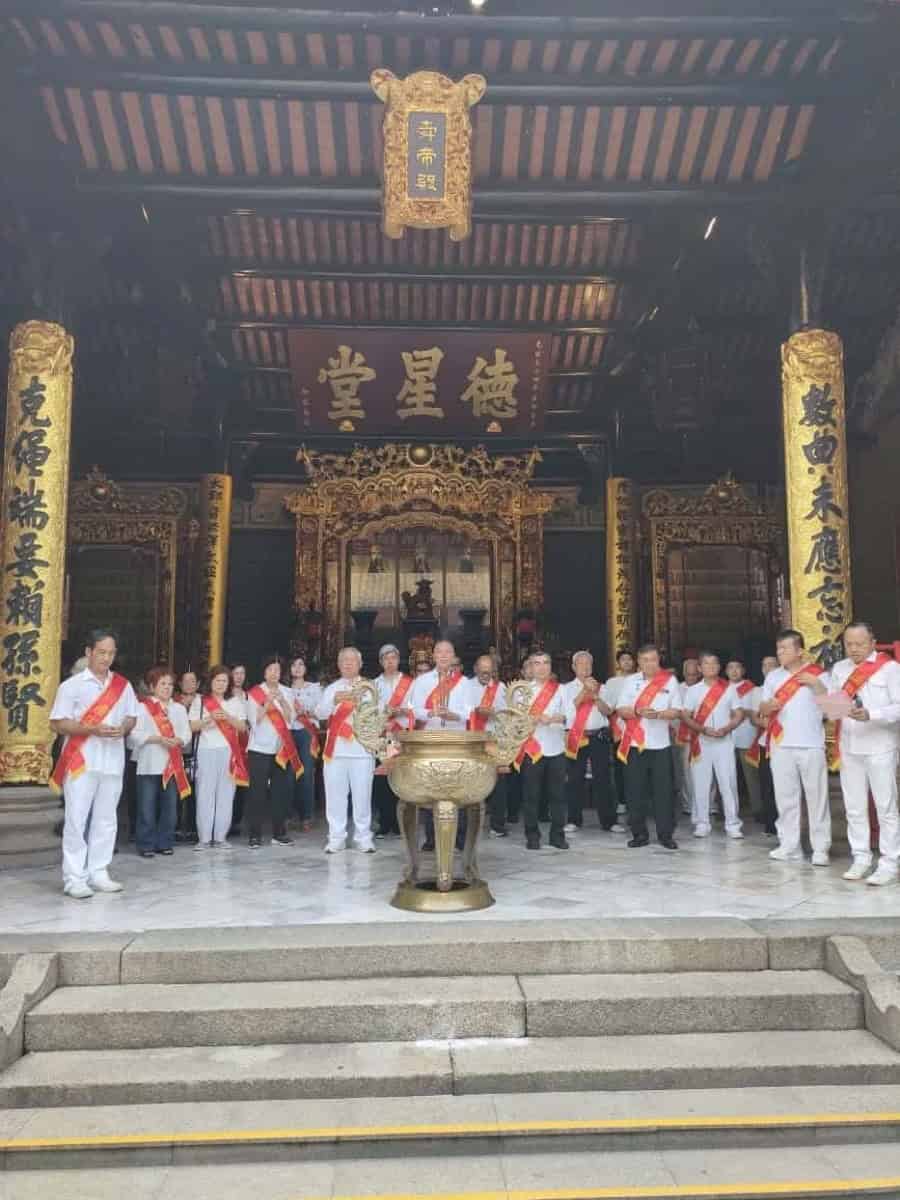
The return is a recurring, funded, communal act, not a sentiment. On 28 March 2019, at Baihe town in Kaiping, the rebuilt Ruliang Hu founding ancestral hall was inaugurated: more than 500 kin (宗亲, zōngqīn) from home and abroad, more than 1.43 million yuan raised, 180 banquet tables laid out in the village. A Wuyi Hu ancestral hall rebuilt by diaspora participation — the living proof that the thread survived.
At the ancient pole of the return stands the Chen-Hu Duke cemetery at Huaiyang: the fifty-eight-acre site of the Iron Tomb we met in Section 2. Its 1995 reconstruction was completed with 334 delegates from Singapore, Malaysia, and China; its 2006 commemorative rite drew thousands and was covered by national television; its motto is “陈氏遍天下,淮阳是老家” — “Chens fill the world; Huaiyang is home.” A framing note, for honesty: the cemetery is institutionally claimed by the Chen surname organizations, with Hu (and Tian, Yuan, Sun, and others) participating as derived branches through Duke Hu of Chen. That is an identity framing within the Shun-descendant family — how the fraternity treats all these surnames as one — not a demographic claim about the tomb. And the overseas institutions themselves come home: the Gee How Oak Tin convention returned to Guangdong for its 34th gathering in Zhaoqing in 2019.
Finding Your Hu Roots
If your family name is Hu — or Wu, or Hoo, or Aw — the practical path begins with the generation-name poem. 字辈 (zìbèi) are fixed-character poems that mark generations, and they link branches across villages and countries. The Fuyao-line poem runs “乃启协,奕纪纲和维,持忠贞孝道,连叠文武科”; the Ruliang branch poem runs “协,奕世永昌和,维持忠厚道,连捷文武魁.” The shared frame — the characters xie and yishi — indicates the two branches’ linkage. (This comes from a single genealogy compilation, so treat the match as probable, not proven.)
Second, cast a wide net for spellings. Mandarin romanizes 胡 as Hu, Cantonese as Wu, Hokkien and Teochew as Ho or Oo, Hakka as Fu; the historical record adds Hoo (Hoo Ah Kay) and Aw (Aw Boon Haw). Diaspora records may carry any of these — a descendant must try them all.
Third, the archives. The Taishan Hu genealogy (1800, 1864, and later editions) is held at the Sun Yat-sen Library in Guangzhou, the University of Hong Kong’s Fung Ping Shan Library, and on FamilySearch microfilm; the catalog also lists a Xinhui-line Hu genealogy (FamilySearch catalog 1074003), and Chinese digitization projects offer Taishan, Xinhui, and Heshan Hu genealogies as electronic editions. The Kaiping Local Chronicles Office publishes its surname survey through its official WeChat account — a starting point for Kaiping lines.
Fourth, the living institutions: overseas Hu clan associations, the Gee How Oak Tin chapters, and the World Hu Kinship Federation all exist to answer inquiries from kin. And finally, the pilgrimage — Huaiyang, where the tomb of Duke Hu of Chen receives its thousands each year.
The pathway in one line: village name, to 字辈 match, to genealogy holdings, to the associations, to Huaiyang.
The Name That Outlived the State
The state is gone. The Annals give it one sentence; the tomb at Huaiyang gives its duke a monument; the surname gives its people an inheritance. Born when a Gui-clan polity fell in 495 BC, carried south through Zhuji Lane, across the Pacific in the four waves of the Wuyi diaspora, through exclusion and paper sons and silver letters, and back to rebuilt halls and banquet tables — the Hu surname is a surviving artifact of history, and every reader who types Hu (or Wu, or Hoo, or Aw) into a search engine is part of that continuity. The name has outlived every state that carried it. Now it is the reader’s turn to carry it.
Continue Reading
- Wong Surname: Meaning, Origin, and the Two Ancient Lineages Behind It
- Cao Surname: Meaning, Origin, and Three Thousand Years from Zhou to Gold Mountain
- The Li Surname: From Ancient State of Li to Wuyi Diaspora
- The Yu Surname: From Shaoguan Statesmen to the Wuyi Diaspora
- The Wuyi Diaspora: Clans, Brotherhoods, and Survival
Stay Connected
Follow RootsOfChina on Facebook and Instagram for new article updates, behind-the-scenes from Kaiping, and stories from the Chinese diaspora.
Sources
- 黄启昌, 《胡姓史话》 (南昌: 江西人民出版社, 2000); 黄启昌, 《中华姓氏通史·胡姓》 (北京: 东方出版社, 2000); 王廷洽, 《中华姓氏谱:胡》 (北京: 华艺出版社, 2000) — the three surname monographs behind the origin-streams debate (以国为氏 vs 以谥为姓) and the 郡望/堂号 system.
- 《春秋·定公十五年》 (“楚灭胡,以胡子豹归是也”) — the classical anchor for the 495 BC destruction of the State of Hu (with the 494 BC / 周敬王二十六年 calendar variant flagged); 郑樵, 《通志·氏族略》; 司马迁, 《史记·陈杞世家》; 朱熹, 《胡氏族谱序》.
- 开平市地方志办公室, 《开平姓氏源流考》 (WeChat, 2023-05-01) — the 儒良胡族 and 海心胡族 branch records; corroborated by 中华胡氏网 zhhusw.com, 《广东地区胡氏源流及字派字辈录入》 (胡一宾, 2014), and 胡氏宗亲网 hszqw.com.cn, 《广东南雄珠玑巷始迁祖扶摇公支系资料》 (2012).
- 开平市政府 kaiping.gov.cn — 《开平书画名家——胡根天》 (2021-05-31); 百合镇儒良胡氏始祖宗祠重建竣工 (2019-04-08); 百合镇胡根天馆藏作品 (2023-08-14); 百合镇儒东村/汤边村胡根天故居 (2019-12-04); 儒东”胡氏儒良文化” (2021-03-10).
- bilibili/古籍书库网, 《台山市71部家谱》 (2023) — 胡氏族谱 entries (1800 first compilation; 1864 光庆堂 re-engraving, 22 volumes; 1968 胡恩德 稿本; 1994 鹤山古蚕 抄本) and 《美洲至孝笃亲特刊》 (1964); holdings at 中山图书馆, 港大冯平山图书馆, and FamilySearch (美国犹他).
- 国务院侨办 gqb.gov.cn (2018); 肇庆市侨联 ql.zhaoqing.gov.cn (2018); 中国驻纽约总领馆 (2022); 江门市政府 jiangmen.gov.cn, 《海外华侨华人热议台山撤县设市30周年》 (2022) — the 至孝笃亲公所 record; 姚氏宗亲网 yaogens.com (1982) — the 1900 Seattle founding.
- 澎湃新闻 thepaper.cn, 《”万金油大王”胡文虎》 (2020); 人民网福建, 《”万金油大王”胡文虎传奇》 (2014); 澎湃新闻, 《胡亚基——中国驻外第一任领事》 (2024); 新加坡宗乡会馆联合总会 sfcca.sg, 《忆曾祖父胡亚基》 (2017).
- 淮阳县政府 huaiyang.gov.cn, 《陈胡公陵园》 (2010); CCTV, 《数千名陈氏宗亲在河南淮阳隆重祭拜宗祖胡公陵墓》 (2006); 中央人民广播电台 cnr.cn (2014) — the Chen-Hu Duke cemetery, its 1995 reconstruction, and the 2006 rite.
- 广东省统战部 gdtzb.gov.cn, 《侨批:跨越山海的家书》; 广东省侨批网 qb.gd.gov.cn, 《开平碉楼巧用侨批家书诉说华侨文化》 (2022) — 银信/qiaopi background; 梅伟强、张国雄, 《五邑华侨华人史》 (广东高等教育出版社, 2001); Madeline Y. Hsu, Dreaming of Gold, Dreaming of Home (Stanford University Press, 2000).
- FamilySearch 目录, 《胡氏族譜》 (新会/揭阳 散居地, c. 1836), catalog 1074003 — https://www.familysearch.org/en/search/catalog/1074003
External Resources:
- FamilySearch Catalog — 胡氏族譜, catalog 1074003 — the microfilmed Xinhui-line Hu genealogy (c. 1836), a doorway into the digitized 谱牒 record.
- 开平市政府 — 《开平书画名家——胡根天》 — the Kaiping city government’s biography of Hu Gentian (2021).
- 中国驻纽约总领馆 — 美洲至孝笃亲总公所第35届恳亲代表大会 — the fraternity’s 2022 convention, as reported by the Chinese Consulate General in New York.
- 澎湃新闻 — 《”万金油大王”胡文虎》 — The Paper’s profile of Aw Boon Haw (2020).
- 澎湃新闻 — 《胡亚基——中国驻外第一任领事》 — The Paper’s account of Hoo Ah Kay (2024).
- CCTV — 2006年陈氏宗亲淮阳祭拜胡公陵墓 — national-television coverage of the 2006 rite at the Chen-Hu Duke tomb.
Suggested Reading
Is this your family’s story?
Roots Of China is built from readers’ family histories. If a story here sounds like your own — a surname, a village, a journey — leave a comment below, or share your family’s story with us and we may be able to help you find your ancestral village.
