


A Fief That Became a Name
The Ye surname begins with a place that outlived its state. Twenty-five hundred years ago, on the floodplain of what is now Ye County, Henan (叶县, Yè Xiàn), lay the fief of Ye (叶邑, Yè Yì) — first recorded in the annals in 576 BCE. The small state it once served vanished; the kingdoms around it rose and fell. But one family carried the name away and kept it, like a seed, across two and a half millennia.
The fief was given to Shen Zhuliang (沈诸梁, Shěn Zhūliáng), a nobleman of the southern kingdom of Chu, known to history as the Duke of Ye (叶公, Yè Gōng). Son of Chu’s minister of war and great-grandson of King Zhuang of Chu, he proved a capable administrator: he built two reservoirs, the East and West Dikes (东陂、西陂), among China’s earliest large irrigation works, and put down the White Duke Sheng rebellion. The Analects record him asking Confucius about good government.
So it may surprise readers to meet the same man in a different guise. “Duke Ye Loved Dragons” (叶公好龙, Yè Gōng hào lóng) — the man who painted dragons on every wall and fled when a real one appeared — is one of the best-known fables in Chinese culture, a byword for hypocrisy. It is also an allegory: Liu Xiang’s Xin Xu (《新序·杂事五》) invented it some three hundred years after the Duke’s death. A moral cartoon, not a biography. The historical Duke was admired for waterworks and statecraft, not mocked for pretension.
Here is the hinge: when Shen Zhuliang was enfeoffed at Ye, his descendants took the name of the fief as their own surname (以邑为氏, yǐ yì wéi shì) — the ancient practice of adopting a place name to mark a clan’s origin. They changed their family name from Shen to Ye, turning a small fief into a portable inheritance that could be folded into a bundle and carried across oceans.
Today that inheritance is one of the most dispersed surname networks in the Chinese diaspora, with deep roots in Taishan (台山, Táishān). The Duke of Ye Tomb Park (叶公陵园) south of Ye County — restored in 1985 and 2001, a municipal heritage site since 2004 — receives some twenty thousand visitors a year, many of them overseas Ye descendants on pilgrimage to the place their name came from. A 2,500-year-old fief, still holding its people.

— The global reach of the Taishanese diaspora — the migration web that carried the Ye surname from the villages of Wuyi to six continents.
From Fief to Surname, from Henan to Guangdong
The surname’s formation explains why a fief name could become a family name at all. In the Spring and Autumn period, nobles were often known by their domains; the Duke of Ye’s descendants formalized this into the surname Ye. Later branches add secondary threads — descent through the Shen surname line, or the royal Ji surname of the Zhou dynasty. These are lineage traditions, not verified genealogies; on the one point that matters they agree: the surname comes from the fief.
The character itself carries a small history. Its traditional form, 葉, is the same character as the word for “leaf”; the simplified 叶 is pronounced yè as a surname and shè as a place name in classical texts. One character, two sounds — and then, at each border, many spellings: Yip and Yee in Cantonese-speaking North America, Yap in Malaya, Yeh in Taiwan. The name changes spelling at the border; the character stays the same.
How did the Ye reach Guangdong? The clan’s genealogies (族谱, zúpǔ) record a long southward drift across the Tang and Song dynasties: the 62nd-generation descendant Yilang moved to Xinfeng in Jiangxi during the Later Tang; Ye Yanqing of the 64th generation settled in Xianyou, Fujian; and in the 66th generation came Ye Yong (叶颙, Yè Yóng), a Southern Song minister of war honored as the ancestor of the Guangdong Ye. His line settled at Nanhai, and five generations later Ye Qiongzhi’s descendants moved on to Xinhui, Huaxian, and Heshan — the chain, as the genealogies tell it, from Henan to the coast.
A second, complementary route runs through the celebrated pass of Zhujixiang (珠玑巷, Zhūjī Xiàng) at Nanxiong, the gateway through which, according to legend, between 143 and 186 surname groups migrated south into the Pearl River Delta — a story now listed as national intangible cultural heritage, told in full in our article on Taishanese migration through Zhujixiang. A Xinhui Ye genealogy preserves the Ye version: the brothers Zhongyi and Zhongshen passed through the pass. The two chains place the same ancestor figures in different generations, never fully reconciled; read them as complementary traditions — the Ye came south, and they came through the same door as everyone else.
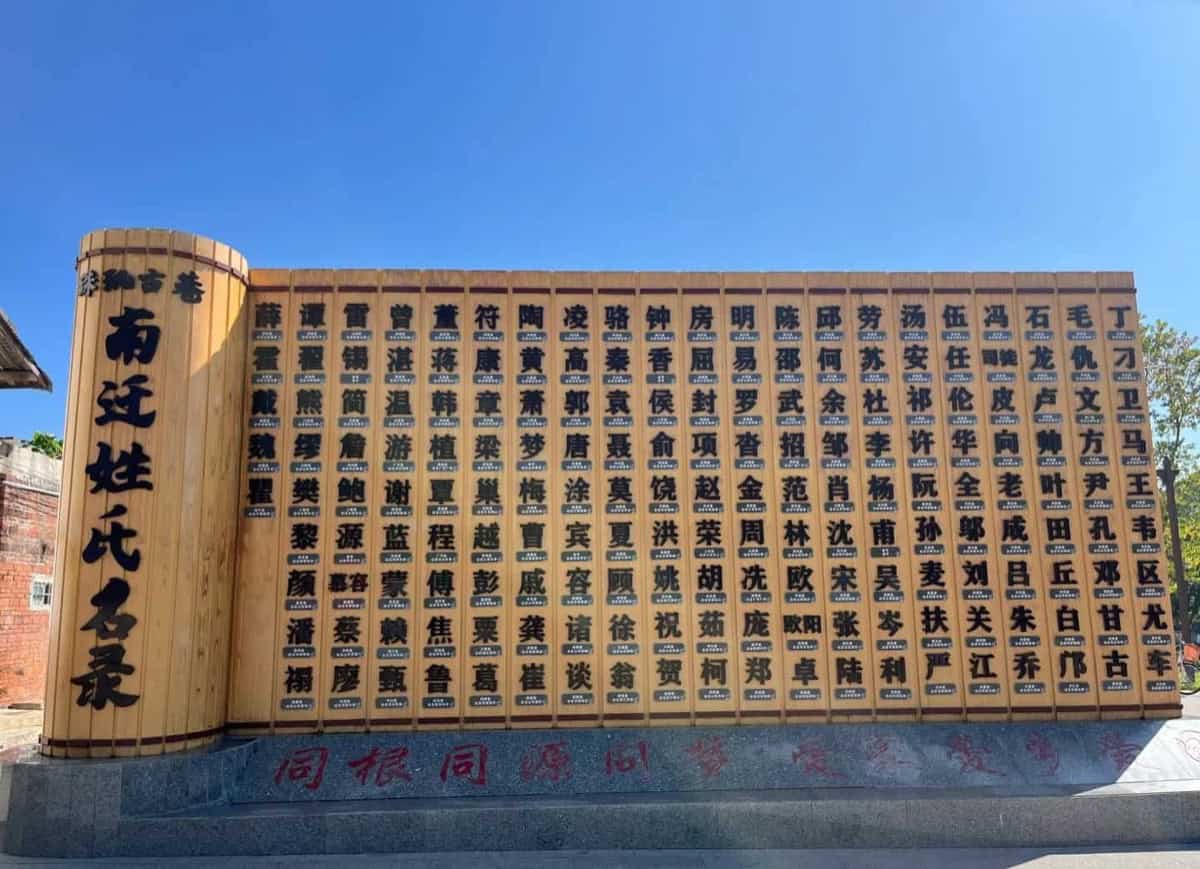
— The Ancestral Surnames Wall at Zhujixiang (珠玑巷), Nanxiong — the gateway through which many Guangdong lineages, Ye among them, passed on their way south.
Six Hundred Years in Taishan: The Village and the Halls
The genealogies date the Ye presence in Taishan to the Ming dynasty. As the clan’s own records claim — and the county’s surname history repeats — the Ye have been in Taishan for more than six hundred years (叶氏南迁台山已六百多年). It is a lineage assertion, not verified archaeology. What is certain is that the earliest Taishan Ye villages cluster at Dugang (独冈, Dúgāng) — Kengwei, Songshan, and Zhuling, founded by descendants in the 73rd through 76th generations from the Duke of Ye. The old motto runs: “Ten thousand years, the root is at Dugang” (万年根本在独冈). Ye Qiongzhi is honored as the founding ancestor of the Taishan Ye, with a memorial hall in his name still standing at Gangning’s Guanghua School.
From Dugang the branch spread: some 1,300 Ye in the eight villages of the Gangning district, 800 at Fucheng Guangming, 700 at Qunqing and Qunhou, 600 at Kengwei and Songshan, 400 at Sanhe’s Junzikeng, 300 at Duanfen’s Dunzhai, 200 at Sanhe’s Hengtang. Each line kept its generation-name poem (班派, bānpài) — fixed characters that tell any two Ye, at one glance, which generation each belongs to. Three remain in use: “Da, jun, chong, jian, ye,” “Jin, yue, yuan, lai,” “Lan, fang, gui, mao.” The name itself is a family tree.
The villages raised two ancestral halls (宗祠, zōngcí) that still stand. In Taicheng, the Ye Ancestral Hall on Yinglang Road was built in 1933, the twenty-second year of the Republic, funded by Ye kin at home and abroad — a fusion building (中西合璧, zhōngxī hébì) crowned with a circular rooftop pavilion and six Roman columns, the showpiece of a clan at the height of its remittance wealth. Today it is rented out, its great hall divided into shops, while the family that built it lives on three continents. The second hall, at Beiheli in Qibei village, Sanhe town, was built in the Republic era — the exact year unrecorded — with a Chinese ancestral-hall interior, a Western exterior, glazed tiles, and windows of Nanyang colored glass. It is dilapidated: the villagers emigrated, the village emptied, and the colored glass fades above an empty floor. Neither hall is formally heritage-listed. For the broader story of such buildings, see our guide to Taishan village history and architecture.
One caution for anyone following the Ye trail: the famous Ye hall with the imperial-examination steles — the Xinwei Village (新维村) Ye Ancestral Hall, with three steles honoring military juren degree-holders of the Tongzhi era — is not in Taishan. It stands in Shilong town, Dongguan (东莞石龙): built in 1861, more than 400 square meters, restored in 2001, its steles dating from 1867 and 1870. A fine hall — and a Dongguan one.
By the county’s count, the Taishan Ye number about five thousand at home and seven thousand overseas; the surname ranks roughly fiftieth nationally. Small enough to be a family, large enough to be a network.
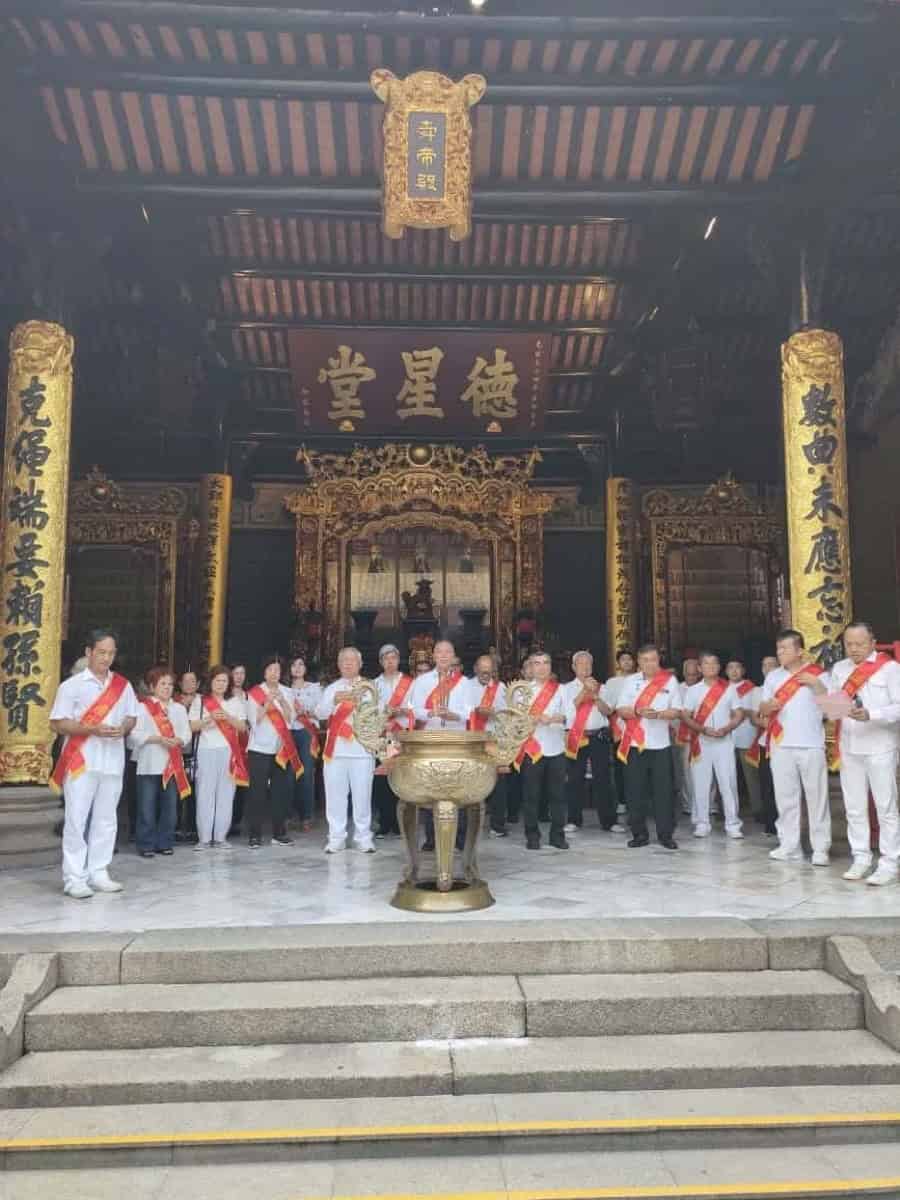
— Ancestral rites at a Taishan lineage hall — ceremonies like this one held the Ye surname’s identity together at home and across the diaspora.

— Inside a Taishan ancestral hall — most lineage halls in the qiaoxiang survive on overseas remittances.
The Passage: Gold Mountain Departure
Sometime in the 1850s, the first Ye villagers of Taishan began to leave — as the rest of the county left, on credit. The credit-ticket system (赊单制, shēdān zhì) advanced a young man his passage to California, Canada, or the Straits Settlements against wages he had not yet earned, binding him to a labor broker until the debt was cleared. He sailed through the county’s hidden ports, then Hong Kong or Macau — the great entrepôts of the system, where the broker firms of Sheung Wan, the Gold Mountain companies (金山庄, jīnshān zhuāng), held his papers and his American address. Those routes are documented in our piece on Wuyi’s hidden ports.
The migration ran along the lines of the surname. A Ye pioneer who established himself sent back for a Ye relative; the relative sponsored the next; village by village, the surname clusters of Chinatown took shape abroad. At home the household became split (两头家, liǎngtóu jiā): the man abroad, the family in the village, each half remaking itself around an absence. Between 1840 and 1940 more than two million people left the Wuyi counties — the five-county diaspora that reshaped Guangdong and the world — and the Ye were one thread in that river.
What did a young Ye man carry? A change of clothes. A slip of paper with an address in San Francisco or Vancouver or Singapore. The characters of his generation poem, if he had sons to name. Everything else — the fields, the ancestral hall, the wife he might marry by proxy — he left behind, expecting to return rich and soon. Most did neither. The Gold Mountain (金山, Jīnshān) kept them, and the letters went home instead.
The Exclusion Era: Names, Papers, and Survival
The doors did not stay open. The United States closed them first, with the Chinese Exclusion Act of 1882 (排华法案, Pái Huá Fǎ’àn), the first law in American history to bar immigration by race. Canada followed with a head tax (人头税, réntóushuì) in 1885 and its own Exclusion Act in 1923 — the legal wall that shaped the lives of the Chinese railroad workers who had built the transcontinentals a generation earlier. The walls did not stop migration; they rerouted it and made it more dependent on the very networks they were meant to break.
This is where the surname became a survival tool. Sons came as “paper sons” (纸儿子, zhǐ érzi) — men whose papers declared them the children of a merchant or citizen who was not their father, identities bought and memorized like script before interrogation at Angel Island (天使岛, Tiānshǐ Dǎo) in San Francisco Bay. Name changes were routine: a Ye became a Yip to match his papers, a Yip became a Yee to pass a brother through. The names on the immigration forms and the names on the family altar diverged, and the true name became family folklore — a second document, kept in the head.
For decades the exclusion laws produced the bachelor society: men who could not bring wives, who lived in boarding houses and sent earnings to households they had not seen in twenty years. One class escaped the worst — the merchants. The merchant exception meant a man with a firm could travel, bring family, hold a status laborers could not; the merchant-middleman class became the community’s lifeline, and in Vancouver the man who ran it was a Ye.
The Letters and the Women Who Kept the Villages
Behind every Gold Mountain man stood a system that carried his wages and his words home: the qiaopi (侨批, qiáopī), or yinxin (银信, yínxìn) — the remittance letter, a letter and money in a single envelope. It was the circulatory system of the qiaoxiang, the emigrant homeland. An overseas firm collected a worker’s savings; a bank in Hong Kong or Guangzhou converted them; a county agent forwarded them; a courier (水客, shuǐkè) walked the last miles to the village gate. The packet carried health, earnings, instructions, longing — and concealed, deliberately, the labor and loneliness that produced the money.
The women who received those packets kept the villages alive. The Gold Mountain wives (金山婆, jīnshānpó) ran the farms, the lineage duties, and the remittance finances for decades at a stretch. Marriages were completed by proxy — a rooster, in the most famous custom, standing in for the absent groom — and children grew up meeting fathers they did not recognize. Their story is told in full in our article on the women of Taishan; the longing that ran through those letters is the subject of our Echoes of Home feature.
The visible legacy of those packets is the built landscape of Taishan itself. The 1920s and 1930s building boom — the fusion halls, the watchtower houses, the schools — was paid for envelope by envelope. A yinxin might arrive with its money already allocated line by line: roof repair, New Year clothes, school fees. Then the system broke. The Depression of the 1930s carried distant crashes into the villages; the Pacific War severed the shipping routes and famine followed; from 1949 the new state froze the transnational channels; only after 1979 did the letters and the visits resume. The qiaoxiang economy had its golden age and its wreckage, and both were written in the same envelopes.

— A qiaopi remittance letter (银信): envelope with postmarks and money notation.
Case Study: Yip Sang, the Contractor Who Built a Chinatown
No Ye story shows the machinery of the diaspora more completely than that of Yip Sang (叶春田, Yè Chūntián; also 叶连生), born September 6, 1845, in Shengtang village (圣堂村), Taishan — the village confirmed, its parent township not, and the careful account leaves it at that. His parents died young, his sister was kidnapped by bandits, and in 1864, at nineteen, he sold his possessions to buy passage to San Francisco — the destination named by the weight of sources, including the Dictionary of Canadian Biography and the UBC archives. He worked as cook, dishwasher, cigar maker, gold miner.
In 1881 he moved north to Canada — Cariboo goldfields, then Vancouver, selling coal door to door. The Canadian Pacific Railway was building its transcontinental line, and the CPR Supply Company hired him onto a construction gang. Literate, numerate, tireless, he rose from bookkeeper to timekeeper to paymaster and finally superintendent of Chinese labour, supplying between six and seven thousand Chinese workers — at the peak, by one estimate, three-quarters of the CPR’s workforce.
In 1888 he founded the Wing Sang Company (永生公司, Yǒngshēng Gōngsī) at 51 East Pender Street, and it became the unofficial bank of Chinatown: recruiting labour, running trans-Pacific import and export (pioneering the salt-fish trade to Japan), forwarding remittances and letters to families in China, selling steamship tickets for Canadian Pacific. By 1908 it was one of Vancouver’s four largest Chinese firms. The building that housed it, raised in 1889 and extended in 1901, is called by the City of Vancouver Archives the oldest surviving building in Vancouver’s Chinatown; in 2023 it became the home of the Chinese Canadian Museum.
His civic weight matched his commercial one: he was instrumental in founding the Chinese Benevolent Association (中华会馆, Zhōnghuá Huìguǎn) and the Chinese Board of Trade; he testified before the royal commissions after the 1907 anti-Asian riot; he headed the Canadian chapter of the Chinese Empire Reform Association (保皇会, Bǎohuáng Huì), sending a relative to receive Kang Youwei in 1899 — and later backed Sun Yat-sen’s revolutionaries. His household was a small nation: four wives, twenty-three children — nineteen sons and four daughters — brought to Vancouver in 1901, more than a hundred people in the Pender Street compound under a patriarch’s 10 p.m. curfew. One hundred people quiet behind one bell: the shape of the family firm.
The children built their own histories: a daughter, Susan, among the first Chinese-Canadian women at the University of British Columbia in 1915; a son, Kew Dock Yip (叶求铎), called to the bar in 1945 as the first Chinese-Canadian lawyer and a leader of the campaign that repealed Canada’s Exclusion Act in 1947; other sons a physician and a soccer pioneer in the British Columbia Sports Hall of Fame. Yip Sang served some ten years as principal of the Aiguo Xuetang (爱国学堂, Àiguó Xuétáng) he helped found, and gave to Taishan Middle School, Lingnan School, and the Guangdong Public Hospital — the old pattern, earnings sent home in institutional form. He died in 1927, his estate valued at some $78,000; by 1996 his descendants numbered more than 660 and gathered in Vancouver for a reunion that made the newspapers. One orphan, one surname, one empire of kin.

— The Wing Sang Building, 51 East Pender Street, Vancouver — now the Chinese Canadian Museum.
Case Study: Yip Kon Seng, Last Kapitan of Selangor
The other great stream ran south, and its signature figure was Yip Kon Seng (叶观盛, Yè Guānshèng; Yap Kwan Seng), born in 1846 in Beimen village, Chixi (赤溪). Chixi complicates the word “Taishan”: it is Taishan’s only purely Hakka town, settled by Hakka migrants in the eighteenth century and torn apart in the 1850s and 1860s by the bitter Punti–Hakka clan wars (土客械斗, tǔ kè xièdòu). In 1867 the Qing court carved it out of Xinning county as a separate administration, the Chixi Ting (赤溪厅); it became a county in 1912 and merged back into Taishan only in 1953. To call Yip Kon Seng a Taishan man is true on the modern map and anachronistic in his own time; he was born a man of Chixi, and the distinction mattered.
He went to Malaya around 1863–64, aged seventeen or eighteen, as a tin miner in Seremban, sponsored by a fellow clansman, Yap Chee Ying (叶致英). In 1870 he followed Yap Chee Ying to Kuala Lumpur to assist Kapitan Yap Ah Loy in building the town, then diversified into a brick kiln at Brickfields and the trading firm Sin Kow Kee (新就记) — rising, by reputation, to be the richest towkay in Kuala Lumpur. The Qing court granted him the honorary rank of Zhongxian Dafu with peacock feather, later carved on his tombstone.
In 1889 he became the last Chinese Kapitan (甲必丹, jiǎbìdān) of Selangor — the colonial system that made Chinese community leaders official intermediaries with the British — holding the office until his death in 1901, while also serving on the Selangor legislative council and as Kuala Lumpur’s first sanitary board member. His philanthropy built institutions that still define the city: a free clinic for tin miners in 1881, expanded and renamed the Tung Shin Hospital (同善医院, Tóngshàn Yīyuàn) in 1894, with a Jalan Petaling shop house donated as its property; Victoria Institution, co-founded 1894; a founding role in the Kwong Tong Cemetery (广东义山, Guǎngdōng Yìshān); a home for the aged; the Chixi Clubhouse funded entirely by himself; $10,000 to Indian famine relief in 1890. The mine worker who arrived with nothing built the hospital that still treats Kuala Lumpur.
His name remains on the map. Jalan Yap Kwan Seng (叶观盛路) runs through modern Kuala Lumpur with the Petronas Twin Towers at its head; a second street bears his firm’s name, Sin Kow Kee — a double honor claimed to be unique. After his death the community built the Sam Yap Temple (三叶庙), the “Three Yaps Temple,” venerating Yap Ah Loy, Yap Chee Ying, and Yap Kwan Seng together — a trio that shares a surname and a Hakka origin but should not be flattened: Yap Ah Loy and Yap Chee Ying were Huizhou-line Hakkas; only Yip Kon Seng was born in Chixi, Taishan. In his last years he returned home, built roads, bridges, and a grand mansion in Chixi town — its plaque read “Chaoyi Di” — and died of tuberculosis in 1901, his funeral a community milestone in Kuala Lumpur and Chixi alike.

— Jalan Yap Kwan Seng (叶观盛路), Kuala Lumpur, with the Petronas Twin Towers at its head.
The Surname That Organized a Diaspora
Individual ambition explains the two Yips; the surname explains why there were so many Ye to follow them. Clan associations (宗亲会, zōngqīnhuì) were the arrival infrastructure of the diaspora: a new Ye arrival in any port landed with the address of a hall, not merely of a relative — a building where he could sleep, find work, borrow money, and be vouched for on the strength of one character in his name. The institution is explored in our study of Wuyi clans and brotherhoods.
The institutions are still there. In Malaysia, the Selangor and Kuala Lumpur Ye Ancestral Hall, founded around 1894, is the oldest of the country’s seventeen Ye surname associations; its secretary still reads the memorial address at the annual commemoration of Kapitan Yap Ah Loy. Vancouver’s Nanyang General Hall (南阳总堂, Nányáng Zǒngtáng), founded 1957, practices the older art of surname uniting (联宗, liánzōng), gathering the Ye with seven other Nanyang-lineage surnames — Cen, Deng, Bai, Li, Han, Teng, Le — under one roof. Hong Kong’s Ye Clan Association traces itself to a Nanyang-hall association founded in 1932; there is a Ye association in Cebu, in the Philippines. And since 2000 the diaspora has had a parliament: the World Ye Clan Federation (世界叶氏联谊总会, Shìjiè Yèshì Liányì Zǒnghuì), founded on October 5, 2000 — in Ye County itself, the ancient fief — by 387 delegates from the United States, Malaysia, Singapore, the Philippines, Indonesia, Hong Kong, Taiwan, and the mainland. Its multi-volume compendium of Ye genealogies won a national genealogy prize in 2018, and its fifth congress met in Hong Kong in 2019. The county abolished two and a half millennia ago is now the headquarters of a global family.
The living diaspora supplies the color: Hong Kong’s Taishan-Ye celebrities include the actress Amy Yip (叶子媚) and Yip Sai Wing of the band Beyond, while the entrepreneur Ye Shijie serves on the Taishan advisory body. Deeper in the record stand Ye Shufan, a Guangxu-era juren whose two examination houses still stand in the Dugang district; Ye Shaoyi, an early aviator buried at Huanghuagang; and the cartoonist Ye Yinquan, whose 102-panel wartime drawings documented refugees. For the sibling surname in our series, see the Cao surname and its diaspora.

— Lighting incense at a family shrine during Qingming — ancestral remembrance remains the heart of diaspora identity.
The Name as Anchor
The State of Ye is gone. The ancestral halls of Taishan stand rented out, dilapidated, or rebuilt. The Kapitan system was abolished. The exclusion laws are repealed. What remains is the name — one character, 叶, carried the whole way: from the fief, to the Dugang villages, through the yinxin envelopes, to a museum in Vancouver and a street in Kuala Lumpur.
Consider what that surname did that no institution could. It was the one document no immigration officer could confiscate and the one address that never changed. A man could lose his papers, his name, even his language, and still walk into a strange port, speak one character, and be fed and set to work by strangers who were, in the only sense that mattered, his family. The Ye name organized the journey at every stage: the pioneer who sponsored the cousin, the hall that received the arrival, the firm that forwarded the remittance, the generation poem that told two strangers exactly how to address each other.
This is the deeper pattern, and why the story matters beyond the Ye themselves. Every diaspora family that kept its name through an ocean crossing was doing what the descendants of Shen Zhuliang did: converting a place into a portable identity, then rebuilding the place — the hall, the tomb, the congress — wherever the name went. The Wong surname runs on the same engine; so does every family that ever opened a genealogy (寻根, xúngēn, “roots-seeking”) and found a village.
The invitation of the Ye story is to do what its own descendants do. Stand at the Duke of Ye Tomb Park, or on Pender Street, or at the head of Jalan Yap Kwan Seng, and read the same character their ancestor carried out of Henan 2,500 years ago. The fief is gone; the name is the inheritance. It is still being opened.
Continue Reading
- The Cao Surname and Its Wuyi Diaspora
- The Wong Surname: Tracing Its Noble Origins and Global Legacy
- Wuyi Diaspora Clans and Brotherhoods: Survival Networks
- The Guangdong Five-Counties Diaspora Legacy
Stay Connected
Follow RootsOfChina on Facebook and Instagram for new article updates, behind-the-scenes from Kaiping, and stories from the Chinese diaspora.
Sources
- Dictionary of Canadian Biography, vol. 15 — Timothy J. Stanley, “YIP SANG,” biographi.ca — Yip Sang’s life arc, 1845–1927, family and community roles.
- City of Vancouver Archives — Yip Sang Correspondence Project, archives.vancouver.ca — Wing Sang Company functions; building dates 1889/1901.
- Vancouver Sun (John Mackie, 2023-05-18) — “Grandson of Vancouver Chinatown icon Yip Sang shares tales as museum prepares to open,” vancouversun.com — 6,000–7,000 CPR labourers; Chinese Canadian Museum at the Wing Sang Building.
- Kuala Lumpur Kwong Tong Cemetery (吉隆坡广东义山) — biographies of founding donors, ktc.org.my — Yip Kon Seng: 1881 Peishan Tang clinic, 1894 Tung Shin Hospital, Victoria Institution, Chixi Clubhouse.
- Embassy of the People’s Republic of China in Malaysia (2007) — “马来西亚华人先贤与路名的历史渊源,” my.china-embassy.gov.cn — Jalan Yap Kwan Seng; last Kapitan of Selangor 1889–1901.
- Taishan Government (台山政府网, 2017-12-19) — “叶姓源流及其繁衍,” cnts.gov.cn — Duke of Ye origin, Dugang settlement chain, generation poems, “600+ years” lineage claim.
- Pingdingshan Cultural Tourism Bureau (平顶山文旅局) — Duke of Ye Tomb Park (叶公陵园), wglj.pds.gov.cn — restoration, 2004 heritage listing.
- Pingdingshan Daily (平顶山日报, 2016-09-10) — World Ye Clan Federation founding congress, Ye County, 2000-10-05, 387 delegates, epaper.pdsxww.com.
- Baidu Baike — “叶氏宗祠” (Xinwei Village, Shilong town), baike.baidu.com — the Dongguan hall: 1861 construction, 2001 restoration, juren steles; and Dongguan government village profile (dg.gov.cn) confirming Xinwei Village is in Shilong, Dongguan.
- Frances Hern (2012) — “Yip Sang and the First Chinese Canadians,” abcbookworld.com — up to 7,000 workers, about 75 percent of the CPR workforce at peak.
Suggested Reading
Is this your family’s story?
Roots Of China is built from readers’ family histories. If a story here sounds like your own — a surname, a village, a journey — leave a comment below, or share your family’s story with us and we may be able to help you find your ancestral village.
