


The Pan (潘) Surname: From the State of Pan to the Wuyi Diaspora
The Pan surname traces to two royal lineages of ancient China. The first descends from the ruling house of the State of Pan (潘国, Pānguó), a small vassal polity of the Zhou period whose princes shared the blood of the Zhou kings; when the state was swept away, its descendants kept its name as their own. The second descends from a noble Pan family of the State of Chu, whose minister Pan Chong (潘崇, Pān Chóng) reshaped the succession of an empire. Twenty-five centuries later, Pan emigrants from the villages of Wuyi (五邑, Wǔyì) boarded ships bound for the gold fields of California and the railroads of the Sierra Nevada — and a grandson born in Vancouver would inherit a name that had survived the fall of states, the march south, and the crossing of an ocean.
The surname is written 潘 (Pān). It is common: the Pan surname (潘姓, Pān xìng) ranks roughly in the thirties to forties among Chinese surnames nationally — one household-registration series places it 36th, the Song primer 《百家姓》 (Bǎijiāxìng, “Hundred Family Surnames”) 43rd — with population estimates ranging from about 6.7 million to 8.4 million depending on source and method. No single figure commands the field. Behind that ordinary character stands the mechanism by which so many surnames were born: 以国为氏 (yǐ guó wéi shì), “taking one’s surname from a state” — a whole polity reduced to one character, which became the family.

Two Birth Certificates, One Name
The genealogies tell one founding story; the classics, another.
The first story is the royal-Zhou claim: family registers trace the Pan line to 毕公高 (Bìgōng Gāo), fifteenth son of 周文王 (King Wen of Zhou), enfeoffed at Bi. His youngest son, 季孙 (Jìsūn), held a smaller fief called Pan — 食采于潘 (shícǎi yú Pān, “received the fief of Pan”) — and his descendants took the place-name as their surname. Where that fief lay, traditions differ: 陕西兴平 (Shǎnxī Xīngpíng) or the lands north of Xianyang, 河南温县 (Hénán Wēnxiàn), or — in a modern school of Pan researchers — 荥阳 (Xíngyáng) as the surname’s sole homeland.
The second story comes from the classics. 潘崇 was tutor to the heir of the State of Chu and engineered his accession as 楚穆王 (Chǔ Mùwáng, King Mu of Chu) in 626 BCE, becoming Grand Tutor (太师, tàishī) of the court. The episode appears in the 《左传·文公元年》 (Zuǒ Zhuàn, the Zuo Commentary) and the 《史记》 (Shǐjì, Records of the Grand Historian), and Pan Chong’s descendants 潘尪 and 潘党 served Chu as senior ministers. He is the first Pan figure securely attested in classical historiography.
The Song scholar 郑樵 (Zhèng Qiáo), in the 《通志·氏族略》 (Tōngzhì, Comprehensive Records of Clans), dismissed the royal-Zhou claim: “潘氏,羋姓,楚之公族,以字為氏……或言畢公高之子季孫食采于潘,謬矣” — “The Pan family is of the Mi surname, a noble house of Chu… as for Bi Gong Gao’s son Ji Sun holding the fief of Pan, that is mistaken.” Yet most registers honor the Zhou-royal descent, and later genealogists stitched the stories together: a municipal account from Xinyang (信阳), Henan — traditional synthesis, not documented history — tells of Chu attacking Pan in 673 BCE, ruler 权涌 ordering his people to take the surname, and his son Pan Chong leading the surrender. Genealogies say royal Ji; the classics say Chu; both stories are the surname’s birth certificates. A third stream deserves one line: during the Northern Wei, per the same 通志, Xianbei 破多罗氏 (Pòduōluó) clansmen adopted Pan.
The Name in History: Poets, Generals, and a Merchant Who Wasn’t Wuyi
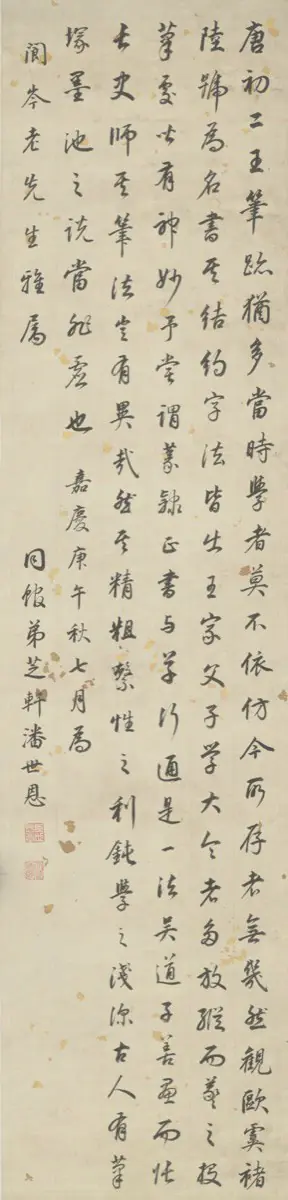
Whatever its origin, the name accumulated a history. No surname’s record is complete without 潘岳 (Pān Yuè, 247–300), courtesy name 安仁 (Ānrén), the Western Jin poet ranked second only to Lu Ji — “潘江陆海” (Pān jiāng Lù hǎi, “Pan’s river, Lu’s sea”) the idiom for their genius. The anecdote of 掷果盈车 (zhì guǒ yíng chē) — women throwing fruit into his carriage as he rode through Luoyang — made his courtesy name the eternal byword for male beauty: 貌比潘安 (mào bǐ Pān Ān). As magistrate of Heyang he planted peach and plum trees until the district was called “one county of blossom” (河阳一县花) — the origin of the 河阳堂 (Héyáng táng, Heyang Hall) name Pan branches carry today. The beauty archetype ended in dynastic blood: Pan Yue was executed in the 八王之乱.
Then the general. 潘美 (Pān Měi, 925–991) helped found the Northern Song, conquered 南汉 (whose fall opened Guangzhou), 南唐, and 北汉, married a daughter to the future Emperor Zhenzong; a Ming scholar ranked him second only to Cao Bin among Song generals. But in opera and fiction, Pan Mei arrives as someone else: 潘仁美 (Pān Rénměi), the scheming villain of the 《杨家将》 (Generals of the Yang Family) sagas — a fictional figure, Pan Mei’s literary double. The kernel of truth: in the 986 northern expedition Pan Mei commanded the army in which Yang Ye died at 陈家谷; the official finding blamed the supervising commissioner Wang Shen, demoting Pan Mei. Fiction blackened his name over centuries — so thoroughly that, according to one account, at least one Pan ancestral hall refuses to stage Yang-family opera (潘杨不两立, “Pan and Yang cannot stand together”). The detail is single-sourced local color, but the inversion matters: diaspora readers meet “Pan” through the opera villain or the beauty idiom, and deserve both.
One more name, briefly. 潘季驯 (Pān Jìxùn, 1521–1595), the Ming water-conservancy engineer, served four terms as Director-General of the Yellow River, building his doctrine on 束水攻沙 (shùshuǐ gōngshā, “constrain the water to attack the silt”) — narrowing the river so its own current scoured its bed — stabilizing it for roughly two centuries.
And then the merchant — with an integrity flag for every Pan descendant. 潘振承 (Pān Zhènchéng, 1714–1788), known in Western records as Poankeequa, arrived in Guangzhou around 1734, founded the hong firm 同文行 (Tóngwén Háng, Tongwenhang) in 1743, and led the 1760 petition that made him an early chief of the Canton Thirteen Hongs (十三行, Shísān Háng); his descendants ran the successor firm 同孚行 into the third generation. But he was born in Fujian — at 白礁村潘厝, historically in 同安县 (Tóng’ān, Quanzhou prefecture), now under 龙海 (Lónghǎi) — and the 龙溪乡 (Lóngxī Xiāng) neighborhood of Guangzhou where he settled is named for his Fujian hometown. His family’s credo — 闯广东、下南洋、过台湾, “break into Guangdong, go down to Nanyang, cross to Taiwan” — mirrors the laboring Wuyi arc in miniature; but he was a Fujian-rooted Canton elite, not a Wuyi-born diaspora ancestor.

Poets, generals, engineers, hong merchants — none of them is the Wuyi story. That story enters through a different door: the long road south.
The Long Road South: Two Migration Memories
Guangdong’s Pan settlement followed the standard Tang–Song corridors by which so many surnames reached Lingnan. Two corridor legends name Pan ancestors; this article presents them as parallel local traditions, neither settled history.
The first is the great corridor memory of 珠玑巷 (Zhūjī Xiàng, Zhuji Lane) at Nanxiong — Guangdong’s canonical founding-migration legend, now intangible heritage. A local gazetteer compilation, the 《潮连乡志·氏族》 (Cháolián Xiāngzhì, Chaolian Township Gazetteer, Clans section), preserves a 《潘氏南迁录》 (Record of the Pan Clan’s Southward Migration): the ancestor 潘文振 (Pān Wénzhèn) entered Fujian in 1000, fled south in the Southern Song, passed through Zhuji Lane, and dispersed across the Pearl River Delta after the 胡妃事件 (Hú Fēi Shìjiàn, the Hu Consort affair) — leaving Pan settlements at Guangzhou’s 珠村, 棠下, and 石牌. The 衣冠南渡 (yīguàn nándù, “the robed southward crossing”) at the level of one surname.
The second memory reaches into the Wuyi counties and must be labeled carefully. According to a surname-origins feature from Kaiping Radio and Television (开平广播电视台), drawn from the 《开平县志》 (Kaiping County Gazetteer), a Pan branch — “原籍直隶大名府,” from Daming prefecture in Zhili — escorted the last Song emperor in his retreat to 崖山 (Yáshān, Yamen) in 1279. When the dynasty fell, the branch’s second son, 有仁 (Yǒurén), hid by 昆仑山 (Kūnlún Shān) in Xinhui, then moved to 潘村 (Pān Cūn, Pan Village) in Kaiping’s 古博都 (Gǔbó Dū, Gubo District) in the Yuan 大德 (Dàdé) era (1297–1307; the source’s “元武帝大德” is a transcription slip), and in the Ming 正统 era (1436–49) branched out to 桥头, 恒美, 灯擎, and 芦荻角. This is a gazetteer-derived local lineage account: single-source, uncertain dates, possible legendary elements in the imperial-retinue framing. It is the most concrete Wuyi Pan settlement story the records offer — and it is not confirmed history.

One calibration keeps the account honest. According to the same gazetteer-based feature, Kaiping has 292 surnames, of which 19 exceed 10,000 people each — and Pan is not among them: a mid-to-small Kaiping surname, plausibly in the 1,000-to-10,000 band; no other source was checked for that figure in this research round. And one honest gap belongs in the record: no Taishan Pan village, hall, or genealogy was verified in this research round — the Taishan surname survey read in full contains no Pan section. The Wuyi Pan story anchors on Kaiping, not Taishan.
The Village the Records Name: Pan Village and the Pan Chuba Register
The village is 潘村 (Pān Cūn) in Kaiping’s Gubo District — again per the gazetteer-derived account, caveats intact. An independent corroboration, with honest limits: the 邝 (Kuàng) clan’s account in a Taishan surname survey places its first migrant ancestor 公昭 at “开平潘村” (古博里潘村甲, Pan Village Section A of Gubo Ward) after 1225. That confirms 潘村 as a genuine historical Kaiping place-name without asserting any current Pan presence — the village’s modern location, and whether any Pan remains, are unverified in this research round.
The name that turns the address into a family appears in a genealogy held at the FamilySearch Library as catalog entry 1098186, the 《潘氏家族》. The register names 潘初八 (Pān Chūbā) as 始遷祖 (shǐqiānzǔ, first migrant ancestor), 潘子禮 (Pān Zǐlǐ) and 潘子義 (Pān Zǐyì) as the second-generation ancestors, and 散居地 (sànjū dì, places of dispersal) 開平縣, 馬來西亞 (Malaysia), and 香港 (Hong Kong). This record supports names and places only — not scale, dates, or routes — so it names Pan Chuba as first migrant ancestor without letting us say the clan was “founded by” him. But the page carries a story before the narrative does: two second-generation names — Zili, Ziyi — and a dispersal list — 開平縣; 馬來西亞; 香港 — spanning an ocean already. Two sons in the founding generation: an early split into two houses, the hook for the dual-arc story.

No verified Wuyi-born Pan notable was identified in this research round. Every near-miss is non-Wuyi — Thirteen Hongs descendants of Fujian and Panyu, Hong Kong entrepreneurs of Hainan and Shunde roots, Guangzhou Pan families of Zhucun and Tangxia. This article therefore anchors its personal story on the Pan Chuba register and the Pan Village account — real records, honestly hedged — not an invented person.
Pan registers are called 族谱 or 家谱 (zúpǔ / jiāpǔ, lineage genealogy), ordered by 字派 or 班派 (zìpài / bānpài, generation poems) — character sequences assigning each generation its place in the descent line. The 1985 《潘氏族谱》 (Pānshì Zúpǔ, Pan Clan Genealogy), compiled by 潘岐横 (Pān Qíhéng) from fragments and memory after the losses of the Cultural Revolution, is the only register located in this research round that explicitly covers Xinhui and Kaiping branches. It names 潘伯润 (also 什五郎) as its Song-era founding ancestor and gathers branches across 清远, 番禺, 兴宁, 新会, 开平, 长宁, 增城, 嘉应, and 义州 — a deliberate 联宗/合谱 (liánzōng / hépǔ, lineage-unification) consolidation using generation poems to knit branches into one book. Generation poems found in this research round are branch-specific — Hong Kong’s 光裕堂 (Guāngyù táng) uses 文绍先贤德俊奕世; the 西社 (Xīshè) branch of Puning, Jieyang, Guangdong uses 仁义存敬爱,世德绍周家,祖宗留美荫,继启振芳铭 — examples of the form, never a Pan-wide system.
Hall names (堂号, tánghào) work the same way: 荥阳堂, 河阳堂, 世德堂, and 光裕堂 mark a branch’s claimed 郡望 (jùnwàng, commandery origin) or famous ancestor — Xingyang the homeland tradition, Heyang Pan Yue’s magistracy. Identity markers, not proof of residence. A structural model outside Wuyi: the 1932 潘世德堂 genealogy of Xiqiao, Nanhai, twenty-four generations from the Song-era 潘志安 — adjacent to Wuyi, not inside it, so a model of the register form only.
The Passage: Credit Tickets, Hong Kong, and the Corridor to Malaysia
The mechanics that carried Pan families out of Wuyi are the region’s classic mechanics — the Pan-specific application inferred from the general pattern, not documented case by case. The passage was financed on credit: the 赊单制 (shēdān zhì, credit-ticket system), a broker advancing the fare against the migrant’s future wages, worked off in a Gold Mountain laundry or a Malayan mine. The emigrant-homeland counties — the 侨乡 (qiáoxiāng, qiaoxiang) — sent their people in four waves: pre-1840s Nanyang, the Gold Mountain rush of 1848–1882, the exclusion era of 1882–1943, and the post-war and post-1978 movements. The Taishanese migration history — Zhuzai and Shedan explains the mechanics in full.
Chain migration ran patrilineally — one brother pulled the next, branches concentrating in single overseas cities. Confirmed region-wide; that Pan families moved through the same system is a reasonable inference, not a documented fact. Hong Kong was the junction — remittance and migration logistics both routed through the port, from the classic thirty-to-sixty-day Pacific Mail Hong Kong-to-San Francisco run (1850–1890) to the six-to-eight-week Vancouver-to-Taishan remittance corridor. The region’s hidden ports and departure infrastructure tell that part of the story.
For the Kaiping Pan branch, the register’s dispersal places — Malaysia and Hong Kong — are the documentary spine. The Kaiping-to-Malaysia corridor is pre-verified regional infrastructure; the Pan branch may have followed it, or is at least associated with it — the records do not let us say the family “rode” that corridor, only that Malaysia stands in the genealogy’s dispersal list. A parallel 1985 Nanhai Pan manuscript, founding ancestor 潘九, documents the same Nanhai-to-Malaysia pattern — a regional pattern of Pan labor migration toward Malaya, probable rather than proven for Kaiping.
The structural frame helps: Taishan gazetteer material documents the 一村一姓 (yī cūn yī xìng, one village, one surname) pattern and township-to-destination clustering — 赤溪 and 田头 to Malaysia, the 梅 (Mei) of 端芬 to Chicago and New York. Pan villages would fit such a frame, but no Pan-specific destination cluster was verified in this research round. One context note: Singapore’s Nanyang Pan Clan Association is largely Hokkien — 永春 (Yǒngchūn) and 南安 (Nán’ān) — so a Kaiping Pan branch in Malaysia and Hong Kong represents the Cantonese and Siyi minority within Pan overseas networks. Not every Nanyang Pan is Wuyi.

Gold Mountain: Where the Streams Ran, and Where the Evidence Stops
The North American arc is where the evidence runs out fastest. 金山 (Jīnshān, Gold Mountain) was the emigrant’s name for California; 旧金山 (Jiù Jīnshān) for San Francisco itself. The rush ran 1848–1882; the exclusion era and rerouting to Canada, Cuba, and Southeast Asia are treated below.
Diaspora scholarship holds that Taishan Pan — Pun or Poon — lineage villages fed the North American stream. But no Taishan Pan village, hall, or named Pan emigrant was verified in this research round. The honest frame is inference: Taishan Pan families, like other Taishan surname communities, would have moved through the credit-ticket and chain-migration system documented for the county — though no Pan-named document proves it yet. The verified Wuyi Pan anchor remains Kaiping: the village the gazetteer names, the register that names Pan Chuba. The broader Wuyi diaspora migration heritage supplies the general texture — gold fields, railroads, laundry and restaurant niches, mining and trade — without claiming any Pan-specific niche.
The regionalized language is deliberate. The Wuyi region as a whole saw near-complete male cohorts leave by the early twentieth century; Wuyi became Guangdong’s most remittance-dependent society; remittance money built the region’s 庐 (lú) mansions and Kaiping’s diaolou watchtowers. Pan households in such villages would have shared this experience — conditional, because village-level Pan evidence is unverified. One preview of the romanization map: 潘 appears as Poon in Cantonese Wade-Giles, Pun in Toisanese, Phua or Pua among Hokkien speakers, and Phan in Vietnam. The Siyi dialect and its cultural heritage explains the Poon-and-Pun half of that map.

The Letter: A Genre Without a Pan Signature
The emotional heart of the Wuyi diaspora is an object: the 侨批 or 银信 (qiáopī / yínxìn, remittance letter) — money and letter in one artifact, the migrant’s wages and his words arriving together. More than 160,000 such items from Guangdong and Fujian were inscribed on the UNESCO Memory of the World Register in 2013, and Wuyi is the genre’s heartland; the earliest surviving Wuyi qiaopi is dated 1875. The relay ran through remittance houses — 金山庄 or 银号 (jīnshānzhuāng / yínhào) — via Hong Kong, then to a village 派批 (pàipī) carrier who walked letter and silver to the door.
The letter was a moral technology: it carried the calculus of filial duty — parents before wives, marriage instructions, lineage obligations — made literacy economically valuable, and set the far-away family at the village table: the amount, the instructions, the signature.
The gap, stated plainly: no Pan-family qiaopi letter, collection, or archive listing was located in this research round, in Chinese or English. The genre therefore carries the emotional weight here — anchored on documented letters that are not Pan. The earliest surviving Wuyi qiaopi, the 1875 letter of the brothers 文光 and 文苑, is not a Pan letter; the 1919 letter of 司徒美堂 (Sītú Měitáng), shown at the Kaiping exhibition, is a Si letter, not a Pan one. They stand in for what a Pan letter would look like — envelope, calligraphy, postmarks, silver notation — the form being common to the genre. A fabricated “Pan letter” is forbidden; the honest empty place where one would be is left open.

Women Who Waited: The Home Front of the Remittance Economy
The other side of the ledger was carried by women. The 金山婆 (jīnshānpó, Gold Mountain wives) — and the wider class of 侨眷 (qiáojuàn, overseas-Chinese dependents) — managed land, children, and ancestral rites alone for decades, memorialized in county gazetteers and chastity arches (贞节牌坊, zhēnjié páifāng). The transnational family ran as dual households: split households (两头家, liǎngtóu jiā, “two-headed family”), proxy marriages contracted across oceans, bachelor uncles whose remittances held the village house together. Documented for Wuyi as a whole; Pan households would have lived them, but no Pan-specific documentation was verified.
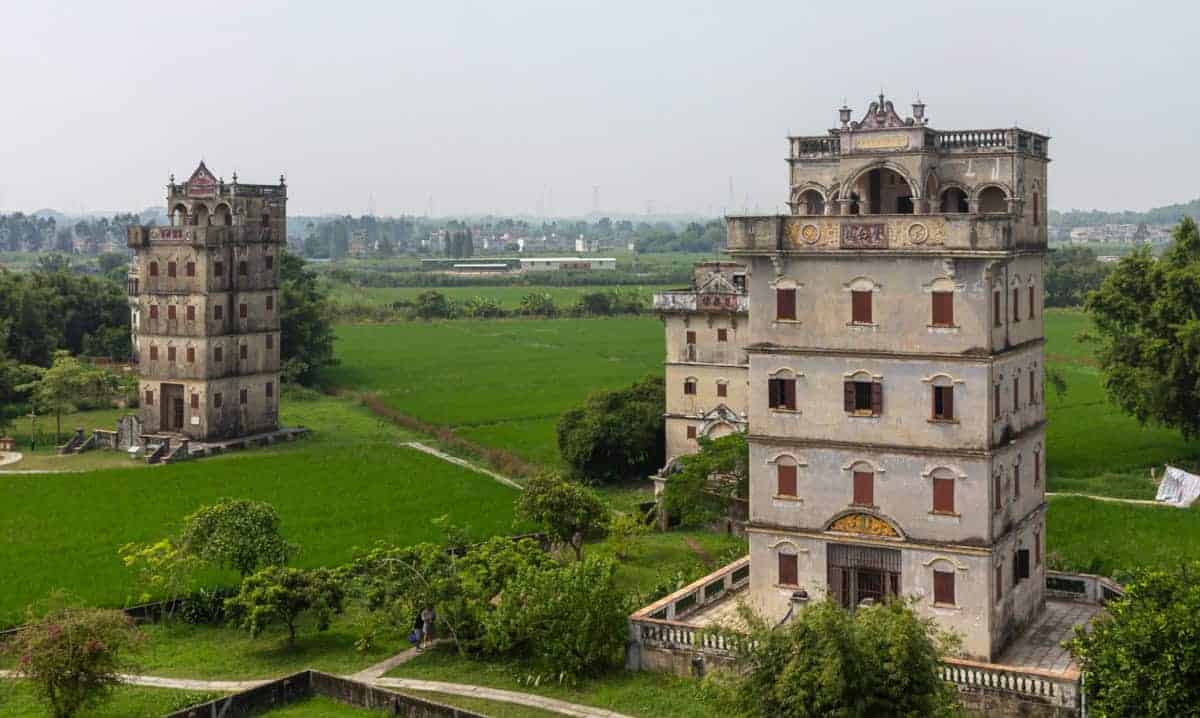
The economics are regional and confirmed: by the 1920s and 1930s Wuyi was Guangdong’s most remittance-dependent society. The landscape it built is visible today — 庐 (lú) mansions, the Kaiping diaolou (开平碉楼, UNESCO World Heritage since 2007), 侨校 (qiáoxiào, overseas-funded schools), roads, the Sun Ning Railway — all remittance-built. The diaolou landscape is Wuyi-wide; whether Pan families specifically built diaolou is unverified at village level, and no claim is made here that “Pan villages built diaolou.”
Both edges of that economy held together: remittances enriched the homeland — and made its loss catastrophic when the Japanese occupation of 1938–45 severed the circuits; Depression-era distress letters precede that. The women who carried the lineage side of the transnational family kept the village, and the surname’s place in it, alive.
Exclusion and Division: Paper Sons, Frozen Ties, and Reconnection
The regimes that cut the arc are documented. The United States’ Chinese Exclusion Act of 1882 closed the door to laboring Chinese until 1943; Canada taxed Chinese arrivals from 1885 and barred them under the 1923 Act until 1947; Cuba and Southeast Asia absorbed the rerouted streams. Under exclusion, survival depended on lineage knowledge itself: paper sons memorized coaching books of family facts for Angel Island interrogations, and the zupu recording an emigrant’s place in the clan became a lifeline document.
After 1949 the ties froze: letters that had crossed the ocean for a century stopped. The post-1978 reforms reopened contact, and the qiaoxiang connection resumed. Those frozen decades are also, honestly, part of why Pan-family letters and rosters may be lost or unlocated — the gap is not an oversight in research but a scar in the record itself. The surname survived regimes of exclusion and silence — and then organized itself across oceans.
The Name Endures: Poon, Pun, Phua, Phan — and the Search for 潘姓
The romanization map completes the arc. 潘 is Poon in Cantonese Wade-Giles — “Poankeequa — the Poon family” in English auction-house records — Pun in Toisanese, Phua or Pua in Hokkien, and Phan in Vietnam, where it is a major surname carried by the anti-colonial leader 潘佩珠 (Pān Pèizhū; Phan Bội Châu, 1867–1940). One caveat: Poon Lim (潘濂), the sailor famed for surviving 133 days adrift, was Hainanese — a romanization illustration only, never a Wuyi Pan case.
Singapore’s 南洋潘氏总会 (Nányáng Pānshì Zǒnghuì, Nanyang Pan Clan Association) was founded in 1939, renamed in 1950, and bought its Cuff Road premises in 1954; its 300–400 members are largely Yongchun and Nan’an Hokkien, and its 80th-anniversary gathering in 2024 drew kin from across the diaspora. The first World Pan Clan Gathering met in Singapore in 1989, and the 世界潘氏宗亲总会 (World Pan Clan Association) was founded in Taipei in 1990; Malaysia has its 潘氏公会, the Philippines its 潘氏宗亲总会, and mainland counterparts such as the Beijing Pan Clan Culture Research Association (third congress 2024). On the homeland side, the ritual circuit still runs: the annual tomb rite for 潘贞公 at Guangzhou’s 沐陂村 — a custom of some three hundred years (People’s Daily, 2014) — draws kin from Singapore and beyond. San Francisco and Vancouver Pan associations are reported in secondary sources — diaspora scholarship — with their current status unverified in this research round; no claim is made here that they are active, addressable, or locatable. The Wuyi diaspora clans, brotherhoods, and survival article sets that institutional story in its regional frame.
Identity was layered: a Kaiping Pan in Vancouver was simultaneously 开平人 (a Kaiping person), a Siyi speaker, and 潘氏 (a Pan) — county, dialect, and surname operating at once, surname associations their institutional face. For a reader carrying the name, the path is concrete. The FamilySearch catalog entries 1098186 (the Kaiping Pan Family register) and 1227910 (the Nanhai Pan genealogy) are searchable by descendants. Genealogy portals such as 谱书网, 族谱录, and 云家谱 carry Guangdong Pan registers, including the 1985 compilation. Clan associations can be approached through the Singapore and world-federation channels; DNA surname projects exist commercially — use them with caution. Roots tourism is real: the 台山银信博物馆 (Táishān Yínxìn Bówùguǎn, Taishan Silver Letter Museum) at 海口埠, the Kaiping diaolou circuit, the county archives. The honest note stands: Taishan Pan village leads remain unverified; the verified anchor is Kaiping’s Pan Village and the Pan Chuba register. For the surname’s wider arc, the Wong surname’s journey is the closest structural sibling; for neighboring clans, see the Guan clan’s history and the Cao surname and the Wuyi diaspora.

A name born of a conquered state and a court minister; carried south by farming clans; split into Poon, Pun, Phua, and Phan across oceans; kept ordered by generation poems and registers; now searched by a great-granddaughter typing 潘姓 from Toronto or Melbourne. The state is gone; the court is gone; the name remains. This article has left its gaps open on purpose — the Taishan villages, the Pan letter, the Wuyi-born notable — because those are the spaces where a descendant’s own research begins.
Continue Reading
- The Wong Surname: Tracing Its Noble Origins and Global Legacy
- The Cao Surname and the Wuyi Diaspora
- The Guan Clan’s History: Legacy and Resilience in the Chinese Diaspora
- Wuyi Diaspora Clans, Brotherhoods and Survival
- Wuyi Diaspora Migration Heritage
- The Five Counties of Guangdong
- Taishanese Migration History — Zhuzai and Shedan
- Wuyi Migration History: Hidden Ports
- Siyi Dialect and Cultural Heritage
Stay Connected
Follow RootsOfChina on Facebook and Instagram for new article updates, behind-the-scenes from Kaiping, and stories from the Chinese diaspora.
Sources
Books
- 梅伟强、张国雄, 《五邑华侨华人史》 (广东高等教育出版社, 2001) — standard scholarly history of the Wuyi emigrant region
- 刘进, 《银信与五邑侨乡社会》 (广东人民出版社, 2011) — core scholarship on the qiaopi/银信 economy of Wuyi
- Madeline Y. Hsu, Dreaming of Gold, Dreaming of Home (Stanford University Press, 2000) — Taishan transnational migration to North America
- 张应龙, 《广东台山华侨史》 (广东人民出版社, 2010) — Taishan out-migration background and Pun/Poon romanizations
- 骆伟, 《岭南姓氏族谱辑录》 (广东人民出版社, 2002) — finding aid for surviving Lingnan Pan genealogies
Primary records and gazetteers
- 《左传·文公元年》 and 《史记·楚世家》 — Pan Chong and the accession of King Mu of Chu (626 BCE)
- 郑樵, 《通志·氏族略》 — the Song-era rejection of the 毕公高 claim; the 破多罗氏 adoption of the surname
- 开平广播电视台, 《开平姓氏源流》 surname-origins feature, drawn from 《开平县志》 — the Yamen-wave settlement of 潘村 in 古博都; Kaiping surname demographics (accessed 2026-08-13)
- 《潮连乡志·氏族》·《潘氏南迁录》 — the 珠玑巷 Pan migration tradition (潘文振)
- 潘岐横 (comp.), 《潘氏族谱》, 1985 — Xinhui and Kaiping branches; 联宗/合谱 consolidation
Web sources
- FamilySearch Catalog 1098186 — 《潘氏家族》 — the Kaiping Pan family register naming 潘初八, 潘子禮, and 潘子義, with dispersal to Kaiping, Malaysia, and Hong Kong (accessed 2026-08-13)
- FamilySearch Catalog 1227910 — 《潘氏家譜》 — the Nanhai Pan genealogy (accessed 2026-08-13)
- Zaobao — Nanyang Pan Clan Association 80th anniversary — 2024 coverage of the Singapore association’s history
- People’s Daily — the Pan Zhengong tomb rite at Mubei Village — 2014 report on the three-hundred-year-old Guangzhou ritual
- Christie’s — the Poon Family Collection — the Poankeequa lineage in English auction-house records
- China News — the historical Pan Mei and the fictional Pan Renmei — on the Generals of the Yang Family inversion
- Encyclopedia of China — Phan Boi Chau (潘佩珠) — the Vietnamese anti-colonial leader who bore the name Phan
- Zhejiang Provincial Water Resources Department — Pan Jixun’s river works — on 束水攻沙 and the Yellow River
- UNESCO Memory of the World — Qiaopi and Yinxin Correspondence — the 2013 inscription of more than 160,000 remittance letters
- Xinyang Municipal Government — the local account of the State of Pan — the 权涌 (Quán Yǒng)/673 BCE tradition as local synthesis (accessed 2026-08-13)
Suggested Reading
Is this your family’s story?
Roots Of China is built from readers’ family histories. If a story here sounds like your own — a surname, a village, a journey — leave a comment below, or share your family’s story with us and we may be able to help you find your ancestral village.
