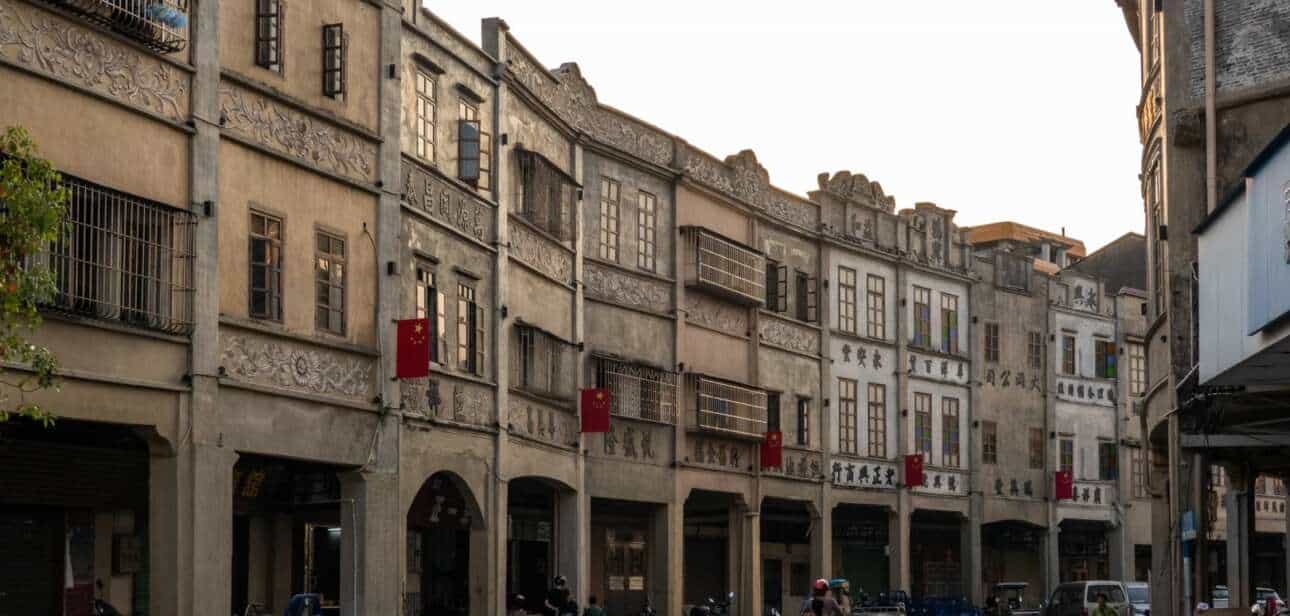
The White Island
The islands rise from the Pacific as white cliffs — not of chalk, not of limestone, but of guano (鸟粪, niǎofèn), the accumulated excrement of millions of seabirds deposited over millennia, thirty to fifty meters deep in places. There is no vegetation. No soil. No fresh water. Only guano, rock, and the…
{{FIG:fig_01}}
One hundred million people alive today carry the surname 李 (Lǐ). If they were a nation, they would be the fourteenth largest on Earth — more populous than Egypt, Vietnam, or Germany. The character appears on mailboxes from San Francisco to Singapore, on tombstones in the goldfields of Ballarat, on business cards in Vancouver,…
When we think of Chinese village life, stereotypes often arise—"rustic," "backward," or "primitive." Yet, beneath these superficial labels lies a deeply rooted cultural fabric that has sustained communities for generations. This cultural richness is particularly vivid in the Wuyi region, encompassing Taishan, Kaiping, Enping, Xinhui, and Heshan, an area renowned for its deep connections to…
For many, Lingnan is a region—lush, southern, coastal—stretching beyond the Nanling Mountains where rivers meet the sea and dialects shift with the wind. But to those whose roots lie there, Lingnan is not just geography. It is temperament. It is inheritance. It is a way to live. Cut off from the imperial heartland by mountains…
The Wuyi region—comprising Xinhui, Taishan, Kaiping, Heshan, and Enping counties in Guangdong—is renowned for its distinctive culture shaped by centuries of migration and ethnic integration. Situated at the junction between the Pearl River Delta and the rugged hills of western Guangdong, Wuyi’s unique identity is a product of diverse ethnicities and historical narratives merging into…
Discover how Wuyi Chinese laborers built the Transcontinental Railroad—then were erased from history in an enduring act of racial exclusion.
If your family traces its roots to Taishan, Kaiping, Enping, Xinhui, or Heshan—collectively known as Wuyi (五邑) —then you are part of one of the most far-reaching Chinese diasporas in history. Across generations and continents, descendants of this small region have built lives in nearly every corner of the world. Yet for many today, especially…
For overseas Chinese with roots in the Wuyi (五邑) region of southern China, the story of emigration is personal. It is one of survival, hardship, and reinvention. But what many may not realize is that long before Guangzhou became a global trading hub, the quieter ports of Xinhui and Taishan were already key arteries of…
For millions of overseas Chinese whose families trace their origins to the Five Counties (Wuyi 五邑) region in Guangdong—namely Xinhui, Taishan, Kaiping, Enping, and Heshan—their ancestors’ migration was more than a physical journey. It was a saga of survival, resilience, and global identity forged from hardship and hope. A Fertile Land Shaped by Challenge Situated…
The Five Counties of Guangdong (五邑, Wǔyì)—Xinhui (新会), Taishan (台山), Kaiping (开平), Enping (恩平), and Heshan (鹤山)—hold a distinctive place in Chinese history and global migration. For many overseas Chinese, especially those whose ancestors left southern China during the 19th and 20th centuries, understanding the Five Counties Guangdong history offers a meaningful pathway to reconnect…