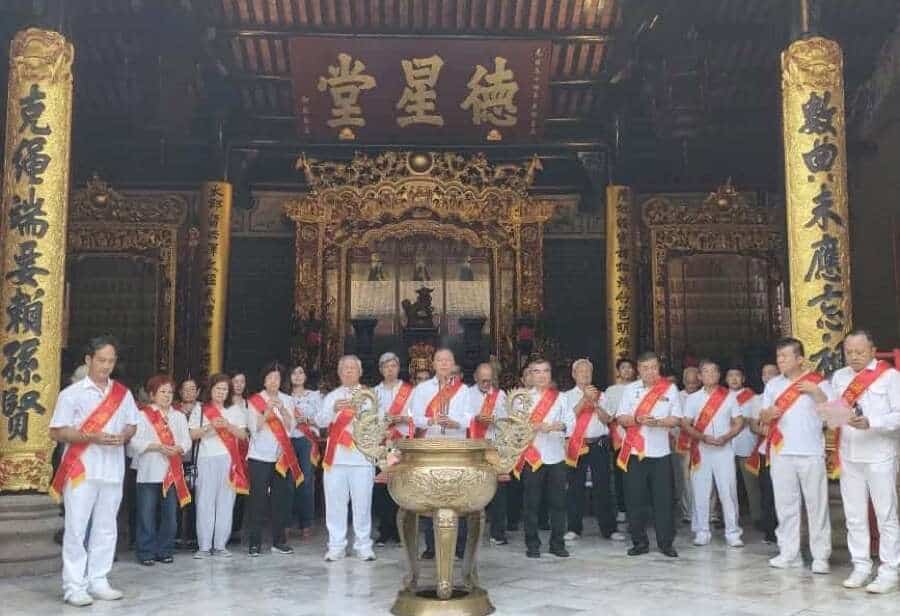
Between 1840 and 1940, over two million people left the five counties of the Wuyi (五邑) region in southern Guangdong — one of the largest sustained regional migrations in modern history. Taishan (台山) sent its sons to build the transcontinental railroad and fill San Francisco's Chinatown. Kaiping (开平) raised diaolou towers with Canadian gold and…
Between 1840 and 1940, over two million people departed from a handful of stone jetties along the Tan River. They were leaving Wuyi (五邑, wǔyì — the five counties of Taishan, Kaiping, Xinhui, Enping, and Heshan), a stretch of rocky, typhoon-prone coastline on Guangdong’s southwestern edge, bound for gold fields in California, tin mines in…
The Guo (郭) Surname: From Zhou Dynasty Nobility to the Wuyi Diaspora
The Guo (郭) surname carries one of the longest continuously documented lineages in Chinese history — three thousand years from the Zhou dynasty’s founding brothers to the diaspora communities of the Wuyi (四邑) region (trace your own surname origins with our Surname Compass).…
nttThe Wuyi (五) region of Guangdong Province sent over two million people overseas between 1840 and 1940 — and every single one of them came from a specific village. Not a city, not a county, but a village. A place with a name, a founding ancestor, a clan genealogy, and a cluster of houses that…
Three thousand years ago, a Zhou Dynasty prince received a fiefdom in the northern plains of what is now Hebei Province. The territory was called Fengcheng (冯城) — Feng City — and when Bi Gong Gao (毕公高), the fifteenth son of King Wen of Zhou (周文王), took up residence there, his descendants adopted the place…
Between 1850 and 1950, millions of Chinese emigrants sent home letters unlike any correspondence in human history. Each one was simultaneously a love letter, a bank transfer, a household budget, and a legal document — all folded into a single piece of paper. These were qiaopi (侨批, qiáopī), the "overseas Chinese correspondence-remittances" that sustained an…
The Name That Carried 3,100 Years
In the eleventh century before the Common Era, a man named Wen Shu (文叔) knelt before King Wu of Zhou and received a fiefdom in the fertile plains of what is now Henan province. The new territory was called Xu (许). Wen Shu traced his lineage to the legendary…
The Name That Means "King"
The Wang surname — 王 (Wáng), simply the Chinese character for "king" — is the second most common surname in the world. One hundred and one million people in China carry it, and an estimated six to eight million more overseas trace their ancestry through it. It is not an…
In 230 BCE, the armies of Qin entered the capital of the state of Han (韩国). Han, smallest and most vulnerable of the seven Warring States, was the first to fall in the Qin unification campaign. Most royal houses that resisted Qin were exterminated. But members of the Han royal family escaped. Fleeing south from…
The Ma surname (马, "horse") is one of the rare Chinese surnames derived not from a place or a clan but from an official military title — and the martial character encoded in that single character has shaped one of China's most resilient lineages for over two thousand years. During the Warring States period (475–221…